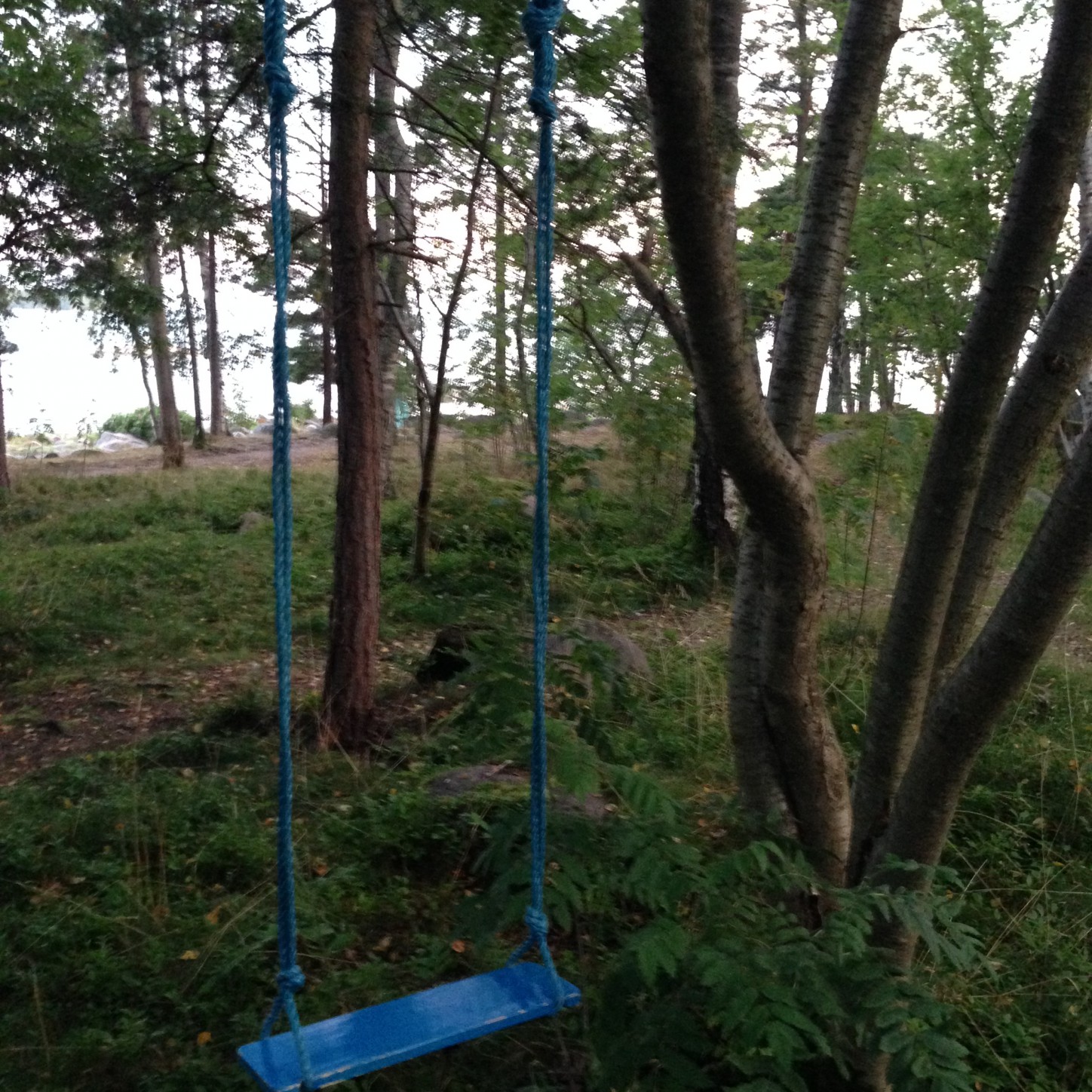
Den lilla blå gungan dyker upp igen, fredagen den 28 augusti på Mörtnäsudden på Drumsö, i en rönn nära bastun alldeles vid ingången till sandstranden. Det är slutetappen på miljökonstutställningen som öppnas lördagen 29 augusti av förening LARU Art och heter Human Era. Se här för mera information om alla konstnärer som är med och vad som sker var och när.
Ikväll, den 26 augusti var jag ute på stranden för att kolla hur det går att få elektricitet från bastun, och det gick fins, eftersom bastuföreningens ordförande och damerna som badade ikväll var informerade, och Petri Anttonen var där i god tid för att få nyckeln, emedan jag kunde komma först inemot åtta. Han hjälpte mig att hänga upp gungan i den unga rönnen, och den blev till slut ganska bra, trots att det inte fanns någon vågrät gren att tillgå. Jag lyckades rigga upp projektorn men någon egentlig projektion kunde vi inte pröva, eftersom jag inte hade en fjärrkontroll till min mediaplayer, dumt. Men den finns tyvärr kvar i Kvarnbäckens galleri, där den kommer att behövas nästa vecks. Så det skall bli spännande att se ifall projektionen syns i gräset och i träden i bakgrunden, för själva rönnen har inte mycket lövverk att komma med på rätt höjd. När jag packade ihop var klockan nio, och då började det bli behagligt skumt. Gatubelysningen är sen ett annat problem, men lyckligtvis lyser den inte direkt på rönnen, tror jag.
Detta var alltså det första testet, trots att det var den andra gången jag besökte platsen. Den första gången visade organisatörerna området och föreslog trakten kring bastun just på grund av möjligheten att få elektricitet.
Nästa fredag, i övermorgon alltså, är det dags för den första delen av föreställningen. Då kommer jag att åka dit med gungan, min kamera och en trefot för att be förbipasserande sitta i gungan. Tyvärr har de lovat duggregn till fredag så vi får se hur många som dyker upp. Sen blir det dags för den egentliga föreställningen på lördagen, men då är det bara jag som gungar, tillsammans med projektionen av de andra, i en video som jag hoppeligen hunnit editera ihop på lördag morgon. Jag tror inte det blir ett problem, men däremot nog tidpunkten. Jag är placerad som den sista på programmet, klockan åtta, som är en eller en och en halv timme för tidigt med tanke pä solnedgången, men kanske man kan dröja på det. Och lyckligtvis har jag en andra chans vid utställningens avslutning i början av oktober, och då är det säkert mörkare. De vänliga bastubadande damerna lät mig lämna en plastkasse med elektriska sladdar intill dörren till bastun. Kanske de kan vila där under hela utställningen, om allt går väl.
Det regnade hela dagen på fredagen, men som ett mirakel tittade solen fram strax innan fyra, då jag hade lovat befinna mig med gungan i stranden och spela in deltagare och förbipasserande som gungade. Jag var där framme innan halv fem, och började fråga folk som kom gående längs sandvägen med hundar, med barnvagnar, joggande, cyklande osv. ifall de ville pröva på min gunga och förklarade att jag höll på att ta bilder av gungande människor. Jag började med föräldrar med gungande barn i den stora gungan vid stranden, men den första lilla flickan ville definitivt inte, och farfar lyckades inte övertala henne, så jag bytte taktik, och väntade vid vägen. På en och en halv timme fick jag tjugosex personer att pröva gungan och ge mig sitt namn dessutom. Så nu gäller det bara att editera ihop en video som jag kan försöka använda för projiceringen imorgon.
Föreställningen är över, och de några få som blev kvar och väntade med mig på solnedgången och skymningen verkade nöjda. En kille sa, att det var vacker, och en annan att det var värt att vänta på. Det lilla jag såg av slutet från videon, på väg hem i bussen, verkade trots allt lovande, men rätt annorlunda än jag tänkt mig. Det var mer som om jag var en projiceringsyta själv. Men det får jag kolla senare.
Dagens session blev en relativt lyckad kombination, trots allt. Halvåttatiden, då solen ännu lyste klart berättade jag för den del av publiken som var kvar efter att ha vandrat omkring på stranden och presenterats en massa konstverk ända sedan klockan två på eftermiddagen vad jag tänkte göra, och att de som inte orkade vänta med mig kunde få se dokumentationen på vimeo via LARU sidan. Dessutom sade jag några ord om namnet, Att gunga tillsammans, och hur vi egentligen alltid jobbar tillsammans med andra även då vi tror att vi gör det på egen hand. Någon har gjort papperet jag skriver på, gungan fungerar inte utan trädet det hänger i, och så vidare. Så berättade jag vad jag tänkte göra, dvs. att sitta i gungan, och så insåg jag att jag kunde be de närvarande pröva på gungan, eftersom det var gott om tid till solnedgången. Och när de väl gjorde det, och åtminstone en del av dem nappade på mitt förslag att titta upp i lövverket, insåg jag, att jag visst borde ta in även detta på video, vilket jag gjorde. Den svaga projektionen syns inte i bilderna, men själva gungandet nog. Jag skickade till och med runt ett papper att skrivs namnen på de uppträdande, de som gungade, men glömde att be den tillbaka. Hm.
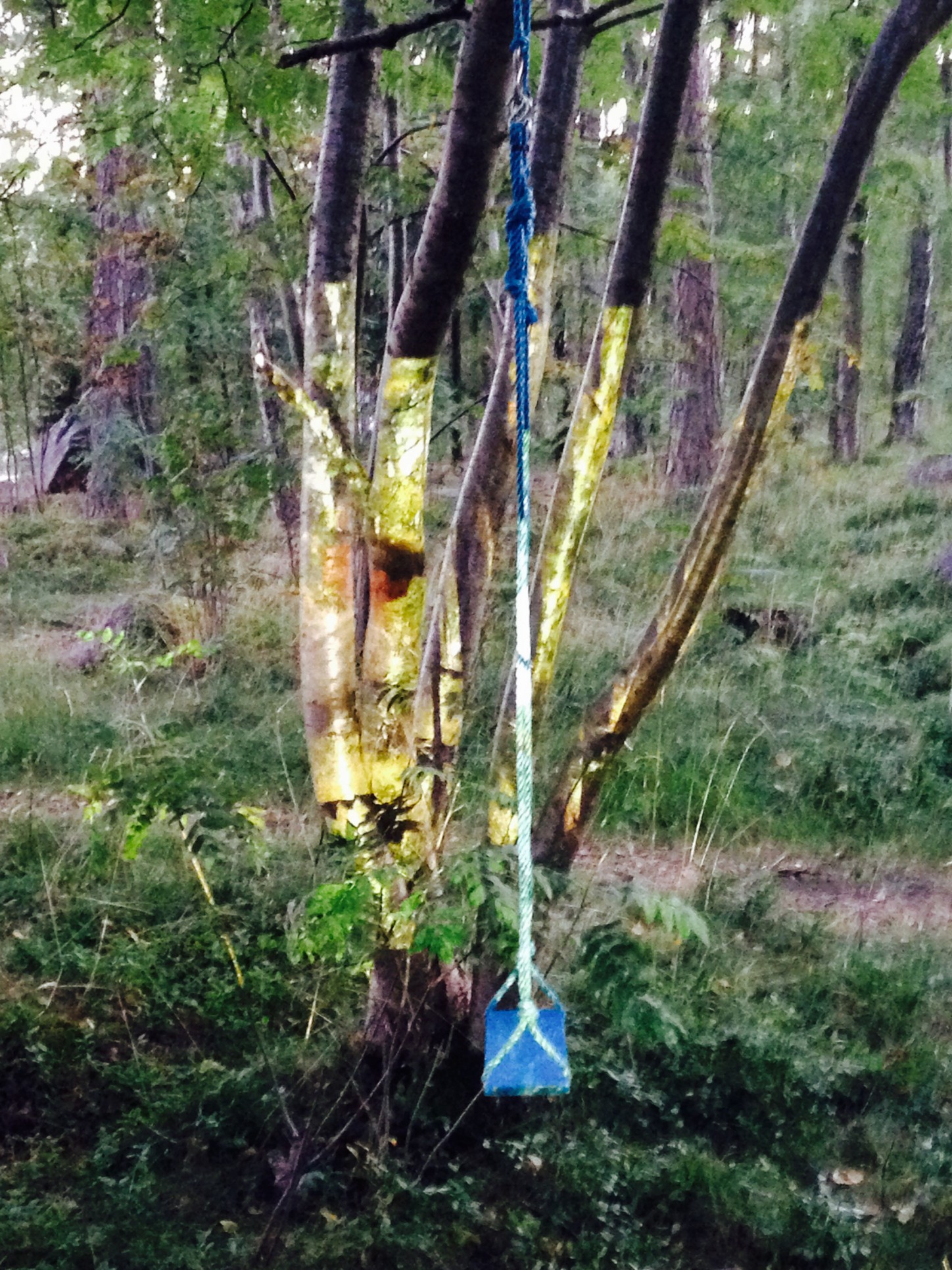
Så det var första delen. Den andra delen bestod sedan av projektionen på de tunna rönnstammarna, och den var ganska vacker när den långsamt började träda fram i och med skymningen. Rörelsen är det som syns, faktiskt. Och den tredje fasen var sedan själva föreställningen, som den här gången faktiskt hade en början och ett slut. Det var slutet som var det viktiga, för jag hade bestämt mig att använda det faktum att videon slutade med mig gungande, och sen med en tom gunga med texterna av alla som gungat. Och att jag skulle försöka synkronisera mina handlingar med den slutbilden. Och just detta “exakta” och planerade slut fungerade som slutkläm på den annars rätt lugns och odramatiska föreställningen. Jag var nöjd att jag använt tid till editeringen i morse.

Det hela fungerade relativt smärtfritt. Men visst fanns det små dramatiska moment under dagen. Det började med att det tog så mycket längre tid att bearbeta videomaterialet, och jag var särskilt irriterad över att jag inte lyckades få sluttexterna att fungera som jag ville med den ny versionen av premier pro editeringsprogrammet. Men det var ju närmast en småsak. Ett mer dramatiskt moment väntade på stranden, då jag började förbereda mig efter att ha följt med presentationerna under dagen. Klockan sex skulle jag få nyckeln från bastun. Jag var där först kvart över och killen som var på plats berättade att någon redan varit och hämtat nyckeln. Vi prövade några andra nycklar, men ingen av dem fungerade för elskåpet, så till slut ringde han, och kvinnan lovade att komma tillbaka med nyckeln, tur som det var. Trots dessa små dramamoment gick allting rätt lugnt till och jag var också koncentrerad nog att inte börja uppträda för mycket. Tvärtom fokuserade jag helt på bilden på trädstammarna för att hängs med rörelsen. I något skede fick jag en känsla av att alla kanske gått sin väg men att jag skulle avsluta föreställningen utan att se efter, eller utan att ta en paus eller byta ställning, trots att det kändes tungt, för jag ville ju ha den på video också. Det kändes bra att folk ändå såg föreställningen och tyckte om den. Men jag minns också den andäktiga viskande stämningen innan jag började, när folk samlades för att titta på den vaga projektionen som så småningom började skimra fram i och med skymningen. Det kändes nästan fel att gå in i bilden och förstörs den sköra rörelsen. Men båda versionerna är intressanta. Projektionen skulle ha behövt lite mera avstånd, och den dokumenterande kameran likaså. En enkel dokumentation av föreställningen, det skede där jag försöker gunga tillsammans med projektionerna, finns att beskåda på vimeo. Men till all lycka finns det en till möjlighet att experimentera med projektet, på avslutning den 4 oktober. Det här konceptet skall jag i vilket fall som helst fortsätta att utveckla…
All posts by Annette Arlander

Cami de Cavalls or How to Perform the Earth
The phrase ‘performing landscape’ feels outdated and quite impossible to use after reading The Ecological Thought by Timothy Morton. Well, the notion of landscape has been controversial for decades, and I have felt the need to explain myself for using it more than once. But now, when my twelve-year project of performing landscape is long since over and done with (although it has not been shown anywhere in its entirety, yet) it is perhaps time to discard the term and find one that feels more suitable for my current concerns. So how about performing the earth? That if anything sounds pretentious, but if we are supposed to think big, as Morton suggests, then why not. And the earth is not only this planet, of course, it is also the soil, the ground, the sand, the stones and the rock I am walking on. But how to perform the earth? Simply by walking on it? For years I used to perform by placing myself in one spot and then returning to that spot again and again to show how everything looked different every time. And of course that technique is still available. Here, on the southwestern shore of Menorca, standing in one spot does not seem the right solution, though. There is a path called Cami de Cavalls circumventing the whole island, and today I walked nearly five kilometers following it, from Cala’n Bosch to Cala Blanca (or whatever the name of the next small cove and tourist resort is). I carried my camera and tripod with me, but did not make a single image. Well, a few snapshots with my phone, just for evidence.
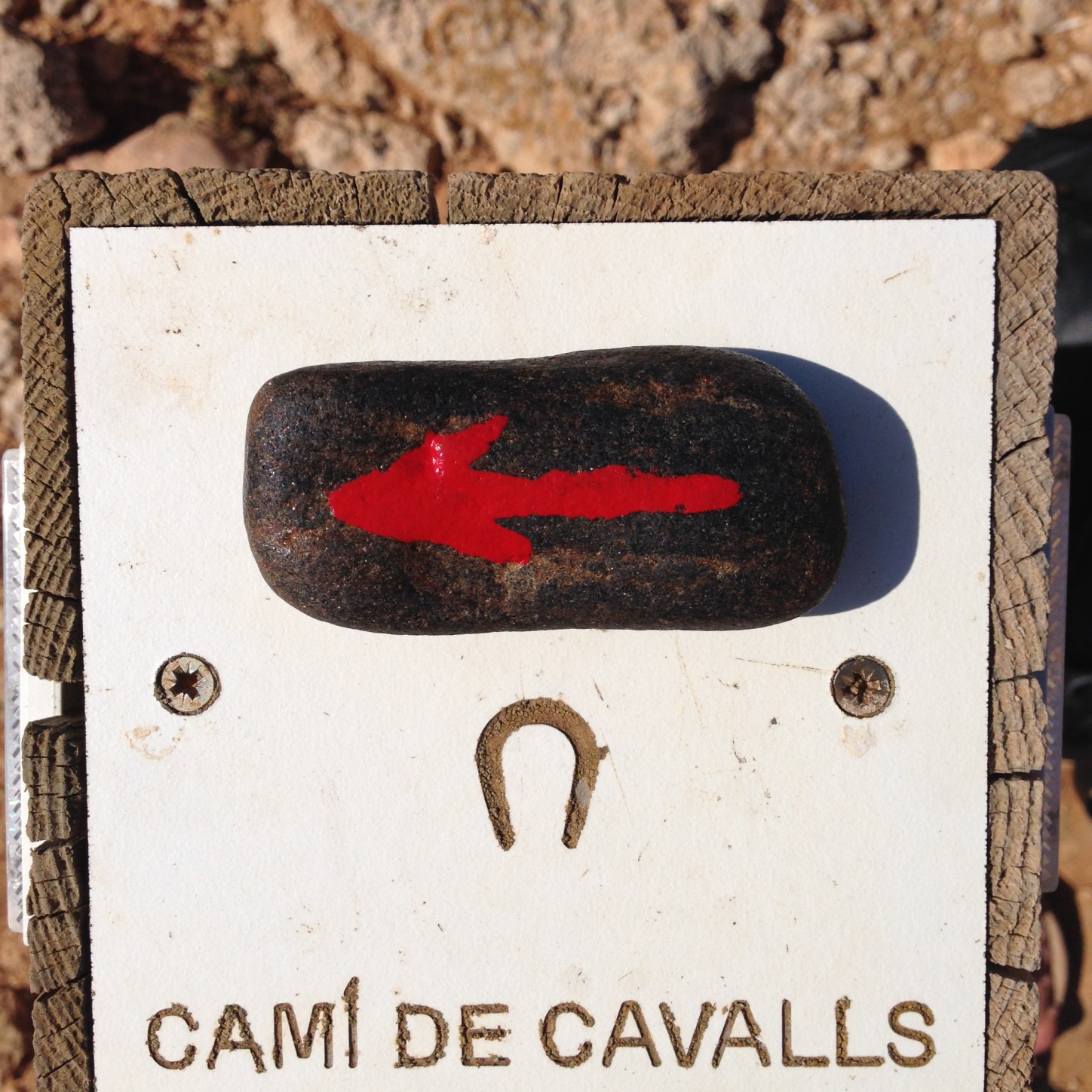
But I thought about alternative ways of performing that path, which follows the coastline and stretches along the rough surface of the cliffs with only a small detour further inland among bushes and low vegetation. One option would be to use the small poles that mark the path as a tool or “rule”, a system to follow, for instance by placing the camera on each pole recording the view along the path from there (and no need to carry the tripod then!). Or perhaps I should stand by each pole and record the image from the previous one, which is not always visible, though. The distances really shift. Or perhaps I should simply record my walk, as I did with my very first attempts in Ireland and in Farrera de Pallars in 1999. What seems clear is the fact that the path is the thing to be performed and recorded. It forms a continuous yellowish line across the land, revealing the soil, the earth, where people and horses have torn away the scarce vegetation. Not many signs of horses on this part of the path, though, neither excrements or signs of hooves. It seems mostly humans have used this path lately and while looking around, it is understandable. The views are great and the path is open, inviting everyone who wants a walk to follow it.

Today, Tuesday, I finally made an attempt. In the afternoon, around five o’clock I decided the sun was low enough to make it worth while to start experimenting. I dressed in a small dark sleeveless dress that I tied up – no scarfs this time – and walked to the start of the path with my camera and my tripod in a simple bag, no backpacks, no fuss. I made the decisions on the spot, like placing the tripod next to the signposts, on the right side facing forward along the path, and at approximately the same height, so slightly lower than normal, and with the horizon dividing the images in half. The gorgeous views of the cliffs and the sea were thus mostly invisible, but the path, the earth itself, the rocks and the soil would be in focus. I decided to walk to the next signpost, stand there for a while – long enough to repeat my ‘mantra’ – and then return to the camera. And then move the camera to the signpost where I had just stood, repeating the action by the next post. This way I walked along the path, returned, walked again with the camera, and so on. I had no idea what it would look like, and whether the next signpost would fit within the frame, since often I could not see the post while placing the camera. When returning home, taking a quick look, the images looked fine. So this is the way to continue tomorrow, or the day after, in the evening light. Perhaps it could become a triptych, walking forwards on the left, standing still in the middle and returning on the right – or then simply a continuation, walking and walking and walking on…

Today, Thursday, I continued my experiment, using the same principles as on Tuesday, starting out around five o’clock. It was easy to find the gate where I finished last time, and now I continued in the wooden part, “metsätaival” as I called it in my mind in Finnish. The brushes obstructed the view of the path, and the sky was covered with clouds, so a few of the images felt really sinister. To make matters worse, there were a lot of bikers and runners on the path, and because of the shrubs I could not see them from a far. So I had to repeat several of the takes since I did not want anybody suddenly jogging in the image. The bushy part of the path ended with a gate, and I thought of finishing there for the day, but the view looked so beautiful and the sun returned, so I went on for a while. While walking I thought about why this rather mechanical way of performing felt so right. With mechanical I mean the system that makes the decisions for me. No need to wonder where to stop walking and stand still for a while, since that is determined by the signpost. And no need to wonder where to place the camera, since that is determined by the signpost, too. And by avoiding all these aesthetic decisions I could focus on enjoying the walk, as well as trusting that the sum total of the decisions made by this “system” would result in a more accurate representation of the path than if I would have tried to find the most pleasing spots to stand and the most interesting views. Of course I could have chosen an even more mechanical system, like using equal distances by counting steps or something, but using the sign posts seems like a more interesting option. Sometimes I could not see the next signpost and would just keep on walking, trusting that it would show up soon. And so it did. And this way I finally solved the problem that has irritated me so often; what I see and what the camera sees are two very different things. Now the camera will see the same view as I do, when I move it to the point where I stood before. Well, since the camera is lower, at the level of my hips, the view is of course not really the same, but closer anyway…
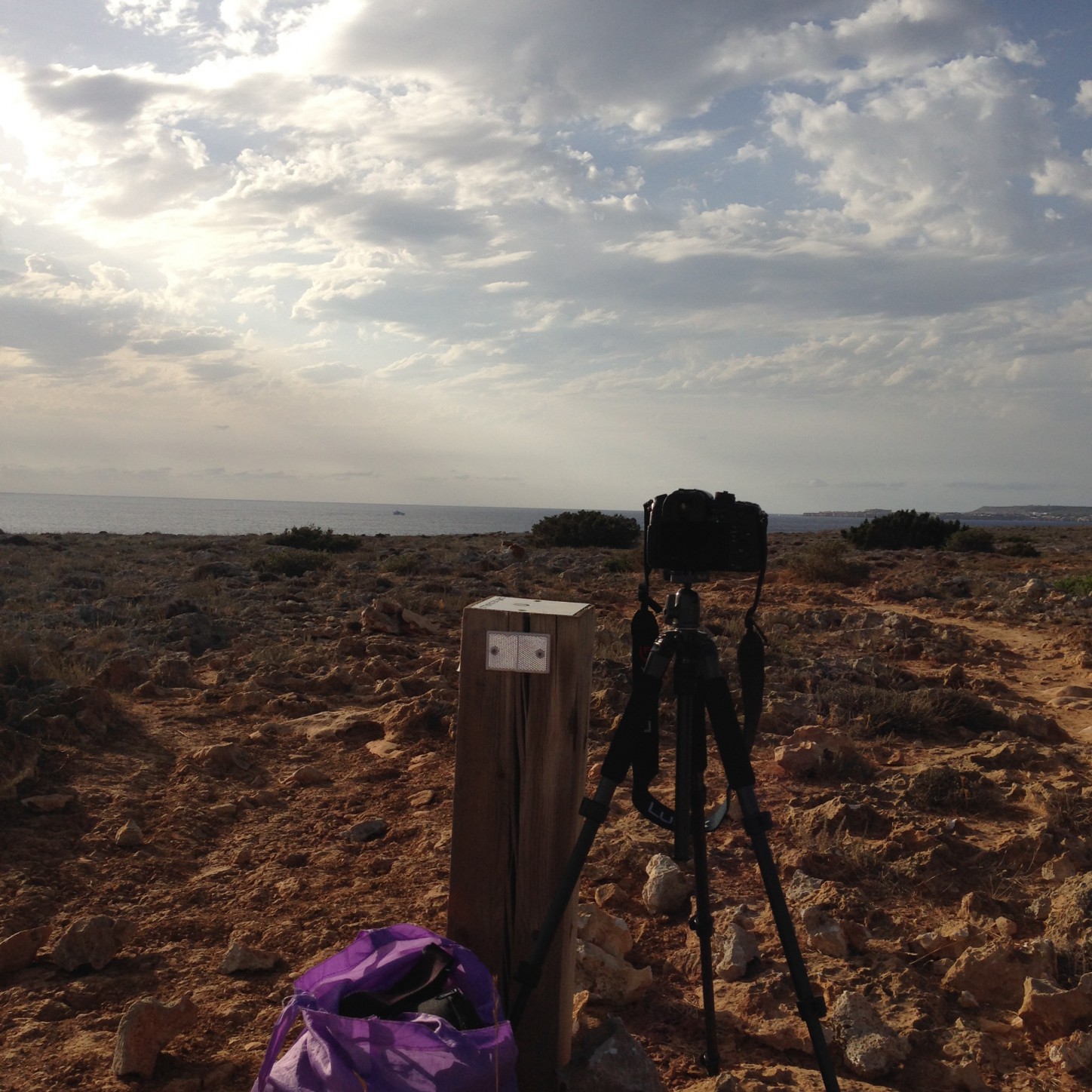
Today, Friday, I continued, and was prepared to finish the project, since they had promised a thunder-storm for tomorrow. Well, I hope that will not happen, since I need to continue for a while. I proceeded rather close to the next village, with the buildings clearly in view in some images, but then the clouds covered the sun and there was less and less light and finally I realized nightfall was quickly approaching. To make matters worse my memory card was full for the “last” image, which was rather dim anyway. Part of the delay was due to people walking their dogs or jogging or whatever, which forced me to wait or to repeat the action. Part was simply my miscalculation. I really had to hurry to get to the village before it was dark, although I felt reassured by the thought that since it was full moon it would not be completely dark. It was very good that I did not try to return the same way, since it was already night when I reached the pavement of human habitation. Then a bus to Ciutadella, and another one from there to Cala’n Bosch. What a trip! But I sure want to make a fourth attempt tomorrow, to finish the path…
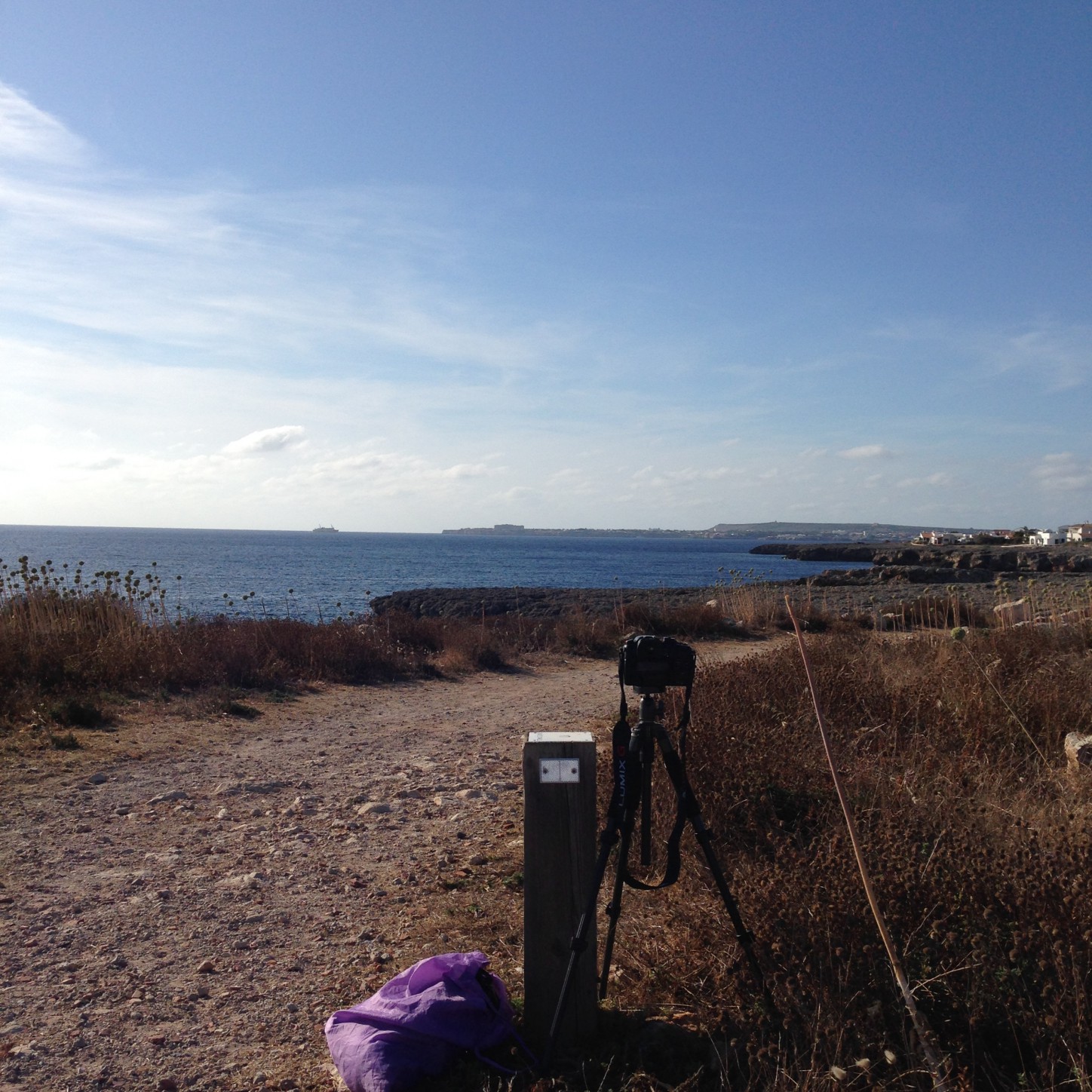
Saturday, last session, and starting with thunder. I left already around three o’clock, since the sky was overcast, so I could as well start earlier, I thought. Near the roundabout on the way a sudden rainfall with thunder suddenly struck, and I spent half an hour with an ice cream in a bar nearby. The sky looked ominous, but when the rain was over I decided to continue, and walked across the cliffs hoping for brighter skies. And yes, by the time I was near the place where I stopped videoing yesterday, the sun was already out. So I started my fourth session in full sunlight, and remade a few of the last images from yesterday. The remaining part of the path was quite long, after all, and some of the images I had to repeat because of frequent passers-by. But it was nevertheless not yet seven o’clock when I was done. And instead of going to have a drink in a bar in Cala Blanca, I decided to walk all the way back, to enjoy the views at a leisurely pace for a last time. Oh dear, it was an exhausting walk. I forgot how long it feels, when one’s feet are sore from stepping on all those sharp stones. The sun was low, so the heat was not bad, but my water was finished and I was, well, exhausted. But I made it, and now I write this at the bar Es Far d’Artrutx. It’s done! Hopefully this will become a finished work, too. And perhaps this way of performing the earth, simply by walking on the earth, will become a new practice to continue…


Artist’s Book – Diary
The artist’s book has not been a personally relevant notion for me. And it has no direct connection to performing landscape. I am proud of the books I have written (two) and the books I have edited (five) and of the web-publications I have been editing with others and in general of all the texts I have written. However, when the artists on Harakka island decided to make an exhibition of artists’ books I wanted to join of course. And without much thought I decided I could participate with some kind of diary. And I especially did not think of it as a video diary, although one could think of the video works I have created on Harakka Island as video diaryies, too. The diary should be a material object, either a notebook bought from a shop (one such I did fill with daily I Ching drawing, but rejected as too easy), or then a pile of paper somehow made into a book.
For a while I had made ”the drawing of the day” each morning, and now I decided to develop this practice into some kind of result. First I drew the phases of the moon, with my ”inktense” pencils, which you can spread out and thin out with water and a brush. Then I started drawing horizons, simple combinations of two colours. And finally I ended up filling small watercolour sketchpads in such a way that the backside of the previous page and the actual page functioned as mirror images or opposites to one another (see image above and below). And in the upper left hand corner I wrote the date with a pencil. To begin with I experimented with placing the horizon on different levels, but soon ended up placing it more or less in the middle. Perhaps this was a result of my video project ”After Sugimoto”, which I started around the same time. His seascapes are divided exactly in two, one half is sky, and the other half is sea. At some point I planned to try all the possible colour combinations of my set of colour pencils, but soon realized that the ”book” would become much too thick. Thus my diary consists of drawings from 17. February to 5. June.
The real problem turned out to be how this pile of paper could be bound or tied or somehow compiled into a book. I planned to take the pile to a shoemaker and ask him to make some holes, so I could tie it myself. A fiend recommended a professional bookbinder, but I hesitated, since the papers did not have any margins for binding. When I finally dared contact them it turned out that they were on holiday. Luckily, I thought. But how to bind the book? I tried with a needle and thread, but the paper was thick and the needle bent. Finally I ended up sowing the papers together one at a time. And because I did it haphazardly, carelessly, the result looks rather funny, or actually clumsy. But why could not a diary be clumsy?
Funny enough, the first art exhibition I ever participated in consisted of diaries, curated by Hannu Gebhard for the Kluuvi Gallery in 1989. There I showed a notebook that was pierced by three holes and tied with wire and three Chinese coins. At that time my diary was irrevocably closed to others and to myself as well. Now my diary is open although it consists only of colours. An a little bit of black thread…


More information about the exhibition Kirjatekoja_English_tiedote+avaj and also here.
Konstnärsbok – Dagbok
Konstnärsboken har inte varit ett relevant begrepp för mig på ett personligt plan. Och den har ju inte något direkt samband med att uppföra landskap. Jag är stolt över de böcker jag skrivit (två stycken) och de böcker jag redigerat (fem stycken) och även över de web-publikationer jag varit med om att redigera och i allmänhet över alla texter jag skrivit. Men när konstnärerna på Stora Räntan beslöt att ordna en utställning med konstnärsböcker ville jag givetvis vara med Och utan att fundera desto mera över det bestämde jag mig för att delta med något slags dagbok. Och jag tänkte definitivs inte att det skulle vara en video dagbok, trots att man givetvis kan betrakta de videoarbeten jag gjort på ön Stora Räntan som ett slags videodagböcker. Den skulle definitivt vara ett materiellt objekt, antingen en färdigköpt anteckningsbok (en dylik fyllde jag sedermera med dagliga I Ching teckningar, men övergav som en alltför enkel lösning) eller en hop papper som på något sett formats till en bok.
Jag hade redan en tid gjort ”dagens teckning” om morgnarna, och nu bestämde jag mig för att odla denna praktik för att uppnå något slags praktiskt resultat. Först tecknade jag månens faser, med mina ”inktense” pennor som man kan bräda ut och späda ut med vatten och pensel. Sen började jag teckna horisonter, enkla kombinationer av två färger. Slutligen började jag fylla små akvarellblock på så sätt att det föregående bladets baksida och det egentliga bladet fungerade som spegelbilder eller motsatser till varandra (se bilden ovan och härunder). Och i det övre vänstra hörnet skrev jag dagens datum med blyerts. Till att börja med experimenterade jag med att placera horisonten på olika höjd, men snart började jag placerade den så gott som mitt på. Kanske det var ett resultat av mitt videoprojekt ”Efter Sugimoto” som jag inledde vid samma tid. Hans havslandskap är delade itu exakt på mitten, hälften himmel och hälften hav. I något skede tänkte jag att jag skulle pröva på alla tänkbara färgkombinationer av min samling färgpennor, men insåg snabbt att ”boken” skulle bli alltför tjock. Så består då min dagbok av teckningar från och med 17 februari till och med 5 juni.
Det egentliga problemet visade sig vara hur denna hög av papper kunde bindas, knytas eller på något sätt sammanställas till en bok. Jag tänkte föra knippet till en skomakare och be dem göra hål så att jag skulle kunna binda den själv. En vän rekommenderade ett bokbinderi, men jag var tveksam, eftersom papperen inte innehöll någon marginal att binda. När jag slutligen tog mod till mig för att kontakta bokbinderiet visade det sig att de var på semester. Lyckligtvis, tänkte jag. Men hur binda boken? Jag försökte med nål och tråd, men papperet var tjockt och nålen vreds. Slutligen fick jag lov att sy ihop papperen ett i taget. Och eftersom jag gjorde det på ett ungefär, ditåt, ser resultatet ganska komiskt ut, rent ut sagt klumpigt. Men varför skulle en dagbok inte kunna vara klumpig?
Ironiskt nog var den första konstutställning jag någonsin deltagit i just en utställning med dagböcker som samlats av Hannu Gebhard för Glo galleriet 1989. Dit förde jag en anteckningsbok som var genomborrad med tre hål och förseglad med ståltråd och med tre kinesiska mynt. Då var min dagbok alltså oåterkalleligt förseglad för andra, ja även för mig själv. Nu är min dagbok öppen, men den innehåller bara färger. Och lite svart tråd…
Mera information on utställningen finns Kirjatekoja_svenska_tiedote+avaj och även här.
Taiteilijakirja – Päiväkirja
Taiteilijakirja ei ole ollut minulle mitenkään omakohtaisesti relevantti käsite. Ja eihän se suoraan liity maiseman esityksellistämiseen. Olen ylpeä kirjoittamistani kirjoista (kaksi kappaletta) ja toimittamistani kirjoista (viisi kappaletta) sekä myös verkkojulkaisuista joita olen ollut toimittamassa ja yleensä kirjoittamistani teksteistä. Mutta kun Harakan taiteilijat päättivät tehdä näyttelyn taiteilijakirjoista halusin tietysti olla mukana. Ja sen enempää miettimättä päätin, että voisin osallistua jonkinlaisella päiväkirjalla. Enkä nimenomaan ajatellut, että kyseessä olisi videopäiväkirja, vaikka Harakassa tekemiäni videotöitä voisi ajatella myös päiväkirjoina. Sen pitäisi tietysti olla materiaalinen objekti, joko valmiina ostettu muistikirja (yhden sellaisen täytin päivittäisillä I Ching piirroksilla, mutta hylkäsin liian helppona) tai jotenkin kirjaksi kyhätty nippu paperia.
Olin jo jonkin aikaa tehnyt aamuisin “päivän piirroksen”, ja nyt päätin jalostaa tämän käytännön jonkinlaiseksi tulokseksi. Ensin piirsin kuun vaiheita, “inktense” kynilläni, joita voi levittää ja ohentaa vedellä ja pensselillä. Sitten innostuin piirtämään horisontteja, yksinkertaisia kahden värin yhdistelmiä. Lopulta ryhdyin täyttämään pieniä akvarellipaperilehtiöitä siten, että edellisen sivun selkäpuoli ja varsinainen sivu toimivat toistensa peilikuvina tai vastakohtina (katso kuva yllä ja alla). Ja vasempaan yläkulmaan merkitsin päivämäärän lyijykynällä. Aluksi kokeilin sijoittaa horisontin eri korkeuksille, mutta pian päädyin sijoittamaan sen kutakuinkin keskelle. Ehkä tämä oli seurausta “Sugimoton jälkeen” videoprojektistani, jonka käynnistin samoihin aikoihin. Hänen merimaisemansa on jaettu tasan kahtia, puolet taivasta, puolet merta. Jossakin vaiheessa ajattelin kokeilevani kaikki mahdolliset väriyhdistelmät värikynävalikoimastani, mutta oivalsin pian, että “kirjasta” tulisi liian paksu. Niinpä päiväkirjani koostuu piirroksista alkaen 17. helmikuuta ja päättyen 5. kesäkuuta.
Varsinaiseksi ongelmaksi muodostui, miten tuosta paperikasasta saisi sidottua, nidottua, tai jotenkin kasattua kirjan. Ajattelin viedä nivaskan suutarille ja pyytää tekemään reikiä, jotta voisin sitoa sen itse. Ystäväni suositteli kirjansitomoa, mutta se arvelutti minua, koska papereissa ei ollut mitään nidontavaraa. Kun lopulta rohkaisin mieleni ja etsin kirjansitomon käsiini, kävi ilmi, että he olivat kesälomalla. Onneksi, ajattelin. Mutta miten sitoa kirja? Yritin neulaa ja lankaa, mutta paperi oli paksua ja neula vääntyi. Lopulta päädyin ompelemaan paperit yhteen yksi kerrallaan. Ja koska tein sen summittain, sinne päin, tulos näyttää aika huvittavalta, suoraan sanoen kömpelöltä. Mutta miksei päiväkirja voisi olla kömpelö?
Huvittavaa kyllä, ensimmäinen taidenäyttely johon olen osallistunut oli nimenomaan näyttely päiväkirjoista, jonka Hannu Gebhard kokosi Kluuvin galleriaan 1989. Sinne toimitin muistikirjan, joka oli lävistetty kolmella reiällä, ja suljettu rautalangoilla joissa oli kiinalaiset kolikot. Eli silloin minun päiväkirjani oli peruuttamattomasti lukittu muilta, ja itseltänikin. Nyt päiväkirjani on avoin, mutta sisältää pelkkiä värejä. Ja hiukan mustaa lankaa…
Lisätietoja näyttelystä löytyy Kirjatekoja_suomi_tiedote+avaj ja myös täältä.
Looking at the Mediterranean Horizon
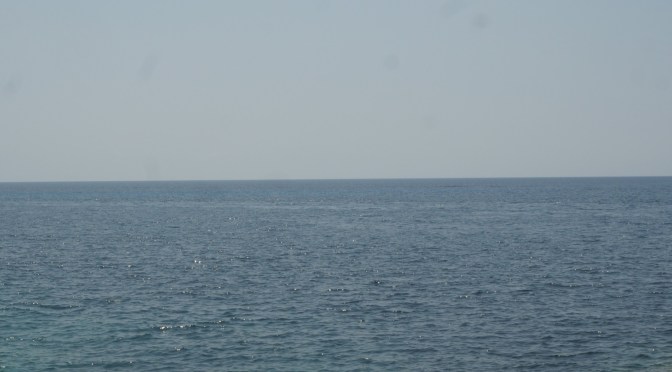
Arriving in Cala’n Bosch, a tourist resort on the west coast of Menorca, I immediately took a walk to the shore and looked at the open sea view thinking, this would be an easy piece. Just pick your spot, since there it was, everywhere, the open horizon. The blue Mediterranean Sea was spreading out in front of me undisturbed by islands, piers, boats or anything. So on Monday afternoon I took my camera and tripod and headed down to the shore, to the same rocky spot I first saw when arriving. I thought that would be a place where people would not be lying on the beach and I would not have to be embarrassed carrying a camera amongst them, as if wanting to document naked flesh or whatever. I walked out on the cliffs, which were surprisingly sharp and uncomfortable to step on, and found a place for my tripod. But to my horror, I saw a spot on the lens. I had my camera cleaned just a while ago, so this seemed like an ironic twist of fate. I did not return back to search for a vacuum cleaner, but resorted to my handkerchief in order to remedy what I could. And it helped a little bit, yes. But now, by the time I was all set up, a boat came by, so I waited for the waves to pass, and then another boat. And then a rubber boat parked right outside the cliffs, and I thought they might start diving or something, so I decided to move. But when I had packed my things and walked halfway up to the road, the boat started to move again, so I returned. Finally I managed to record almost three minutes of the view with an empty horizon, half of the image sea and the other half sky, à la Sugimoto, before two sailing boats showed up. Funny enough, even with plenty of empty horizon, recording it might prove to be a challenge.
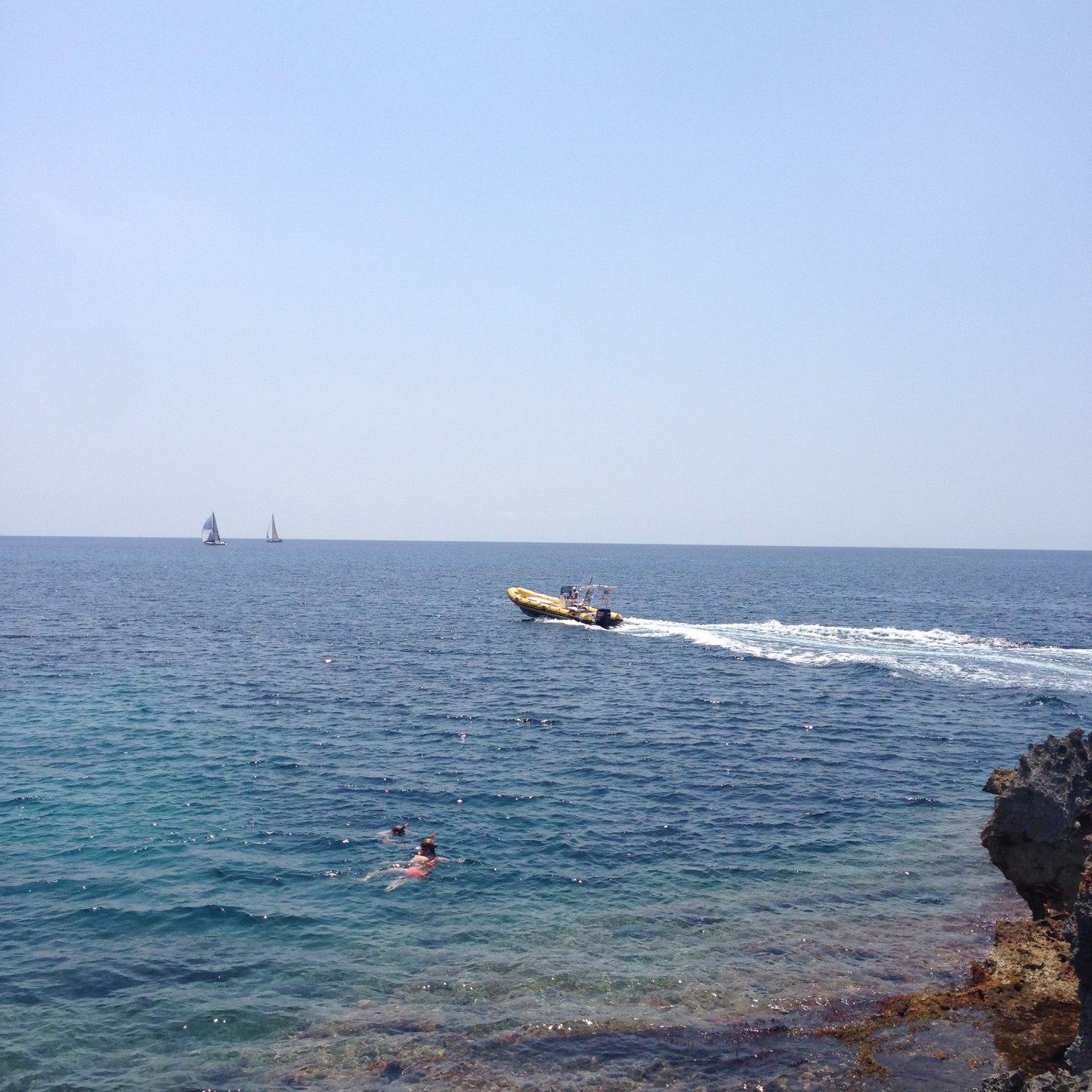
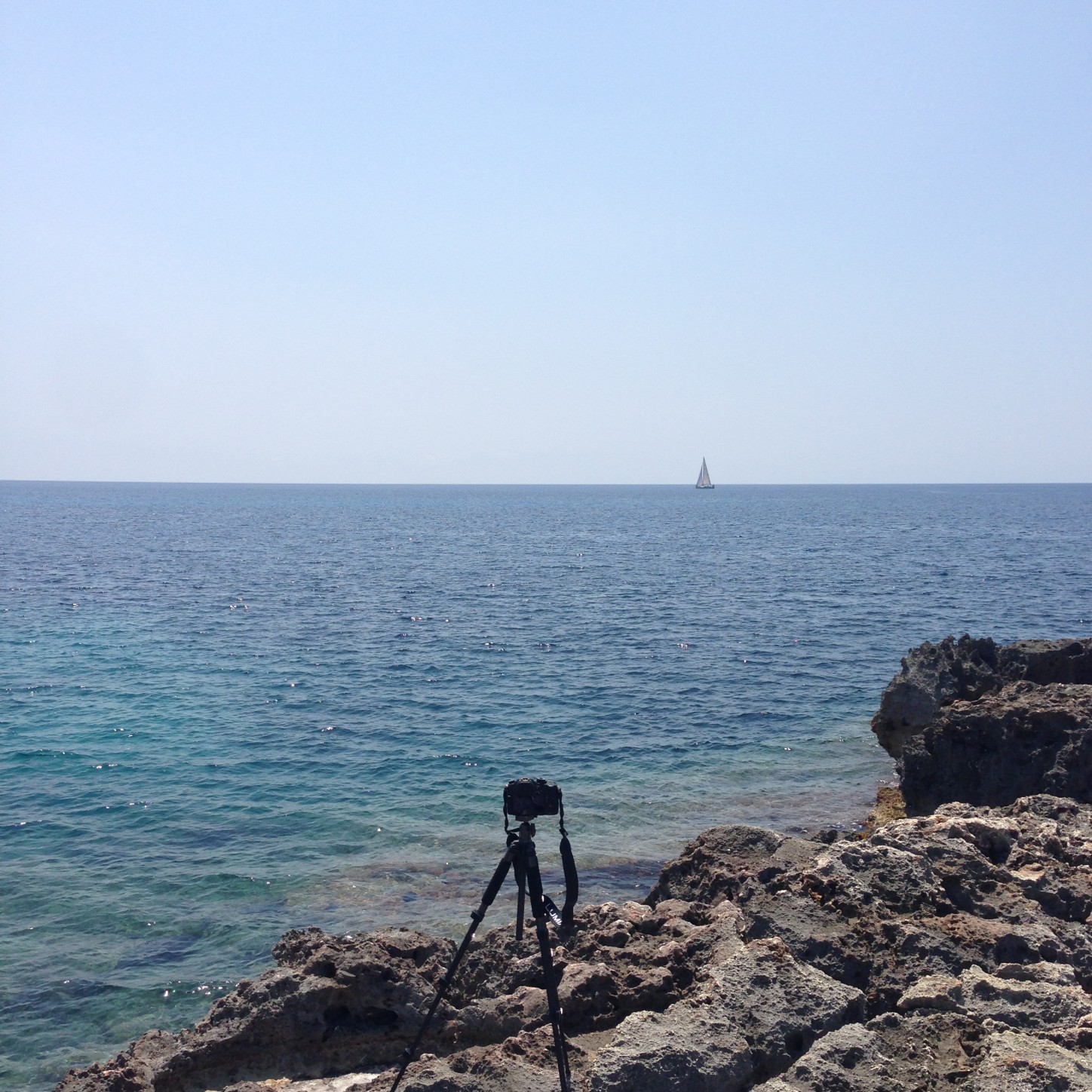
The real challenge was nevertheless ahead of me, that is, finding enough of an Internet connection to be able to upload these images and this text as a blog post. It took me two days.
Fluid Horizons on Amager Strand in Copenhagen
The initial get-together and the first key-note presentation of Fluid States North, which is part of the all-year and all-around-the-globe event Psi #21 Fluid States took place in a beautiful wooden bath house on Amager Strand, a recently renovated beach area in Copenhagen during midsummer, 18-21 June 2015. Unfortunately the weather was not the best possible, with drizzling rain and a chilly wind, so the experience had an element of endurance performance to it. I decided immediately, however, to return to the spot with my camera after the conference, in order to look if I could find a slice of an empty horizon.
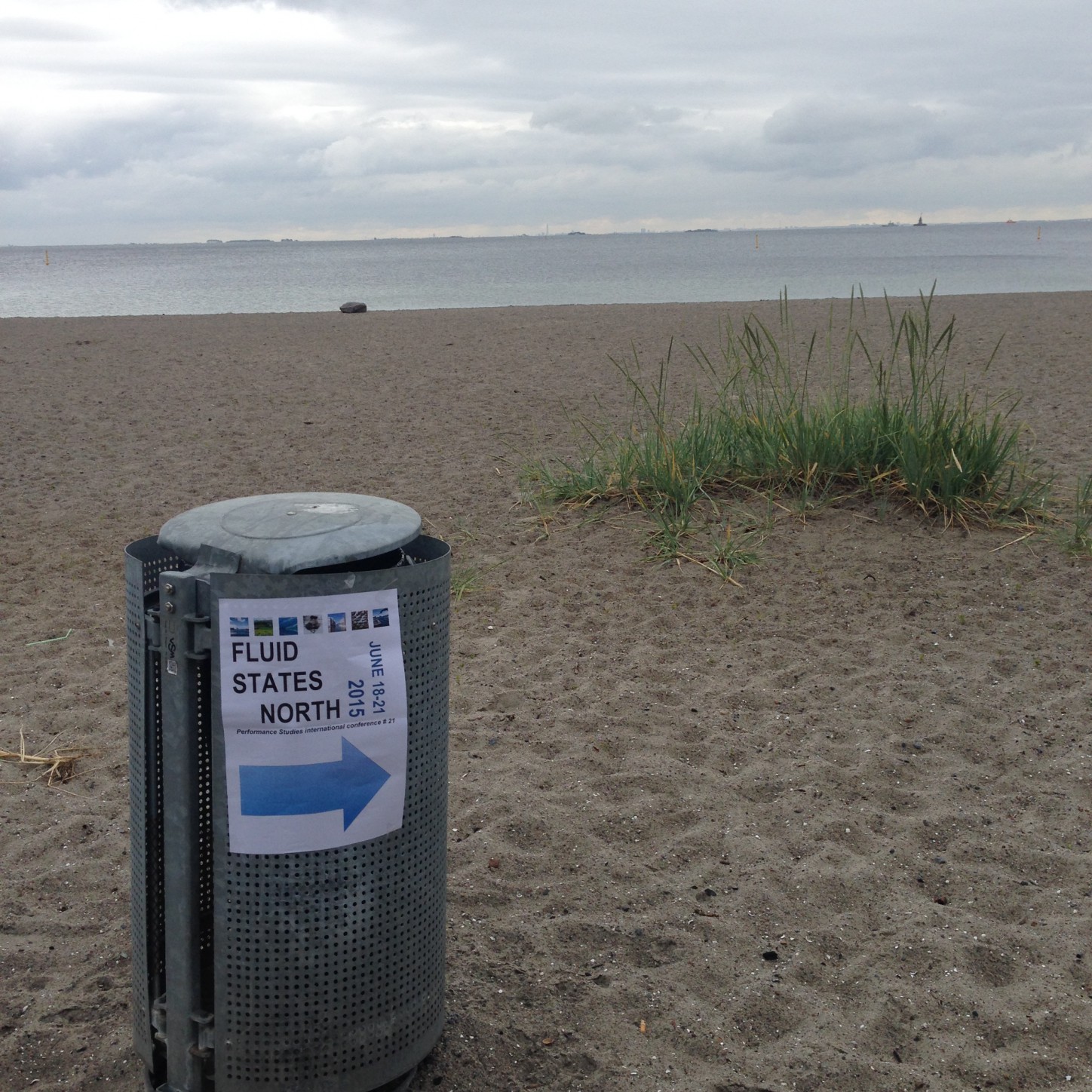
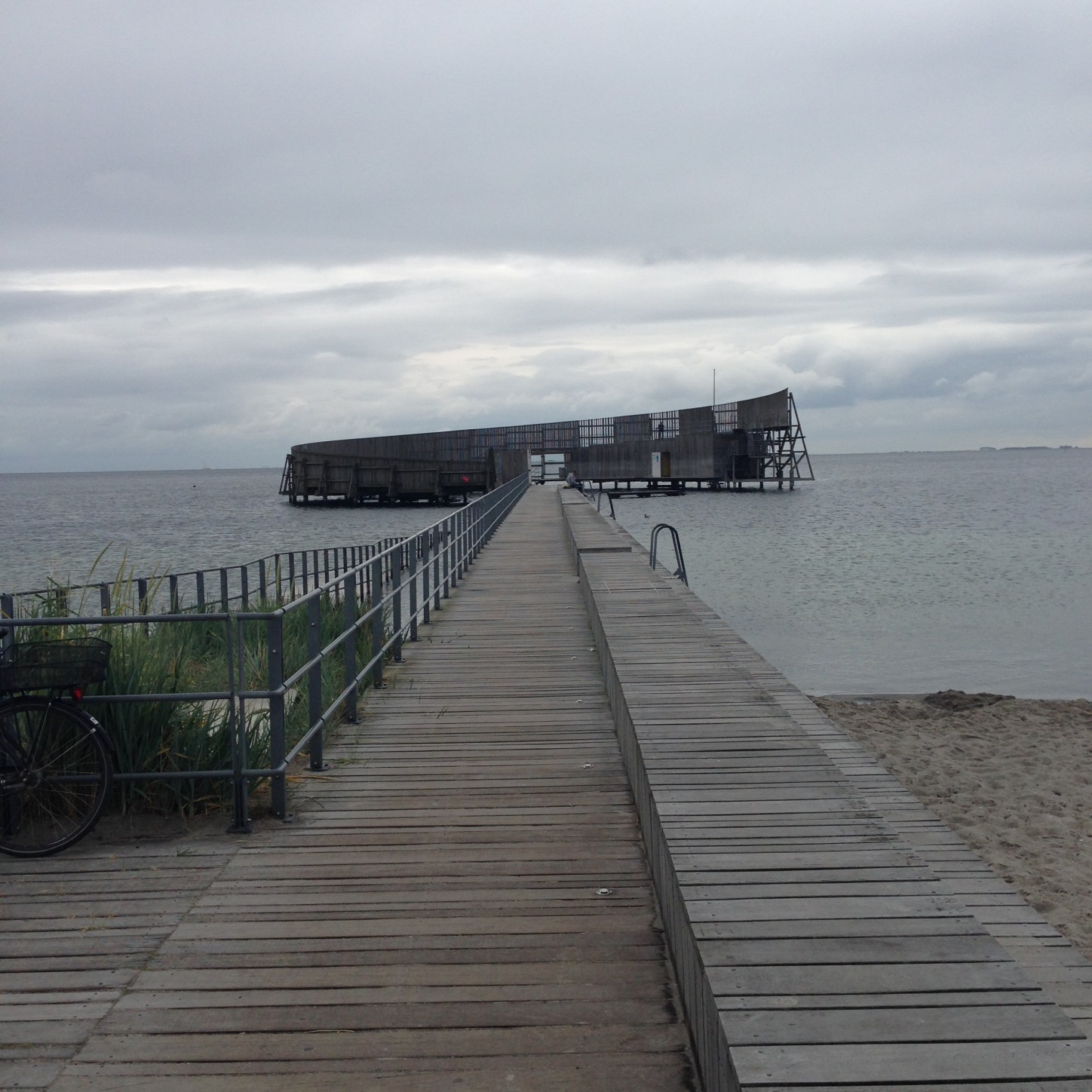
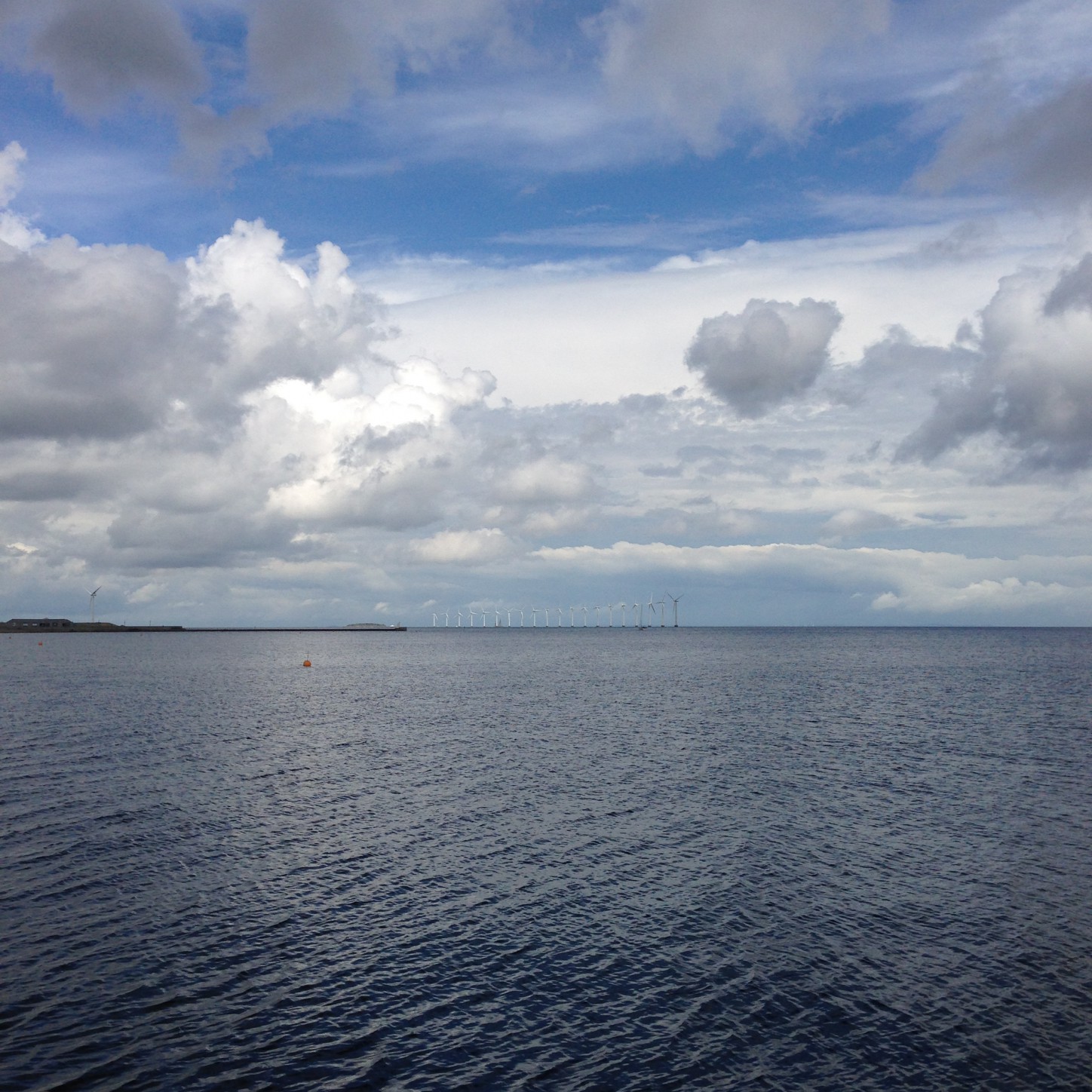
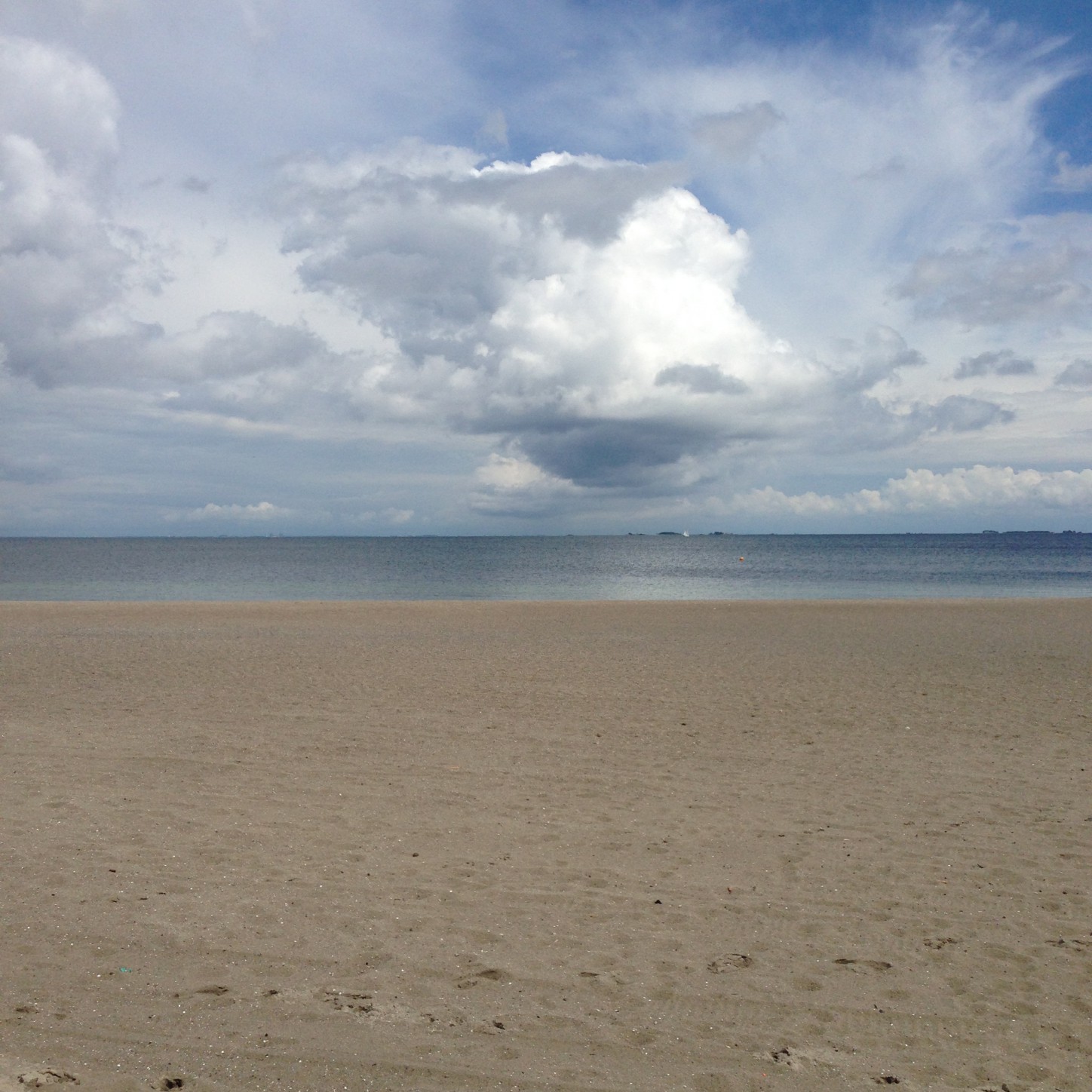
And that I did this afternoon, Monday 22nd June. After a rainy morning the sky cleared at least partly and there were moments of sun when I stepped out from the Metro at Femoren, a stop between Amager Strand and the Airport. And the mud in the adjacent park and the noise from people taking down something that looked like the stage of an outdoor concert from the weekend before, the place was much more inviting, and looked almost like a beach. There was nobody on the beach proper, of course, midsummer in Scandinavia is rarely suited for such activities, but some people were enjoying the walk. And nobody was disturbed when I walked out to the small pier and placed my camera on a tripod on the large boulders in order to find a spot were no islands or windmills or boats or the famous Orebro bridge in the distance would intervene with the horizon. The clouds were dramatic, though, and no evenly grey image like the one captured on my iphone during the first visit could be created this time.

This time – one more attempt to begin the series of videos with the working title “After Sugimoto”, referring to Hiroshi Sugimotos’s famous Seascapes – I was using a new objective in my camera, and now the camera was properly cleaned by a professional, too, so presumably no dirty spots on the lens would disturb the view. It was not so easy to find an “empty spot” on the horizon, but I think i almost succeeded this time. The windmills to the left and the bridge to the right were hopefully cropped out of sight. While standing on the rocks, as immobile and silent as possible during the recording I listened to the surrounding sounds, inspired by all the recordings on Amager included in the audio papers I heard at the presentation of Fluid Sounds yesterday. At least the music listened to be the roadies taking down the stages on the shore, the airplanes landing on the airport nearby, the signal beep of the trucks backing, and occasional sounds of people passing by, talking, as well as the soft splashing of water against the rocks next to the ripped were easily discernible. Perhaps i should try to use a proper microphone and record the sounds for my videos in a more conscious and deliberate way…

The Cleft of Hell
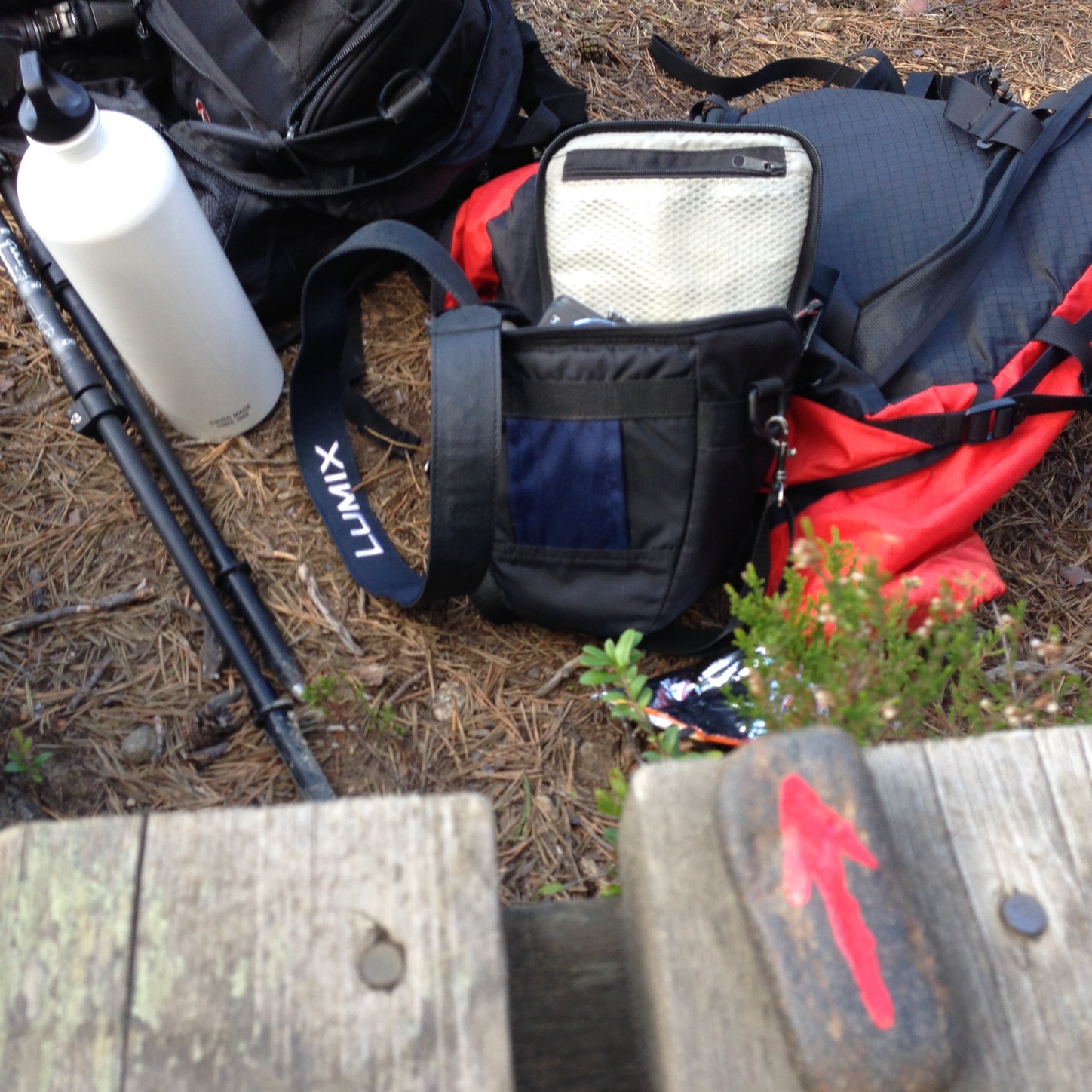
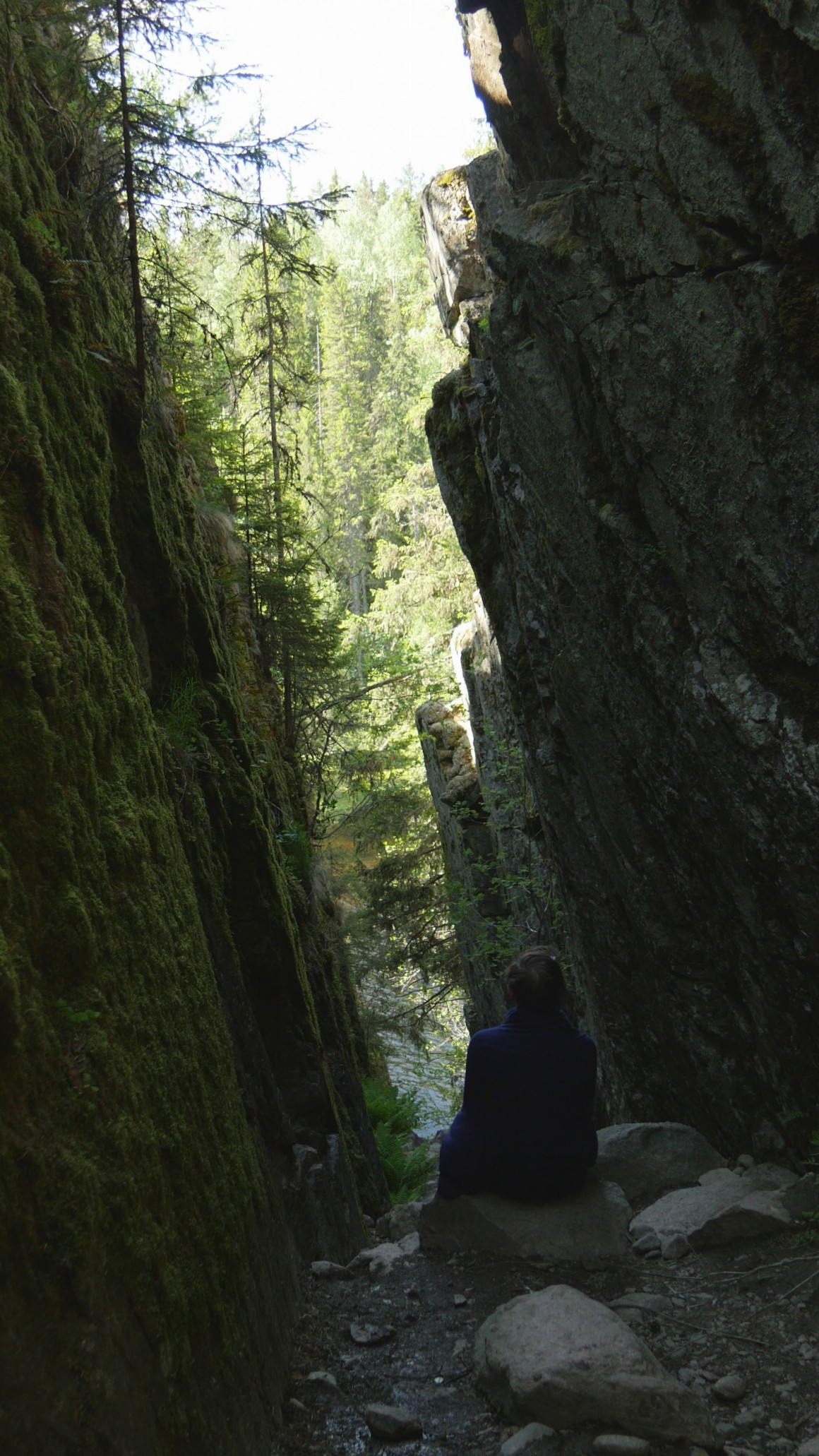
One of the main attractions in the Helvetinjörvi National Park in central Finland is the narrow gorge called Helvetinkolu (Hell’s cleft) that leads down to the lake. More about the park and the famous cleft here. Hiking in the area with a friend during the weekend and enjoying the various forest types and many small lakes next to each other was not meant as a working trip, although I did bring my camera. And the small stone with the red arrow, of course.
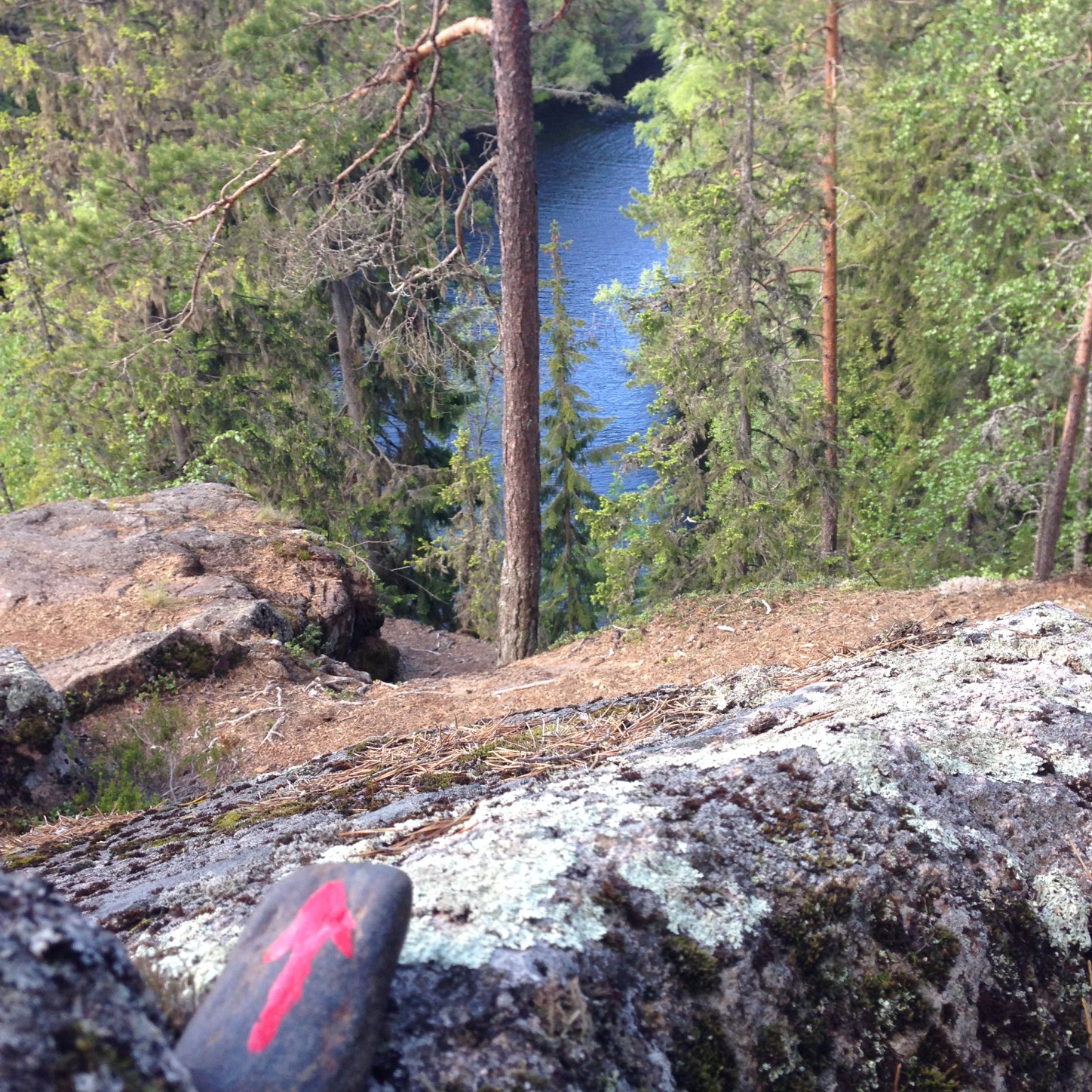
Seeing the steep slopes immediately reminded me of a project I tentatively started last autumn in Oulanka National Park in the North East (see the blog post “Little Bear’s Trail”), something that could be called the vertical landscape. In order to capture something of that vertical feeling I turned my video camera on its side, and why not? Already Bruce Naumann played with turning monitors upside down. It was only when I tried to show some of the vertical video clips at a screening event that I realized the problem; I could not change the position of the projector for my clip only. Obviously these experiments were stuff for installations only, and partly because of that I did not pursue them any further. Only when I saw this landscape did I change my mind again. Even though there were no rivers or rapids rushing through the gorges here, the shores of the lake were steep. And the cleft Helvetinkolu is vertical for sure.

It looks a little like a gateway, and since the lake is narrow, deep and the water is dark, one could imagine that it leads to the underworld. Sitting in the gorge, which is quite impressive by Finnish standards, since there are no really high mountains in the country, and listening to the wind howling above, I could easily imagine some evil spirit appearing to chase away disturbing visitors like me.

Searching for the Horizon
Finding an empty horizon is not so easy, not even in coastal cities like Venice. I started playing with the horizon because of a small green line in my new camera. It is indicating when the horizon is in balance and dividing the image nicely in two equal halves. After playing with the idea of images cut in half by the horizon I encountered the famous Seascapes, the minimalist black and white photographs by the Japanese master Hiroshi Sugimoto. Although a video image brings in the temporal dimension, and adds color and movement, the still images look almost the same so I soon realized whatever I did would be “After Sugimoto”.
After a few attempts in Helsinki my first image in Bilbao was blue on blue as planned, but there some dirt on the lens destroyed my attempt. In Helsinki the weather was bad and the raindrops were blurring the image. Another day the sea was rough, spraying the image again; it seemed almost impossible to get a “clean” video clip. The simpler the image, the more all kinds of imperfections stand out. In automatic still images the camera seems to be able to clean the spots, but not with a video. Thus I carefully cleaned my camera, and decided to start again, and then once again.
Venice should be no problem, I thought, once one gets a little further out of the historical city. I looked at the map, and realized Lido di Venezia would probably be my best bet. I have been there before, for the first time in 1996, when I tried to write the radio play Via Marco Polo (living in a pension on via Marco Polo). So I headed out there after a nice lunch with colleagues on Murano. We were visiting the place with the glass factories as an antidote to the overload of contemporary art we had experienced during the opening week of the Venice Biennale. The sky was turning dark in the afternoon when I took a vaporetto first to San Marco and then another one to Lido.
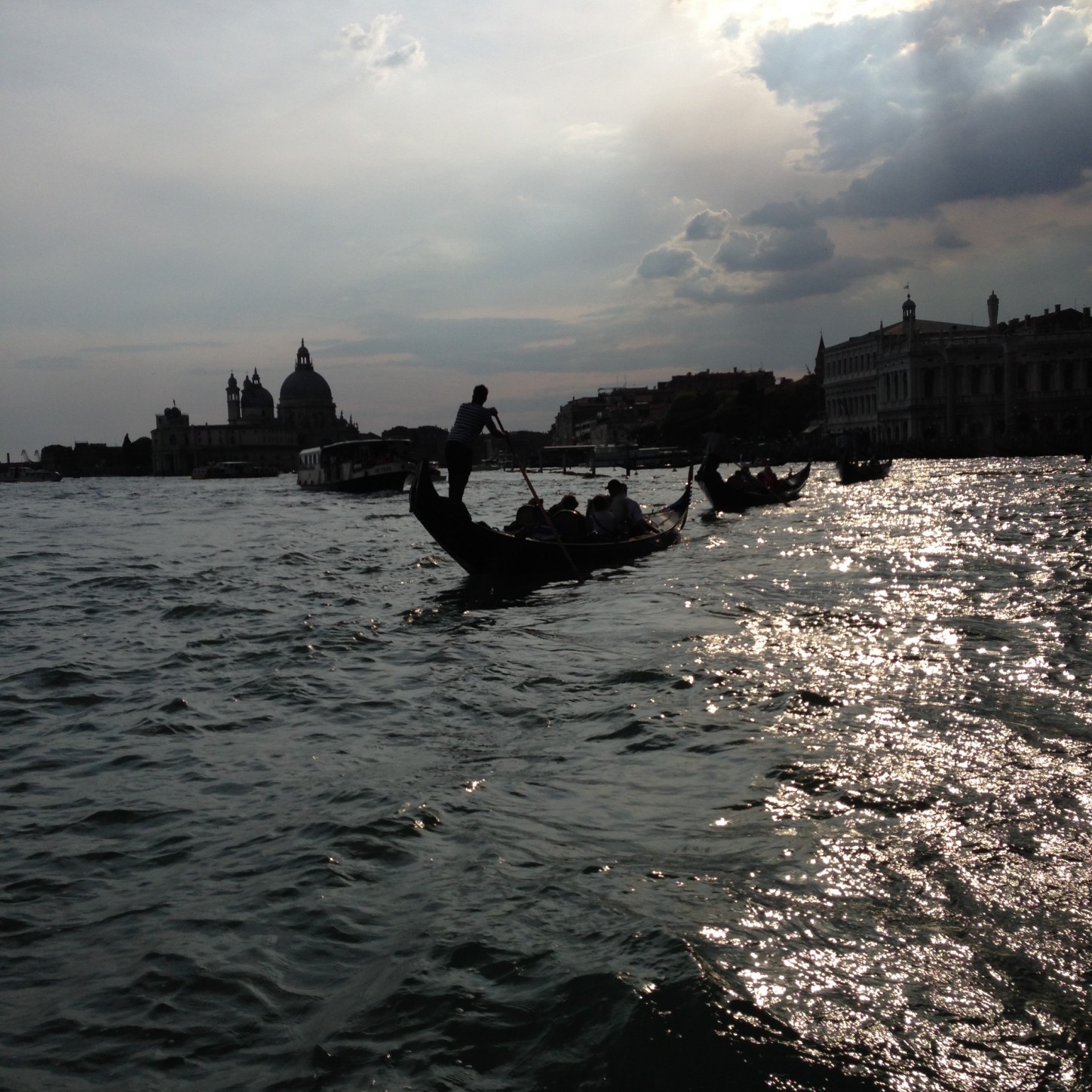

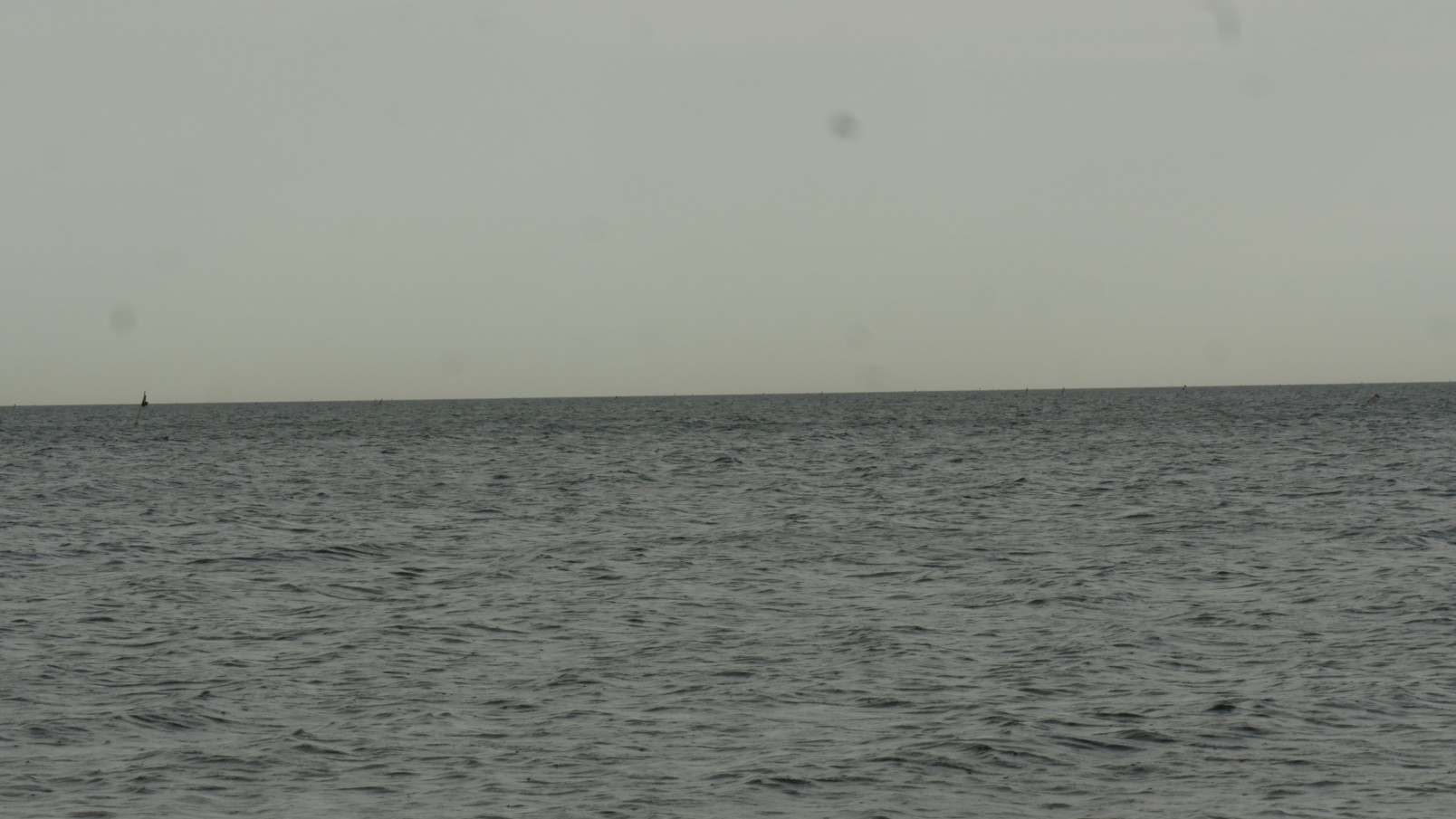
On Lido I walked straight across the island, heading for the beach, in opposite direction to the crowd returning from there, and already felt the first rain drops on my skin. As soon as I had found my way to the shore and placed my tripod in the sand the rain started. I managed to frame the image properly with the help of the zoom and stood there in the rain, clutching the tripod in the wind, recording a sequence of three minutes. When finishing I realized the camera had slowly moved downwards, the horizon was no longer exactly in the middle. I considered for a moment whether I should try to find shelter and wait for the rain to pass, but decided I could perhaps return the next day. Only in the vaporetto on the way back, looking at my “catch” did I realize the water spots on the lens in the video recording, and almost wanted to cry. The spots felt like some weird form of curse. Should I perhaps make these annoying disturbances part of the project? The biggest spot is clearly visible in the still photo taken with manual focus.
The next day I made a new attempt, returned to the same “free beach”, walked out on the rocky pier where people were sunbathing and placed my tripod at the edge. Everything was fine, although a woman nearby was speaking on the phone, which irritated me at first, but then I realized that might make quite a fascinating soundscape.

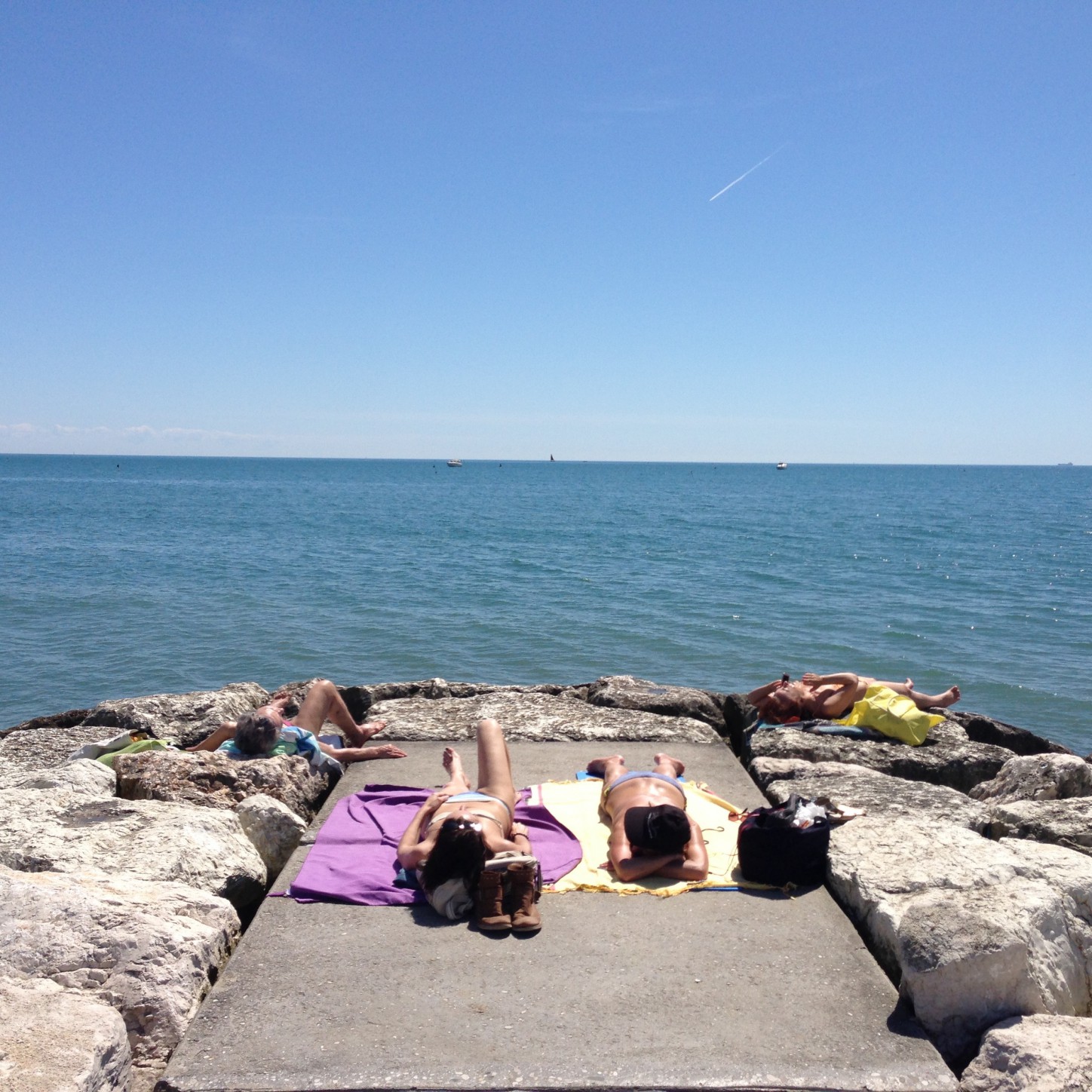
The sun was shining, life was smiling and the ice cream I picked up on the way back tasted delicious until I saw the results: the same spot was still there. Now all I can do is take the camera to be cleaned by a professional and hope for another chance to visit these shores. The idea of abstract minimalism is turned upside down on video, at least in my hands, so it seems.


Horisonten på hälft
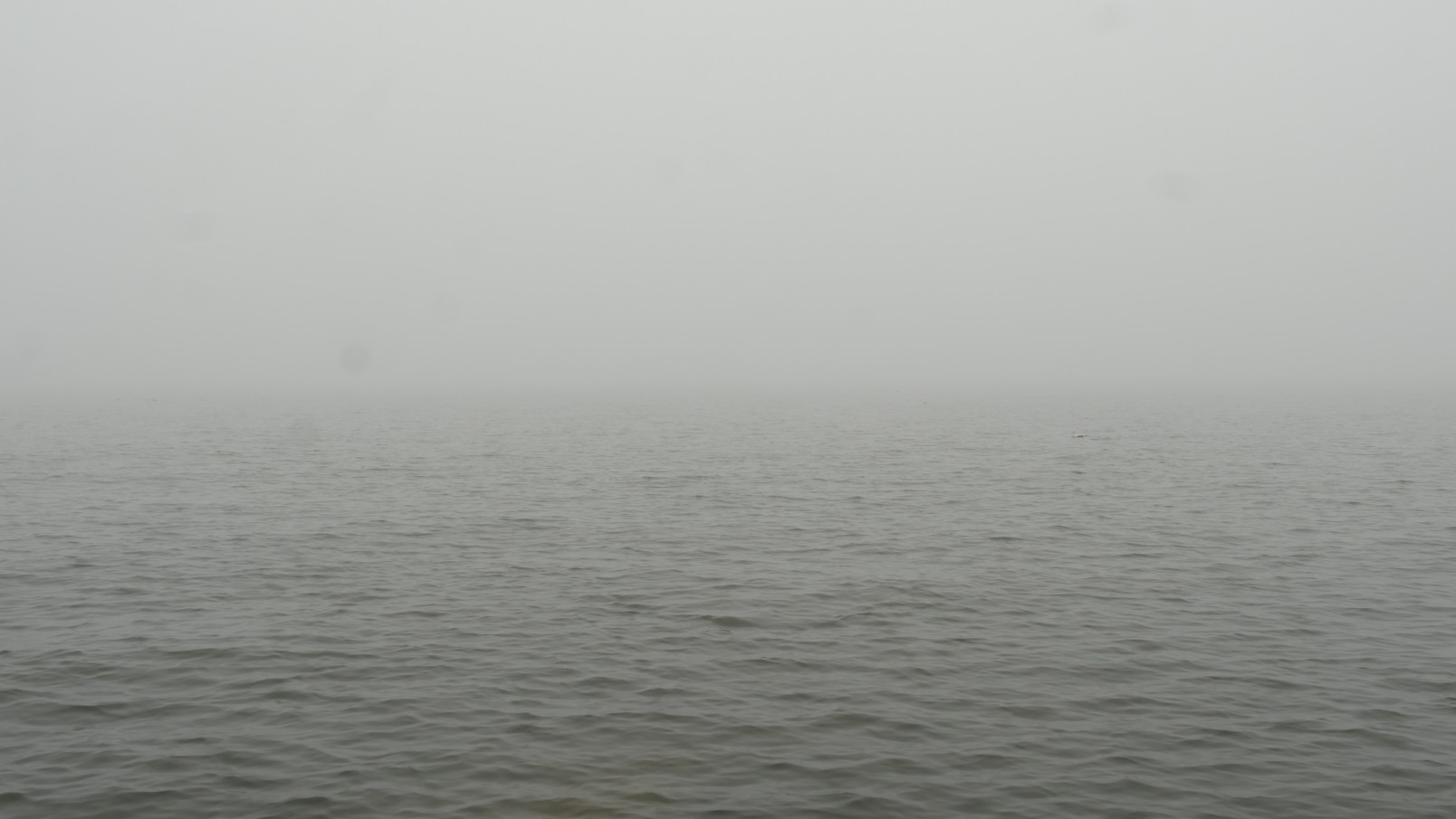
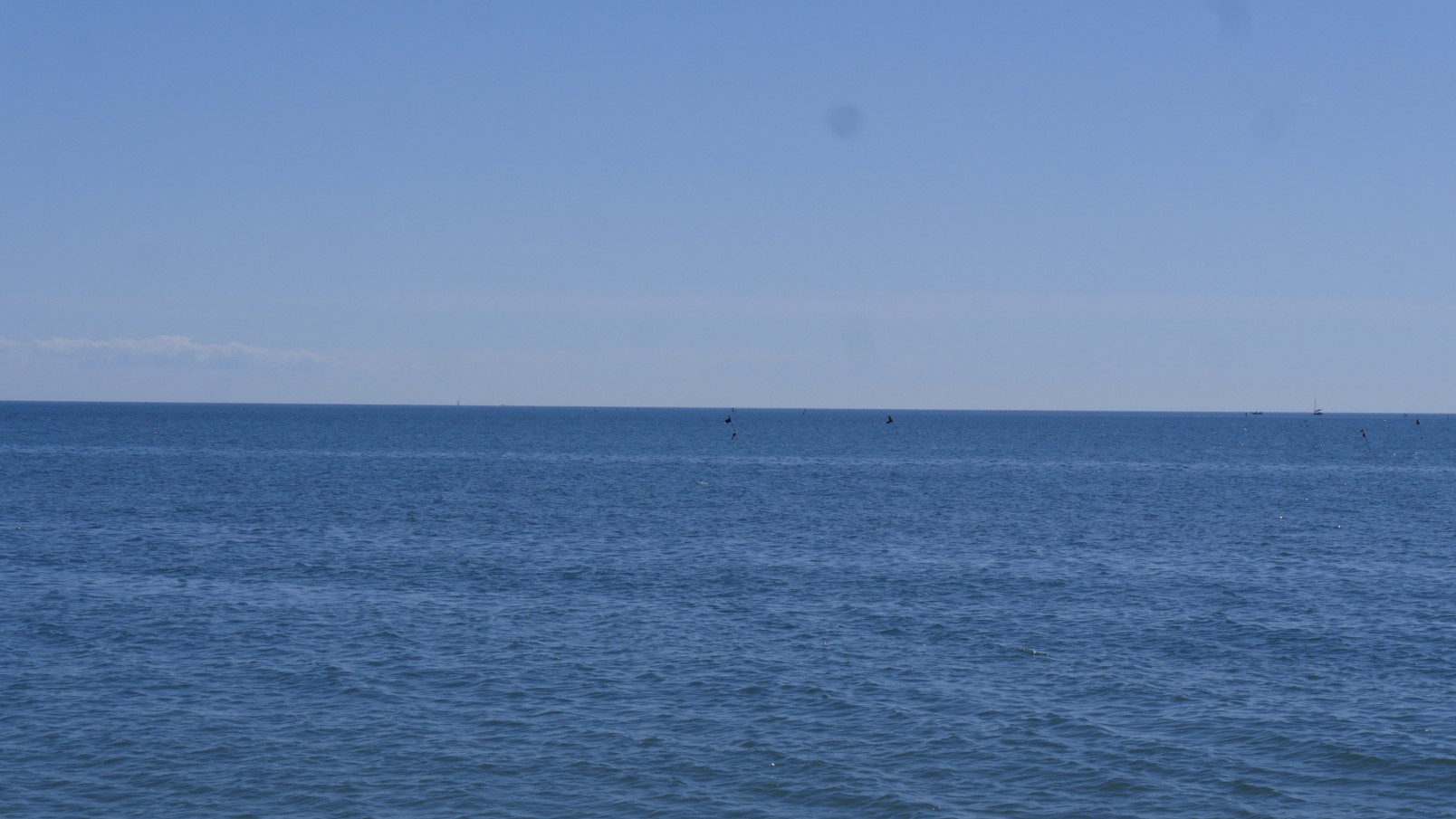
Att hitta en öppen horisont i Helsingfors är inte så lätt, trots att stadens centrum ligger långt ute till havs jämfört med många andra kuststäder. Men i tjock dimma försvinner alla små öar och skär, alla fyrar och sjömärken. För ett par veckor sedan försökte jag banda in en bild från sydvästra stranden av Stora Räntan, men då var vinden så hård att regnet och vågorna piskades mot kameran och vattendropparna täckte bilden. Den här gången var det nästan vind stilla och jag stod fascinerad på stranden och lyssnade på båtarnas mistlurar som ljöd i den vita massan. En flock ejdrar hade samlats utanför ön och deras svagt ylande ljud var gåtfullt vemodiga och säregna jämfört med de sedvanliga skrikande måsarna och gläfsande gässen.
Då jag såg dimman skyndade jag mig iväg till ön för att försöka ännu en gång få en lämplig inledningsbild till den serie små videon med arbetsnamnet “After Sugimoto”. Att göra bilder med horisonten exakt vid halva bilden, med 50 % hav och 50% himmel var en idé som kom sig av balansmätaren i min nya kameran, en grön vågrätt linje tvärs igenom bilden. Men då jag stötte på de eleganta svartvita fotografierna av den berömda japanska mästaren Hiroshi Sugimoto, fanns det inget annat alternativ än att göra serien “After Sugimoto”. Hans seascapes är gjorda runt om i världen, och utgår från tanken att hav oh himmel är de samma överallt. Det är nästan den raka motsatsen till vad jag har hållit på med, då jag återvänt till samma plats varje vecka och försökt visa att allting förändras hela tiden, även samma plats är sig olik hela tiden.
I en video blir effekten givetvis en helt annan då rörelsen kommer med, och ljudet. Men i stillbilderna är släktskapen uppenbar, i synnerhet under en grå och dimmig dag, då bilden ter sig nästan svartvit. Minimalismen är krävande. Två droppar eller fläckar av något slag går lätt att urskilja i videobilden och i de bilder som tagits manuellt. Automatiken putsar synbarligen bort små orenheter, men tolkar också ljuset helt annorlunda. Suck. Ju mindre man försöker göra, desto svårare blir det…