
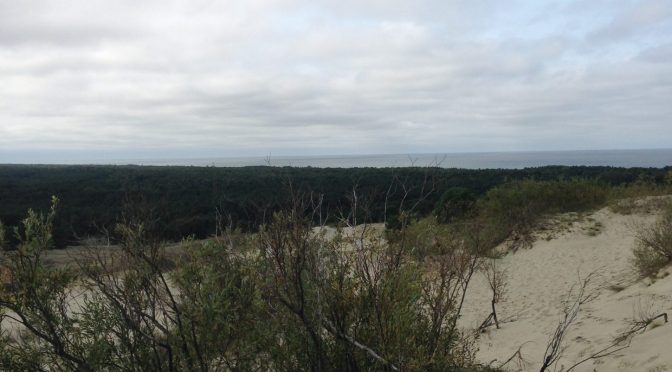
Vilnius airport is rather close to the actual centre of Europe, they say, although from my point of view its is rather far in the east, which relates to the fact that it is the eastern border of the European Union, which is of course something else than the geographical “continent”. I tend to forget that Russia has a large European part, in the same way as people living further south in Europe tend to forget the actual extent of the territories of the nordic countries. On the north-south axis the centre of Europe is somewhere in southern Sweden (Karlskrona). This is my first trip to Lithuania, and only this morning did I realize that I can use euros here. The reason for my trip is a short residency at Nida Art Colony at the coast, in what used to be called Courland, on the narrow strip of land crossing over the bay, the Curonian Spit, actually rather near to the Russian border and Kaliningrad. It sounds exotic and exciting. My first stop, Vilnius Airport, was fairly ordinary. Some form of pastry filled with chicken (yes?!) tasted rather Russian, but perhaps it is one of my prejudices, too. Or a situation resembling the weird similarity of greek coffee and turkish coffee, despite all the differences. And now the shuttle bus is moving, heading towards Kaunas first, and then the next stop, Klaipeda!
Well, actually I am sitting in Smilthyne now. Klaipeda passed quickly, because there was a cab with my name on a paper in the window right where the shuttle bus parked, so I just transferred my bag from one car to the next. A silent oldish and rather fat man drove me to the harbour and charged 4 euro for it, which is decent, I suppose. And the ferry ticket, which I managed to purchase, despite placing one euro in the wrong place first, where it got stuck, but anyway, granted me access to the ferry which was to leave in five minutes. I remember from the travel plan that I was to take the ferry at six, and the bus at ten past six, but it felt stupid not to go on the ferry, since the opposite shore looked so much nicer. Well, it looked nicer, but everything was closed, because it is off-season, of course. So I started following the signs, walking along the shore, after finding the bus stop and confirming the time-table. And after dragging my bag for a while along the flat shore – everything seems rather flat around here – I found this harbour cafe that is open, with a few clients, and enjoyed a bruschetta with gorgonzola, fig jam and a slice of pear with my tea. Not bad. I can imagine this as a real tourist paradise in summer months. They say it has been popular especially with germans since the beginning of last century. Anyway: Next stop Nida!

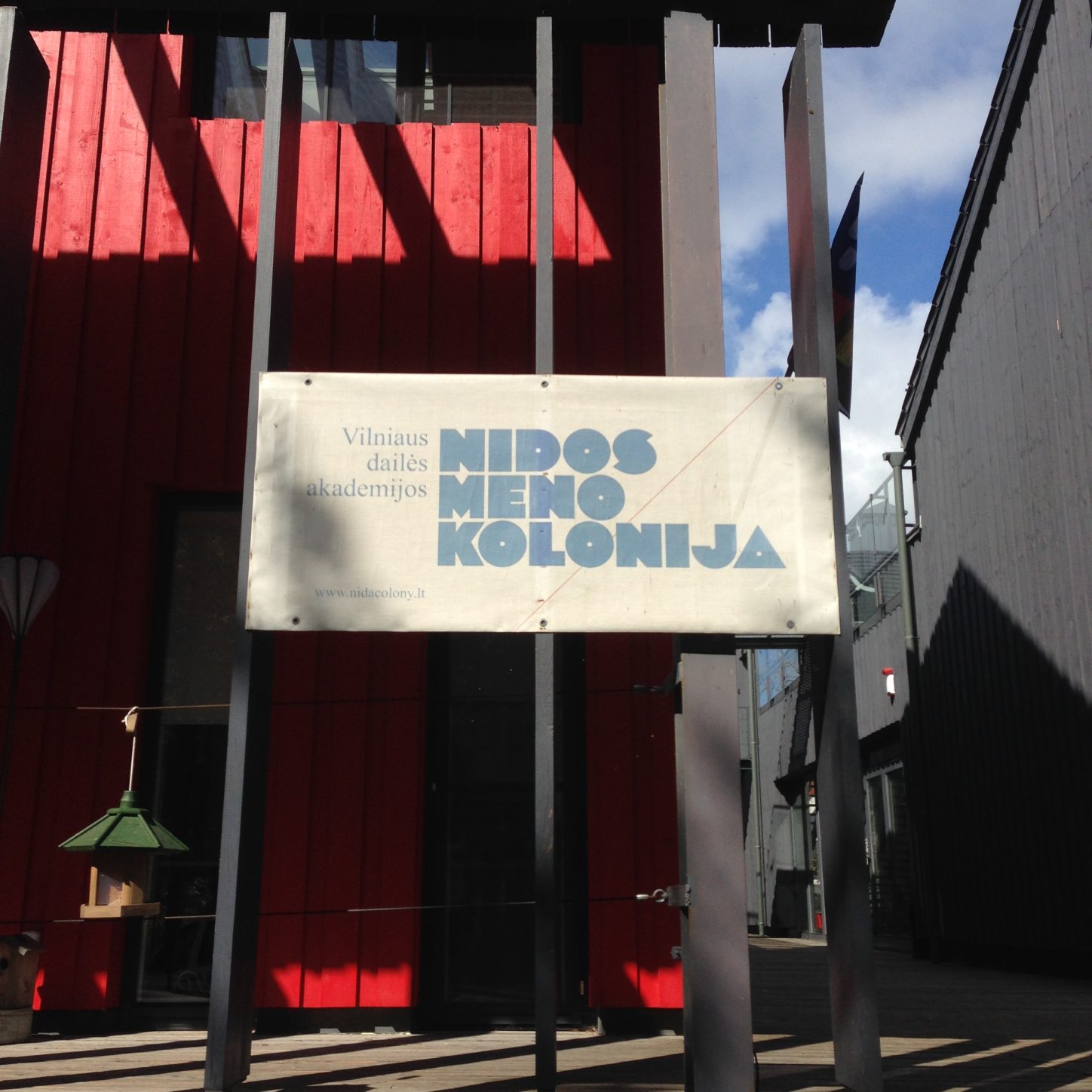
And yes, Nida really looks like a place with more than hundred years of experience in tourism – picturesque, clean, cosy and peaceful but a little lively too, in the right corners. A friendly guy, the manager, was there to meet me for the bus, suggested we go shopping first, because he had a car and the walk to the colony is about 20 minutes. After packing up, organising my stuff, making the bed and so on and so on, and after I put my feet up for a moment, I was ready for a walk down to the local pub or bar, and found the first one next to the market. The walk down the slope is no problem, but the way up with heavy grocery bags can be something else, of course. Despite my legs still hurting, I am a walker, so I look forward to some nice evening walks…
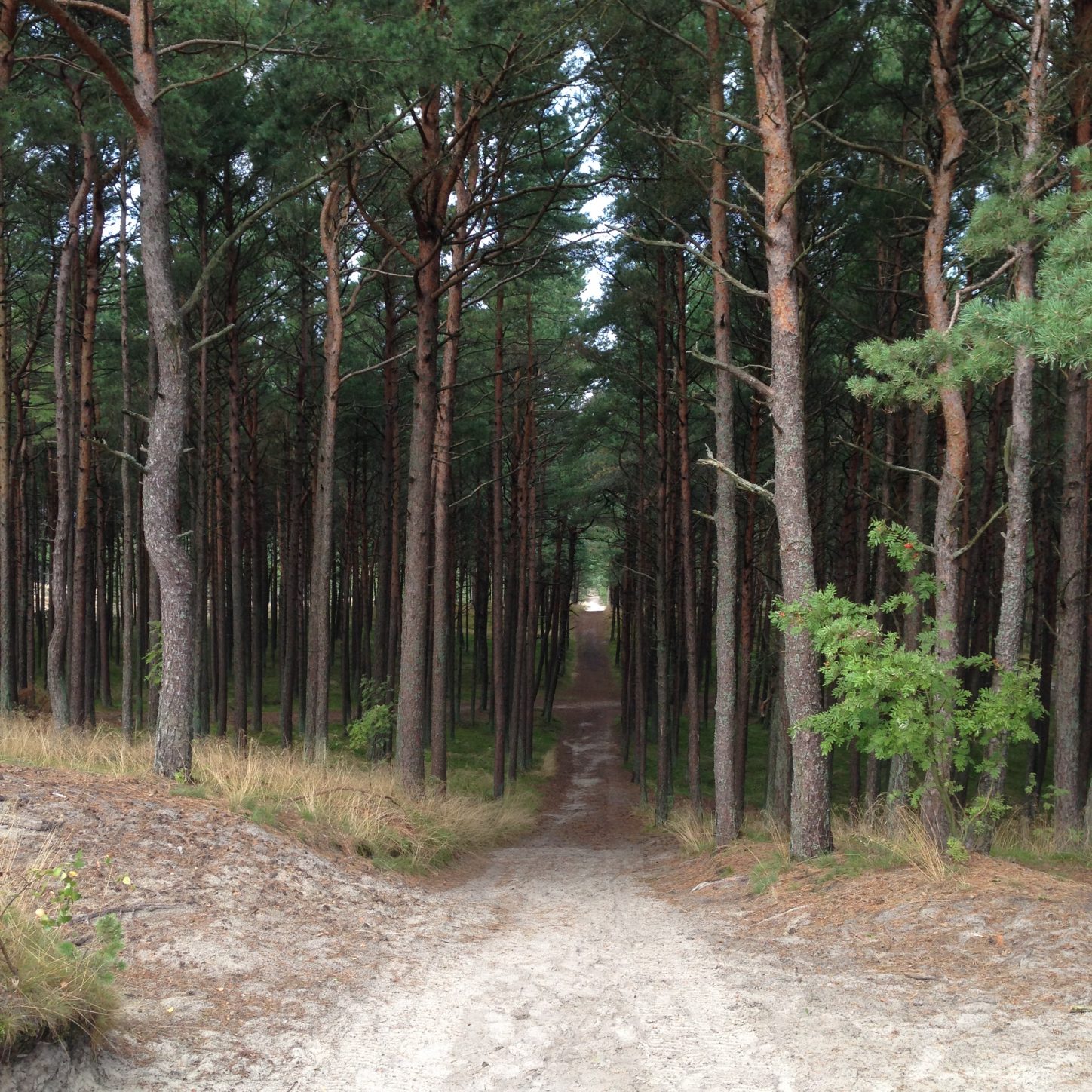
After spending two days in Nida, meeting the other artists-in-residence, enjoying a meal and sauna together, I have been walking in the forest, among the dunes, between the sea and the lagoon, looking for special trees. But they are all beautiful and fairly similar. So far I have not been able to see the trees for the forest. Fortunately there is still time….
All posts by Annette Arlander

Sense it – don’t tell it
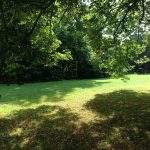
The most stressful moments are the most calm sometimes… I am sitting in an apartment in Odense, Denmark, listening to the quiet sound of the refrigerator and the regular ticking of the clock by the entrance, waiting for my poor little computer to render a video, or not even render it but export it non-rendered. There is 1 hour and 50 minutes of export time left and the participatory performance is supposed to start in an hour in a park at the other end of town. I have all equipment here with me, and it is too far to walk there and make everything ready and then come and fetch the computer. And I do not even have a car… and, and. Luckily Danish people are fairly relaxed, but they also like their comforts, so I guess nobody wants to stay up one or two hours extra simply for the joy of swinging with an image projected on a tree. Well, well.
The first part of the performance went well, the sun was shining, the swing was nice and well placed, and quite a few people were interested in swinging and seemed to enjoy it. That is one reason why I am late, the video is more than 30 minutes long. And I have not even had the chance to see it yet. Wow. I thought of walking across town with the computer open on my arm, in order to be able to prepare the projector and the rest while the program is exporting the material, but then I am afraid that the electricity there will not work, or that the power runs out in the middle of the walk or whatever. So I just have to wait patiently…


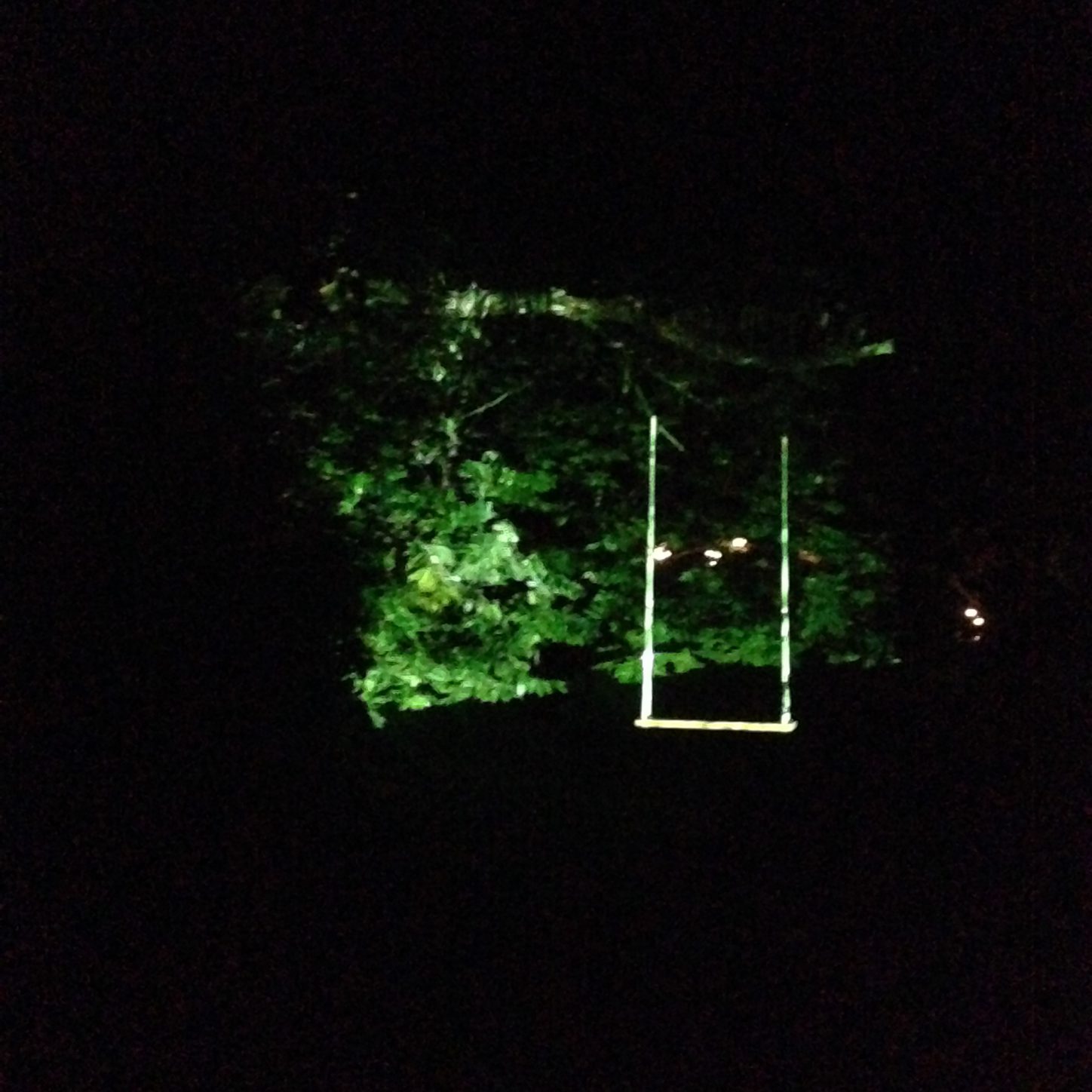
I got a ride to the park and there were other things happening so people did not have to wait too long, and everybody was very helpful giving light with their phones as torches – what an idiot I was not to take my headlamp with me, it would have made life easier in the darkness. But then again, the darkness was good for the projection. No time to experiment or try out things, I just dragged the cable to a spot left of the swing and placed the tripod with the camera in line with the swing, at least somewhere in the vicinity where it had been during daytime. I had nothing to put the projector on, except its own bag, and the same with the computer. Miraculously everything found the right place, somehow, and the swinging movement was visible on the foliage and the swing was hit by the light of the projector sufficiently to be distinguished and so on. Some people were trying out the swing and I would have liked to run through the whole half hour film, but people were tired. I suggested that I could just stay in the park, because I would have liked to film the whole thing on the foliage, perhaps swinging there myself. But the electricity cables could not be left there, and they wanted to pack them away, so I had to stop it before it even really began. Well, people liked the image, and I have a few moments on video, although not much is visible in the darkness. And the photos are completely dark, really. So not much remains to show of this afterwards, but it was an experience and for me a learning experience for sure…
Because I was editing the video all day I missed the rest of the program of the first day of the seminar “Sense it … don’t tell it” in Odense 1-2. September, organised by Nordic Performance Art – reaching a new audience, an organisation that specialises in new music theatre, despite its name. The second day I joined in and had my talk amongst the other presentations and exercises. It was very interesting and fun although more about relational aesthetics or what seemed like participatory strategies in working with theatre and performance than about the environment, so in some sense I was quite out of place. Hopefully my small contribution about process and performance – based on the text for the coming book edited by Emma Meehan and Hetty Blades – was at least somewhat relevant to some of the participants, who seemed to represent a broad scope of practices from children’s theatre to dance, from music theatre to socially engaged art practices and more. And as you could expect in contexts linked to theatre it was all about doing, improvising, moving together, and of course sharing emotional exercises, which was engaging, but exhausting, too.
Back in town and busy
Only two visits to the trees in Helsinki this week, on Tuesday and Wednesday morning. My plan was to include Thursday, too, but I chose to go to CARPA 5 – colloquium on artistic research in performings arts, where I have a small installation running nonstop for the duration of the event. One reason was the rainy weather, I have to admit. And I had to make preparations for a trip to Odense in Denmark, where I am participating in an event organised by Nordic Performance Art, facilitating a participatory performance with swinging and also speaking at the seminar. So my thoughts were everywhere else except wih the trees. On Tuesday I was preparing for a busy day, but the weather was calm. On Wednesday the wind was strong, but the direction was such that the camera on the tripod was not under direct attack. The only incident I remember was an alder leaf falling gently down on my head while sitting on the stub, a surprise and a strange feeling, a sign of autumn.
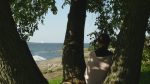

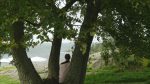
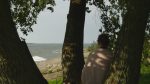
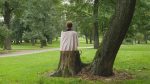
It seems like everything is happening at the same time this weekend. Besides Carpa 5 there is the Art in the Environment Nordic symposium 2017 in Vartiosaari. I managed to see the end of one performance by Anna Rubio at HIAP in Suomenlinna, which is part of the symposium, that is all. Then there is the event I am performing at in Odense, organised by Nordic Performance Art (a slightly misleading name, I guess). Moreover, one of my videos is shown as part of a screening curated by Leena Kela at an event called Meetings – Video and performance art festival in Mid- and western Jutland in Denmark on the same day. And then there is probably many other interesting things going on, but as one cannot be everywhere at once, one has to trust that anywhere is the right place for that moment…
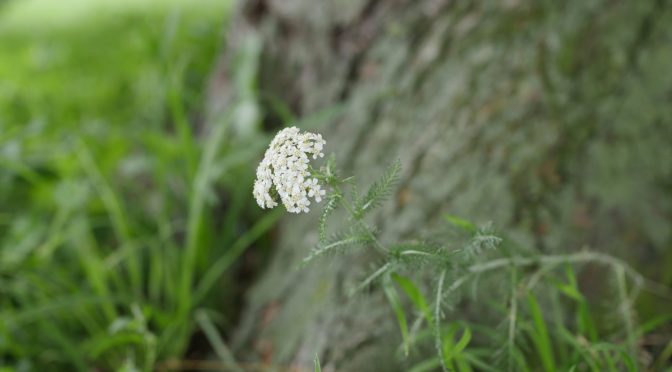
Aavistus syksyä
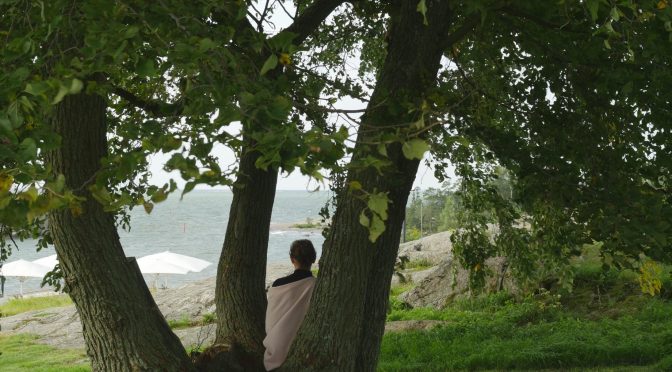
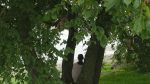
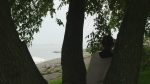
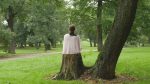
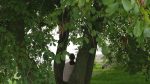
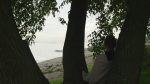
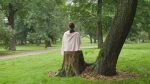
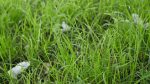
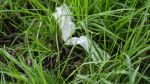
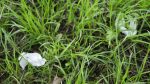
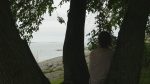
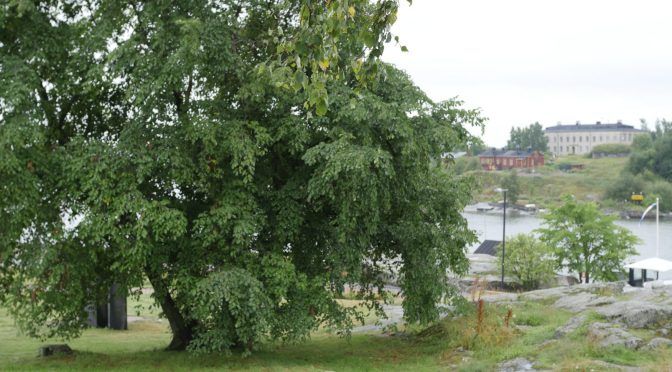
Vaikka elokuu on vielä täydessä käynnissä ilmassa on jo aavistus syksyä: pensaissa on marjoja eikä kukkia, benjihyppääjät ovat kadonneet Kaivopuiston rannasta, vain pietaryrtit ja siankärsämöt (kuvassa yllä) jaksavat vielä kukkia. Kävin istumassa lepän kannolla ja jalavien juurella kahtena aamuna, ja aiemmista rutiineistani poiketen juuri tässä järjestyksessä. Sää oli harmaa, sadetta enteilevä, mutta meri oli melko tyyni – horisonttiviivaa oli vaikea erottaa usvaisesta harmaudesta. Maanantaina huomasin hämmennyksekseni, että joku oli käyttänyt puiden tarjoamaa suojaa vessanaan, ainakin paperinriekaleista päätellen (katso kuvat alla). Onneksi muita jätöksiä ei näkynyt, eikä kärpäsiäkään ollut pyörimässä ympärillä, mutta tuntui silti erilaiselta istua siinä vieressä. Hm.
Olen yhä tietoisemoi ajan kulumisesta. Kohta on jo syyskuu, ja vierailuni tulevat harvenemaan, sillä olen periaatteessa koko syyskuun Liettuassa residenssissä. Jottei kuvasarjani katkeaisi kokonaan, ja muistakin syistä, tulen käymään Helsingissä kuun puolivälin paikkeilla, mutta se on vain pikakäynti, joten tuskin ehdin vierailemaan puiden luona kuin ehkä kerran. Paljon elokuuta on kuitenkin vielä edessä.
Huomenna, keskiviikkona alkaa Turussa taiteen ja tieteen välinen tapahtuma Aboagora, jonne minäkin olen menossa puhumaan paneelissa, jonka nimi on “Liminal Stages: Artistic Research and Art With(in) Research”. Tuore kuvataiteen tohtori Markus Rissanen ja matemaatikko Vadim Kulikov keskustelevat, performanssitaiteilija ja tohtoriopiskelija Leena Kela kertoo projektistaan, ja ilmeisesti hänen ehdoksestaan minäkin olen mukana. Tarkoitukseni on puhua otsikolla “artistic research and/ as interdisciplinarity” ja hyödyntää artikkelia, jonka kirjoitin vuosi sitten pieneen julkaisuun Portugalissa. Tapahtuman ohjelmassa on monenlaista esitelmää ja alustusta, konsertteja ja vaikka mitä (katso ohjelma), ja on oikeastaan sääli etten voi osallistua kuin ensimmäiseen päivään…
August – Month of the Hazel
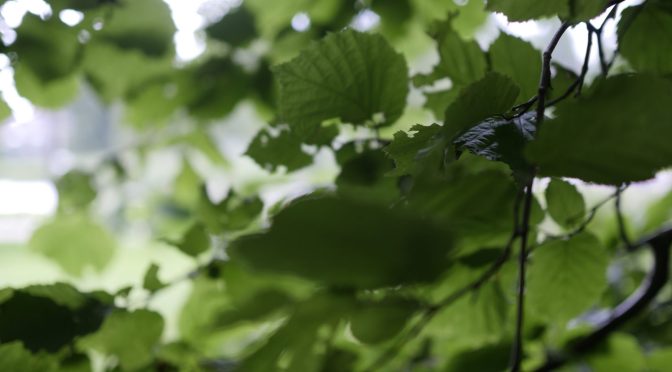
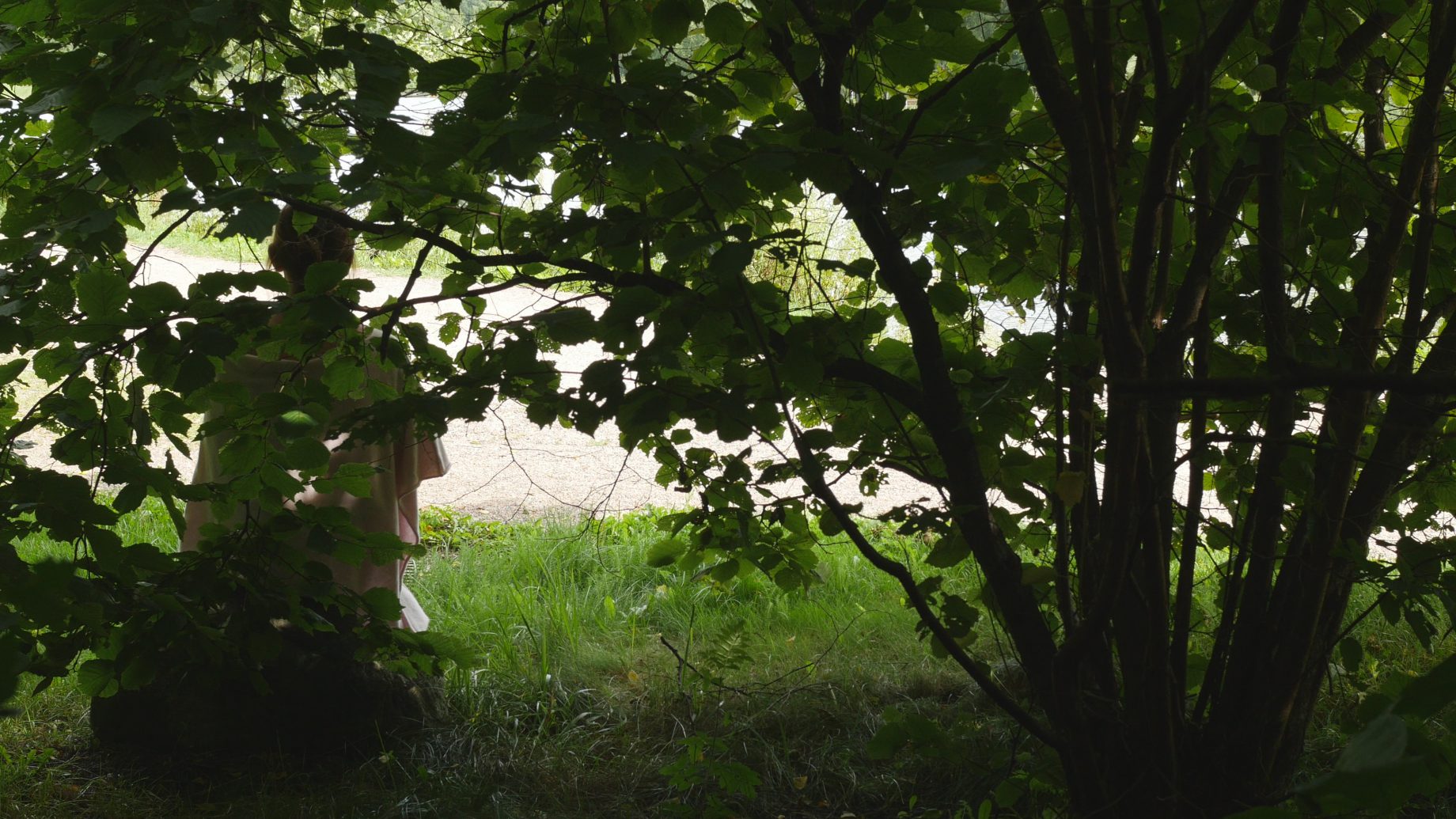
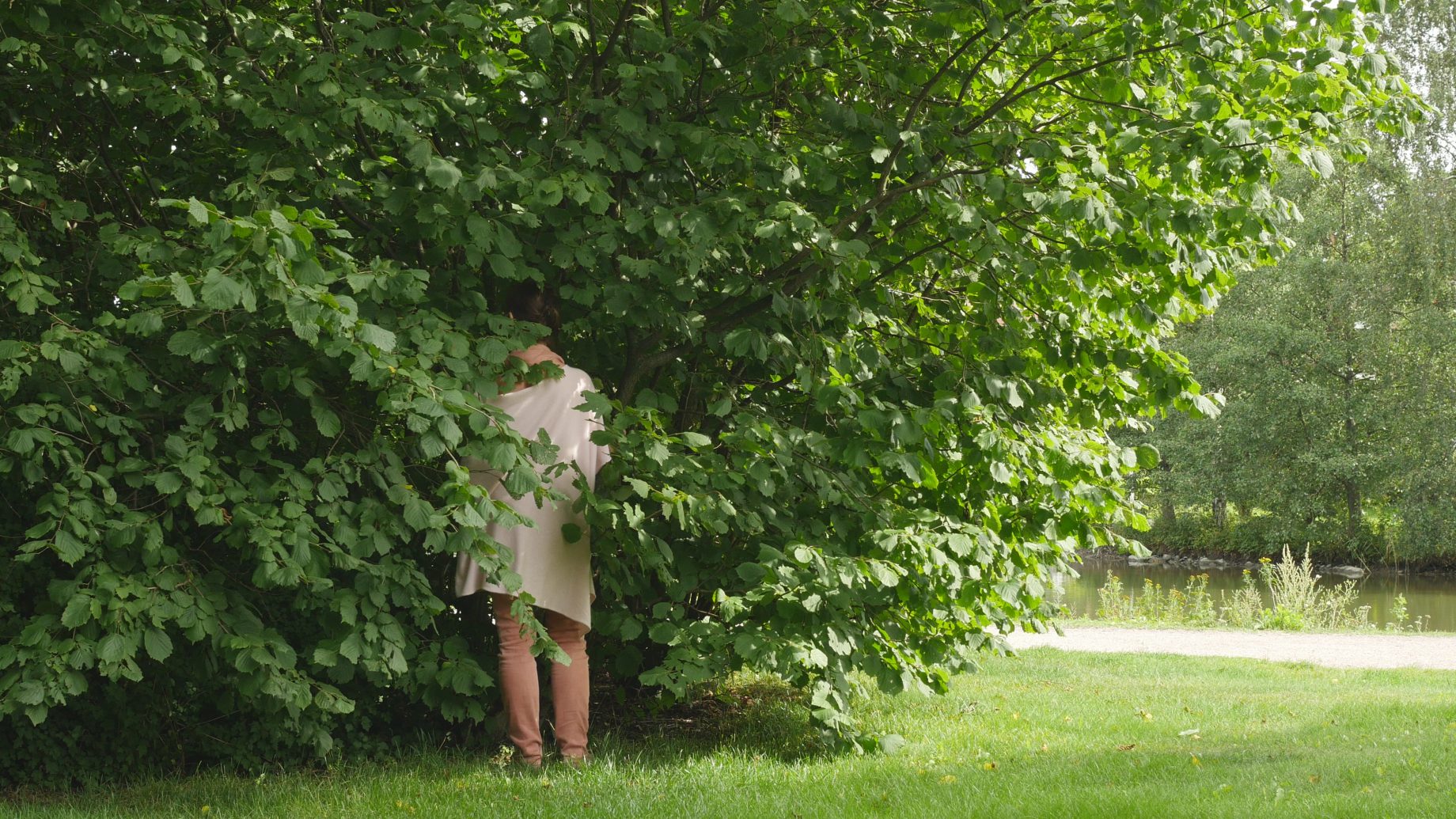
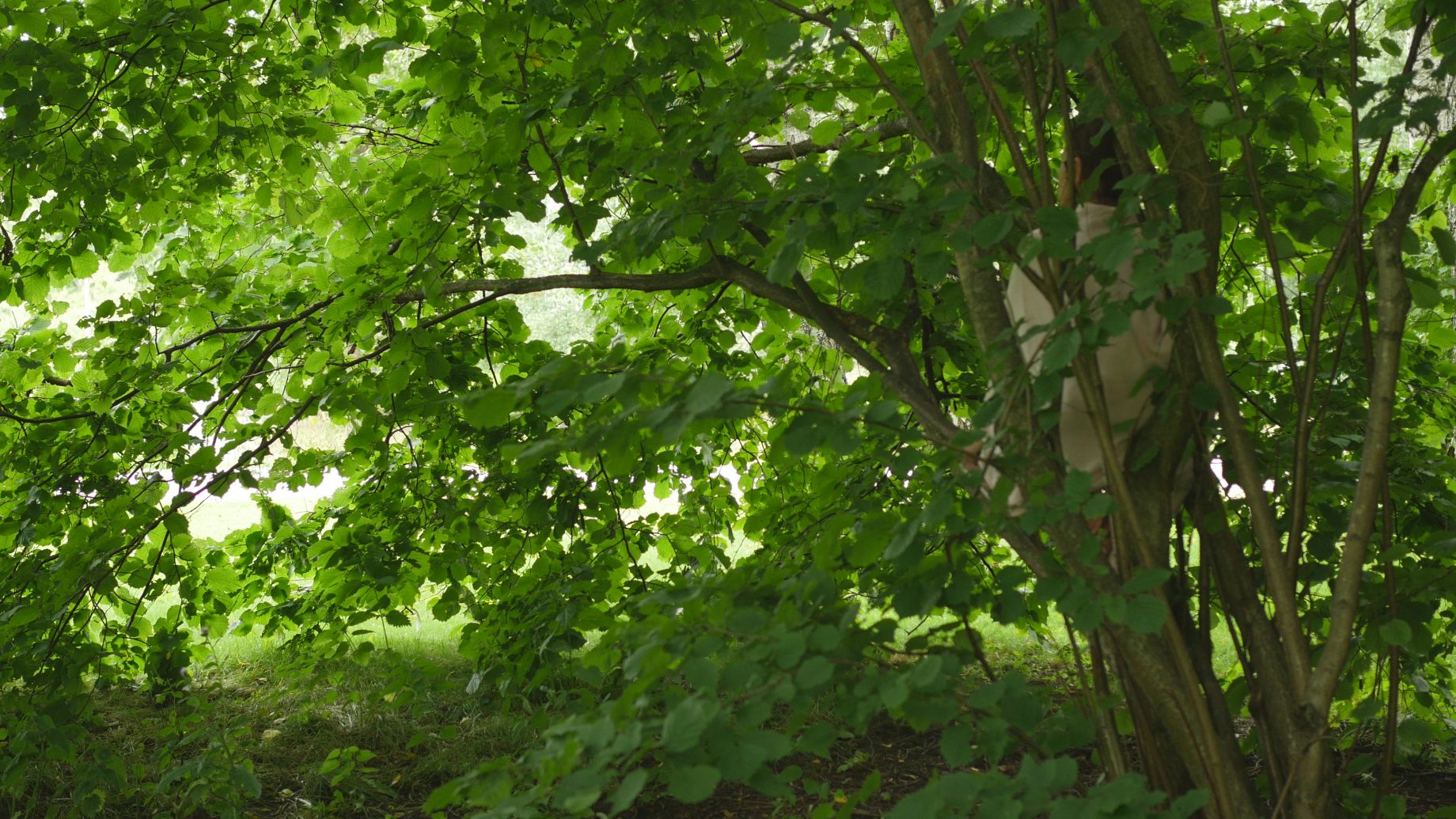
For once it was easy to find the tree of the month for my tree calendar – based on the ancient celtic tree calendar – namely the hazel, whose month (according to one version of the calendar) is from 5 August to 1 September. I found a nice group of hazels growing next to the path following the shore near Herttoniemi Manor from a map on the internet that listed fruit trees and bushes with berries in Helsinki. These hazels did not have any nuts, though, or hardly any traces of them, really. But they looked thriving and there was no doubt they were representatives of the common hazel, Corylus Avellana. I walked among them and tried to find a suitable framing for the image, including some water but not the houses. At first I sat on a rock next to one of the hazels near the path, and placed my camera in the middle of the bushes. Then I tried to find animate with more space and placed the camera on the lawn, standing in or amongst the branches holding on to one of the thicker stems. In Finnish there is a satin “kolmas kerta toden sanoo”, meaning something like “the third time is the real one”. And that proved correct this time. For the third image I found a bush with several stems bowed in a way that I could venture to sit on them, actually sitting in the small tree, and that version seemed like the nicest one, despite the darkening of the sky towards the end. Only when I left the park and walked back towards the metro station, returning to the city centre, did the rain start.
The material is now edited into three videos, Hazel in August 1 (10 min. 40 sec.), Hazel in August 2 (10 min. 10 sec.) and Hazel in August 3 (9 min. 35 sec.) and I still think the third version is the “real” one.
Home Again after Documenta 14
After spending a few days in Kassel, Germany, experiencing Documenta 14, it was a pleasure to return to the trees in Helsinki for three mornings in a row. Two of them sunny and bright and the third, this morning, a grey day with drizzle. Not that visiting Documenta would not have been a pleasure, but it was exhausting, too, especially on Saturday, when everybody seemed to have decided to go there and the queues were long. The amount of people everywhere felt unfamiliar to somebody living in Finland, where we tend to look for crowds to get close to each other for a moment, for festivals and the like, and then quickly retreat to a safe distance afterwards, with plenty of emptiness around, if possible. Not many people passed by in the park these mornings; a group of small children from the nearby Kindergarten.
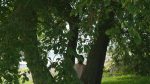
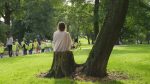

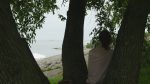
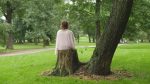
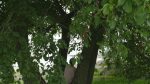
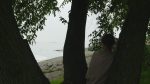

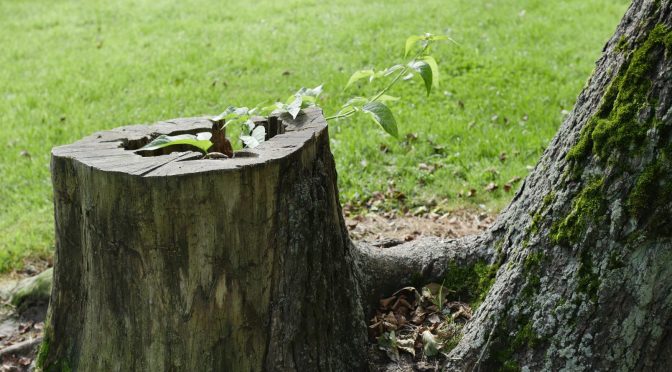
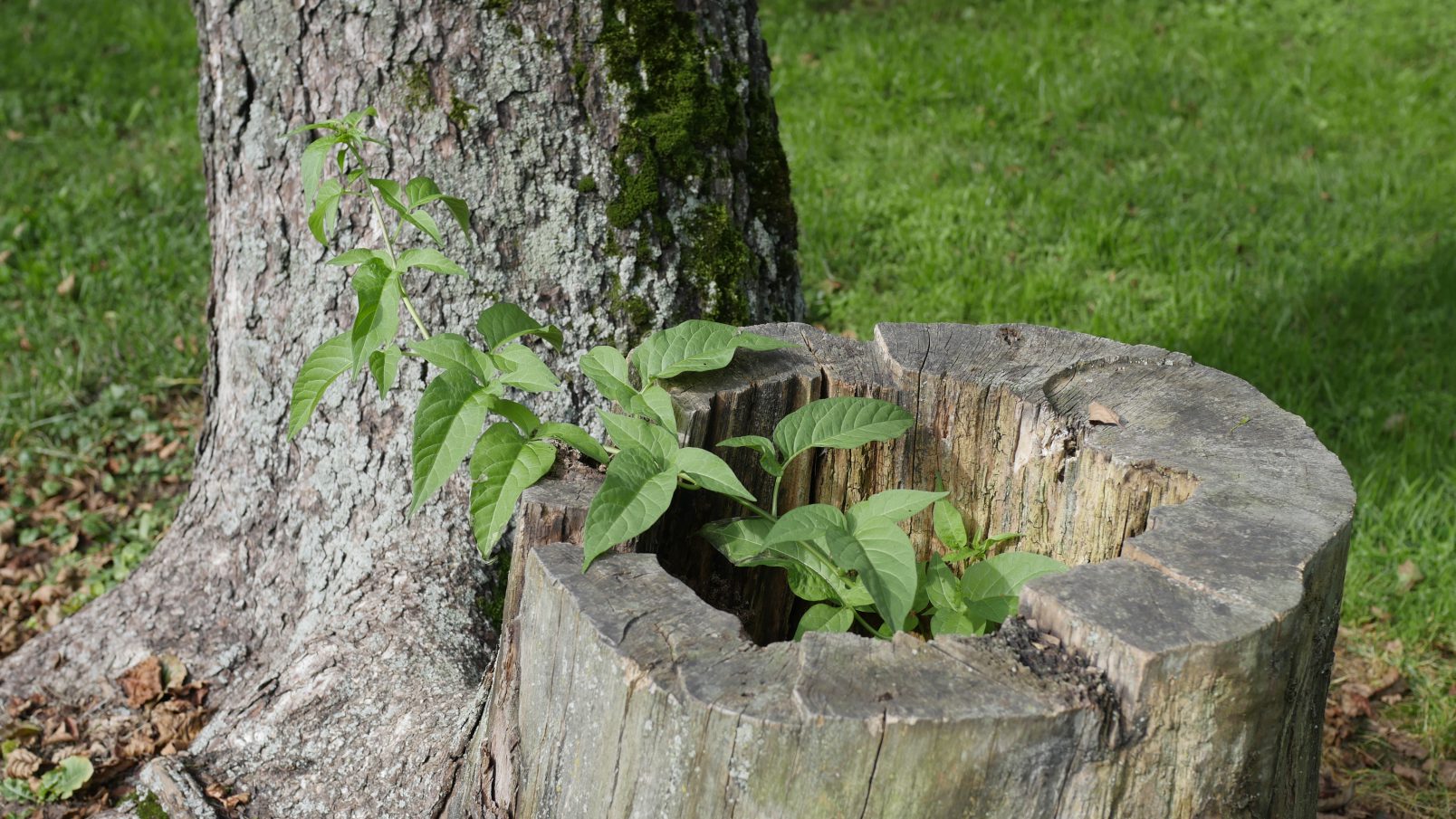
The plant growing from the hollow stub of the alder has gained in vigour and is now reaching far beyond its cosy base (see image above, and below).
But what about Documenta and plants? There were Beuys’ Oaks, of course, and in the current exhibition in Kassel, in Documenta Halle, Aboubakar Fofana from Mali had assembled plenty of living indigo plants as part of his work Fundi (Uprising). There might have been others, I could not see everything, in the overabundance of art works, but it seemed otherwise plants were present mainly as materials, or as representations.
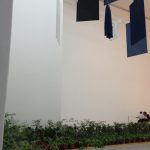
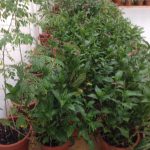
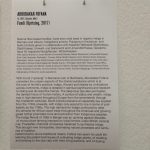
There were three different plants that had been used to produce traditional indigo dye, Indigofera arrecta, Polygonum Tinctorium or Japanese indigo and Isatis Tinctoria or woad, which all contain indigotin and where a source of wealth and misery in colonial times, before synthetic methods for dyeing were developed. I remember reading a beautifully written ethnographic study about indigo, I suppose it was Indigo: the Indelible Colour That Ruled the World by Catherine McKinley, but I am no longer sure. And as a child I read a strange novel from the thirties or forties, called Aniliini in Finnish, which described the background to the chemical inventions related to textile colours, which has stayed in my mind more as vague atmosphere than any story as such. These thoughts never occurred to me while strolling in Kassel, I did not even think the art work in question was so special. But now, in retrospect, I am fascinated by the world it opens up. And similarly, various worlds could be entered via each and ever art work, uh! It is just too much…

Friska vindar och nästan stiltje
Söndag morgon i Brunnsparken, lugnt och stilla, förvånansvärt lite skräp, uppehållsväder med gråa moln vid horisonten men häftiga vindbyar. När jag sitter under almarna uppe på backen ser jag på de vita vågkammarna på det skummande havet och på strand-caféts fågelskrämma som virvlar vilt i vinden. Och samtidigt är jag orolig över kameran; kommer den att stå sig mot vindstötarna, trots att jag inte lade någon extra vikt för att balansera den. När jag återvänder efter den andra bilden ser jag förklaringen till det lilla ljudet jag hörde, som kändes nästan som inbillning: det var mikrofonen som ramlat av från sin ställning ovanpå kameran, och blivit hängande i sladden. Undrade ifall den fortsatte att banda och hur själva ramlandet eventuellt låter… Jag kollade med samma, och kameran skakar på bilden när mikrofonen faller, men fortsätter att fungera, och mikrofonen bandar också, men ett mer dämpat ljud, och så hörs det knaster då mikrofonen rör vid stativet eller liknande. Men själva bilden var det inget fel på, efter skakningen.
Måndag morgonen hade vädret förändrats, jämnt grått men nästan stiltje. Jag besökte alen först och fortsatte sedan upp på berget, och insåg att det inte var helt stilla på havet. Det var svalare, så jag började nysa där jag satt, och det ville jag inte ha med på bild, så jag gjorde om den andra seansen. Varför censurerar jag bort naturliga företeelser som at nysa? För att det blir för specifikt och personligt då. Ifall jag sitter som en figur, är jag en människa i allmänhet, just en figur, men om jag rör på mig och nyser och har mig, blir det jag, en särskild person. Hm. – Jag tvekade vilken bild jag skulle använda som vinjett bild, och insåg att jag aldrig sett efter hur almen eller almarna – för det är ju en grupp, trots att de växer ur samma rot – ser ut från det motsatta hållet, från havsssidan. Så det är den bilden som får fungera som vinjett, här ovan.
Orsaken till att jag besökte träden så här i början av veckan är, att jag kommer att vara på resa resten av veckan, först i Stockholm, för att besöka träden där, och sedan i Kassel, för att besöka Documenta. Det ser jag fram emot med stor förväntan, faktiskt. Men mer om det i framtida anteckningar…



Sateen jälkeen
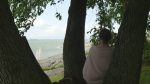
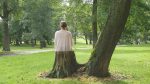
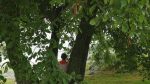
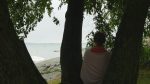
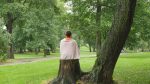
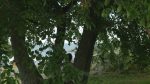
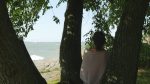
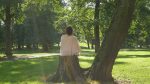
Ja myös ennen sadetta! Sateen jälkeen kirjoitin otsikoksi keskiviikkona, kun lähdin puiden luokse heti sateen lakattua. Ja Eilen torstaina olikin jo aurinkoista. Tarkoitukseni oli vierailla puiden luona vielä tänään perjantaina, mutta sade yllätti ja jatkui niin rankkana, että käännyin takaisin ja jätin kolmannen vierailun sikseen. Olin toki pukeutunut kunnon sadevaatteisiin, mutta kameralle minulla ei ollut sopivaa suojusta, ja ajatus pakottaa itsensä istumaan rankkasateessa periaatteen vuoksi ei tuntunut järkevältä. Tätä kirjoittaessa istun Harakan saaren vanhassa lennättimessä näyttely-vahtina, ja sade vain yltyy. Alkuviikon aurinkoisten päivien jälkeen jatkuva sade tuntuu erityisen ankealta. Toki useimpina päivinä on satanut pieniä kuuroja, mutta ne vain virkistävät kasvillisuutta. Tällainen pitkä jatkuva sade tuntuu erilaiselta. – On turha odotella näyttelyyn kävijöitä, tuskin kukaan keksii lähteä retkelle tällaisella säällä. Pienet sadekuurot sen sijaan toimivat hyvin sisään heittäjinä, sillä näyttelyssä on ainakin katto pään päällä. Ja puut varmasti pitävät vedestä, siitä ei ole epäilystäkään. Kaivopuiston puut joiden luona vierailen viikoittain saavat kyllä varmaankin vettä maastosta, mutta Harakan kallioilla kasvit ja pienet puut ovat helisemässä, ellei sade täydennä lätäköitä säännöllisesti. Mutta vähempikin riittäisi! Tältä viikolta minulla on siis vain kaksi vierailua, joista ensimmäinen poikkeaa aiemmista sikäli, että jatkoin matkaani suoraan Harakkaan, enkä siksi ollut pukenut ylleni tavanomaista mustaa “esiintymis-asuani” vaan oranssinpunaisen puseron, jonka kaulus erottuu kirkkaana väriläiskänä kuvissa. Torstaina väri oli hillitympi, mutta poikkesi sekin tutusta mustasta. Kuvittelin, ettei vaalean punertavan huivin alta näkyisi mitä minulla on ylläni, mutta kaula-aukko näkyy liiankin hyvin. Pitäisihän minun tietää, että kun kuvan perusrakenne ja pääasialliset elementit pysyvät samana kuvasta toiseen, pienikin muutos erottuu, ja pistää silmään erityisenä tapahtumana. Eli tällä kertaa tapahtuma olikin sitten oranssinpunainen puseroni!
July – Month of the Holly
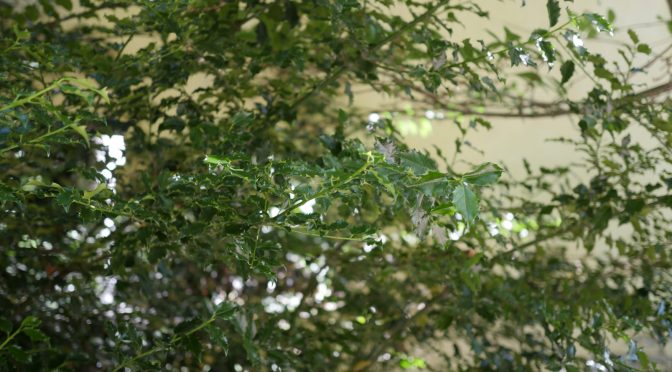
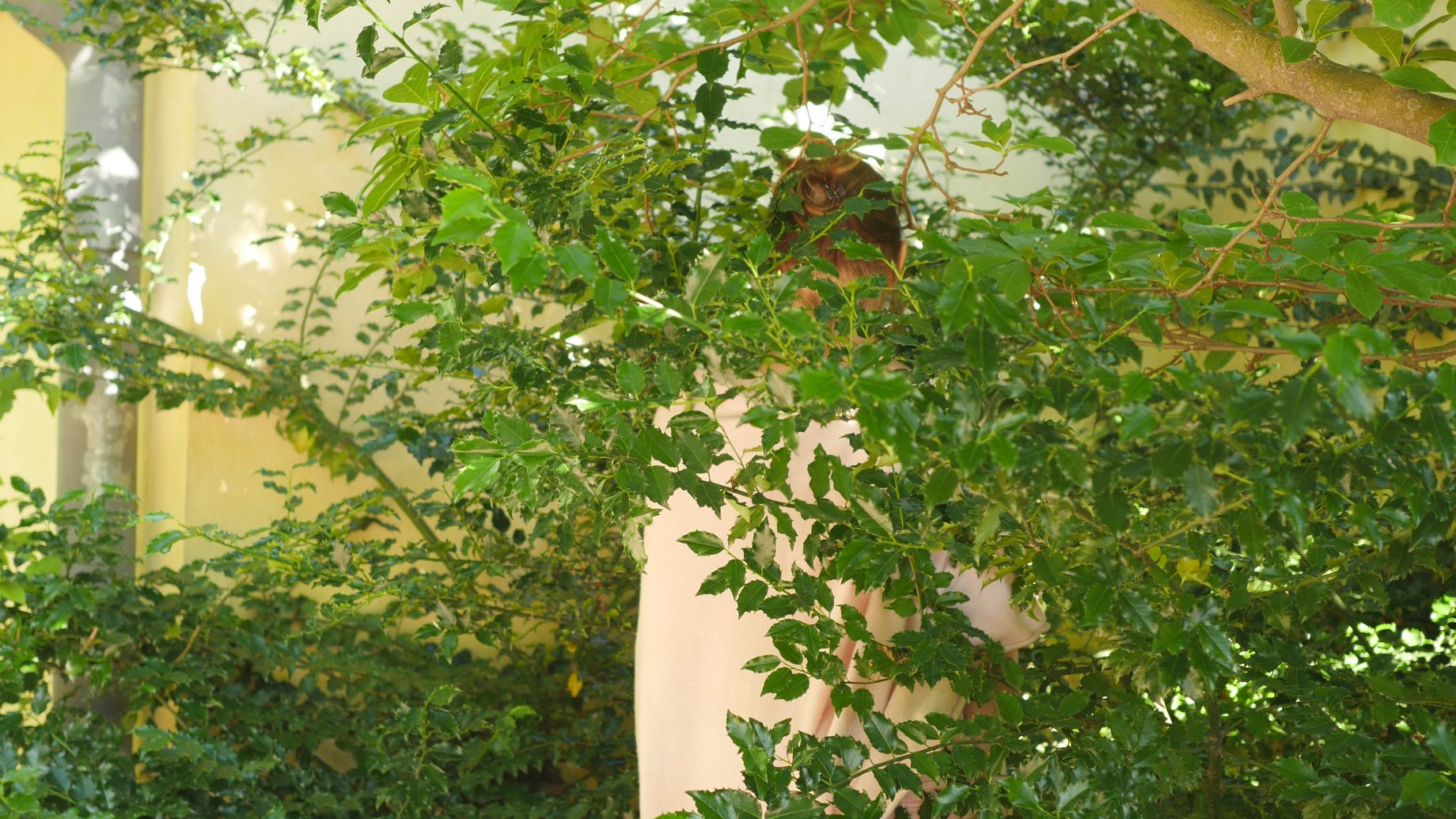
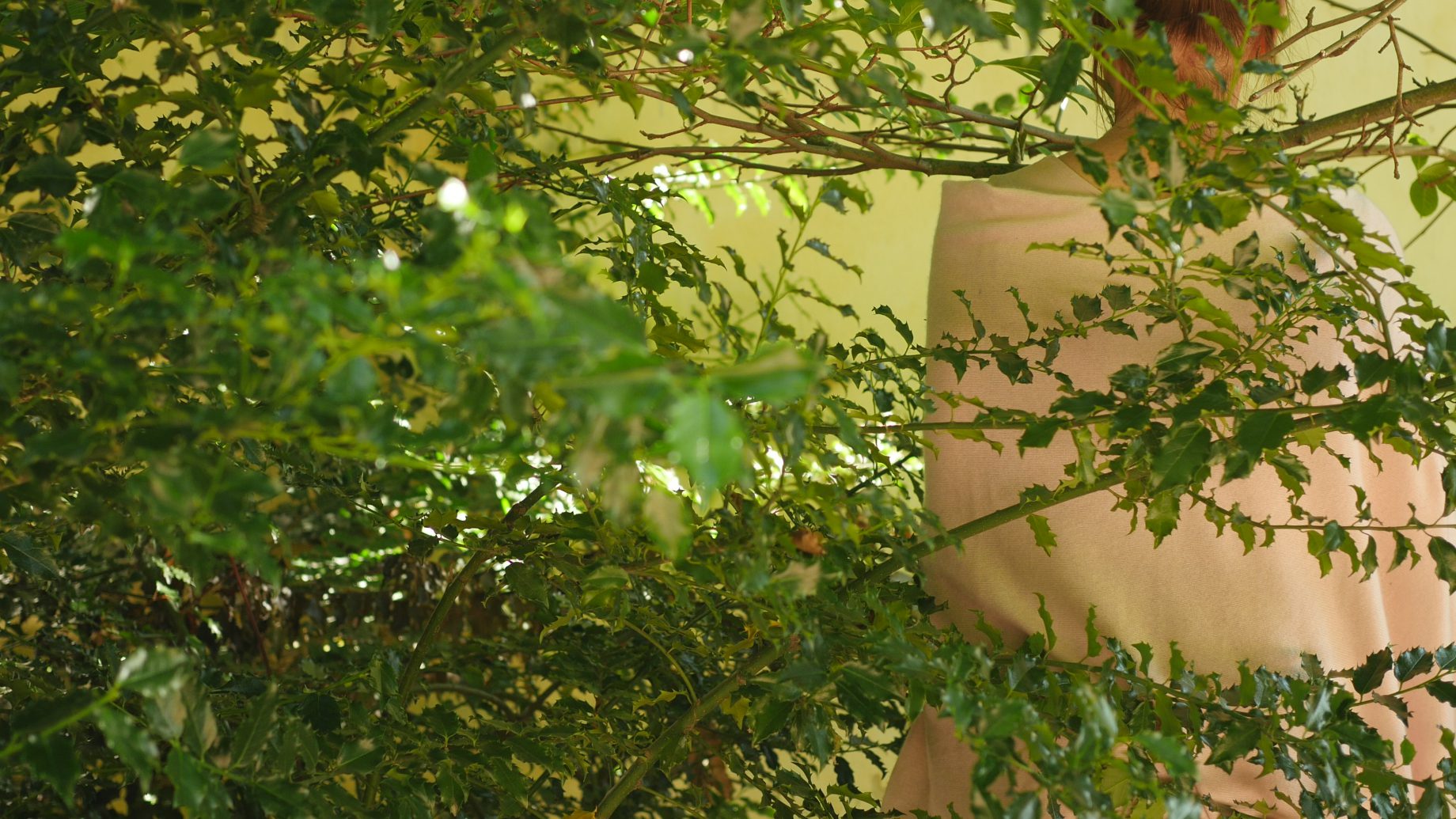
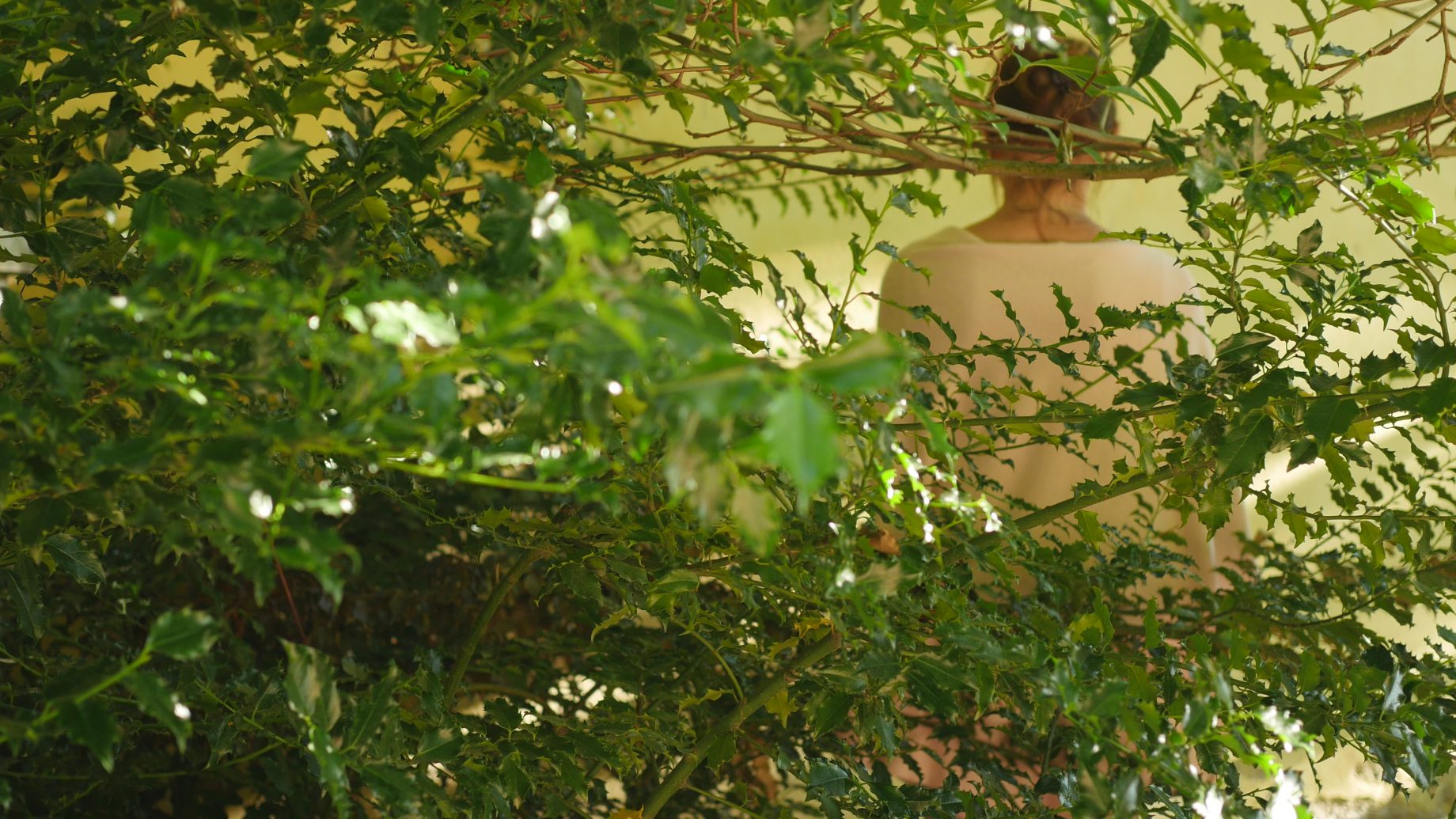
Finding a holly (Ilex aquifolium) in Helsinki is no easy matter, but there are some hollies here, although they have trouble surviving the winter and need a protected spot to grow in. Hybrids between the usual holly, which grows as far up north as Denmark, and another relative (Ilex rugosa) have been created to survive here (Ilex x meserveae), although their leaves are not as sharp, they say. The holly is the tree (or shrub) for the 9nth lunar month in the Celtic Tree Calendar from July 8 to August 4, and one of the most difficult ones from a Finnish perspective. My original idea was to find trees for the tree calendar on the shores of Helsinki, but some compromises are necessary. At the end of the Töölönlahti bay there are some thriving hollies, but they are completely mixed with other shrubs and growing in a narrow area between the footpath and the main road, thus difficult to perform with. The holly that I decided to begin with I found in the Kajsaniemi Botanical Garden, growing in a corner next to some Magnolias. At first I thought it completely impossible to do anything with the hollies there, since they were cramped in a corner, against a wall and he area was so limited, but then that proved an asset. Instead of sitting on the ground next to them, as I planned at first, I framed the image so that the signs describing their names remade out of sight below the frame and stepped “inside” the shrub, standing amongst the branches. I made three attempts, and in the last one I am actually standing next to the wall, behind the holly, as it were. I tried to stand immobile for approximately ten minutes each time, and it was relatively easy, except in the first image when some of the sharp leaves tried to get into my eyes so I had to keep them closed for most of the time. That image is probably the nicest, though, since I am almost completely covered by the leaves. The last image is probably the most beautiful in a conventional sense, because of the sunlight playing on the wall. Anyway, I think I am happy with these first attempts, although they have very little in common with the first images of the calendar, when I tried to find trees by the sea shore. The three sessions resulted in three videos, Holly in July 1, Holly in July 2 (9 min 22 sec.) and Holly in July 3 (10 min 20 sec.). The third one is fascinating, because after a few minutes the camera decided to focus on the leaves in the foreground rather than the human being in the background, probably waiting in vain for the human to continue to move. And when the leaves move in the wind, they then get the attention they deserve.
Holidays as a Gallery Guard
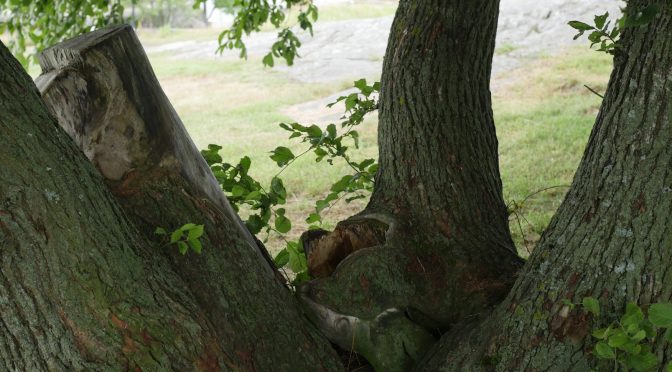
Now that the grass around the elm tree is cut the stubs of the two trunks that accompany the three growing ones are more visible. One of them is completely hollow, and was perhaps cut down because it was rotting from the inside, while the other is cut rather high and looks like it was a quite healthy when cut off. Anyway, they all grow from the same root, so when I say I am sitting in the elm tree I am actually not describing the situation clearly. I am sitting under the elm trees or at the foot of the elm trees or, well? – Most of the time these (holi)days I am actually sitting in the former telegraph on Harakka Island, as a gallery guard of sorts.
Spending time as a gallery guard is a nice form of holiday activity, especially when the gallery or exhibition space is a small wooden house built at the end of the 19th century to serve as a telegraph for the Russian military, and situated on an island with nature preservation areas. And of course it helps if the exhibition you are taking care of is your own. Well, Harakka Island is very close to the centre of Helsinki and I have my studio there in the former Chemical Research Laboratory of the Armed Forces, together with quite a few other artists, so this is actually a working place for me. In summertime, however, the place feels almost like a summer cottage. Perhaps moving down the slope from the big main building to the little wooden house creates the feeling of cottage life. So here I sit and drink tea and chat with the occasional visitors, who are not very many I must confess.
The exhibition is called Cami de Cavalls and shows two works recorded on the horse path with that name on Menorca in July 2015, as well as a small work recorded in Stockholm in 2016, Summer at Söder. For more information about the exhibition, please look at Cami de Cavalls. And because the exhibition is open on from noon to 5 pm, I have plenty of time to visit the trees in the Kaivopuisto Park in the mornings.
 Performing Landscape