
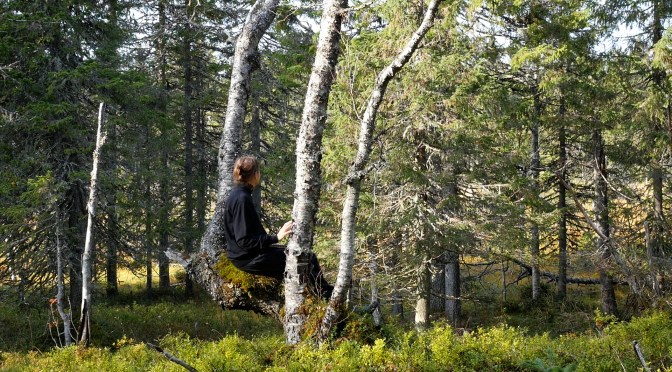
Efter en produktiv september månad i Mustarinda residenset tänkte jag mig, att det var nog, ifall jag fortsatte min lilla performance, min “dagliga björk” med den gamla björken bakom Mustarinda huset. Men den sista dagen beslöt jag mig ändå för att försöka sätta mig och skriva ett brev till en gran som jag lagt märke till tidigare, där den låg på marken vid stigen. Jag tänkte mig att det kunde vara intressant att försöka skriva något på svenska, för jag hade skrivit på finska till en annan gran veckan innan. Men alldeles intill granen såg jag plötsligt en björk som såg inbjudande ut. De flesta träden i den urgamla skogen är antingen raka och höga eller så ligger de på marken, jag har inte sett något träd med grenar att kliva upp på. Och där var nu plötsligt en björk som jag skulle kunna sitta på, jag kunde inte begripa att jag inte märkt den tidigare. Så jag valde att sätta mig hos den och skriva till björken istället, och lät granen vänta. Jag spelade in texten senare och kombinerade den med bilden, men då själva skrivandet tog mer än 20 minuter, blev den upplästa texten bara drygt fem minuter, så versionen med texten blev mycket kortare. Båda versionerna – Dear Birch (20 min 15 sec) och Kära Björk (5 min 50 sek) – finns på Research Catalogue, här. Och här nedan är texten jag skrev framför kameran.
Kära björk,
trevligt att träffas så här, smått överraskande, på stigen. Jag var egentligen på väg att besöka den avlidna granen här intill, när jag plötsligt fick syn på den mjuka gröna mossa som växer på din stam där den förgrenar sig, som en liten bekväm fåtölj, faktiskt. Och solen lyste så inbjudande på den, att jag bestämde mig för att sätta mig ner en stund framför kameran och skriva några ord till dig. Du kanske tycker att det är underligt att jag tilltalar dig på svenska, här mitt i det finska Kajanaland, där nästa språk efter finskan och den lokala dialekten antagligen skulle vara ryska – eller då engelska eller tyska eller tom tjeckiska, som några av gästerna i Mustarinda-huset här intill förmodligen talar, ifall de råkar gå här förbi. Men jag väljer att skriva till dig på svenska, inte så mycket för din skull som för min egen skull, för att se hur det känns. För ärligt talat tror jag inte det spelar någon roll för dig vilket språk jag skriver på. Men det som kanske, eventuellt, och förhoppningsvis har någon betydelse är, ifall jag lyckas artikulera mina tankar med hjälp av att skriva, eller inte. Och än så länge har jag bara pladdrat på för att komma igång. Har jag något att tala om för dig eller något att säga ens mig själv just här, just idag? Det är min sista dag i Mustarinda, min sista dag i den här gamla tysta skogen som jag lärt mig att älska, med sin tjocka mjuka mossa, sina många döda träd liggande om vartannat, och sin friska luft som är så mjuk och härlig att andas. Jag kommer att sakna den här skogen, det vet jag, och jag kommer också att försöka besöka skogar som finns närmare mig, senare. Jag hoppas du njuter av din boplats här, intill stigen, och nära kärret som öppnar sig genast på andra sidan den. Du har faktiskt två målade färgklickar på en av dina stammar, en blå och en grön, för att markera de två stigarna som här är sammanslagna, och som förgrenar sig lite längre bort. Du har levt här en bra stund, antar jag, även om du inte är någon åldring precis. Och det kan hända att du faktiskt är äldre än du ser ut, ifall det varit ont om ljus eller näringsämnen här; eller så kan det ju hända att du inte är så gammal, men ser äldre ut på grund av de kalla vintrarna med tung snö, som skadat många av granarna här. Eftersom du fäller dina löv är det inte lika farligt för dig, antar jag; dina kala grenar samlar inte på så tunga bördor som sedan kunde knäcka dem. Men mossan jag sitter på är en annan slags riskfaktor. Om den samlar väta skapar den röta, så att du faktiskt kan falla i tu med tiden. Det händer ibland åt gamla träd som har en grenklyka eller en fördelad stam. Förlåt att jag låter som en olycksfågel, jag tror du har det bra här och så vitt jag kan se går det ingen nöd på dig. Jag borde tvärtom vara tacksam för mossan du bär på, för trots att den är ganska våt och kall är den mjuk och behaglig att sitta på, som en kudde avsedd för förbipasserande. Ja, jag vet att den inte är avsedd för det, och jag antar att du egentligen hellre skulle bli av med den – fast det vet jag egentligen inte. Kanske ni har något slags samarbete på gång, mossan och du, precis som det berömda samarbetet mellan svampmyceliet och dina rötter. Men nu spekulerar jag om sådant som jag bara läst om, istället för att lita på mina egna sinnen och förnimmelser här och nu. – Det som kanske är det härligaste med den här skogen är tystnaden. Nu när det inte blåser är det verkligen tyst. Inget avlägset motorbrus – någon enstaka gång ett flygplan, men det är väldigt sällan. Och just nu är det så tyst att pennans skrapande mot papperet känns som rätt högljutt. Eftersom det är vindstilla, kommer myggen fram, trots att det är sent på hösten här. Men solen värmer just nu, och dimman dagarna innan, för att inte tala om mängden regn tidigare, har bjudit på perfekta omständigheter åt all slags mygg att ta en extra runda. – Det är så tyst att jag trodde mig höra kameran gå av. Det är oberoende av dags att avsluta det här brevet. Jag beklagar att jag inte egentligen har några tankar att artikulera just nu. Men jag är glad och tacksam att jag fått sitta en stund i din famn, och önskar dig allt gott framöver. Tack!
All posts by Annette Arlander

Uusi kuusi kuitenkin
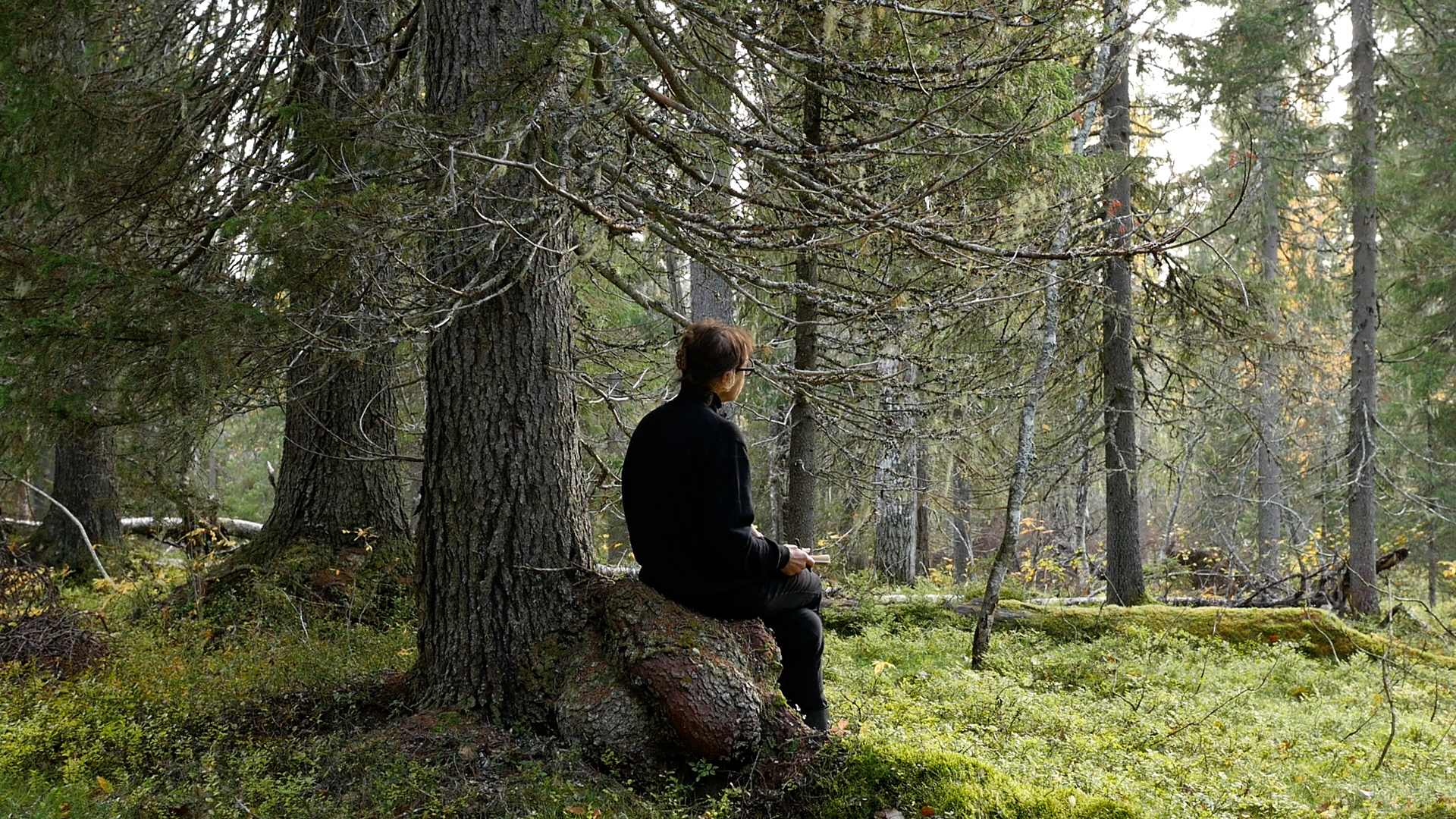
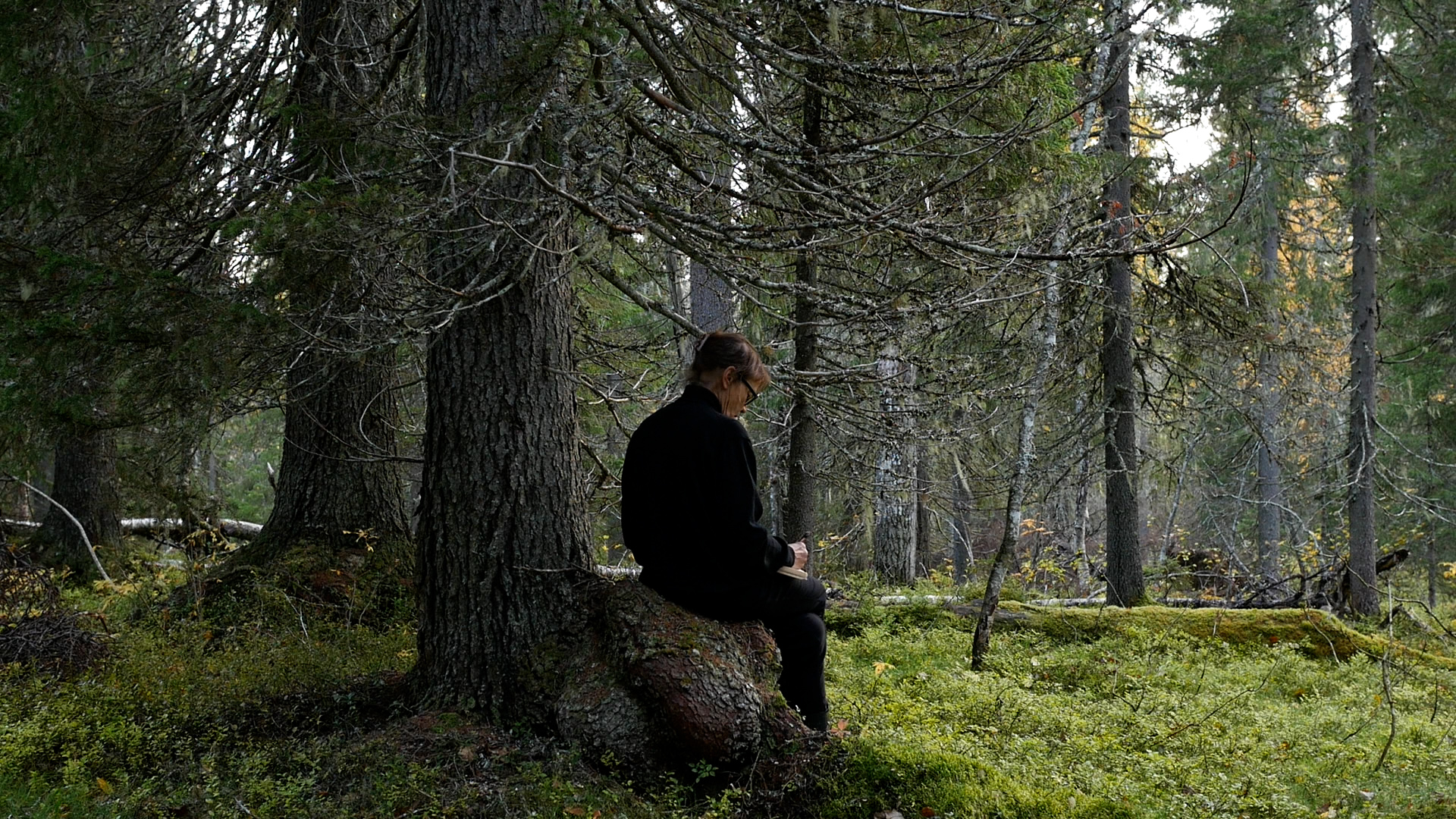
Syyskuu Mustarindassa lähestyy loppuaan ja vielä on paljon mitä pitäisi ja haluaisi tehdä. Viime viikon päätteeksi sain kuitenkin kuvattua, kirjoitettua ja äänitettyä pienen työn uuden kuusen kanssa, johon olen suhteellisen tyytyväinen, ainakin nyt. Kuusi kasvaa polulla lähellä Paljakan luonnonpuiston rajaa ja istuin sen pahkalla kirjoittamassa illan suussa perjantaina 25. 9. koko kameran maksimiajan 21 min, ja vähän ylikin. Kirjoitin tekstin puhtaaksi mitään olennaista muuttamatta ja kun äänitin sen sen kesto supistui viiteen minuuttiin. Niinpä samasta videomateriaalista on nyt pitempi versio, Dear Spruce (20 min 15 sek) ja lyhyempi versio, jossa suomenkielinen teksti on lisätty kertojan äänenä, Rakas kuusi (5 min 47 sek). Ne löytyvät molemmat RC alustalta, täältä.
Teksti, kirjeeni kuuselle, jota kuvassa kirjoitan, on yksinkertaisuudessaan tämä:
Rakas kuusi, tai kuusi hyvä, kiitos että tarjoat tämän mainion istumapaikan aivan metsäpolun varrella. Jo ensimmäistä kertaa täällä kulkiessani, syyskuun alussa, heti saavuttuani Mustarinda-taloon, olen pannut sinut merkille ja ajatellut että voisin tulla istumaan syliisi hetkeksi. Näen sen ottamistani valokuvista. Mutta sitten unohdin sinut kokonaan, ja vaikka olen kulkenut tästä ohi lähes päivittäin, en ole kiinnittänyt sinuun mitään huomiota. Vasta muutama päivä sitten, nyt kun syyskuu jo lähestyy loppuaan, huomasin sinut tässä polun varrella ja muistin aiemmat suunnitelmani. Pysähdyin oikeastaan katsomaan outoa kuusentynkää vain muutaman metrin päässä polulla, edessäni. Kuusi on katkennut, mutta sen alin oksa on jäänyt elämään ja sojottaa suurena viuhkana polun yllä. Pysähdyin tähän kohtaan polkua jo kaksi kertaa aiemmin, kuvatessani vanhaa vaikuttavan muotoista haapaa, joka seisoo veistoksellisena tässä lähistöllä. Olin niin keskittynyt miettimään miten saisin sen kuvattua, etten muistanut sinua lainkaan. Vasta kun asetin kamerajalustan aivan lähellesi kuvausta varten tajusin läsnäolosi. Suo siis anteeksi tämä laiminlyöntini, olisinhan voinut tulla luoksesi jo paljon aiemmin. Mutta toisaalta, tuskin olet kaivannut huomiotani, tai yleensä ketään istumaan juurakkopahkallesi, vai miten tätä juuresi päälle kasvanutta muodostelmaa pitäisi kutsua. Se on vallan oivallinen levähdyspaikka, enkä varmaankaan ole ensimmäinen ihminen, joka tässä istuu. Mutta voi olla, että olen ensimmäinen ihminen, joka istuu tässä kirjoittamassa kirjettä sinulle. Ei, en aio ripustaa näitä papereita oksaasi, enkä edes haudata niitä juurellesi, tämä kirje on vain yritys tarkentaa ajatukseni, niin että sinun olisi helpompi aistia ne. En tiedä kykenetkö varsinaisesti lukemaan ajatuksia, tuskin ymmärrät ihmiskieltä, mutta voisin kuvitella, että pystyt jotenkin aistimaan läsnäoloni ja ehkä myös ajatukseni jollakin tasolla. Luonnontieteilijät ovat oivaltaneet, että kasveilla ja varmaan siis kuusillakin ja siten myös sinulla, on erittäin monimuotoiset aistikyvyt ja ne näkevät monen laatuista valoa paljon tarkemmin kuin ihmiset silmillään. Mikseivät ne voisi erottaa ihmisten aikeitakin jollakin tavalla, koska onhan sillä väliä, olenko tulossa kaatamaan puuta, vai rauhallisella mielin tekemään tuttavuutta. Täällä metsässä sinun ei tarvitse pelätä ihmisten ryhtyvän sinua kaatamaan, mutta myrskytuulet tai tykkylumi tai niiden yhdistelmä on kyllä kaatanut monia sukulaisiasi. Aivan tyystin sammaloitunut runko tässä edessäni taitaa olla entinen kuusi, vaikka maassa makaava tuoreempi vainaja onkin koivu. On niin harvinaista nähdä elämän eri vaiheet samassa metsässä, kun niin suuri osa metsästä on niin sanottua talousmetsää, enemmän tai vähemmän saman ikäisistä puista koostuvia viljelmiä, plantaaseja. Mahdatko itsekään tietää, miten etuoikeutettu olet, kun saat kasvaa täällä elämäsi alusta loppuun kaikessa rauhassa? No, rauha on tietysti suhteellinen käsite, kulkeehan tästä ihmisiä ohi vähän väliä, mutta silti. Runkosi on täynnä kaikenlaisia jäkäliä, ja niitä kasvaa myös vanhoilla kuivuneilla alemmilla oksillasi. Ja naavaa, joka on niin kaunis merkki puhtaasta ilmasta, niin ainakin sanotaan. Latvuksesi on komea ja vihreä, ja tämä juurakkopahkasi ei näytä haittaavan sinua mitenkään, ellei haitaksi lueta sitä, että jokunen ihminen saattaa asettua tähän hetkeksi istumaan. Se on itse asiassa hyvä muistutus siitä, ettei kannata hävetä vammojaan ja erilaisia ”epämuodostumia”, joita elämä meille tuottaa. Niistä voi olla joskus vaikka hyötyäkin, jos ei itselle, niin ohikulkijoille. Kiitos siitä rohkaisusta, jos se tuli mieleeni sinulta. Ja näine eväineni jatkankin nyt matkaani. Kaikkea hyvää sinulle tulevan talven varalle, ja kiitos vielä vieraanvaraisuudestasi!
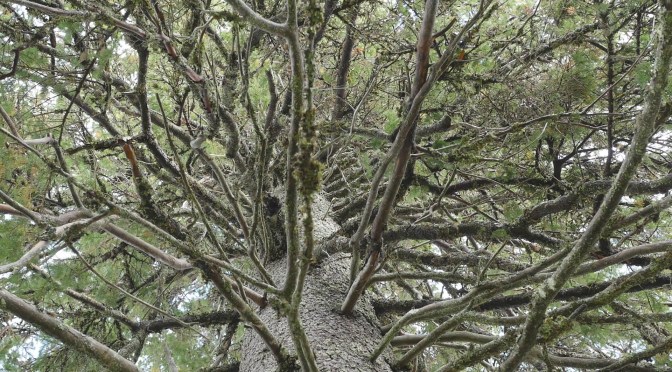
Paljakan Kuusen kanssa
Saapuessani Mustarindaan emäntäni Hanna osoitti jo matkalla korkeaa kuusta joka näkyi ruohottuneen metsätien perällä ja sanoi sen olevan paikkakunnalla huomattava puu. Sittemmin olen kysellyt ihmisiltä ja se tiedetään kyllä, mutta ei siihen ole yhdistetty sen kummempia tarinoita tai kertomusta miksi se on jätetty sinne kasvamaan nuorten kuusten keskelle. Ei sillä myöskään ilmeisesti ole mitään erityistä nimeä, omissa videoissani kutsun sitä nyt nimellä The Spruce in Paljakka. Olen nimittäin ottanut tehtäväkseni vierailla sen luona useaan otteeseen ja kokeilla eri lähestymistapoja ja aiemmin käyttämiäni keinoja esiintyä kameralle sen kanssa. Niinpä olen kiertänyt sen ympäri, kuvannut sitä juuresta latvaan, istunut sen juurella, katsellut sitä läheltä ja kauempaa, kurottanut kohti sen oksia, ja jopa yrittänyt maata maassa sen alla jalat runkoa vasten. Mutta ne yritykset kamerani sensuroi, kieltäytymällä toimimasta. Olen koonnut joitakin kuvia ja videoita jokaisesta vierailustani RC alustan sivulle, tänne. Jonakin päivänä ehkä kirjoitan artikkelin, jossa valitan vaikeutta esiintyä yhdessä tuollaisen jättiläisen kanssa ja käyn läpi kaikki yritykseni. Mutta nyt jatkan vielä kokeitani, pari viikkoa minulla on aikaa tuskailla kuusen kanssa ja nauttia viilenevästä syksystä täällä korvessa, ikimetsien keskellä.


With a Birch in Mustarinda
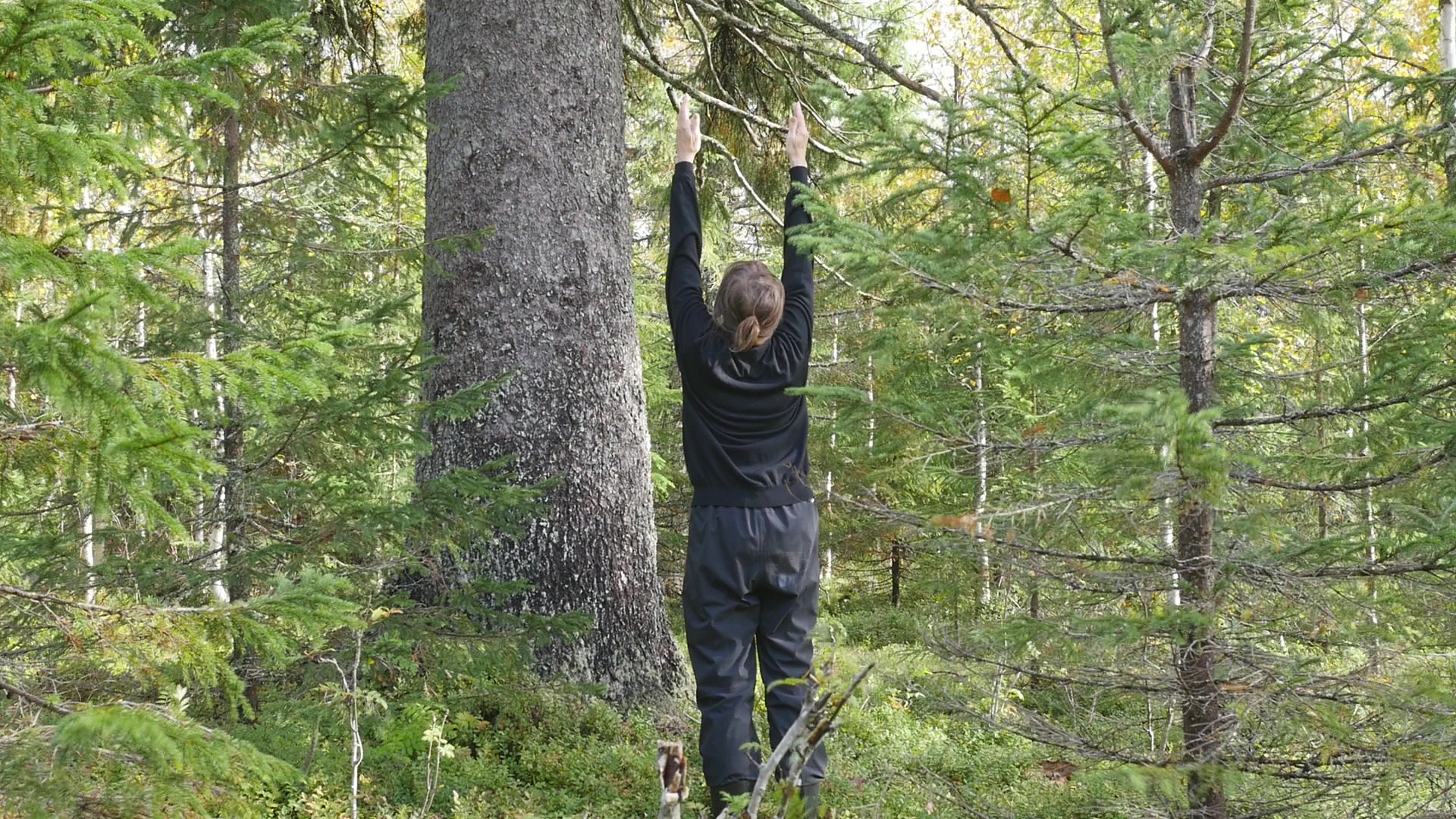
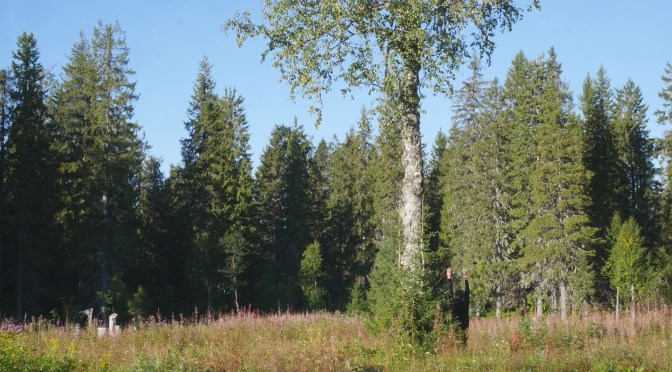
Going out to find a tree to befriend was the first thing to do yesterday, when waking up in the Mustarinda House in Hyrynsalmi, where I will spend all of September. The house is a former school situated up on the Paljakka Hill right next to the protected old-growth forest in the Paljakka Strict Nature Reserve. The forest is mostly tall spruce trees with occasional birches and aspen. The trees around the house are interesting-looking old birches, and I chose one of them, behind the house, towards the forest (see image above, yesterday, and below, today). The small spruces growing next to the birch caught my eye, and I thought I could join them in reaching up towards the crown of the birch. The dry tree trunks in the meadow to the left in the image are an insect hotel, an artwork of by Markku Hernetkoski. So, my plan is to continue my practice of “becoming a tree” together with the birch while I am here – for the whole month, actually. (You can follow my diary on the RC, here.) I hope to find some other trees to work with as well, but this birch will be my trusted diary companion come rain or shine. I am happy to be in this exceptional place – see Mustarinda website – and hope that my time here will be productive. My plans include writing the first version of the text to a small book called Performing and Thinking with Plants. Anyway, I am enjoying the luxury of being so near to what we would call “korpi” in Finnish, which would probably translate as “wilderness”, but is not really the same. According to the Wiktionary it is either “a boreal forest type appearing on moist moraine soils, characterized by dense growth of spruce as the dominating tree species and deep layer of moss as undergrowth”, or simply a deep forest, an area remote from dense population; backwoods, backwater, the sticks or even a type of desert. Well, there is dense growth of spruce and plenty of moss. And the area is not too densely populated, the nearest village is 23 km from here. Ideal for focusing on trees, one would imagine…


Mitt i Mustarinda
Min första dag i Mustarinda huset uppe i Hyrynsalmi, bortom Kajana i nordöstra Finland, intill Paljakka naturreservatet med dess urskog lider mot sitt slut, och det är snart dags för bastu. Mer om stället på webbsidan, här. Idag inledde jag ett slags dagbok tillsammans med en gammal björk på gården, och gick den kortare stigen in i skogen – helt magisk terräng faktiskt. Det enda jag saknar är vatten – en sjö, en tjärn, en å, nånting. Det finns ett kärr alldeles intill, men det har inget öppet vatten. Och den lilla ån som rinner under landsvägen inte så långt härifrån, befinner sig på det fridlysta området där man inte får röra sig. Gränsen är märkt med vita målade streck på trädstammarna… Jag vågade mig upp i utkikstornet idag, och från den högsta avsatsen kunde man se vida omkring – skog, skog, skog så lång ögat når. Men inte att undra på det, österut är det skog hela Sibirien igenom, och västerut är det mest skog innan kusten. Ett radiotorn rätt nära uppe på fjället eller berget är det enda som påminner om människorna. Det finaste med det här stället är tystnaden. I skogen är det faktiskt tyst, om det inte är något djur eller vinden som för oväsen, och då hör man det faktiskt. Det sägs att det här är ett av landets mest snörika områden, och för något år sedan fanns det så mycket snö att många trädtoppar bröts. Man kan se spåren av det i skogen. – Min plan är att hitta någon uråldrig gran att tillbringa en dag med, förutom björken som jag hälsar på dagligen, och så skriva på texten till boken Performing and Thinking with Plants. Få se om jag får något gjort, just nu känns det som om jag helst skulle bara vandra i skogen…


Matkalla Mustarindaan
Syyskuun ensimmäinen päivä junassa, matkalla Helsingistä Kajaaniin, ja sieltä bussilla Hyrynsalmelle, josta minut – meidät (neljä naista) – haetaan autokyydillä Mustarinda taloon. En ole aiemmin vieraillut paikassa, ja nyt asetun sinne kuukaudeksi. Mustarinda on jo varsin maineikas taidekeskus ja residenssi, ja kokeilu, johon liittyy pyrkimys toimia jollakin tavoin ekologisesti järkevästi. Seuralla on monipuoliset verkkosivut, ja niiden perusteella päättelen, että paikka on keskellä metsää, vailla minkäänlaista vesistöä lähistöllä. Odotan jännityksellä tulenko viihtymään, löydänkö lähistöltä puita joiden kanssa tehdä tuttavuutta, minkälaiselta tuntuu ikimetsän läheisyys ja onnistunko kirjoittamaan ensimmäisen käsikirjoitusversion suunnittelemastani kirjasta, jonka työnimenä on Performing and Thinking with Plants. Viime vuoden jatkuvan matkustamisen jälkeen, ja palattuani koronan takia kotiin Helsinkiin Johannesburgista jo maaliskuussa, tämä on ensimmäinen matka pitkään aikaan. Ja syyskuu on hyvä residenssikuukausi. Muistan elämäni ehkä taiteellisesti tuottoisimman kuukauden Farrera de Pallarsissa Pyreneillä syyskuussa 1999, ja myös residenssi Nidassa Kuurinniemellä Liettuassa vuonna 2017 oli syyskuussa. Syyskuussa on vielä valoisaa ja suhteellisen lämmintä, mutta enää ei olla lomatunnelmissa vaan sadonkorjuu jatkuu ja ihmisetkin varustautuvat talven varalle, jos ei muuten niin poimimalla puolukoita. Niin minäkin varmaan tulen tekemään, mutta yritän myös kuvata ja kirjoittaa…

From the Mainland
Video works in The Telegraph on Harakka Island 15–26 July 2020, noon to 5 pm.
Welcome to the opening on Monday 14 July at 4-6 pm.
The following works are included in the exhibition:
With Elms in Kaivopuisto 1 & 2 (2018)
In 2017, between 10.1. and 17.12., I visited a group of elms in Kaivopuisto Park in Helsinki altogether 101 times. I video recorded and edited these visits into a two-channel installation (1h 41 min 10 sec.), with one-minute images of each visit, here combined as a split-screen version.
With an Alder in Kaivopuisto (2018)
In 2017, between 12.1. and 17.12., I sat on an alder stub in Kaivopuisto park in Helsinki altogether 100 times. I video recorded and edited these sessions into a video (1h 40 min 10 sec) with one-minute images of each session.
With the Maple Tree (Corona Diary) (2020)
During the spring 2020, between 29.3. and 31.5., I performed daily for a video camera with a maple tree in the yard of Tehtaankatu 18 in Helsinki, and edited the performances into a diary of sorts (62 min 22 sec).
The works are linked to the projects Performing with Plants and Meetings with Remarkable and Unremarkable Trees
Mantereelta
Videoteoksia Harakan lennättimessä 15–26.7. 2020 klo 12–17.
Tervetuloa avajaisiin tiistaina 14.7. klo 16-18.
Seuraavat työt ovat esillä näyttelyssä:
With Elms in Kaivopuisto 1 & 2 (2018)
Vuonna 2017, 10.1. ja 17.12. välisenä aikana vierailin jalavaryhmän luona Kaivopuistossa Helsingissä yhteensä 101 kertaa. Kuvasin vierailut videolle ja editoin niistä kaksikanavaisen installaation (1t 41 min 10 sek.), joka sisältää minuutin jokaisesta vierailusta, tässä yhdistettynä “split-screen” versioksi.
With an Alder in Kaivopuisto (2018)
Vuonna 2017, 12.1. ja 17.12. välisenä aikana istuin lepän kannolla Kaivopuistossa Helsingissä yhteensä 100 kertaa. Kuvasin istunnot videolle ja editoin niistä videon (1t 40 min 10 sec), joka sisältää minuutin jokaisesta istunnosta.
With the Maple Tree (Corona Diary) (2020)
Keväällä 2020, 29.3. ja 31.5. välisenä aikana esiinnyin kameralle päivittäin vaahteran kanssa Tehtaankatu 18 pihalla Helsingissä, ja editoin esitykset eräänlaiseksi päiväkirjaksi (62 min 22 sec).
Työt liittyvät projekteihin Performing with Plants ja Meetings with Remarkable and Unremarkable Trees
Från fastlandet
Videoarbeten i Telegrafen på Stora Räntan 15–26.7. 2020 kl. 12–17
Välkommen på vernissage tisdagen den 14.7. kl. 16-18.
Följande arbeten ingår i utställningen:
With Elms in Kaivopuisto 1 & 2 (2018)
Under året 2017, från den 10.1. till 17.12., besökte jag en grupp almar i Brunnsparken i Helsingfors sammanlagt 101 gånger. Jag spelade in besöken och editerade dem till en två-kanalig video installation (1t 41 min 10 sek.) med en minut av varje besök, här kombinerade till en “split-screen” version.
With an Alder in Kaivopuisto (2018)
Under året 2017, från den 12.1. till 17.12., satt jag på en alstubbe i Brunnsparken i Helsingfors sammanlagt 100 gånger. Jag spelade in seanserna och editerade dem till en video (1t 40 min 10 sek) med en minut av varje besök.
With the Maple Tree (Corona Diary) (2020)
Under våren 2020, från den 29.3. till 31.5., uppträdde jag dagligen för kamera med en lönn på gården till Fabriksgatan 18 i Helsingfors, och editerade uppträdandena till ett slags dagbok (62 min 22 sek).
Verken är kopplade till projekten Performing with Plants och Meetings with Remarkable and Unremarkable Trees
Exposition and / as Method
These links are related to the public zoom webinar lecture at SKH Stockholm University of the Arts on Monday 22 June a 2 pm
Structure of the talk:
Background
What is an exposition?
Examples
Method, or way of doing things
video
two quotes – composition and concept
Two expositions of my current research project, in process
Meetings with Remarkable and Unremarkable Trees (archive on the RC)
https://www.researchcatalogue.net/view/761326/761327
Meetings with Remarkable and Unremarkable Trees (blog)
https://meetingswithtrees.com/
Two examples of recently published expositions related to previous research projects
1.
Annette Arlander, ‘Behind the back of Linnaeus – Bakom ryggen på Linné‘, RUUKKU – Studies in Artistic Research, 14 (2020) https://doi.org/10.22501/ruu.470496 [accessed 19/06/2020], http://www.ruukku-journal.fi
(if interested, see also the archive/timeline of the whole project Performing with Plants:
https://www.researchcatalogue.net/view/316550/316551 )
2.
“HTDTWP presents: The Transformative Potential of Performance” Annette Arlander, Hanna Järvinen, Tero Nauha and Pilvi Porkola in Leena Rouhiainen (ed.) Proceedings of CARPA 6 Artistic Research Performs and Transforms: Bridging Practices, Contexts, Traditions & Futures Nivel 13 (2019)
https://nivel.teak.fi/carpa6/annette-arlander-hanna-jarvinen-tero-nauha-and-pilvi-porkola-htdtwp-presents-the-transformative-potential-of-performance/
a script of our performance in four parts, including a link to a page on the RC with the video shown as a background to my part of the performance, “Revisiting the Juniper”
https://www.researchcatalogue.net/view/727848/727849/0/0
(if interested, see also the archive/timeline of the whole project How to do things with performance https://www.researchcatalogue.net/view/281037/281038/31/25
Examples of methods
The above expositions include examples of one of my main methods, performing for camera with trees in order to create rough time-lapse videos. The video Dear Firethorn Rhus II (with text) 6 min., here as a low-resolution file, is a recent example of trying out a new method, writing to trees next to them. https://www.researchcatalogue.net/profile/show-work?work=823675
Two quotes related to “Concept and Composition”
Composition
“Two dimensions are combined in a performance. A performance is both a work and an event, both composition and exchange. The dimension emphasized can vary. Therefore, it could me more meaningful to speak of a performance composition and a performance event rather than a performance plan and a performance.[or script and mise-en-scene] /–/ A performance composition is a compound of all the material that is meant to be seen, heard, experienced through touch or kinesthetic sense, rhythms or references to meaning, a kind of base for the performance. A performance composition is not only a mental object or structure, but consists of material, physical and living elements, a collaboratively constructed world or entity, whose core or “soul” can be called the performance world. In an ideal case the performance world is the part of the performance composition, which everybody strives to recreate and embody in each performance event.
The performance event is the performance itself, what takes place in the performance space between performers and spectators. This event is influenced by many other things besides the performance composition. The amount of space in the performance composition left for improvisation or chance occurrences is variable. The performer can change or apply the performance composition according to circumstances and respond to the mood of the moment during the performance event or situation. Correspondingly, the spectator can choose another position or perspective in relationship to the performance, than the one proposed by the performance composition. Two performance events based on the same performance composition, can be very different, or very similar.”
Arlander, Annette “Esitys Tilana” [Performance as Space] Acta Scenica 2 Helsinki: Theatre Academy 1998, p 16. (translated by AA)
Concept
“According to Bohr, theoretical concepts (e.g., “position” and “momentum”) are not ideational in character but rather are specific physical arrangements. For example, the notion of “position” cannot be presumed to be a well-defined abstract concept, nor can it be presumed to be an inherent attribute of independently existing objects. Rather, “position” only has meaning when a rigid apparatus with fixed parts is used (e.g., a ruler is nailed to a fixed table in the laboratory, thereby establishing a fixed frame of reference for specifying “position”). /–/ Similarly, “momentum” is only meaningful as a material arrangement involving movable parts. Hence, the simultaneous indeterminacy of “position” and “momentum” (what is commonly referred to as the Heisenberg uncertainty principle [which is about indeterminacy rather than uncertainty] is a straightforward matter of the material exclusion of “position” and “momentum” arrangements (one requiring fixed parts and the complementary arrangement requiring movable parts).”
Karen Barad “Posthumanist Performativity: Toward an Understanding of How Matter Comes to Matter” Signs: Journal of Women in Culture and Society 2003, vol. 28, no. 3, p 814.
Other sources mentioned
Arlander, Annette. Performing Landscape – Notes on Site-specific Work and Artistic Research. Texts 2001-2011. Acta Scenica 28. Theatre Academy Helsinki 2012.
https://helda.helsinki.fi/handle/10138/37613?locale-attribute=en
“Om metoder i konstnärlig forskning / On methods of artistic research” in Torbjörn Lind (ed.) Metod – Process – Redovisning Konstnärlig Forksning Årsbok 2014 Vetenskapsrådet 2014, Method – Process – Reporting Artistic Research Yearbok 2014 Swedish Research Council 2014, 13-25 / 26-39. https://www.vr.se/english/analysis/reports/our-reports/2014-07-01-artistic-research-yearbook-2014.html
 Performing Landscape