
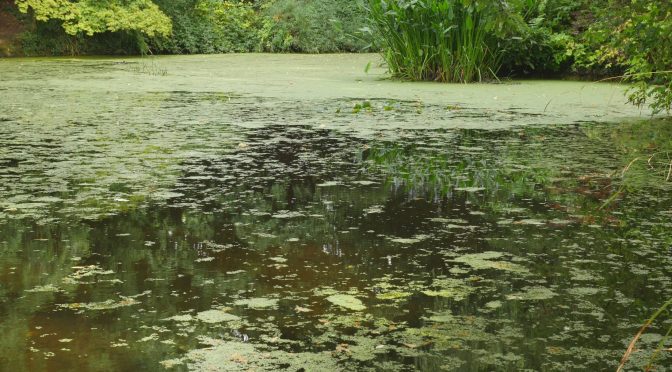
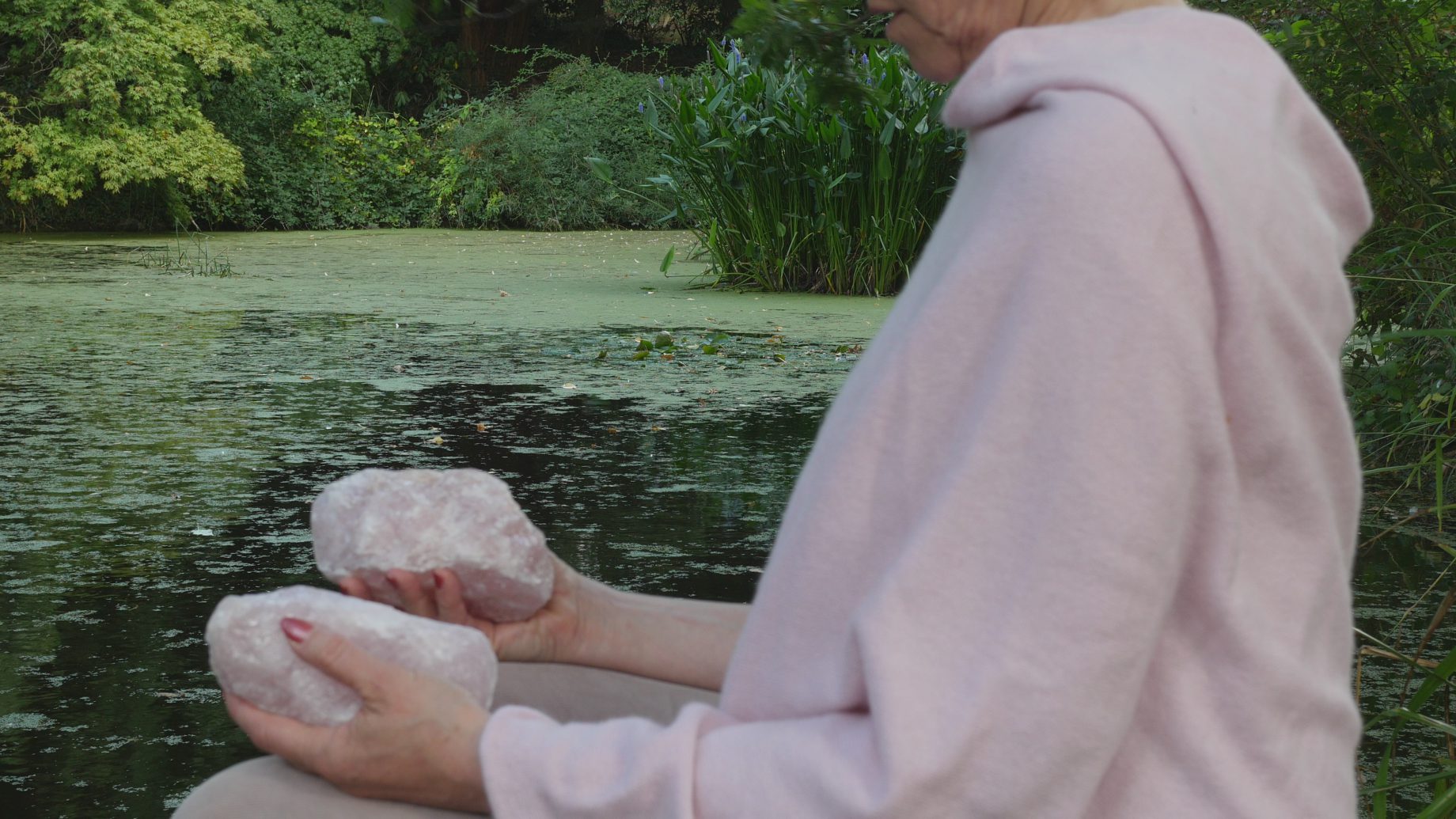
Performing for camera can have its drawbacks, unless you check and double-check and then do it once more. This experience was confirmed once again in Exeter this weekend. I was participating in the third seminar organized by the Rock-Body project, see rock-body website , an exciting interdisciplinary mixture of scholars and artists from various disciplines, including geographers, geologists, performance studies scholars and philosophers. As part of this event dancer and choreographer Paula Kramer planned to create a site specific dance piece, eventually together with David Paton and Carolyn Deby, who invited me to join in. I happily agreed to sit somewhere with a rock in my lap, as Carolyn suggested. I thought I could sit immobile in the foreground watching them, as it were. When I saw the chosen site, under a huge old oak tree by a pond, where they already had placed the rocks they would work with, it was obvious that the only place to sit was at the piece of rock at the edge of the pond, in the background. I had brought with me two lumps of rose quartz that I had at home, because I expected that it might be hard to find “feral” rocks of a suitable size in the city. I noticed them at home when returning from the previous workshop in Penryn and connected them with the image I made there, due to their colour. In the morning after the seminar in Penryn I sat on the shore in Falmouth with a pale pink scarf in the rain and made a short video piece that I called Body on the Rocks. (See blog post) Of course I wanted to make a sequel with Rocks on the Body using the same scarf. And this I could somehow do based on the image to be created live during the performance. In the video the focus would be on the rocks in my hands. I was not sure if I would find the time to do it, so I asked Carolyn to take some snapshots with my phone in order to have some documentation. And they remain the sharpest images of those two pieces of rose quartz:
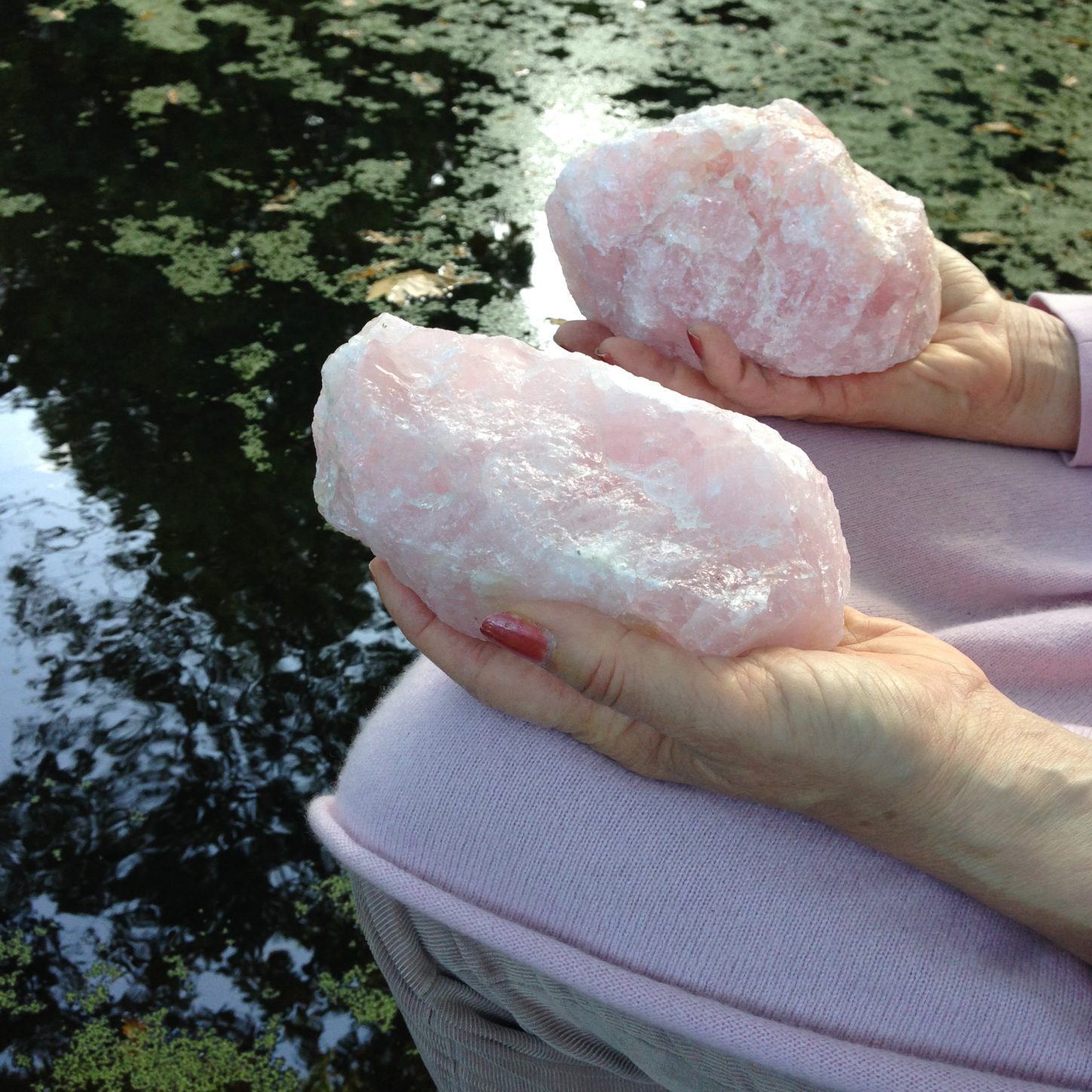
Photo by Carolyn Deby
In the morning on the day of the performance, the last day of the seminar, I went to the site with my camera and tripod, the scarf and the rocks to try to perform a session. I made some tests, recording a few seconds of video and then looking at it and adjusting the position of the tripod, recording again, and quickly realized I needed a close up to show “rocks on the body”.
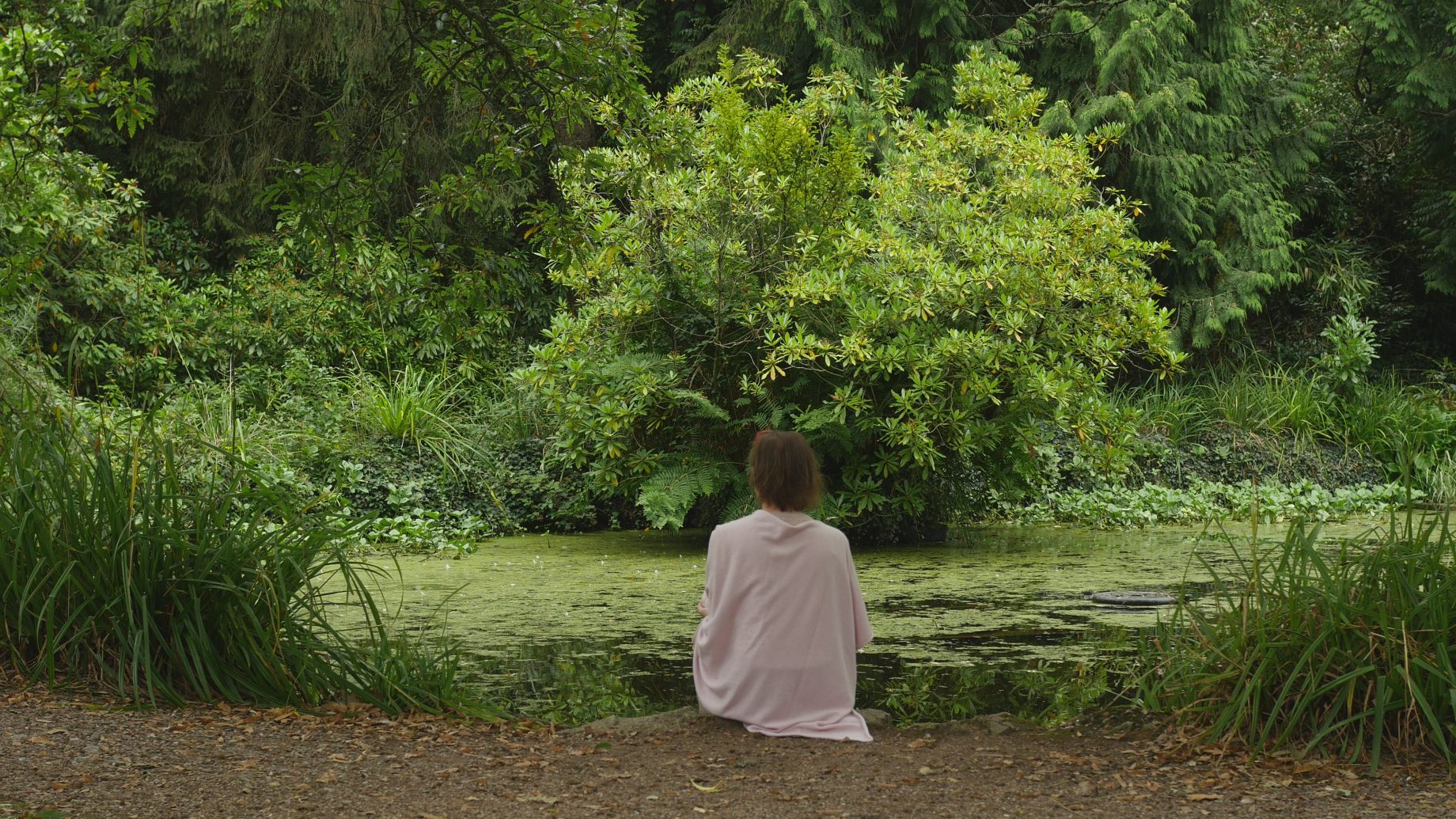
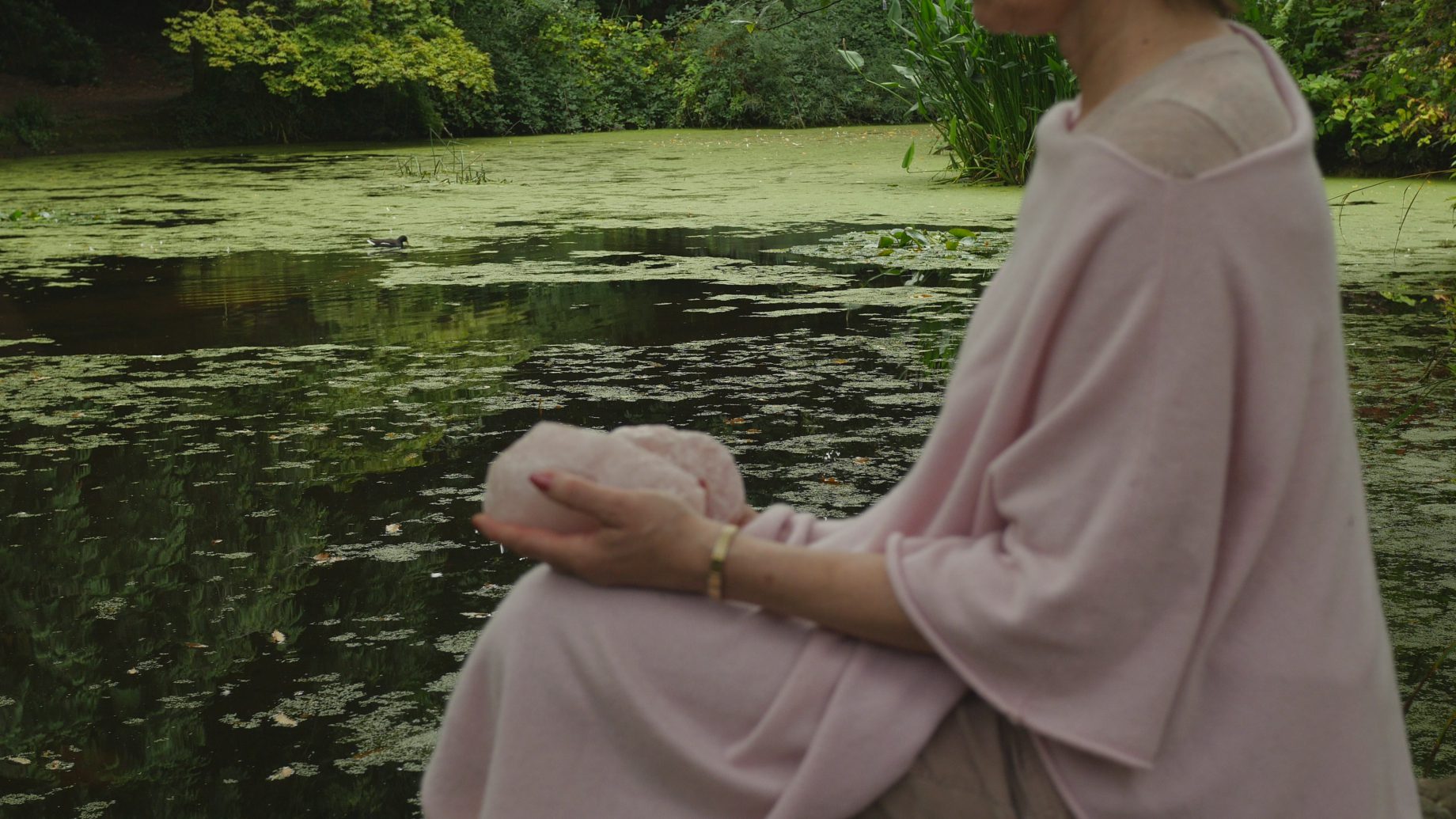
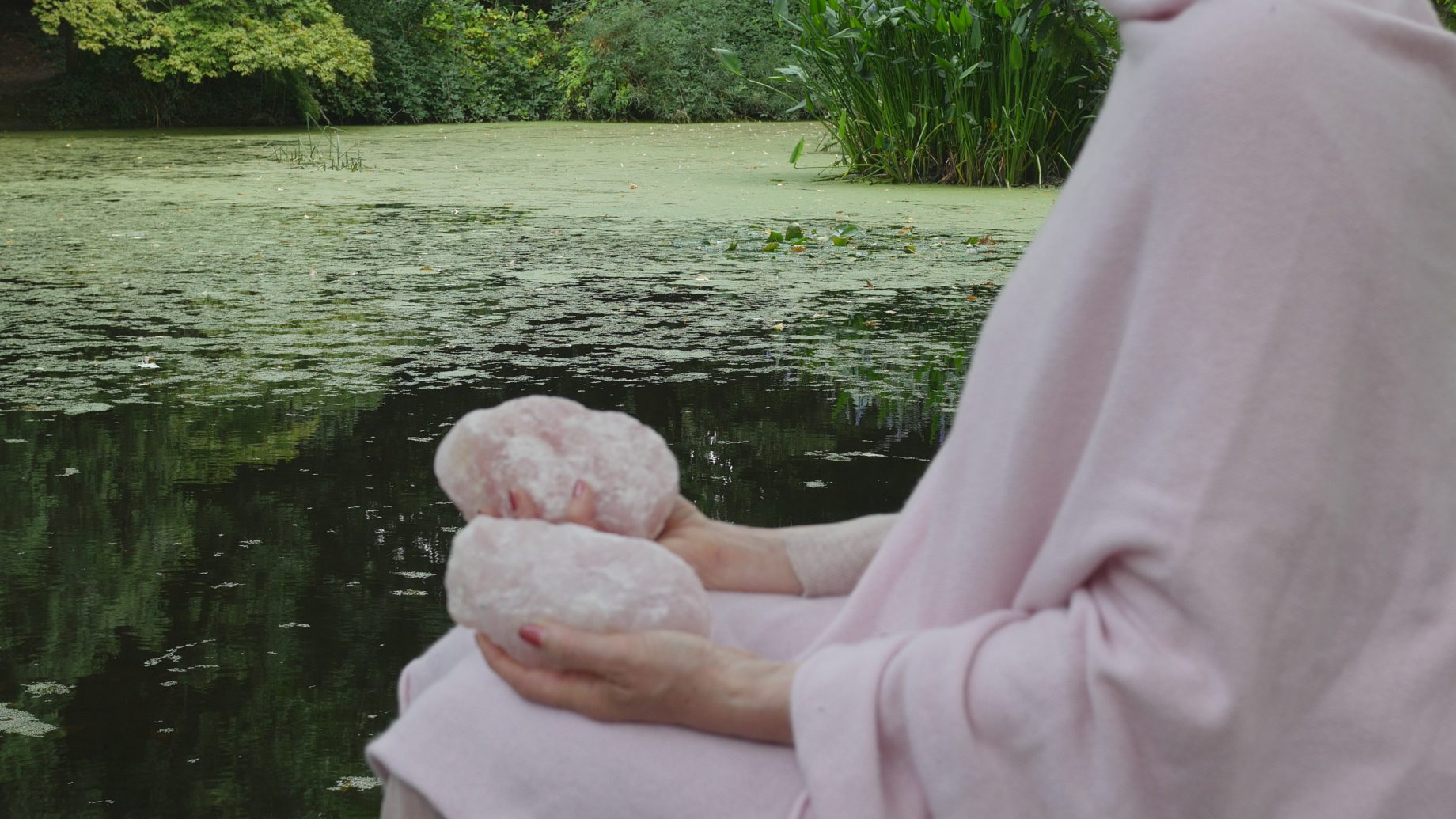
The morning was overcast and there was not much light in the shade of the oak. While moving about trying to adjust the image I was somehow careless, so one of the rocks fell into the pond. I was shocked, feeling like Adalmina, the little princess in a fairy tale by the Finnish writer Zachris Topelius, who lost her pearl and thereby all her good fortune in a pond due to her vanity. Luckily the pond was not very deep, I could see the rock and tried to reach it but quickly noticed there was no other way than to undress and climb down into the pond. I did that and retrieved the rock, hoping that nobody had passed by exactly then. The rock felt nice and fresh after having its bath, so I washed the other one, too. When I finally sat down I saw a huge fish swim by, probably curious or expecting to be fed. I decided to use my phone as a timer, since I wanted to have enough material but also to be in time for the seminar, and thought 15 minutes would be enough so I put the timer on 17 minutes, started the camera – or so I thought – and sat down. I counted my breathing, partly to calm down, partly to focus, since sitting was surprisingly uncomfortable and the rocks in my hands felt heavy. Some birds were making loud sudden sounds that startled me and would probably show in the image. Slowly it started to rain, softly. The droplets created beautiful patterns on the surface of the pond, and I was happy with this link to the rain in Falmouth. The rain came and went several times, almost starting and then receding again and never really turning into a proper rain. Finally the sun came out and made the rocks sparkle in my hands. I wondered about the time, but decided to continue until 250 breaths and leave it at that; my left leg felt numb and enough was enough. I got up and realized the camera was black, when did it turn off and why? I looked again, and once more, and finally realized, I had never turned it on! And the same might be true of the timer, or then I just did not hear the sound. I felt devastated, all this beauty and pain had been in vain, experienced by me alone. By now it was five minutes to ten, I had been sitting there for more than half an hour, so I had to hurry to the seminar. – Later Paula told me she had seen me sitting, when she came to practice, and the sun arriving, too, but did not want to disturb me. It was a consolation to know there had been a witness, but I still wanted to make the image…
I decided to make a new attempt just before the actual performance, and then to remove the camera and the tripod before the audience arrived. And that is exactly what I did, although the session was rather short, 100 much shorter breaths. But of course there was neither raindrops on the surface of the pond or sun glistening on the quartz in my hands this time. Even the camera angle seemed less interesting, although that might be my imagination.
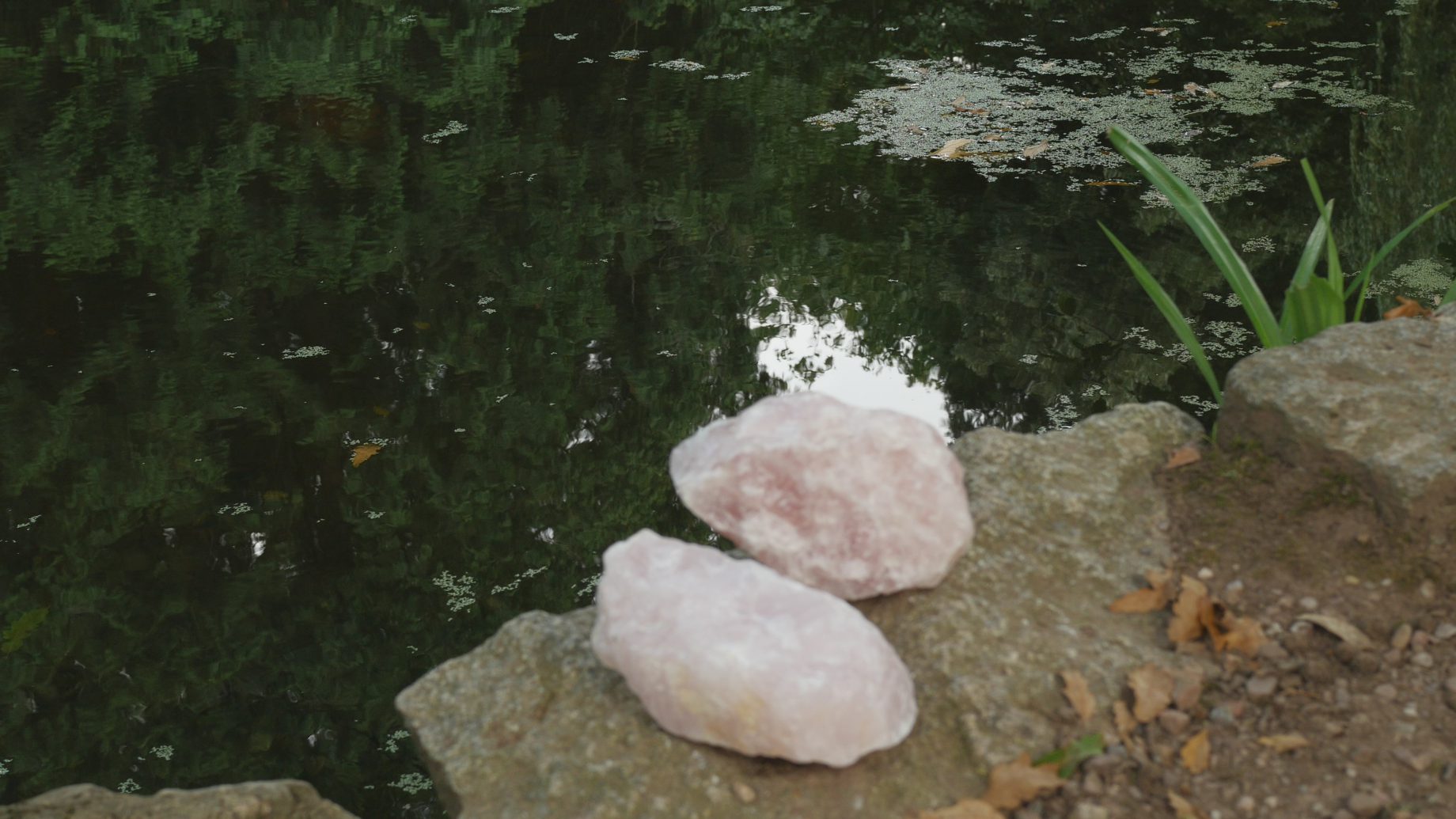
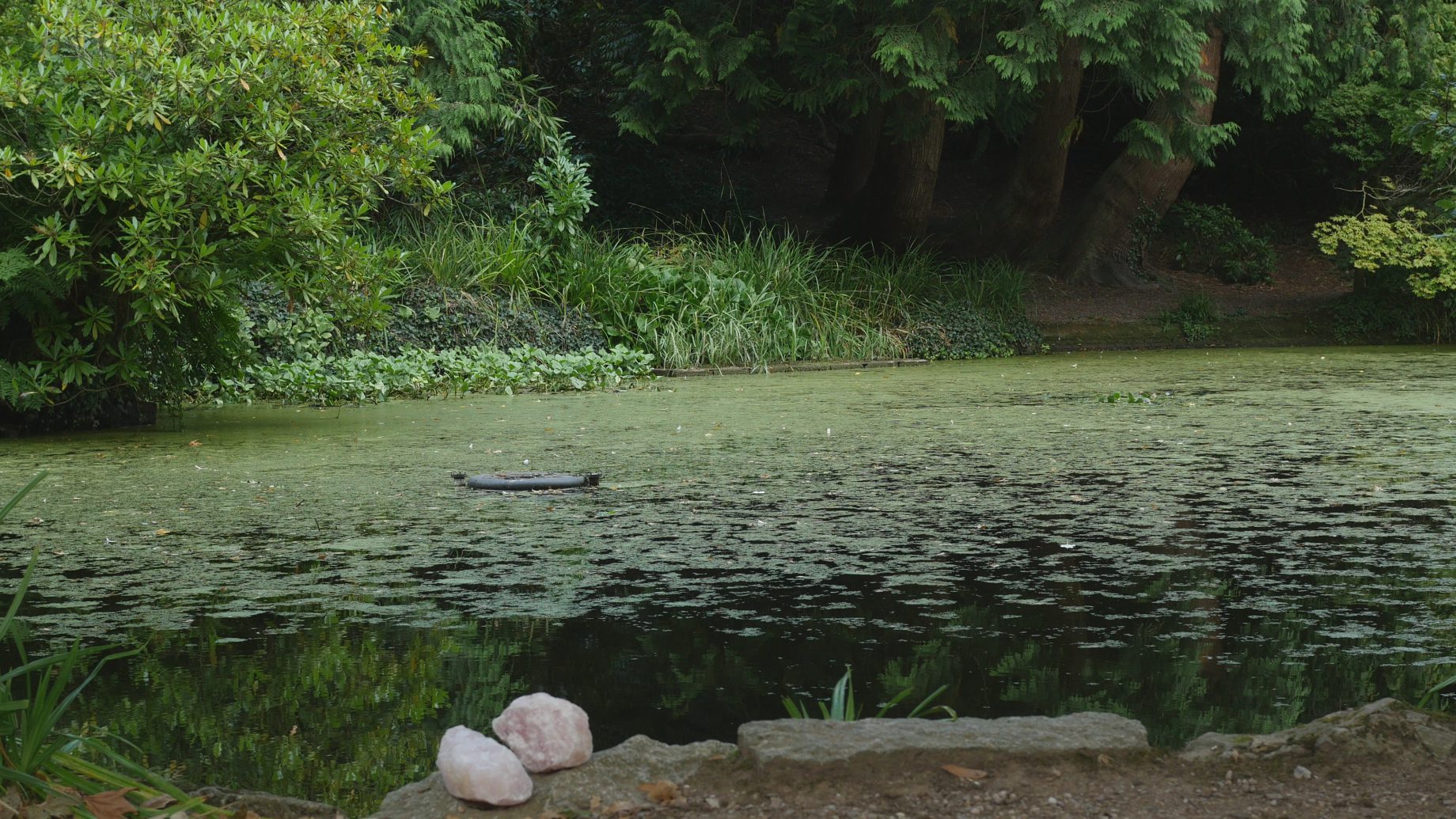
The actual performance went well, although a little faster than planned. And it was fascinating having the audience move about. At some point I looked up from the rocks in my hands and saw people standing and watching us from the other side of the pond. Moreover, at some point somebody was sitting down next to me by the pond; I saw a glimpse of blue, but did not recognize who it was. I was mainly listening to David hammering on the large rock and realized the two pieces of rock I had in my hands had also been violently cut off from somewhere. Sitting with the two pieces in my hands became like an act of strange helpless mourning. When I heard the piece of rock fall I waited for a while and then got up, leaving the two pieces of rose quartz on the rock by the pond and walked to the oak, as planned. There I noticed Paula was just about to begin, so I waited standing until she had moved further away, before sitting down to watch the rest of the action, and realized that I could actually have sat with the rocks in my lap much longer…
For an idea of the performance, please look at the rock_body_programme_notes
And for an idea of the whole endeavor, look at the rock-body website.
Category Archives: English
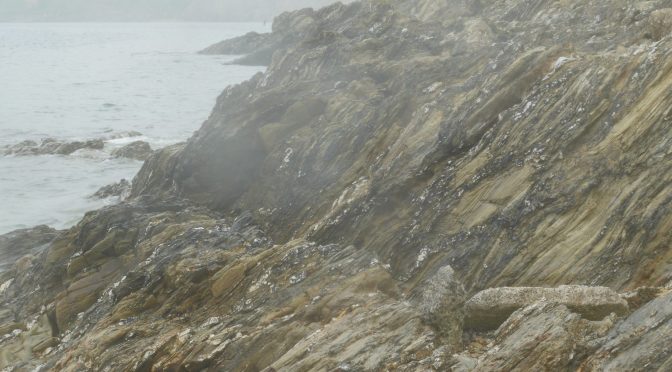
Body on the Rocks in Falmouth
After participating in the inspiring seminar organized by Rock/Body: Performative Interfaces Between the Geologic and the Body I asked some of the participants with knowledge of the area around Penryn where I could possible find ‘live rock’ or ‘wild rock’ nearby, and they suggested the beach in Falmouth, adding that I would not find granite but sandstone, which was fine for me. I thought I could walk down to Falmouth in the evening after the seminar, but the weather was getting worse and the discussions were interesting, so I decided to try in the morning instead. And yes, I easily woke up at six with the light, left my room at seven with a biscuit and some water, my camera and my pale pink poncho and headed towards to shore to see if I could find some rock to pose with. It took me an hour to get to Falmouth, and half an hour more to find the beach and some rocks by the beach. On the way to the beach I noticed there were two trains going up to Penryn, one at 9.30 and the other after 11, which was a little late considering that I should be catching the train to Truro and London at 12.47. But I thought I could take the risk if I found something to really work with. I followed some paths that led me nowhere near rocks so despite the high tide I decided to simply walk on the shore to the end of the beach, where I placed my tripod at the end of the concrete path and sat down on the first ‘wild rock’ on the shore. No time for too many tryouts. And the rock sure was wild enough, very different from the cliffs smoothened by the glacial ice at home.


I sat on the shore for ten minutes and got out of the image in order to have enough of “empty” view to create a slow cross-fade. The drizzle was turning into rain, and the raindrops blurred the image into something foggy, pale and soft. The rain made the decision to return easier, I took the earlier train and had some time for breakfast and farewells. So in the end I made only one image, but perhaps it was enough. Sitting on a rock on the shore is nothing new for me, I have done it in too many works, but the soft whiteness of the rain could have been fascinating, if I would have had enough time to wait for the image to be completely obliterated…

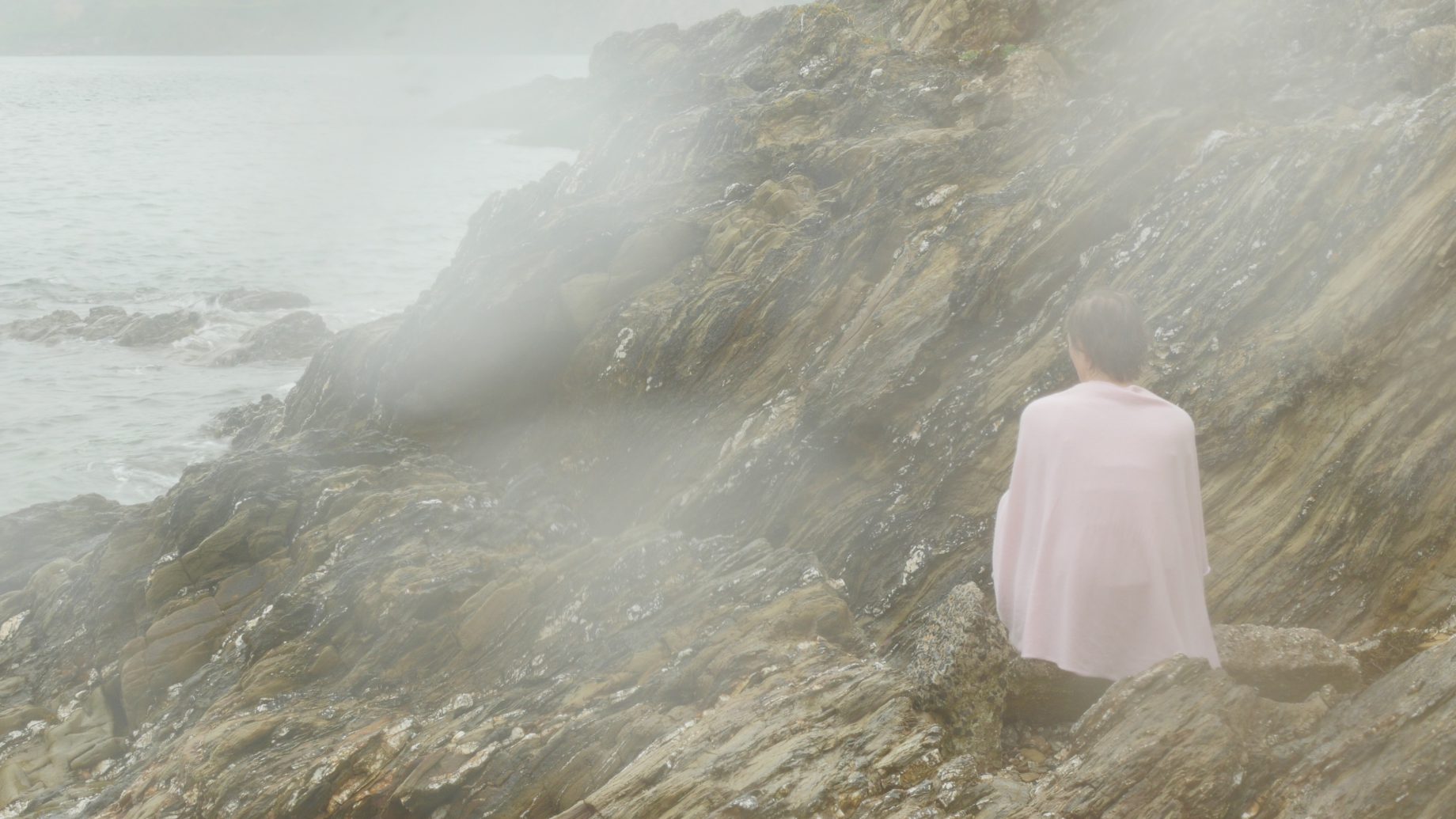

And only now, writing this, did I realize I was so focused on rocks that I forgot to record the ocean view, my customary “After Sugimoto” image, although the open sea at Falmouth would have been ideal for that.
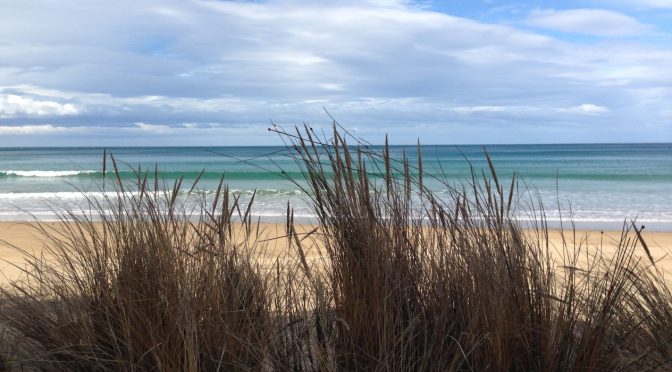
Apollo Bay and The Great Ocean Walk
After participating in the conference Performance Studies International PSI #22 Performing Climates I had reserved a week to stay in Australia and perhaps find some landscape to perform in and with. When planning this I did not realize it is winter here, that is, the rainy season. In a city like Melbourne some rain now and then does not matter so much, but in the country side rain is a nuisance. The footpaths are all wet and slippery, the landscape looks grey and worst of all, the camera does not like water. When I looked at the weather forecast it showed sun at the end of the week, when I would return to Melbourne, but what could I do. So early on Sunday morning I took a tram to the Southern Cross station and then a train to Geelong, where i could catch a bus to take me along the great ocean road all the way to Apollo Bay for a start. I arrived here in the afternoon yesterday, and spent some time walking to the guesthouse on the outskirt of this little town and then back again, along the beach. I was very happy that I brought a proper rain suit with me, a pair of trousers and a coat to wear on top of my normal clothes. Rain is a lot less irritating, when you do not get wet. I walked up to the Mariner’s Lookout to enjoy a great view of the bay, and headed back to the village to get a torch. And sure it came in handy when I had to find my way back after dinner in the evening.
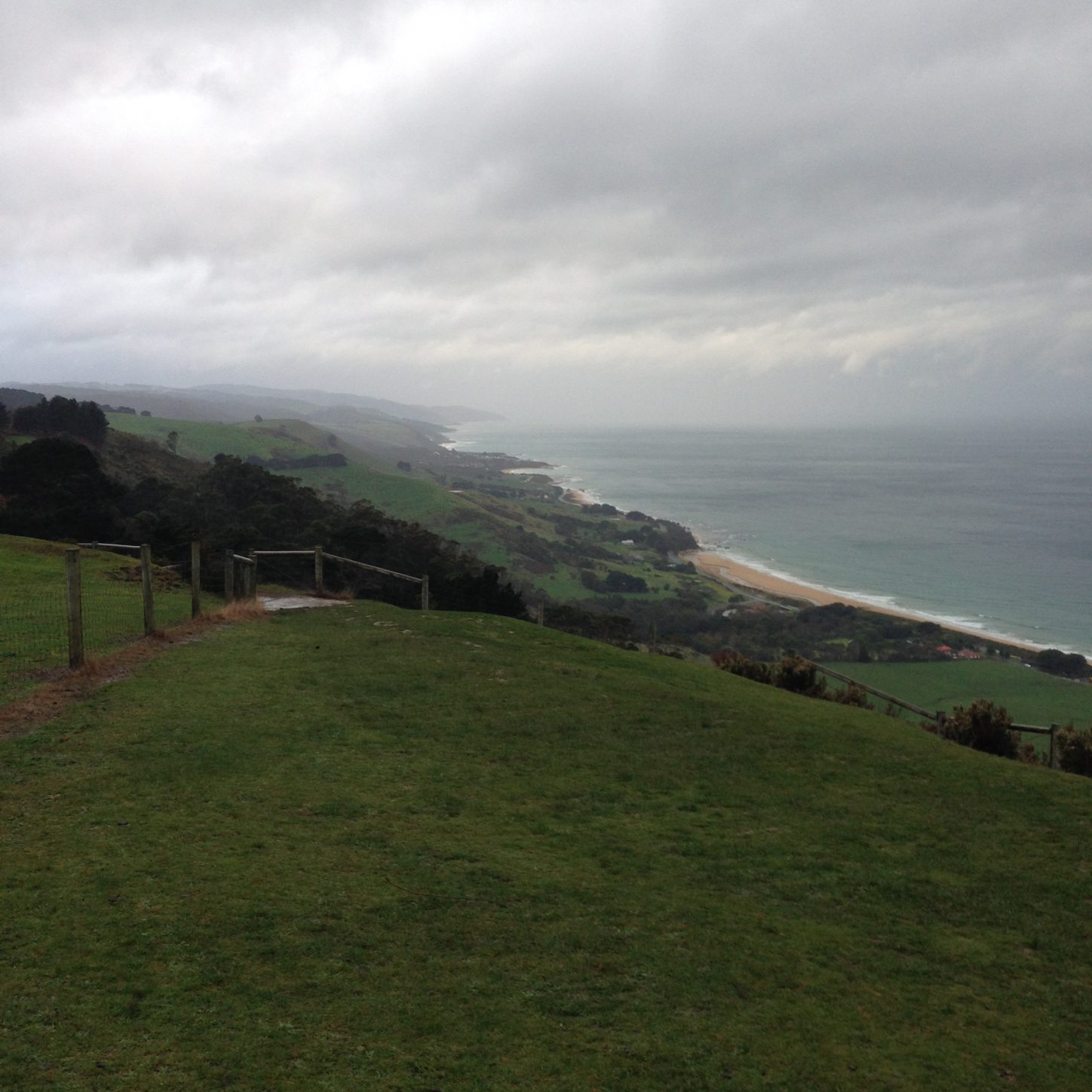
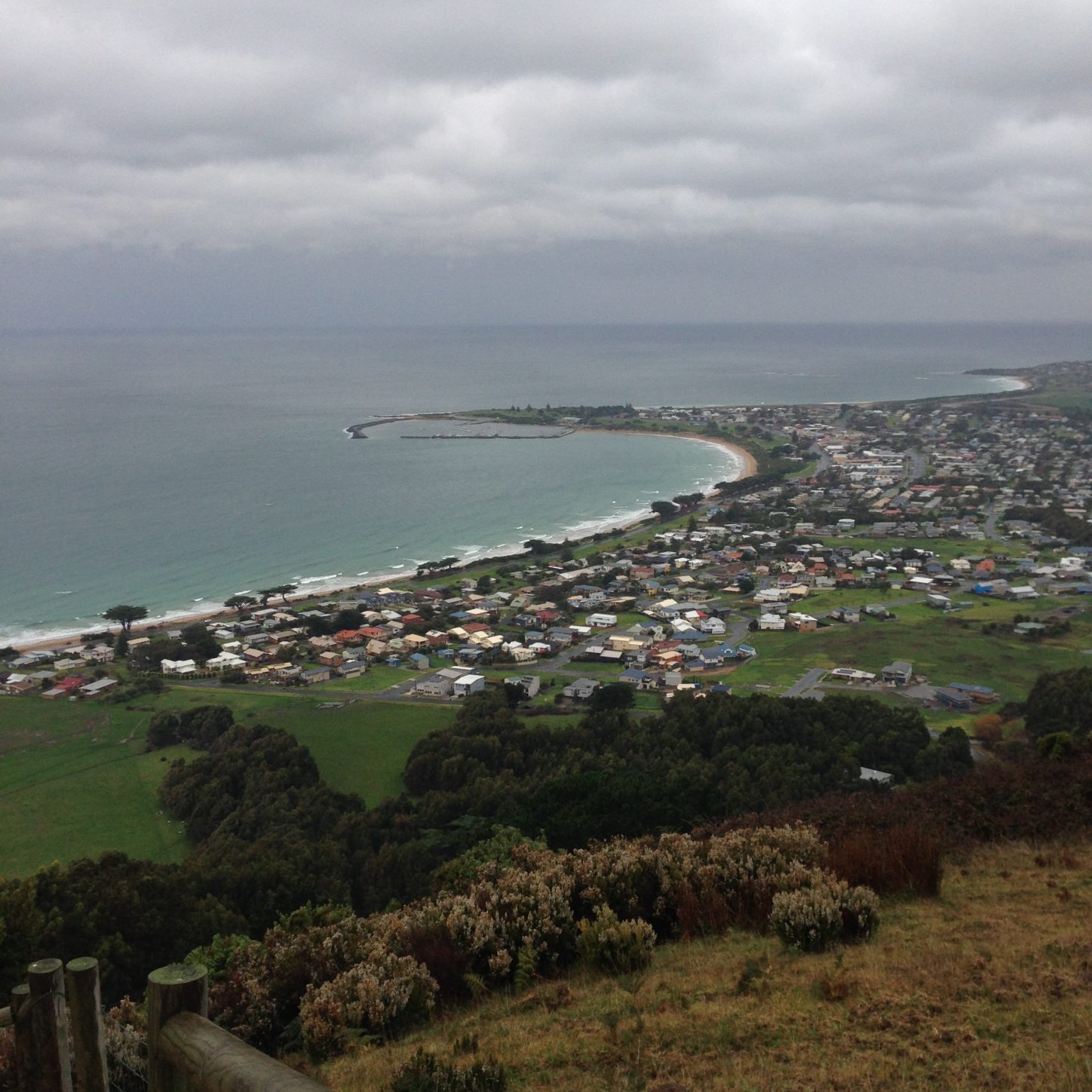
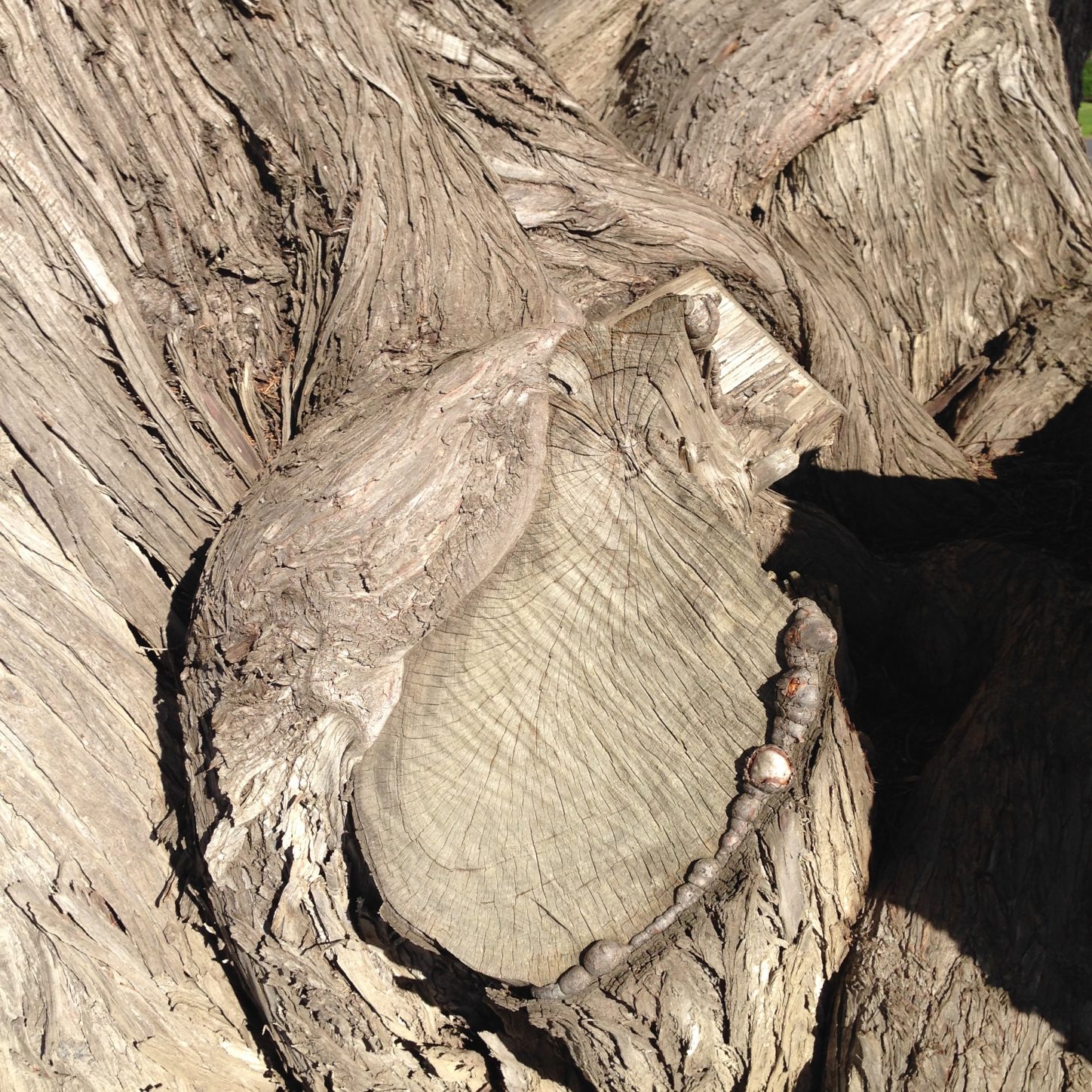
This morning the sky was clearer and the sun was out, which made the strong wind a lot more enjoyable. I walked along the shore and tried to think of what to work with? Perhaps the tall trees growing along the path, which seemed rather special in many ways. But what to do with them? Simply making photos of their rather spectacular trunks did not seem so interesting…


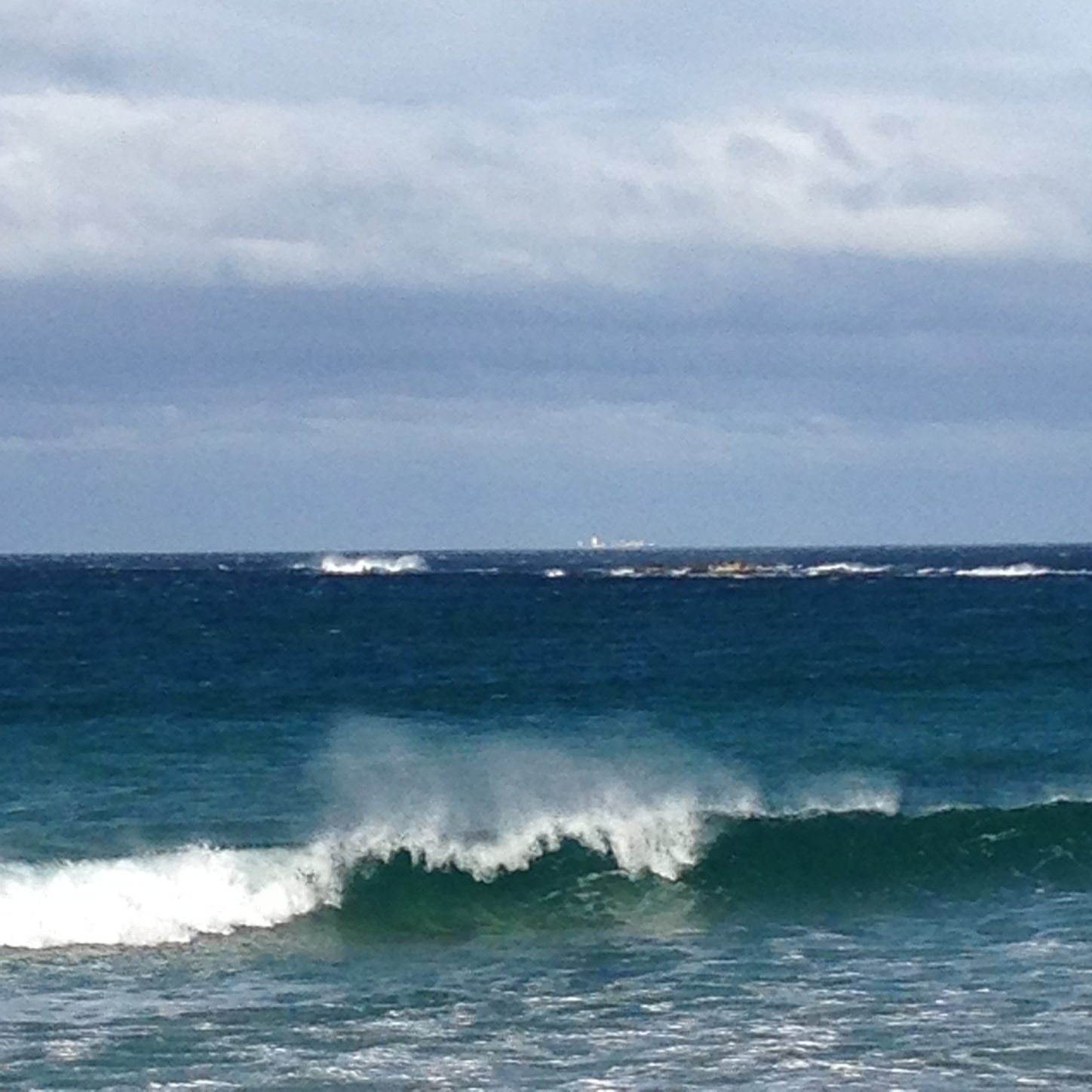
I tried to record my customary sea view, after Sugimoto, but did not find a place where the surf would not be included when the horizon was at the middle of the image. The waves look great, of course, although they are hard to catch, except by accident.
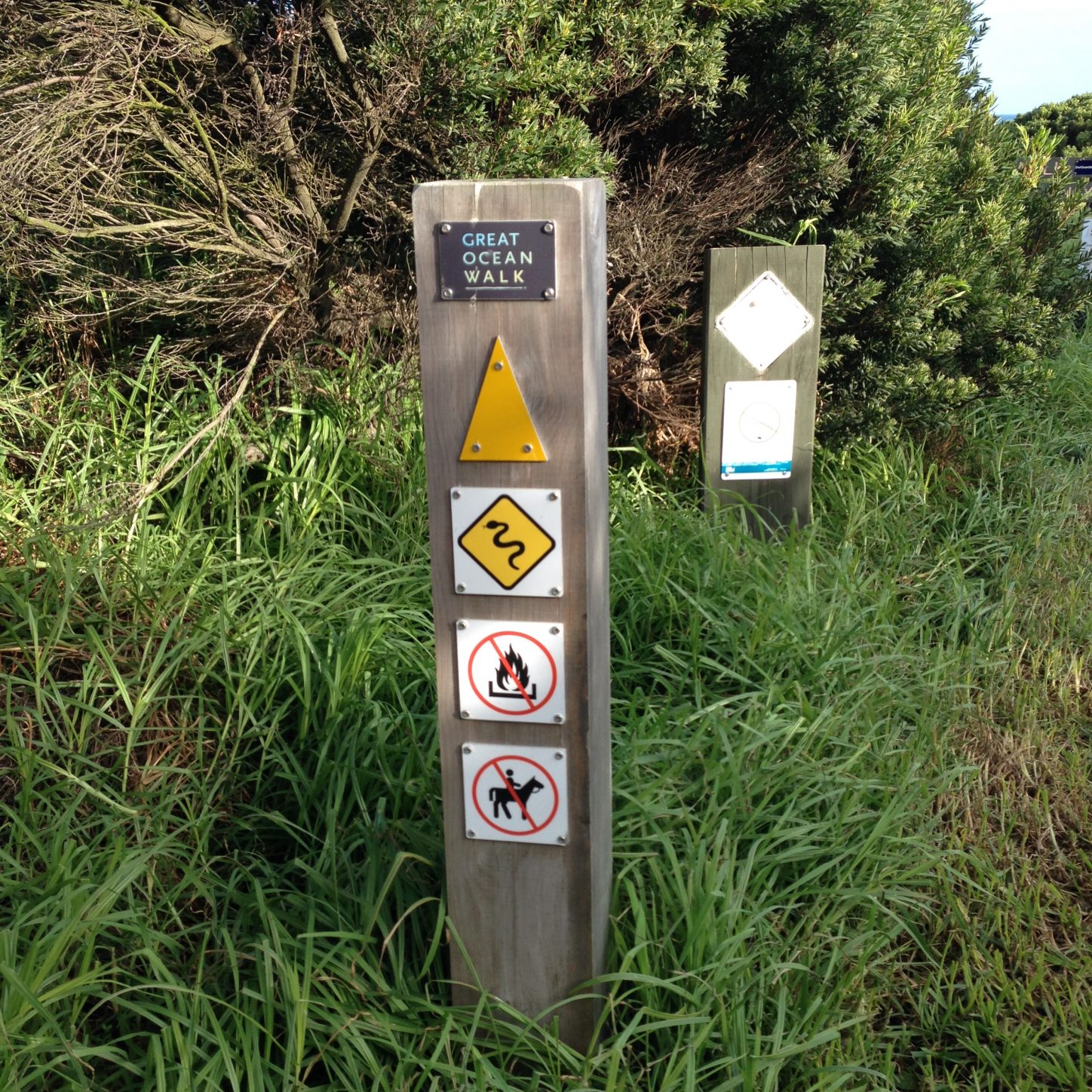
In the afternoon I walked up to Marengo, the village where the path called the great ocean walk actually starts. And I walked on it for a while, enjoying the scenery. But then the path led me down to the beach and a sign warned against high tide. I knew the tide was on its way in, and the path might be under water at the time I would be coming back before sunset, so I decided to turn back there and then although the sun was shining and the rainbow over the sea was like a perfect decoration.


Before I reached the bridge across the river that separates Marengo from Apollo Bay, the rain was pouring down. And tomorrow the weather forecast promises more rain. I have one more day to walk around here, and to try to find some place to perform in or with. If I cannot find anything, then so be it. In that case I simply have to enjoy walking in the rain simply for the fun of it…

Sandkås to Allinge
Walking with my camera, looking for the right spot to record the sea and the sky, half and half, “after Sugimoto”, feels inspiring and relaxing after a rather long pause, since Christmas, actually. It feels good to return to looking at the horizon, and here, on the northern coast of Bornholm in the southern part of the Baltic Sea, an open sea view is provided all along the coast. The footpath following the shore from Tejn past Sandkås towards Allinge, a former fishing village now serving as an idyllic tourist centre, is a joy to walk on and I feel tempted to make pretty pictures here and there. On Friday, when I arrived, the sky was grey and with some drizzle every now and then. After walking the path back and forth I decided for a rocky platform at the beach closest to the hotel I am staying at, and recorded the soft grey view, after Sugimoto’s seascapes, which of course are black and white photographs.

The camera on a tripod on a flat rock at the beach at Sandkås and the Baltic Sea opening towards the north.

The view from the same spot along the beach to the left, towards northwest.
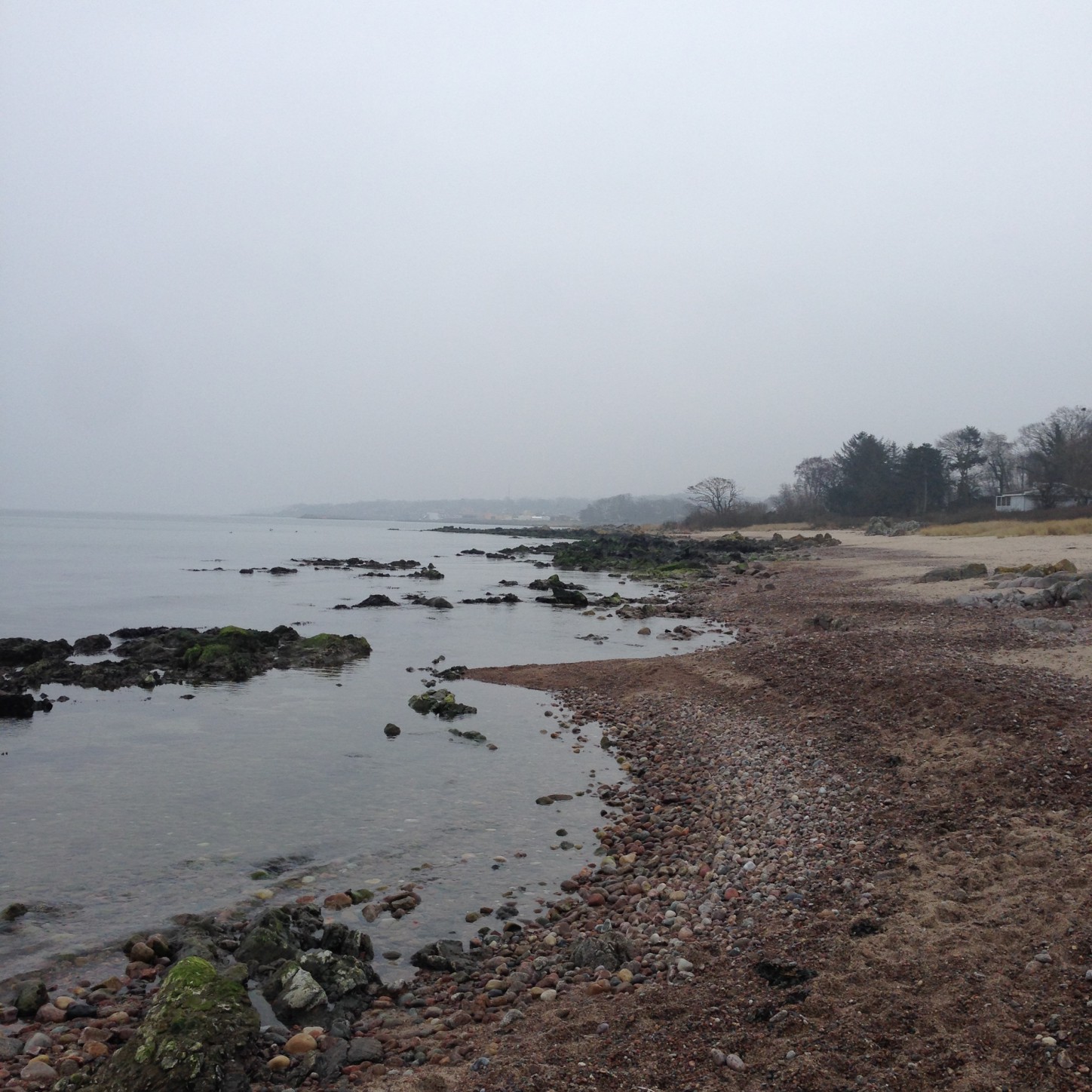
The view from the same spot to the right, towards southeast.
Today, Saturday, the sun was shining bright from early morning. I returned to the same path with a plan to record some of the magic views, the small coves and the cliffs covered with yellow lichen that I saw yesterday. Without the soft mist and the mellow shades at dusk the landscape was no longer magic in the same way. Merry and noisy people with children or dogs were walking along the path. Everything looked beautiful, but also mundane. I decided a new version of the horizon was unnecessary and resolved to begin by recording some of the benches I looked at on Friday, fascinated by the spots chosen for contemplating the view. It might be a good idea to take an image of the bench and then another image from the bench.

The view from the first bench I tried.

The bench itself, from behind.
In some places the benches were placed in such a way that it was impossible to get behind them to take a picture, but in several places it was possible to make an image of the view from behind the and then sitting on it.
A third approach, standing with my purple woollen sweater among the yellow cliffs at various distances, remains to be tried out – perhaps tomorrow.

The Tide at Kan Tiang Beach
Arriving at Kan Tiang Beach in the peaceful southern part of Koh Lanta felt like a relief, partly because it was nice to be in a small tourist village instead of the hustle and bustle of Christmas in a tourist town like Ao Nang, partly because the feeling of being in the countryside was inspiring. Looking at the tide coming in and going out on the rocky beach yesterday made me decide that I would want to record the tide somehow. And today my travelling companion wanted to go to a small rocky cove nearby, because that would be a good place for snorkeling. The morning was windy and I had no desire trying to do some snorkeling in rough sea – I have bad experiences of that before – but the idea of a small rocky cove sounded ideal for recording the tide, so I was happy to follow on the entangled path through the jungle. It was not far, but we lost the path and had to press ourselves through some heavy bushes, uh, and I was afraid I would never find my way out from there again. The cove was pretty and secluded, though. And I soon discovered the path from the beach, so I was not afraid of staying there on my own. It was only a few hours before high tide, and a small tree was standing in the middle of the cove, growing right from the rock, or so it seemed. It would be standing in water by high tide, I assumed. So I framed my image to include the tree, and used the horizon to divide the image into two halves, as I am accustomed to lately. Then I walked into the image and stood by the tree, and intuitively leaned against it, using it for support and comfort.

I decided to repeat the same image once every hour to record the changes produced by the tide and to use the time in between to record some images of rocks and water that could be combined into some sort of slow cross fade mix, perhaps. The tide never rose very high, and most of the day I spent recording the receding sea, which was not very spectacular, and searching for some shade in the intervals.
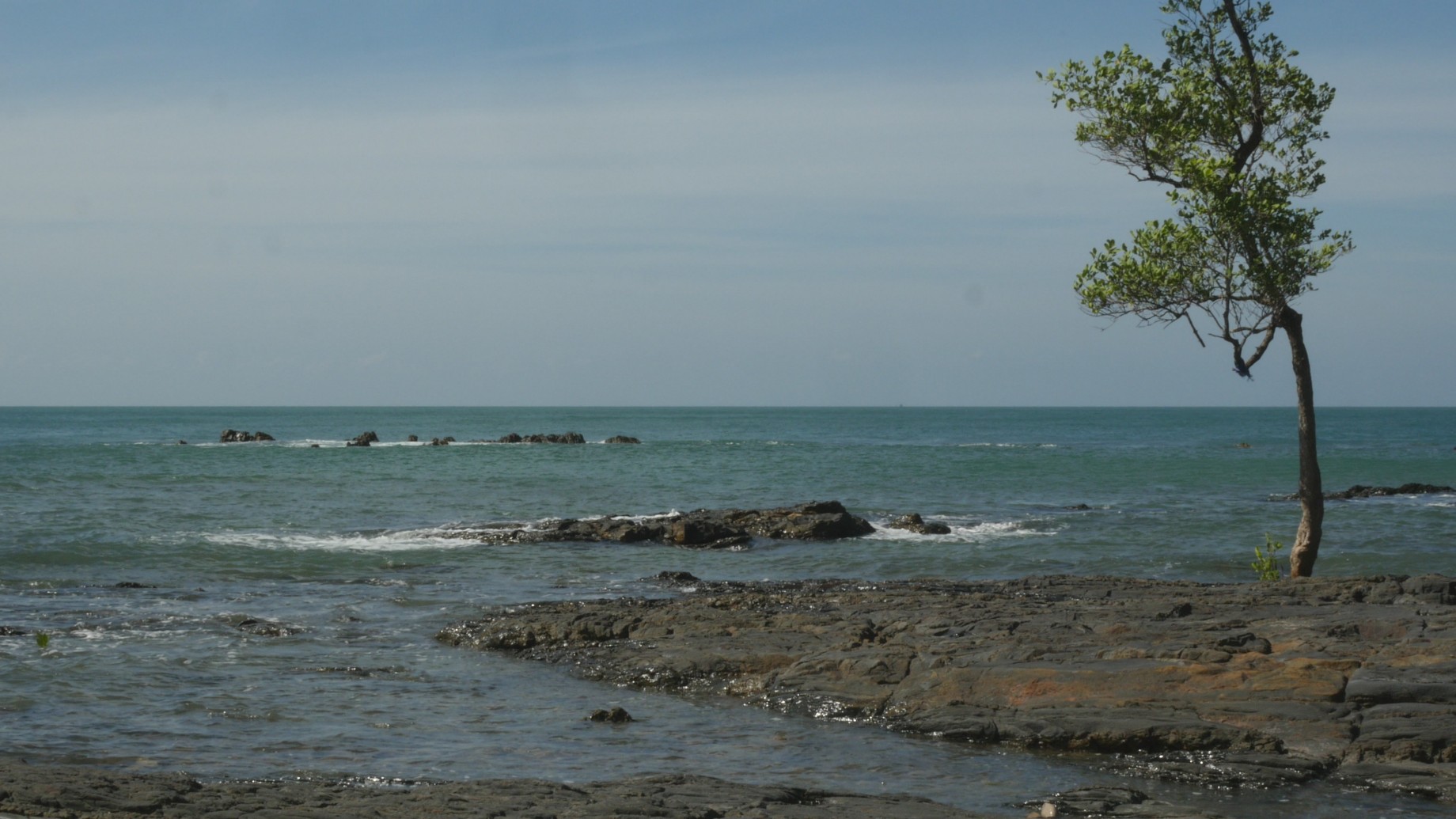

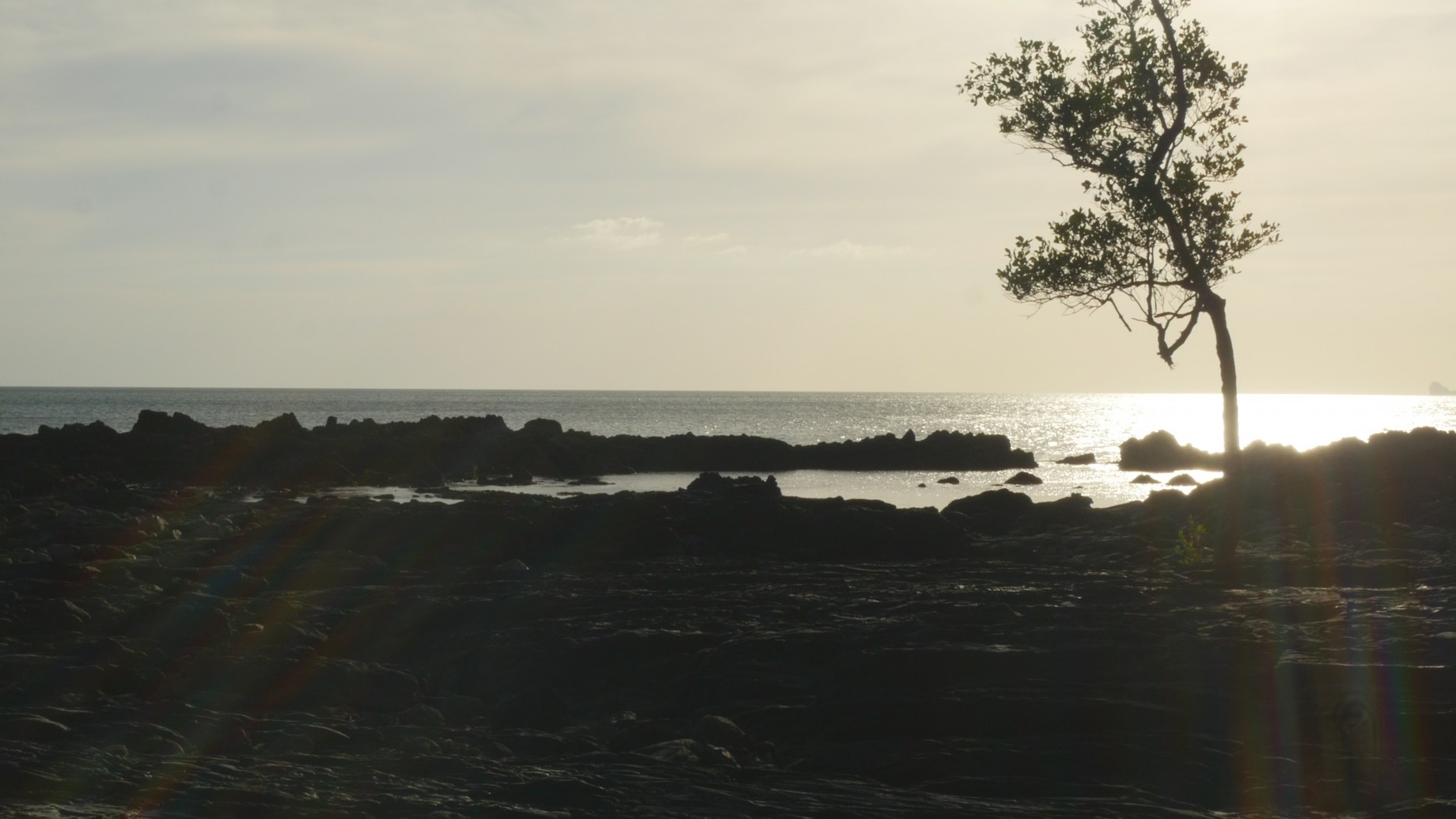
The day was rather hot and exhausting, but satisfying too. After I finished I tweeted that this was the first time in ages that I felt this might be something like a small work. In any case I want to go on working with the tide…
On Nopparat Beach
Ao Nang in the province of Krabi in Thailand is a crazy place to work “After Sugimoto”, or rather his “Seascapes” with water and sea in equal measure without any disturbing details, since the peculiarity, speciality and beauty of the landscape here consists of the karst islands rising up from the sea in the most weird formations. Moreover, the local long tail boats are dotting the sea. To look for an open and even, undisturbed horizon here seems rather funny. But that, too, is possible of course, since there is plenty of Andaman Sea to enjoy. I do not have my zoom lens with me, so it is not that easy to find a place with open horizon between the islands. What makes it even more difficult is the strong sunlight; it is hard to distinguish what is there, in reality, in the image, and what remains outside the frame. And although I walked to the more secluded, or let us say less popular beach, called Nopparat Thara Beach, there are still plenty of people around. I waited patiently for one couple to get up from the water, and put my tripod next to the waterline. Funny enough a local woman, or a semi local tourist, perhaps chinese or japanese, came to take a photo with her phone next to my tripod, as if trying to understand what I was recording. Her ‘thank you’ is audible at the end of the second take.
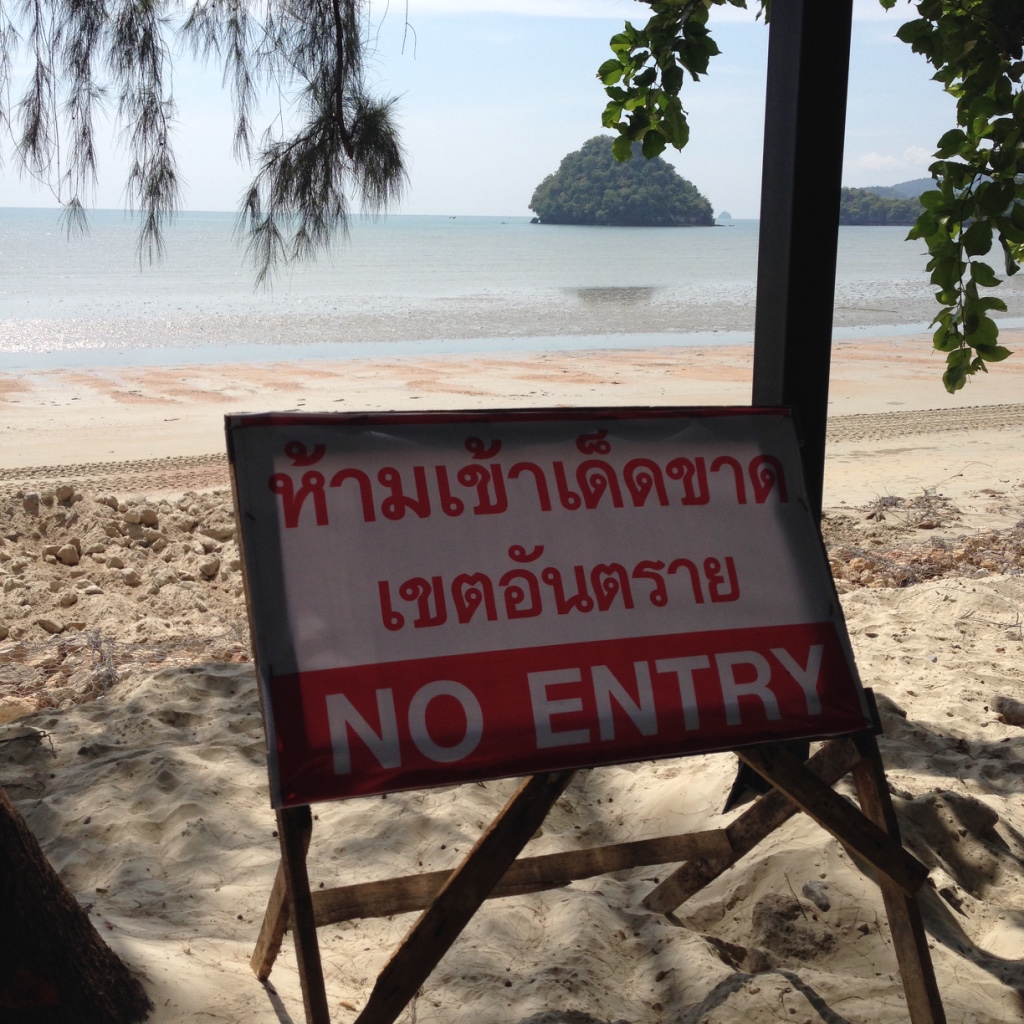
I walked along the beach until the gate to the national park at the end, and marvelled at the change of the landscape at low tide. There were plenty of warning signs declaring ‘NO ENTRY’ or ‘CONSTRUCTION’ and then also some information about the low tide, when you could easily walk to the small islands near the shore and also advice what to do if attacked by poisonous jellyfish.
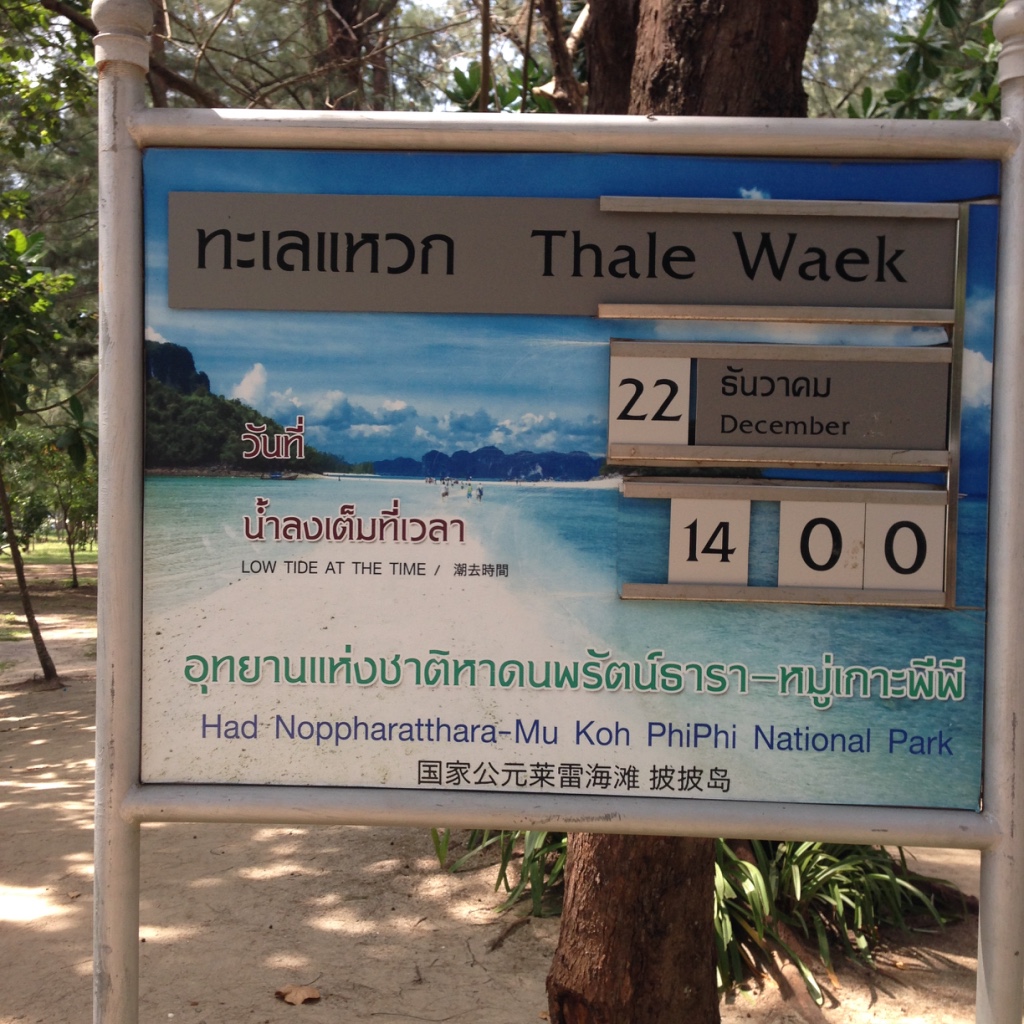
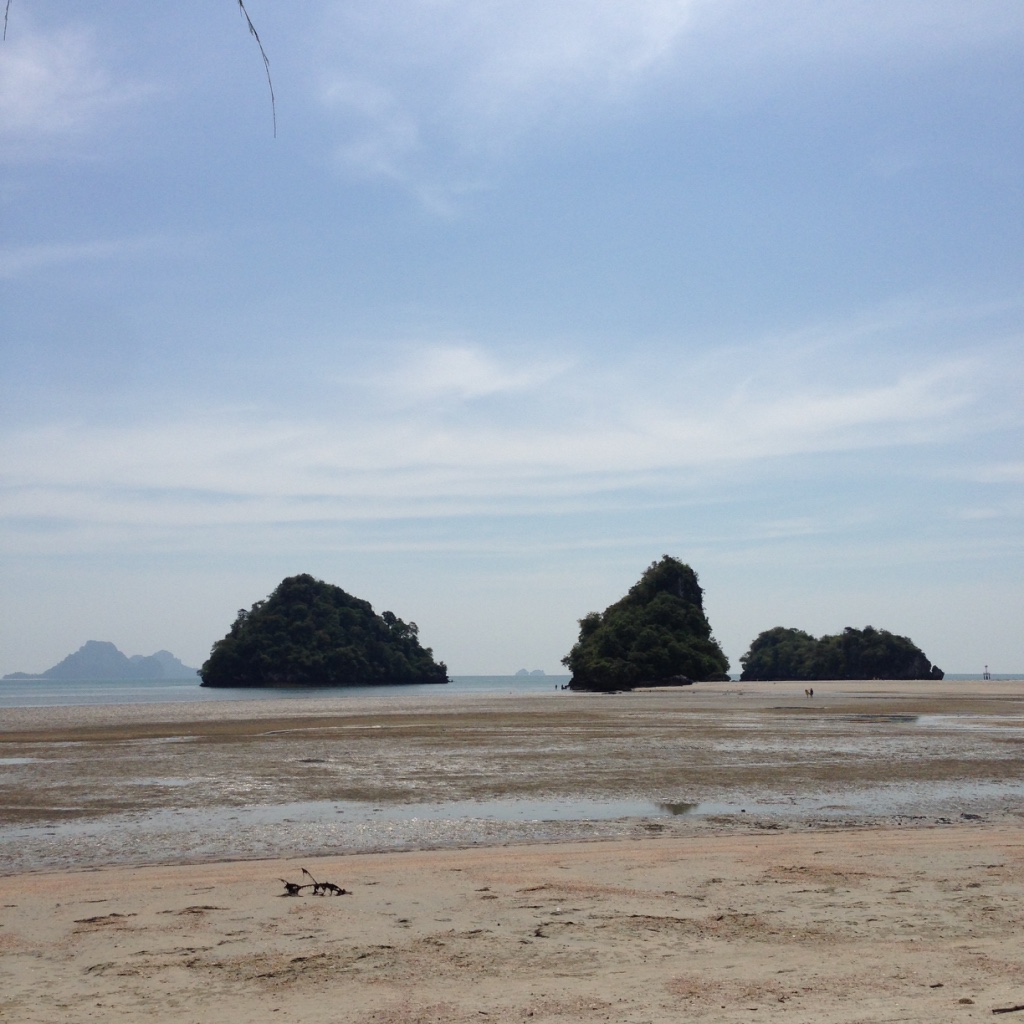
I was warned, and walked over along the ridge of sand, no short cuts through the mud. The rocks looked like strange houseplants rising directly from the sand. It was nice looking at the rocks at close distance, but there was nothing really interesting. On the way back, walking along the beach under the trees, trying to find some shade I stopped at a small pavilion and decided to document the view with all the hazy islands rising on the horizon, when a bulldozer suddenly appeared in my image, like some prehistoric monster.
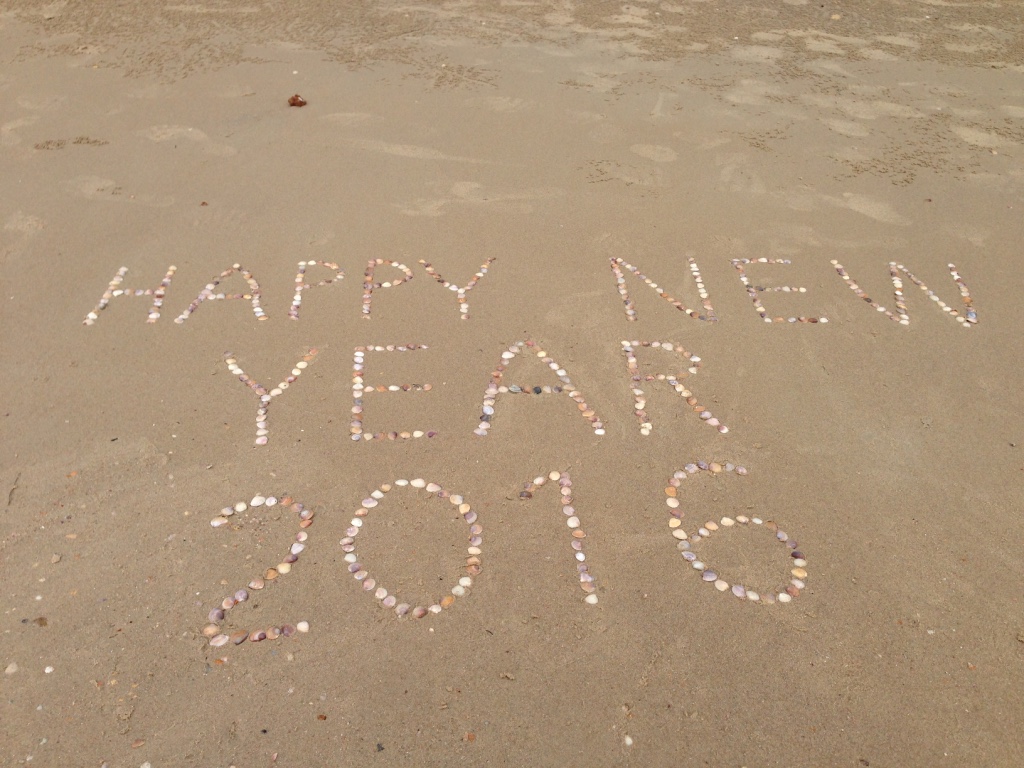
Besides doing my “After Sugimoto” images I tried to write “God Jul” or “Hyvää Joulua” in the wet sand. It did not look that good, really, partly because of my boring handwriting, partly because of the greyish sand. And I realized it might be a better idea to write Happy New Year, anyway! Why not. I thought I could try to write the text with the small sea shells lying on the beach, since I saw a love note written with them on the other beach yesterday, and it looked quite beautiful. I was too tired and sweaty after my walk to try any serious work, and chose to return home as soon as possible. But the next day I finally returned to write my Seasons Greetings. So here they come:
South of St. Kilda
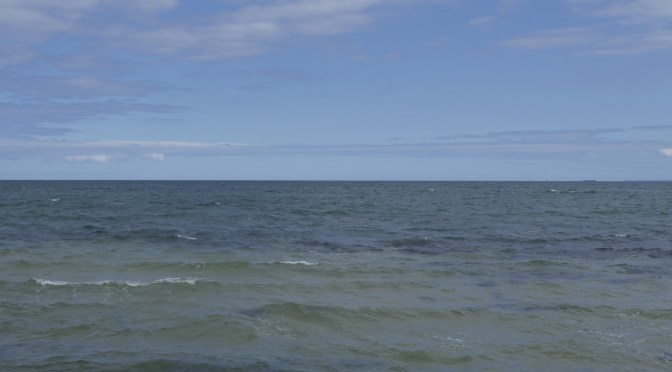
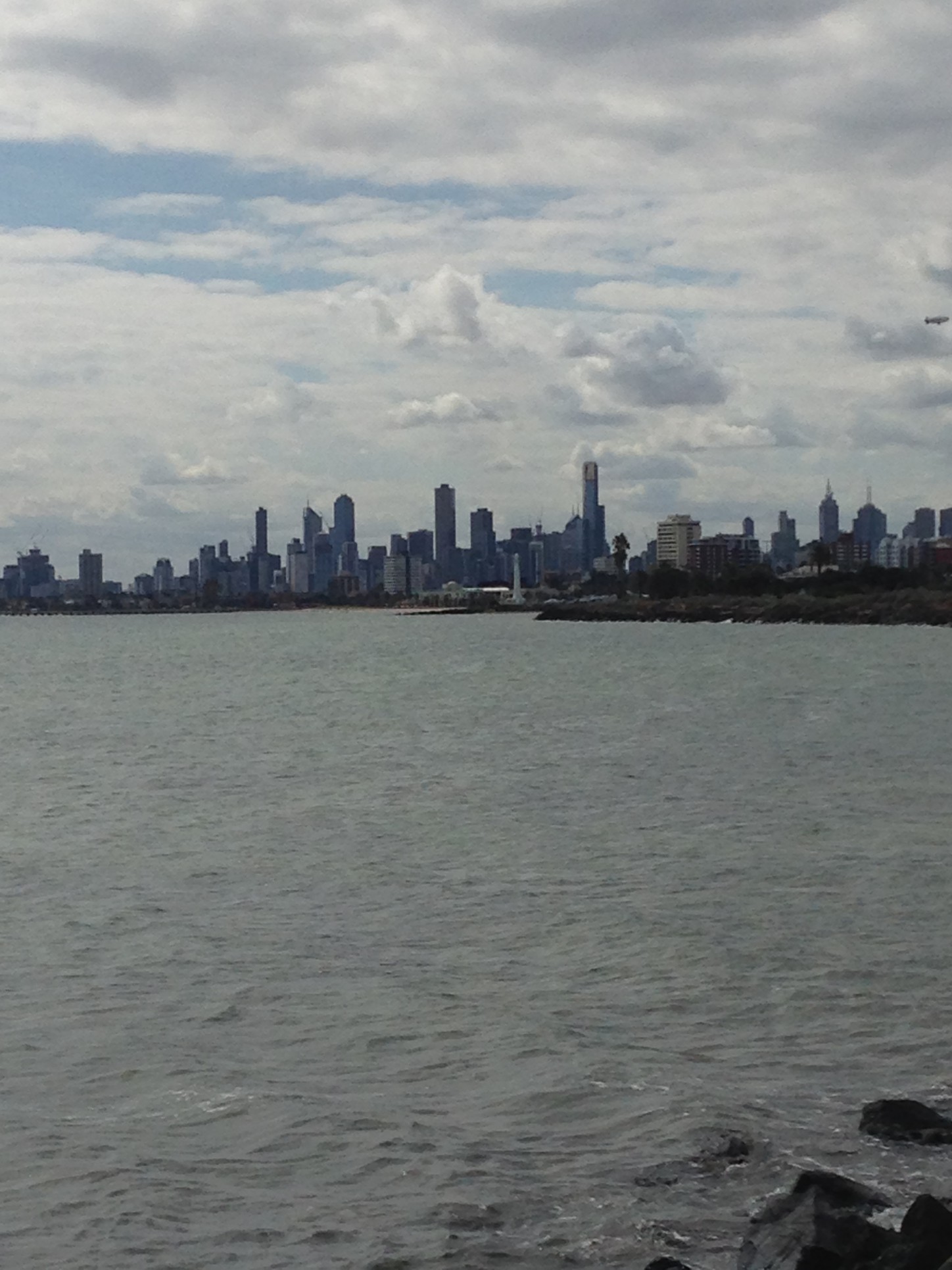
Missing the possibility of recording an ocean view from Southern Australia, or more specifically Melbourne, was out of the question. During my short visit to the conference New Materialism VI – matter, ecology, relationality at Victoria College of Art University of Melbourne I had no time to see anything except the city centre; no desert, no kangaroos, not even the black swans. But I really had to get to the ocean. So I jumped on the tram and headed for St. Kilda beach, the seashore of the city. On the way I listened to two students who were discussing doctors that travelled out into the desert with an airplane that was equipped like a small hospital, making brief stops in the villages to help sick or old people there. And I realized I had no idea of this vast country after visiting this one city, which reminded me of San Francisco, probably because of the trams and the cold nights. Once at the beach I was impressed by the fun fair atmosphere, the beautiful empty beach and the small marina, but there was no open sea view. I started to walk southwards, and asked an old lady for advise. She told me how to find the path that followed the shoreline. It turned out to be a double road, one for runners and the other for bikers. I walked for a while, until I reached a spot with what I imagined to be an empty horizon and made my image “After Sugimoto” from there. Actually I am not sure if the horizon was really open, or whether the other side of the bay was simply so far that one cannot see it with the naked eye. The image with the sea and the sky looked fine, though, with waves on the sea and clouds in the sky. When I turned back and looked at the horizon towards the North, I marvelled at the skyscrapers of the city of Melbourne. I returned with another tram, along another route, to see at least a glimpse of the city, if not of this huge country or continent that I really would like to explore one day….



Cami de Cavalls or How to Perform the Earth
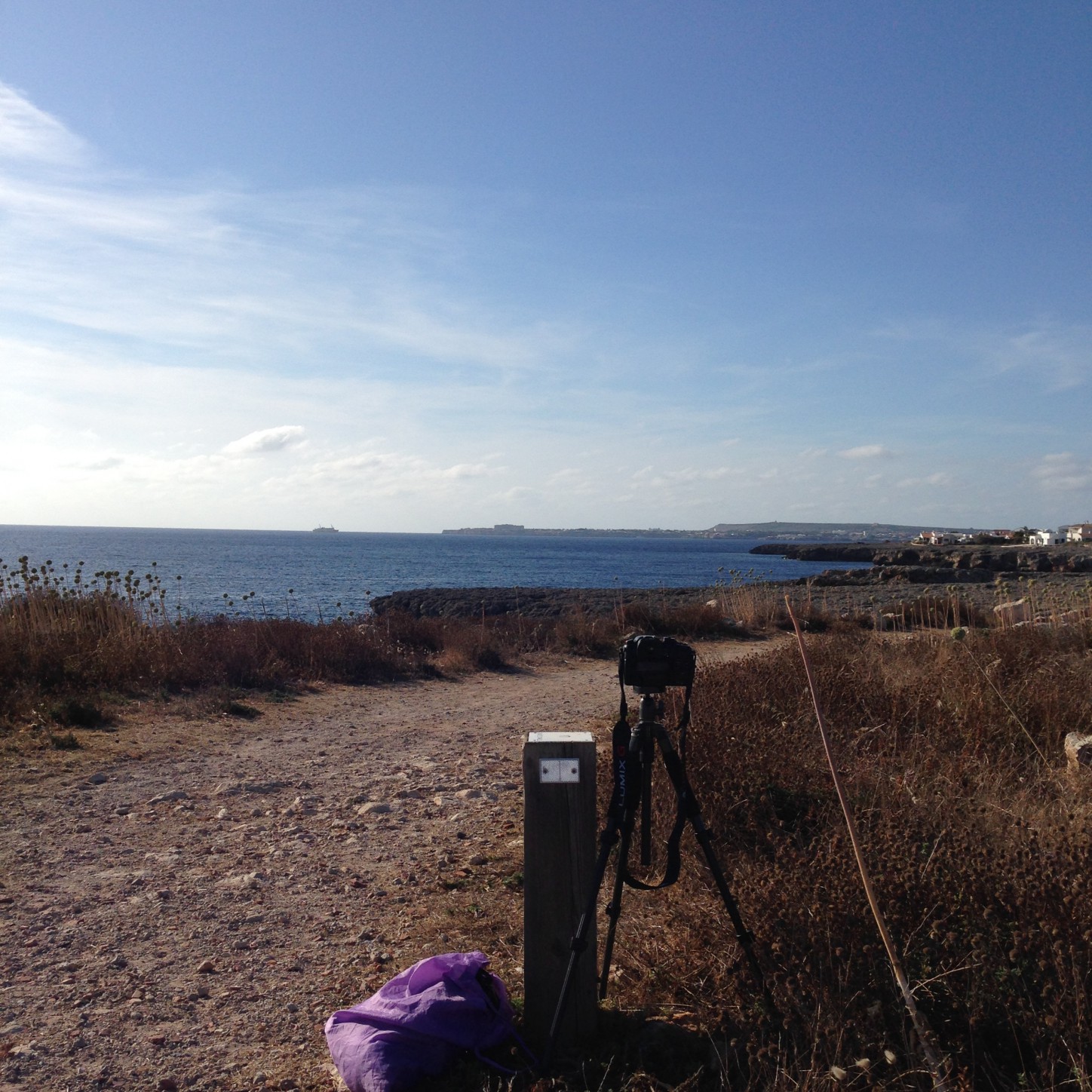
The phrase ‘performing landscape’ feels outdated and quite impossible to use after reading The Ecological Thought by Timothy Morton. Well, the notion of landscape has been controversial for decades, and I have felt the need to explain myself for using it more than once. But now, when my twelve-year project of performing landscape is long since over and done with (although it has not been shown anywhere in its entirety, yet) it is perhaps time to discard the term and find one that feels more suitable for my current concerns. So how about performing the earth? That if anything sounds pretentious, but if we are supposed to think big, as Morton suggests, then why not. And the earth is not only this planet, of course, it is also the soil, the ground, the sand, the stones and the rock I am walking on. But how to perform the earth? Simply by walking on it? For years I used to perform by placing myself in one spot and then returning to that spot again and again to show how everything looked different every time. And of course that technique is still available. Here, on the southwestern shore of Menorca, standing in one spot does not seem the right solution, though. There is a path called Cami de Cavalls circumventing the whole island, and today I walked nearly five kilometers following it, from Cala’n Bosch to Cala Blanca (or whatever the name of the next small cove and tourist resort is). I carried my camera and tripod with me, but did not make a single image. Well, a few snapshots with my phone, just for evidence.
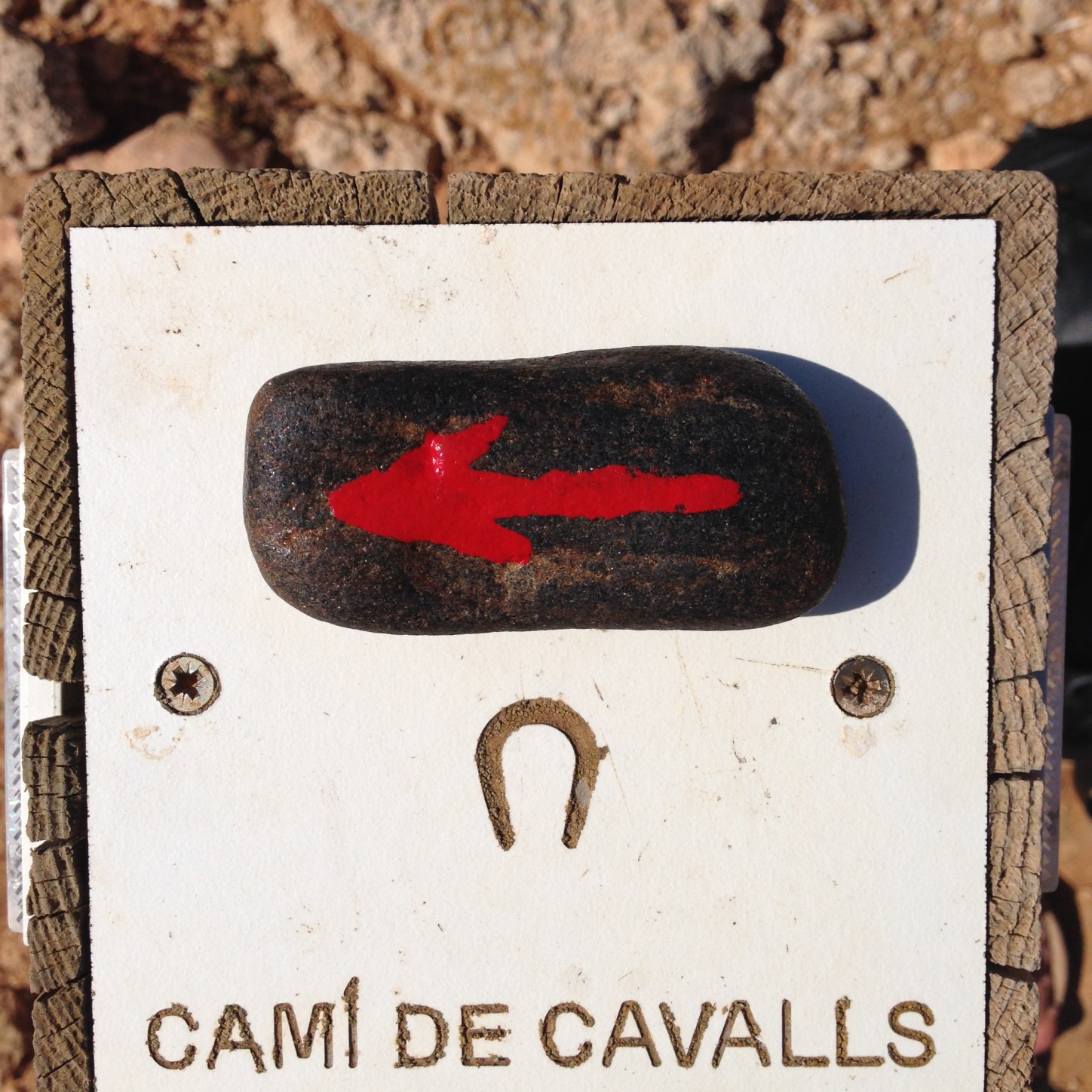
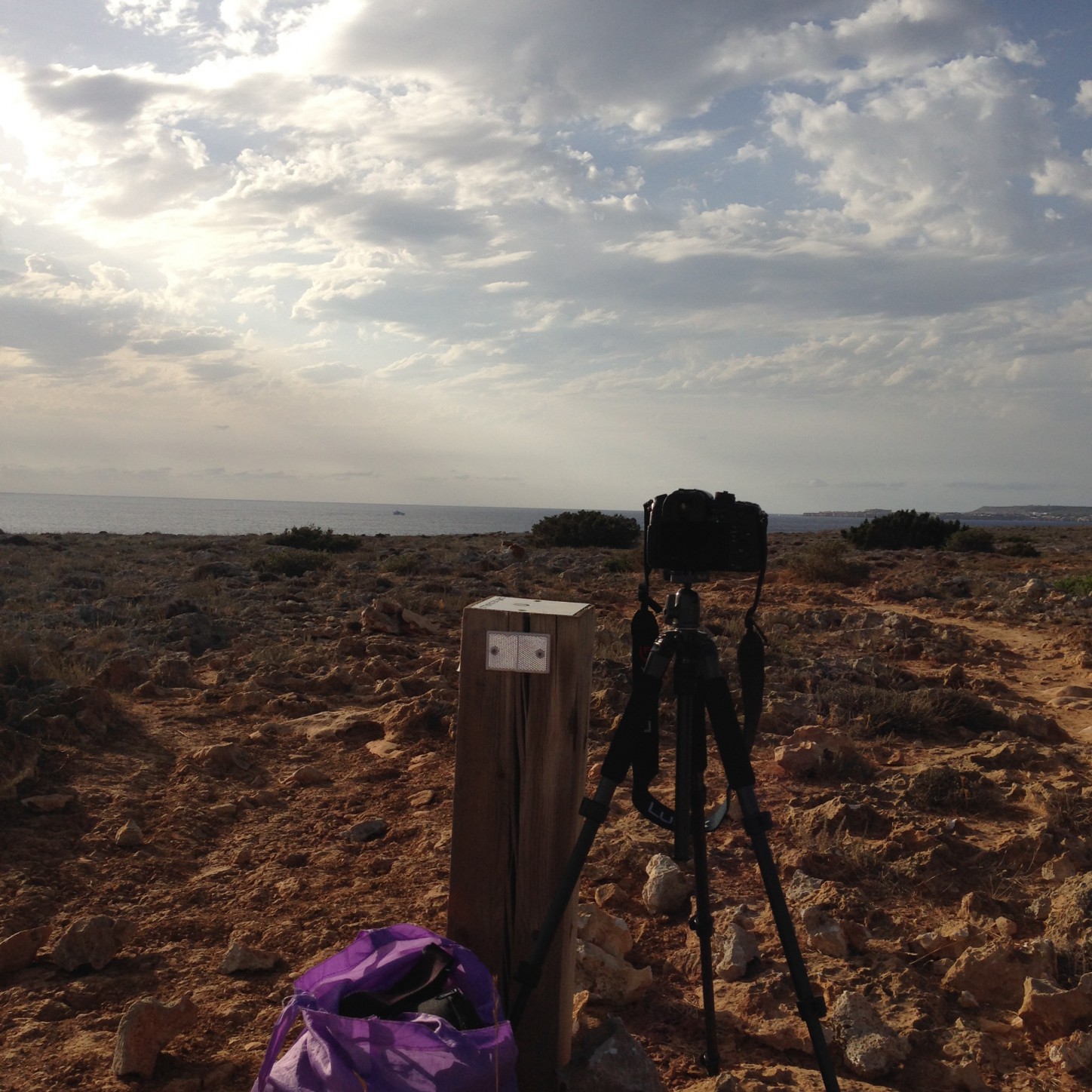
But I thought about alternative ways of performing that path, which follows the coastline and stretches along the rough surface of the cliffs with only a small detour further inland among bushes and low vegetation. One option would be to use the small poles that mark the path as a tool or “rule”, a system to follow, for instance by placing the camera on each pole recording the view along the path from there (and no need to carry the tripod then!). Or perhaps I should stand by each pole and record the image from the previous one, which is not always visible, though. The distances really shift. Or perhaps I should simply record my walk, as I did with my very first attempts in Ireland and in Farrera de Pallars in 1999. What seems clear is the fact that the path is the thing to be performed and recorded. It forms a continuous yellowish line across the land, revealing the soil, the earth, where people and horses have torn away the scarce vegetation. Not many signs of horses on this part of the path, though, neither excrements or signs of hooves. It seems mostly humans have used this path lately and while looking around, it is understandable. The views are great and the path is open, inviting everyone who wants a walk to follow it.

Today, Tuesday, I finally made an attempt. In the afternoon, around five o’clock I decided the sun was low enough to make it worth while to start experimenting. I dressed in a small dark sleeveless dress that I tied up – no scarfs this time – and walked to the start of the path with my camera and my tripod in a simple bag, no backpacks, no fuss. I made the decisions on the spot, like placing the tripod next to the signposts, on the right side facing forward along the path, and at approximately the same height, so slightly lower than normal, and with the horizon dividing the images in half. The gorgeous views of the cliffs and the sea were thus mostly invisible, but the path, the earth itself, the rocks and the soil would be in focus. I decided to walk to the next signpost, stand there for a while – long enough to repeat my ‘mantra’ – and then return to the camera. And then move the camera to the signpost where I had just stood, repeating the action by the next post. This way I walked along the path, returned, walked again with the camera, and so on. I had no idea what it would look like, and whether the next signpost would fit within the frame, since often I could not see the post while placing the camera. When returning home, taking a quick look, the images looked fine. So this is the way to continue tomorrow, or the day after, in the evening light. Perhaps it could become a triptych, walking forwards on the left, standing still in the middle and returning on the right – or then simply a continuation, walking and walking and walking on…

Today, Thursday, I continued my experiment, using the same principles as on Tuesday, starting out around five o’clock. It was easy to find the gate where I finished last time, and now I continued in the wooden part, “metsätaival” as I called it in my mind in Finnish. The brushes obstructed the view of the path, and the sky was covered with clouds, so a few of the images felt really sinister. To make matters worse, there were a lot of bikers and runners on the path, and because of the shrubs I could not see them from a far. So I had to repeat several of the takes since I did not want anybody suddenly jogging in the image. The bushy part of the path ended with a gate, and I thought of finishing there for the day, but the view looked so beautiful and the sun returned, so I went on for a while. While walking I thought about why this rather mechanical way of performing felt so right. With mechanical I mean the system that makes the decisions for me. No need to wonder where to stop walking and stand still for a while, since that is determined by the signpost. And no need to wonder where to place the camera, since that is determined by the signpost, too. And by avoiding all these aesthetic decisions I could focus on enjoying the walk, as well as trusting that the sum total of the decisions made by this “system” would result in a more accurate representation of the path than if I would have tried to find the most pleasing spots to stand and the most interesting views. Of course I could have chosen an even more mechanical system, like using equal distances by counting steps or something, but using the sign posts seems like a more interesting option. Sometimes I could not see the next signpost and would just keep on walking, trusting that it would show up soon. And so it did. And this way I finally solved the problem that has irritated me so often; what I see and what the camera sees are two very different things. Now the camera will see the same view as I do, when I move it to the point where I stood before. Well, since the camera is lower, at the level of my hips, the view is of course not really the same, but closer anyway…
Today, Friday, I continued, and was prepared to finish the project, since they had promised a thunder-storm for tomorrow. Well, I hope that will not happen, since I need to continue for a while. I proceeded rather close to the next village, with the buildings clearly in view in some images, but then the clouds covered the sun and there was less and less light and finally I realized nightfall was quickly approaching. To make matters worse my memory card was full for the “last” image, which was rather dim anyway. Part of the delay was due to people walking their dogs or jogging or whatever, which forced me to wait or to repeat the action. Part was simply my miscalculation. I really had to hurry to get to the village before it was dark, although I felt reassured by the thought that since it was full moon it would not be completely dark. It was very good that I did not try to return the same way, since it was already night when I reached the pavement of human habitation. Then a bus to Ciutadella, and another one from there to Cala’n Bosch. What a trip! But I sure want to make a fourth attempt tomorrow, to finish the path…
Saturday, last session, and starting with thunder. I left already around three o’clock, since the sky was overcast, so I could as well start earlier, I thought. Near the roundabout on the way a sudden rainfall with thunder suddenly struck, and I spent half an hour with an ice cream in a bar nearby. The sky looked ominous, but when the rain was over I decided to continue, and walked across the cliffs hoping for brighter skies. And yes, by the time I was near the place where I stopped videoing yesterday, the sun was already out. So I started my fourth session in full sunlight, and remade a few of the last images from yesterday. The remaining part of the path was quite long, after all, and some of the images I had to repeat because of frequent passers-by. But it was nevertheless not yet seven o’clock when I was done. And instead of going to have a drink in a bar in Cala Blanca, I decided to walk all the way back, to enjoy the views at a leisurely pace for a last time. Oh dear, it was an exhausting walk. I forgot how long it feels, when one’s feet are sore from stepping on all those sharp stones. The sun was low, so the heat was not bad, but my water was finished and I was, well, exhausted. But I made it, and now I write this at the bar Es Far d’Artrutx. It’s done! Hopefully this will become a finished work, too. And perhaps this way of performing the earth, simply by walking on the earth, will become a new practice to continue…


Artist’s Book – Diary
The artist’s book has not been a personally relevant notion for me. And it has no direct connection to performing landscape. I am proud of the books I have written (two) and the books I have edited (five) and of the web-publications I have been editing with others and in general of all the texts I have written. However, when the artists on Harakka island decided to make an exhibition of artists’ books I wanted to join of course. And without much thought I decided I could participate with some kind of diary. And I especially did not think of it as a video diary, although one could think of the video works I have created on Harakka Island as video diaryies, too. The diary should be a material object, either a notebook bought from a shop (one such I did fill with daily I Ching drawing, but rejected as too easy), or then a pile of paper somehow made into a book.
For a while I had made ”the drawing of the day” each morning, and now I decided to develop this practice into some kind of result. First I drew the phases of the moon, with my ”inktense” pencils, which you can spread out and thin out with water and a brush. Then I started drawing horizons, simple combinations of two colours. And finally I ended up filling small watercolour sketchpads in such a way that the backside of the previous page and the actual page functioned as mirror images or opposites to one another (see image above and below). And in the upper left hand corner I wrote the date with a pencil. To begin with I experimented with placing the horizon on different levels, but soon ended up placing it more or less in the middle. Perhaps this was a result of my video project ”After Sugimoto”, which I started around the same time. His seascapes are divided exactly in two, one half is sky, and the other half is sea. At some point I planned to try all the possible colour combinations of my set of colour pencils, but soon realized that the ”book” would become much too thick. Thus my diary consists of drawings from 17. February to 5. June.
The real problem turned out to be how this pile of paper could be bound or tied or somehow compiled into a book. I planned to take the pile to a shoemaker and ask him to make some holes, so I could tie it myself. A fiend recommended a professional bookbinder, but I hesitated, since the papers did not have any margins for binding. When I finally dared contact them it turned out that they were on holiday. Luckily, I thought. But how to bind the book? I tried with a needle and thread, but the paper was thick and the needle bent. Finally I ended up sowing the papers together one at a time. And because I did it haphazardly, carelessly, the result looks rather funny, or actually clumsy. But why could not a diary be clumsy?
Funny enough, the first art exhibition I ever participated in consisted of diaries, curated by Hannu Gebhard for the Kluuvi Gallery in 1989. There I showed a notebook that was pierced by three holes and tied with wire and three Chinese coins. At that time my diary was irrevocably closed to others and to myself as well. Now my diary is open although it consists only of colours. An a little bit of black thread…


More information about the exhibition Kirjatekoja_English_tiedote+avaj and also here.
Looking at the Mediterranean Horizon
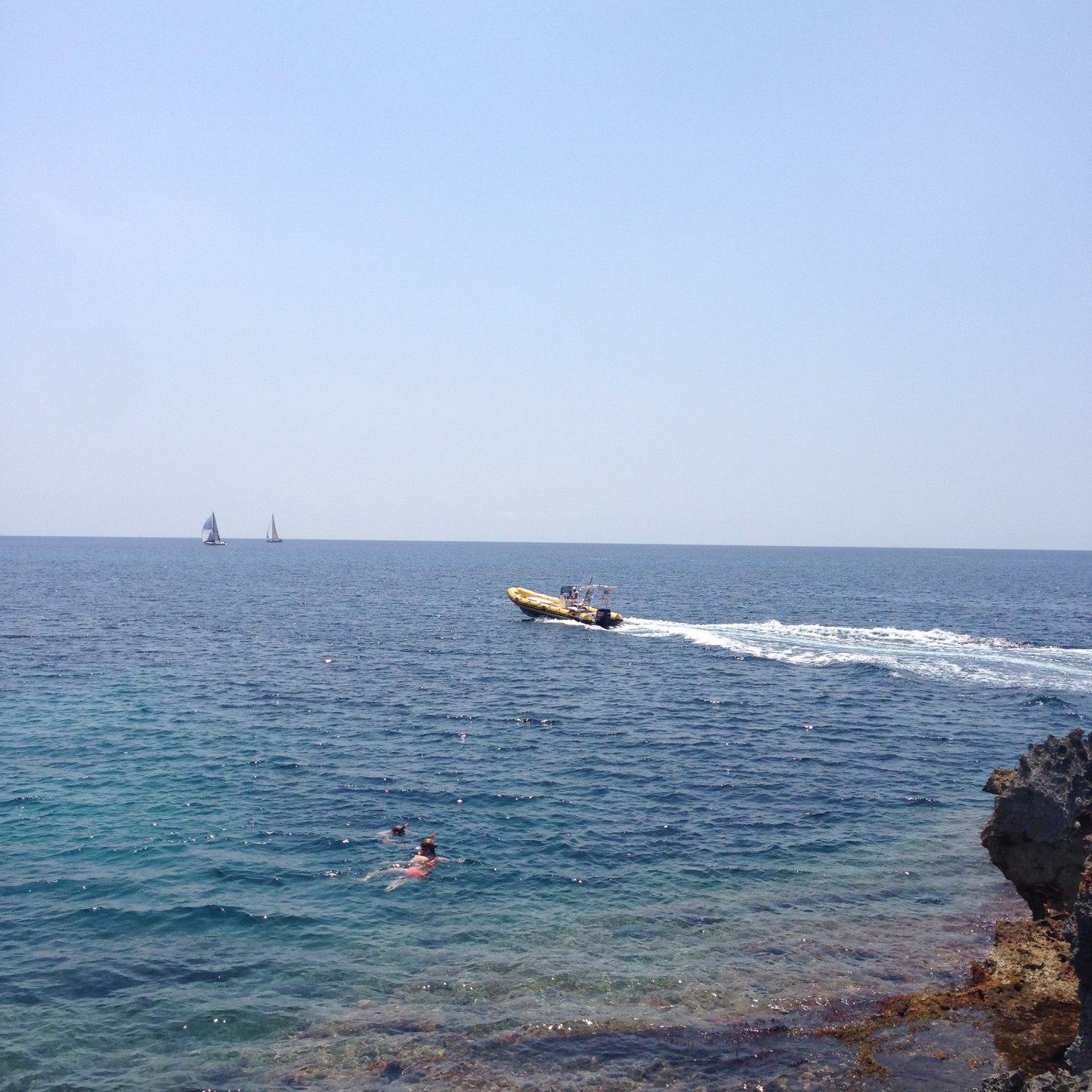
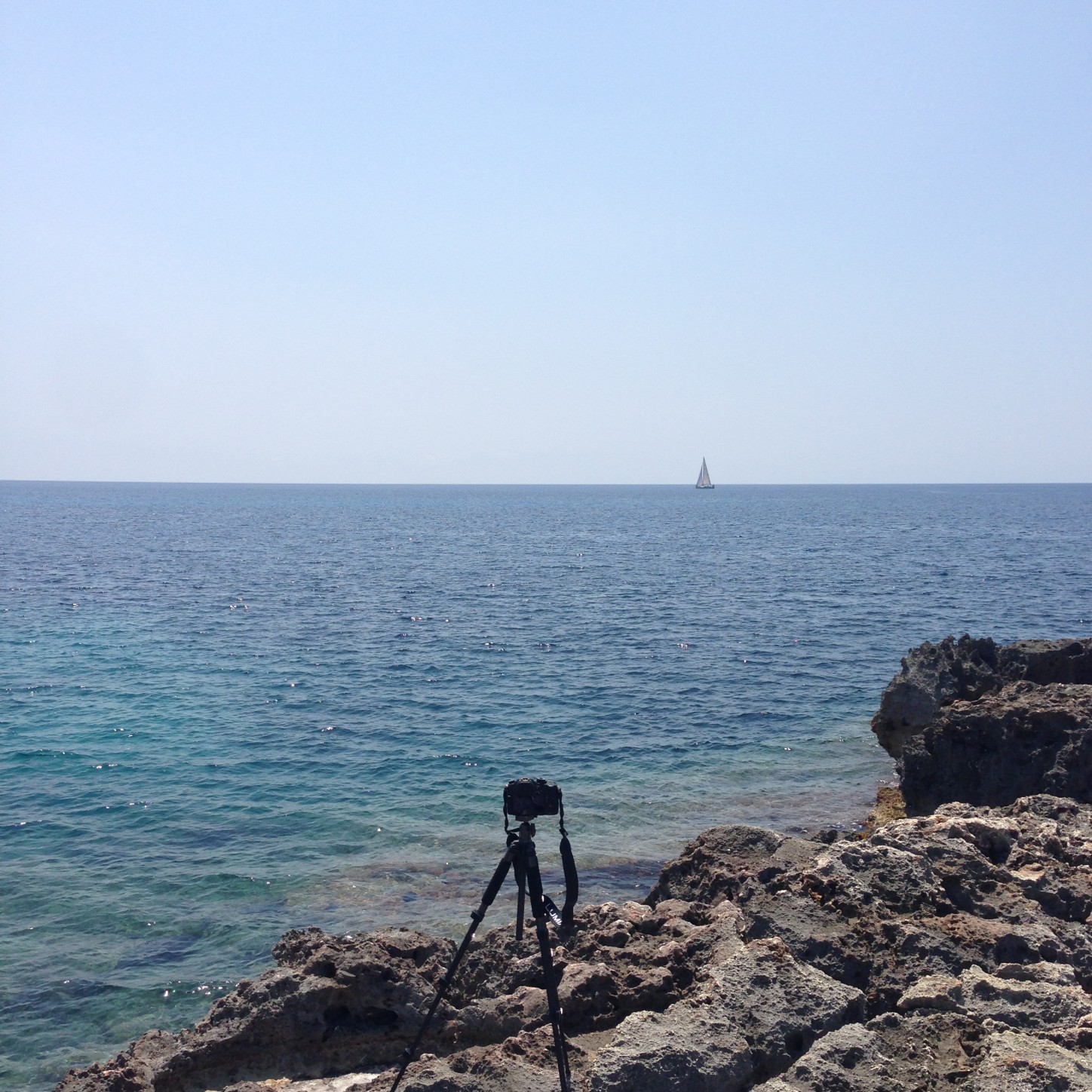
Arriving in Cala’n Bosch, a tourist resort on the west coast of Menorca, I immediately took a walk to the shore and looked at the open sea view thinking, this would be an easy piece. Just pick your spot, since there it was, everywhere, the open horizon. The blue Mediterranean Sea was spreading out in front of me undisturbed by islands, piers, boats or anything. So on Monday afternoon I took my camera and tripod and headed down to the shore, to the same rocky spot I first saw when arriving. I thought that would be a place where people would not be lying on the beach and I would not have to be embarrassed carrying a camera amongst them, as if wanting to document naked flesh or whatever. I walked out on the cliffs, which were surprisingly sharp and uncomfortable to step on, and found a place for my tripod. But to my horror, I saw a spot on the lens. I had my camera cleaned just a while ago, so this seemed like an ironic twist of fate. I did not return back to search for a vacuum cleaner, but resorted to my handkerchief in order to remedy what I could. And it helped a little bit, yes. But now, by the time I was all set up, a boat came by, so I waited for the waves to pass, and then another boat. And then a rubber boat parked right outside the cliffs, and I thought they might start diving or something, so I decided to move. But when I had packed my things and walked halfway up to the road, the boat started to move again, so I returned. Finally I managed to record almost three minutes of the view with an empty horizon, half of the image sea and the other half sky, à la Sugimoto, before two sailing boats showed up. Funny enough, even with plenty of empty horizon, recording it might prove to be a challenge.
The real challenge was nevertheless ahead of me, that is, finding enough of an Internet connection to be able to upload these images and this text as a blog post. It took me two days.
 Performing Landscape