
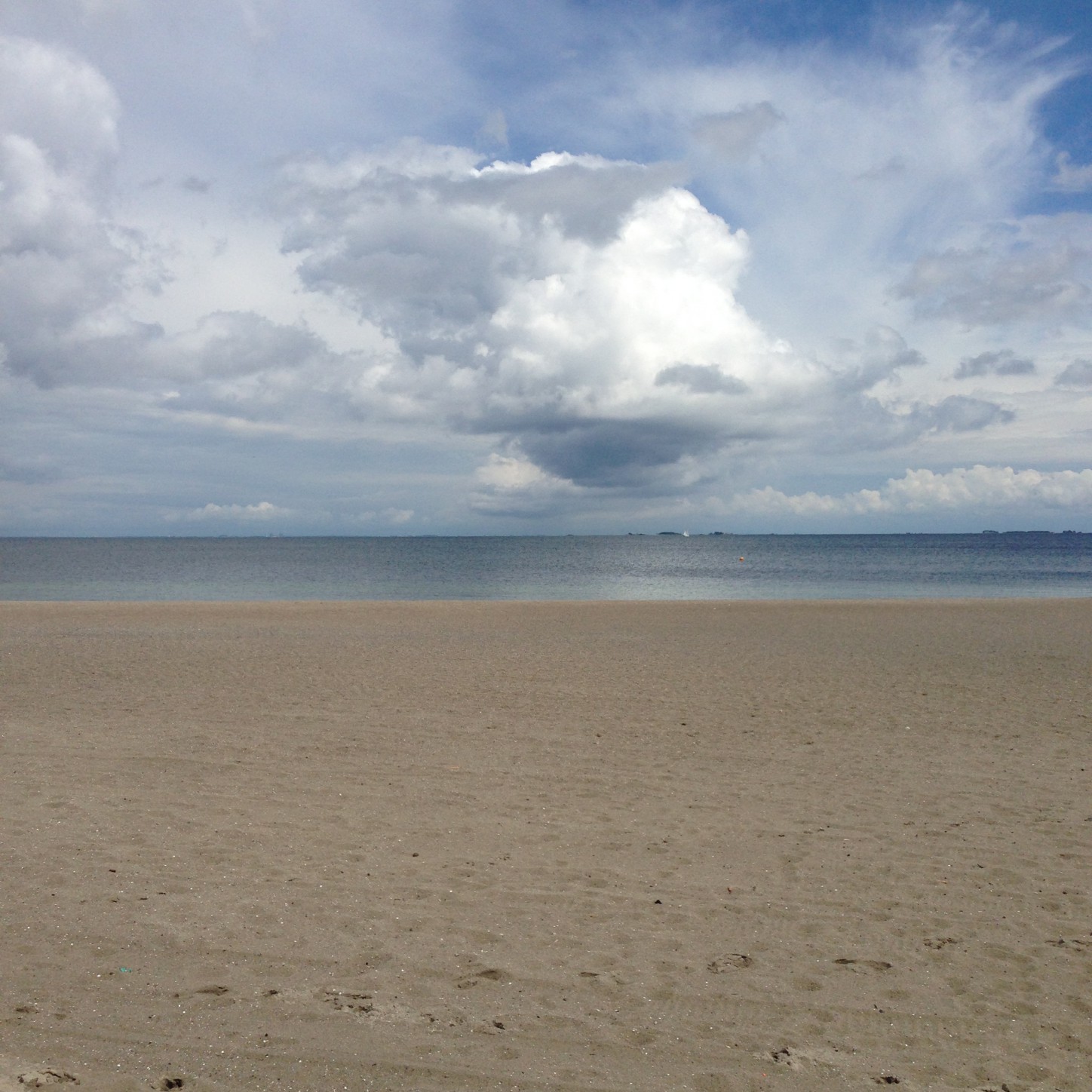
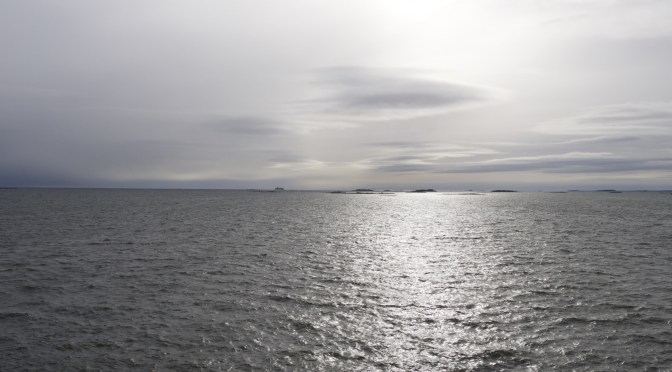
The initial get-together and the first key-note presentation of Fluid States North, which is part of the all-year and all-around-the-globe event Psi #21 Fluid States took place in a beautiful wooden bath house on Amager Strand, a recently renovated beach area in Copenhagen during midsummer, 18-21 June 2015. Unfortunately the weather was not the best possible, with drizzling rain and a chilly wind, so the experience had an element of endurance performance to it. I decided immediately, however, to return to the spot with my camera after the conference, in order to look if I could find a slice of an empty horizon.
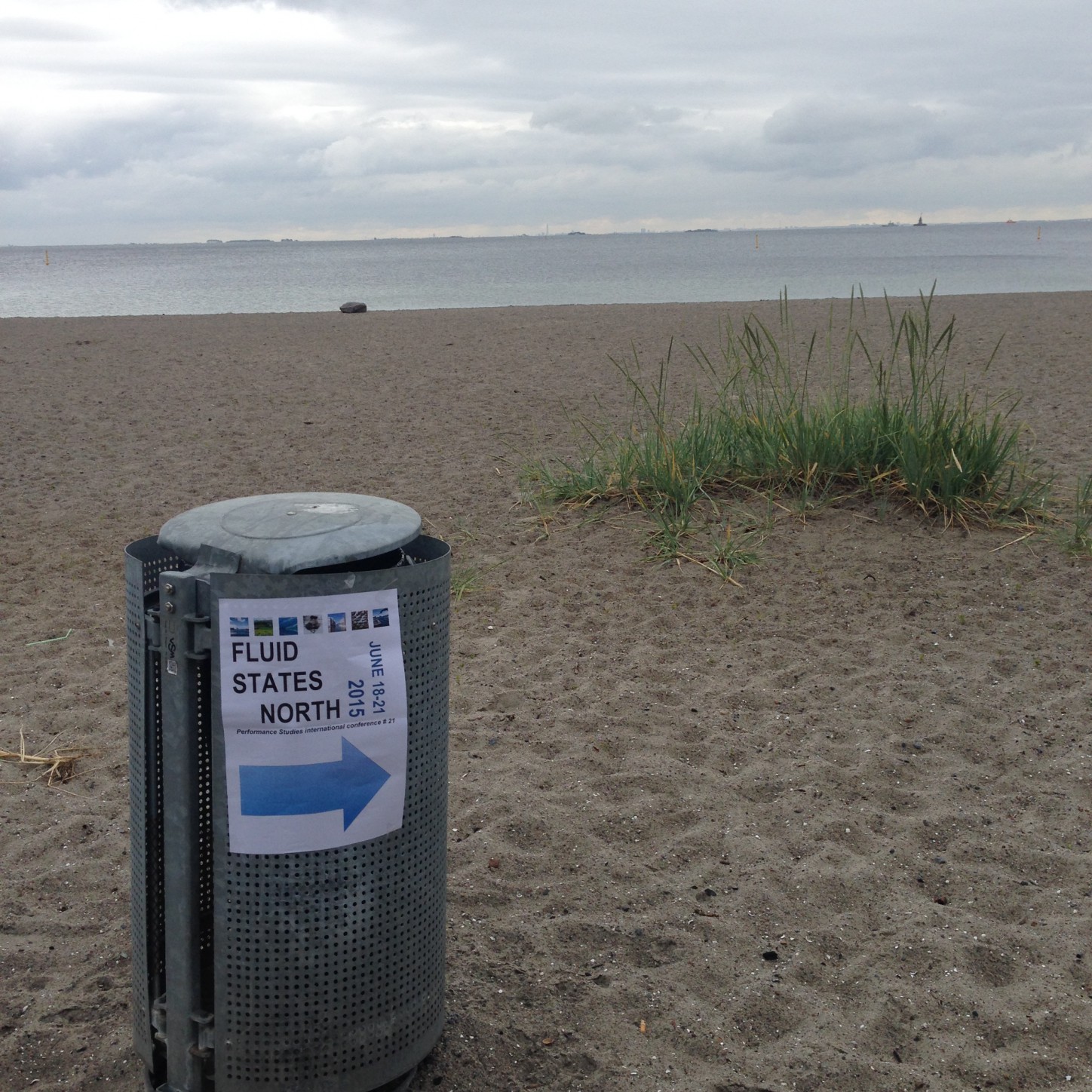
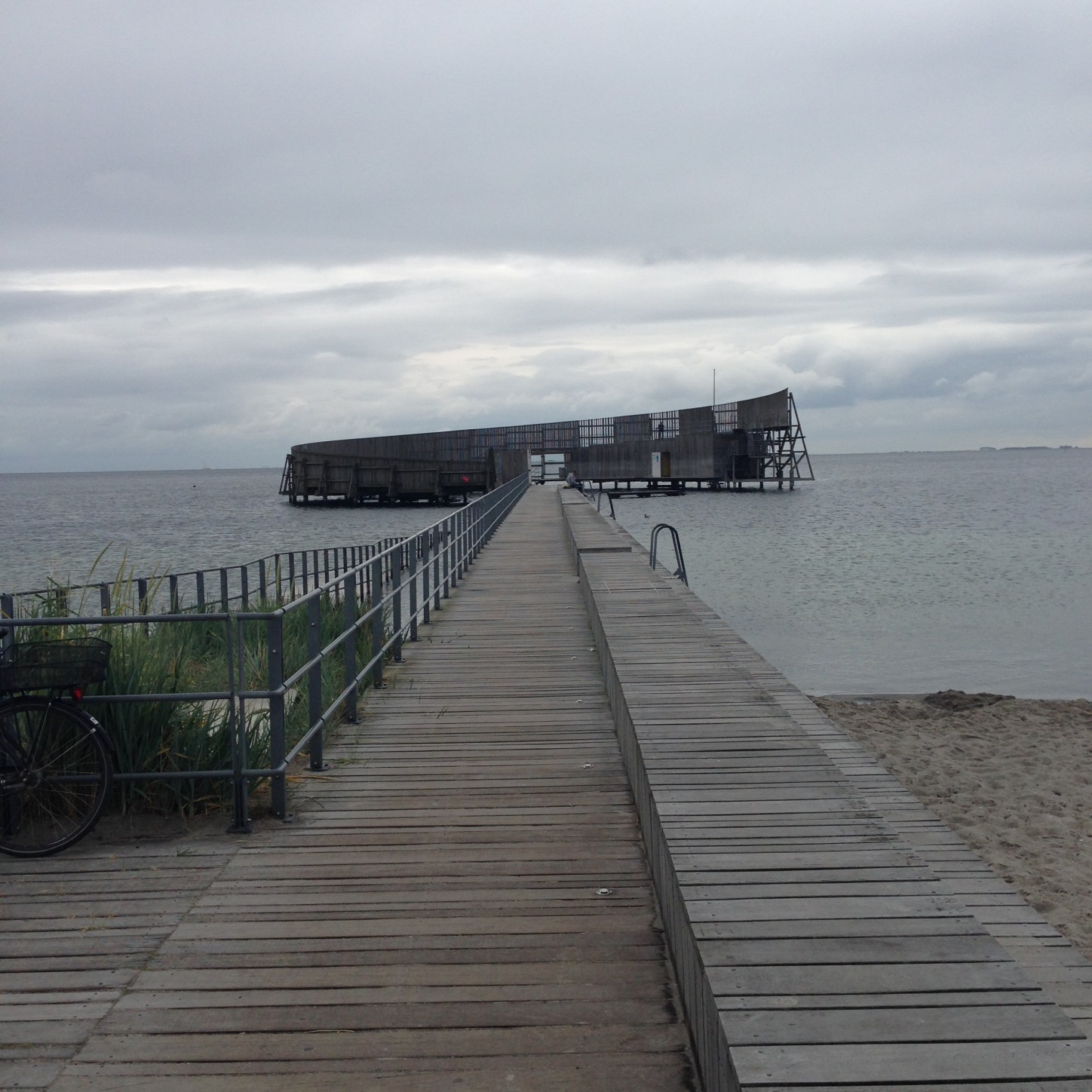
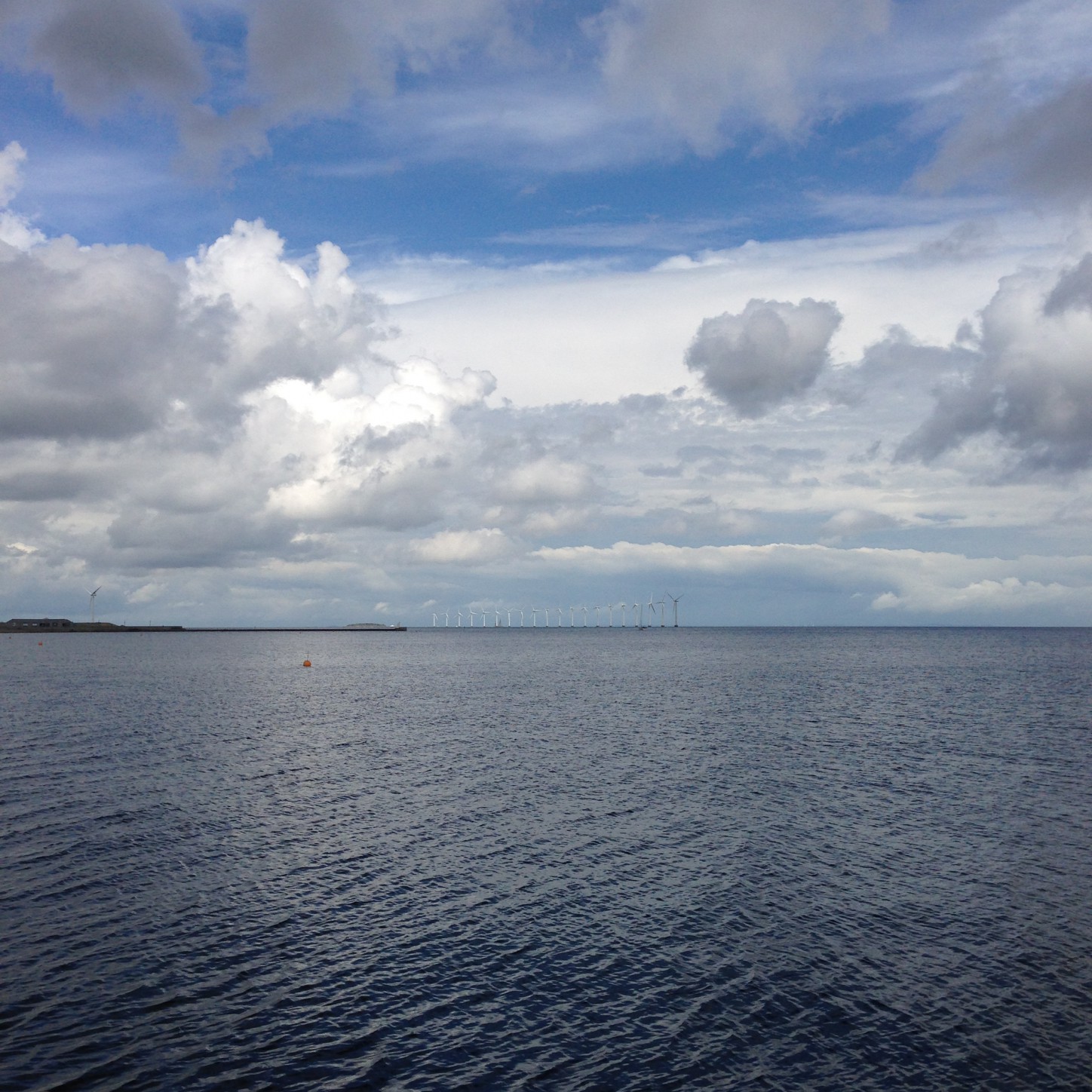
And that I did this afternoon, Monday 22nd June. After a rainy morning the sky cleared at least partly and there were moments of sun when I stepped out from the Metro at Femoren, a stop between Amager Strand and the Airport. And the mud in the adjacent park and the noise from people taking down something that looked like the stage of an outdoor concert from the weekend before, the place was much more inviting, and looked almost like a beach. There was nobody on the beach proper, of course, midsummer in Scandinavia is rarely suited for such activities, but some people were enjoying the walk. And nobody was disturbed when I walked out to the small pier and placed my camera on a tripod on the large boulders in order to find a spot were no islands or windmills or boats or the famous Orebro bridge in the distance would intervene with the horizon. The clouds were dramatic, though, and no evenly grey image like the one captured on my iphone during the first visit could be created this time.

This time – one more attempt to begin the series of videos with the working title “After Sugimoto”, referring to Hiroshi Sugimotos’s famous Seascapes – I was using a new objective in my camera, and now the camera was properly cleaned by a professional, too, so presumably no dirty spots on the lens would disturb the view. It was not so easy to find an “empty spot” on the horizon, but I think i almost succeeded this time. The windmills to the left and the bridge to the right were hopefully cropped out of sight. While standing on the rocks, as immobile and silent as possible during the recording I listened to the surrounding sounds, inspired by all the recordings on Amager included in the audio papers I heard at the presentation of Fluid Sounds yesterday. At least the music listened to be the roadies taking down the stages on the shore, the airplanes landing on the airport nearby, the signal beep of the trucks backing, and occasional sounds of people passing by, talking, as well as the soft splashing of water against the rocks next to the ripped were easily discernible. Perhaps i should try to use a proper microphone and record the sounds for my videos in a more conscious and deliberate way…
All posts by Annette Arlander

The Cleft of Hell
One of the main attractions in the Helvetinjörvi National Park in central Finland is the narrow gorge called Helvetinkolu (Hell’s cleft) that leads down to the lake. More about the park and the famous cleft here. Hiking in the area with a friend during the weekend and enjoying the various forest types and many small lakes next to each other was not meant as a working trip, although I did bring my camera. And the small stone with the red arrow, of course.
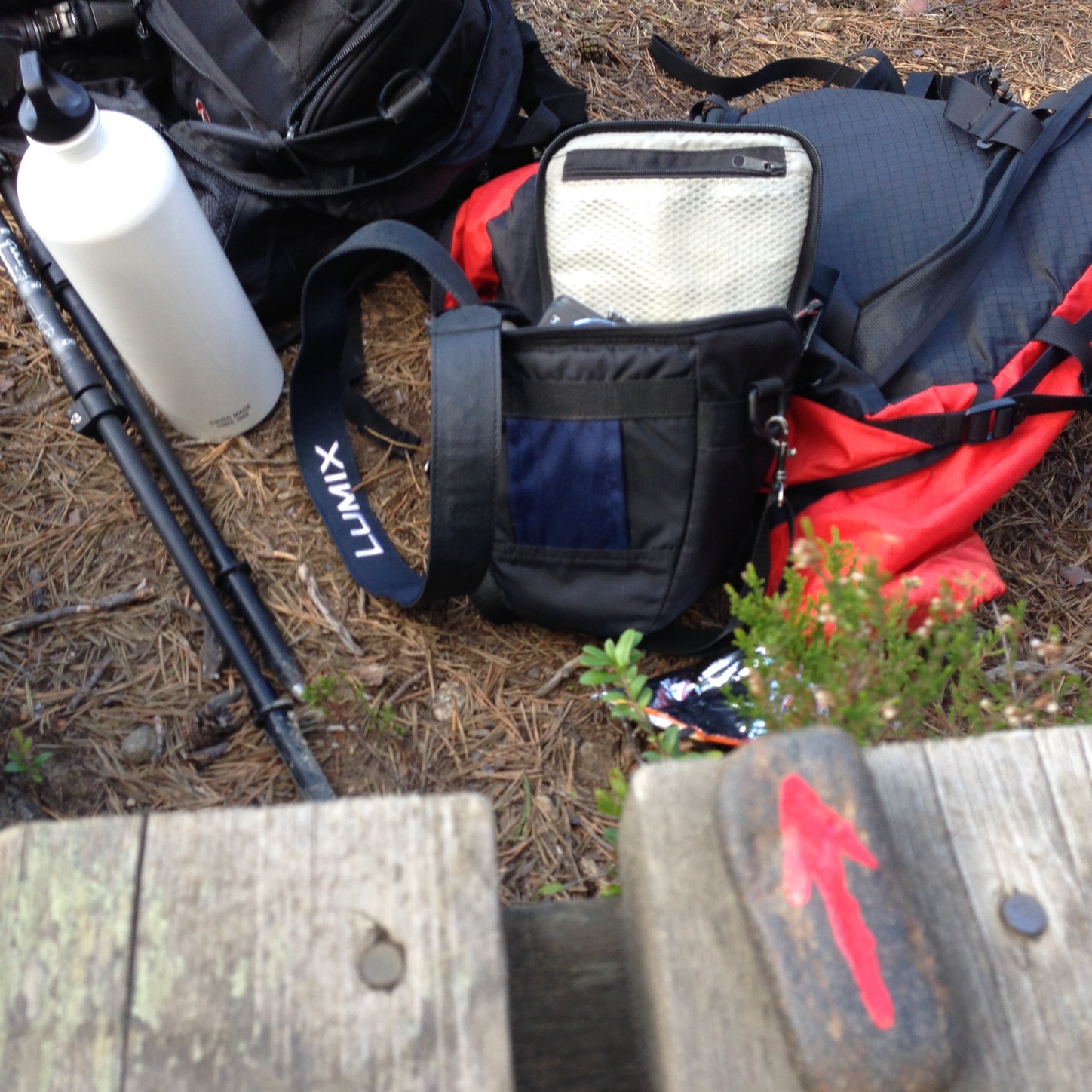
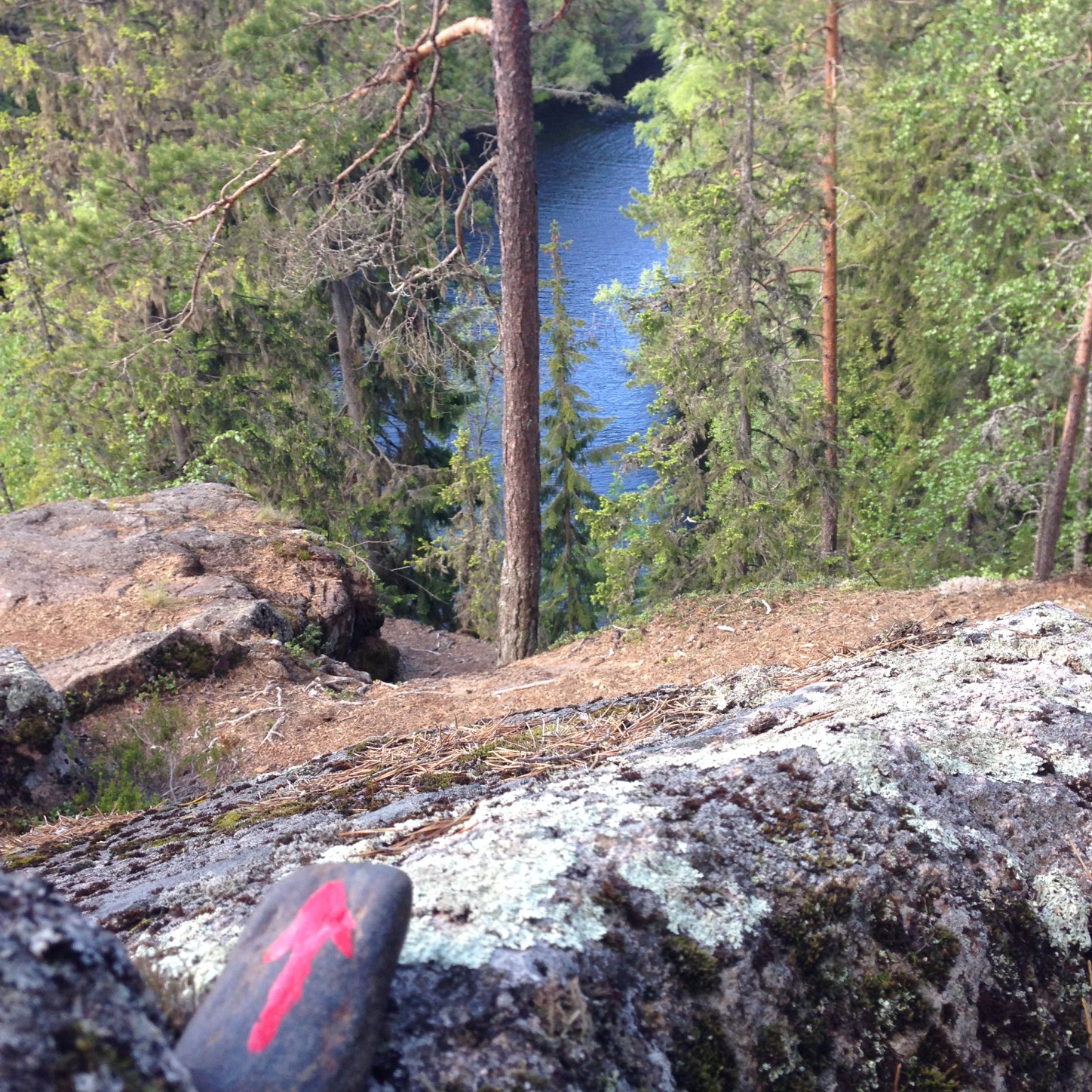
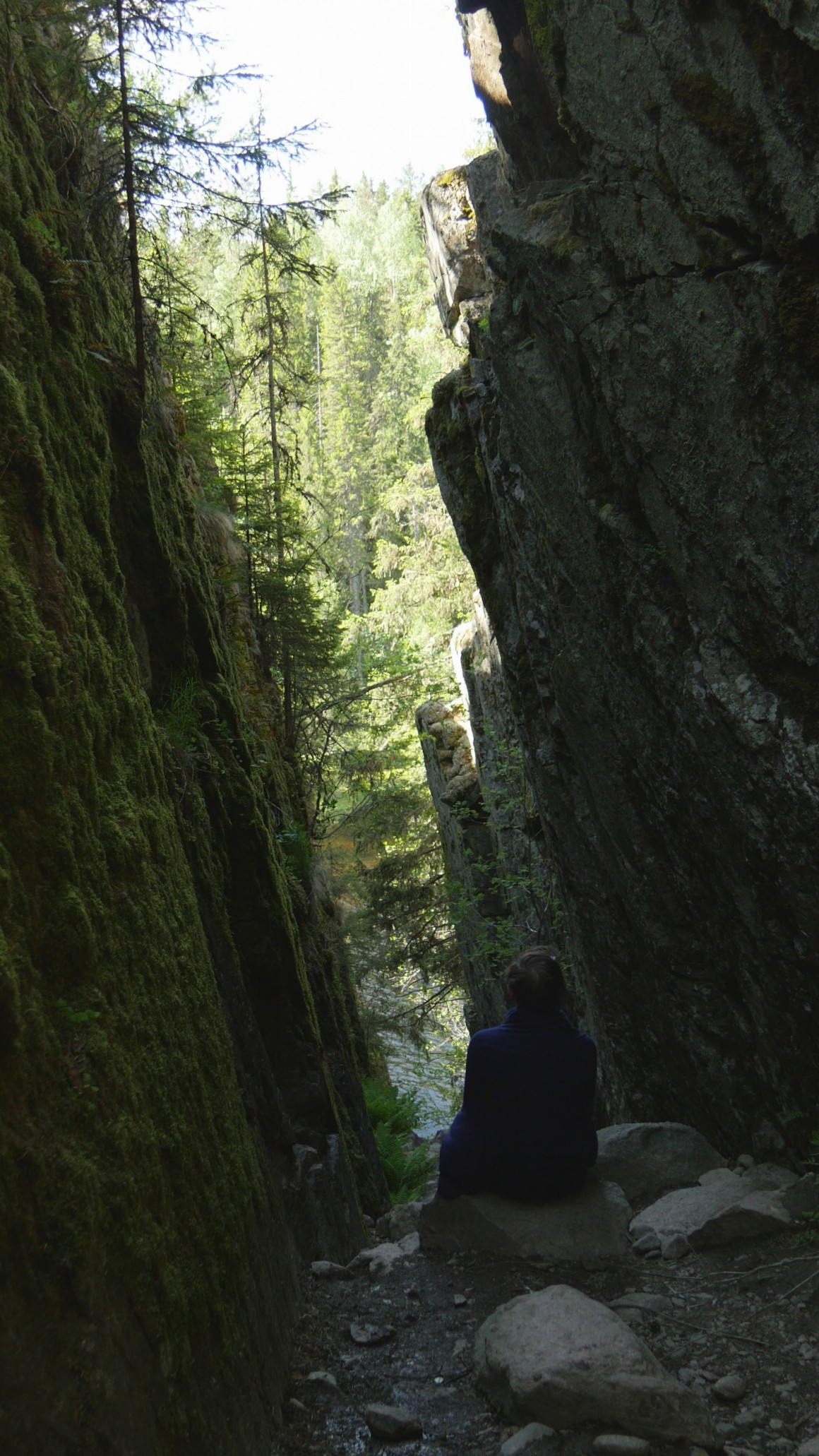
Seeing the steep slopes immediately reminded me of a project I tentatively started last autumn in Oulanka National Park in the North East (see the blog post “Little Bear’s Trail”), something that could be called the vertical landscape. In order to capture something of that vertical feeling I turned my video camera on its side, and why not? Already Bruce Naumann played with turning monitors upside down. It was only when I tried to show some of the vertical video clips at a screening event that I realized the problem; I could not change the position of the projector for my clip only. Obviously these experiments were stuff for installations only, and partly because of that I did not pursue them any further. Only when I saw this landscape did I change my mind again. Even though there were no rivers or rapids rushing through the gorges here, the shores of the lake were steep. And the cleft Helvetinkolu is vertical for sure.

It looks a little like a gateway, and since the lake is narrow, deep and the water is dark, one could imagine that it leads to the underworld. Sitting in the gorge, which is quite impressive by Finnish standards, since there are no really high mountains in the country, and listening to the wind howling above, I could easily imagine some evil spirit appearing to chase away disturbing visitors like me.

Searching for the Horizon
Finding an empty horizon is not so easy, not even in coastal cities like Venice. I started playing with the horizon because of a small green line in my new camera. It is indicating when the horizon is in balance and dividing the image nicely in two equal halves. After playing with the idea of images cut in half by the horizon I encountered the famous Seascapes, the minimalist black and white photographs by the Japanese master Hiroshi Sugimoto. Although a video image brings in the temporal dimension, and adds color and movement, the still images look almost the same so I soon realized whatever I did would be “After Sugimoto”.
After a few attempts in Helsinki my first image in Bilbao was blue on blue as planned, but there some dirt on the lens destroyed my attempt. In Helsinki the weather was bad and the raindrops were blurring the image. Another day the sea was rough, spraying the image again; it seemed almost impossible to get a “clean” video clip. The simpler the image, the more all kinds of imperfections stand out. In automatic still images the camera seems to be able to clean the spots, but not with a video. Thus I carefully cleaned my camera, and decided to start again, and then once again.
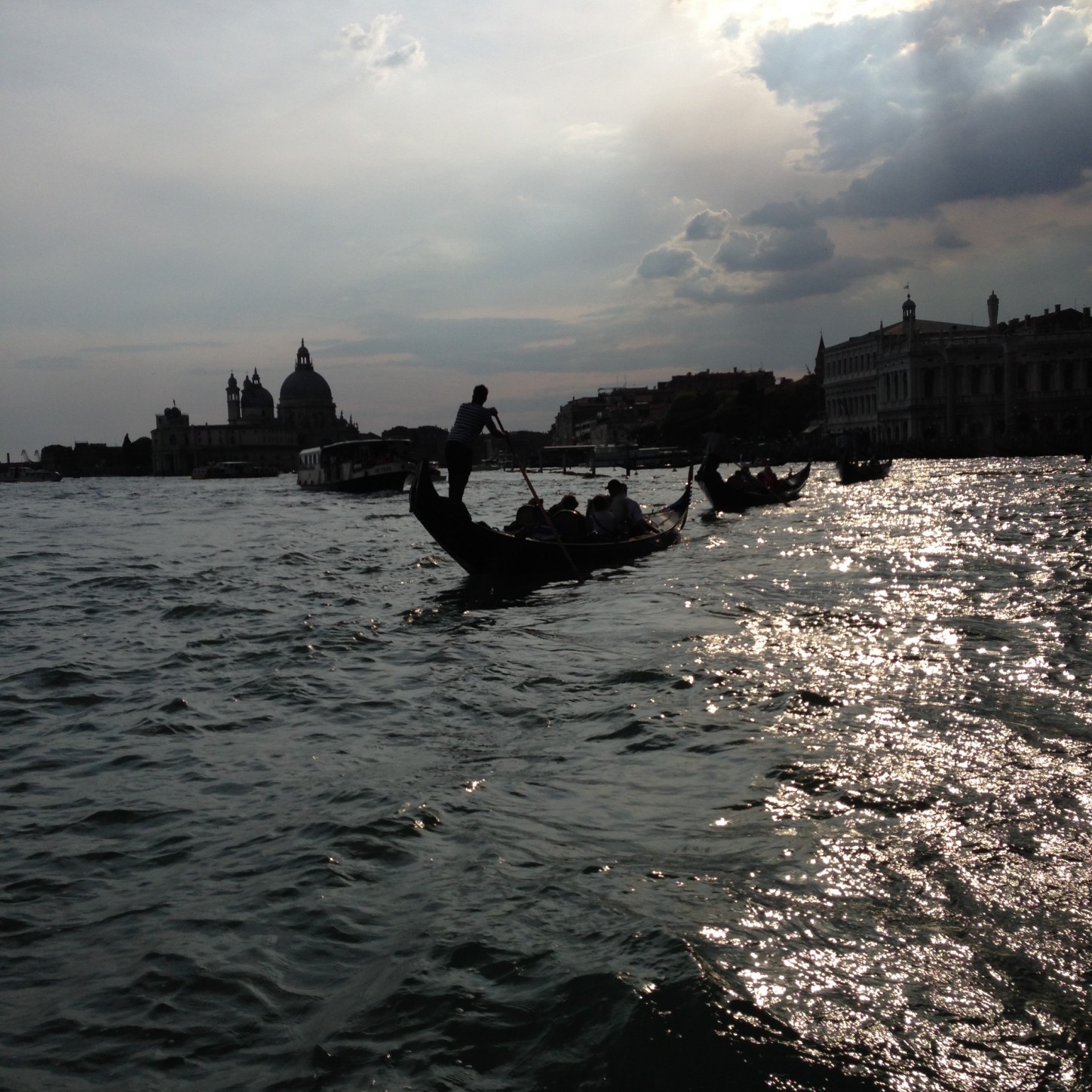
Venice should be no problem, I thought, once one gets a little further out of the historical city. I looked at the map, and realized Lido di Venezia would probably be my best bet. I have been there before, for the first time in 1996, when I tried to write the radio play Via Marco Polo (living in a pension on via Marco Polo). So I headed out there after a nice lunch with colleagues on Murano. We were visiting the place with the glass factories as an antidote to the overload of contemporary art we had experienced during the opening week of the Venice Biennale. The sky was turning dark in the afternoon when I took a vaporetto first to San Marco and then another one to Lido.

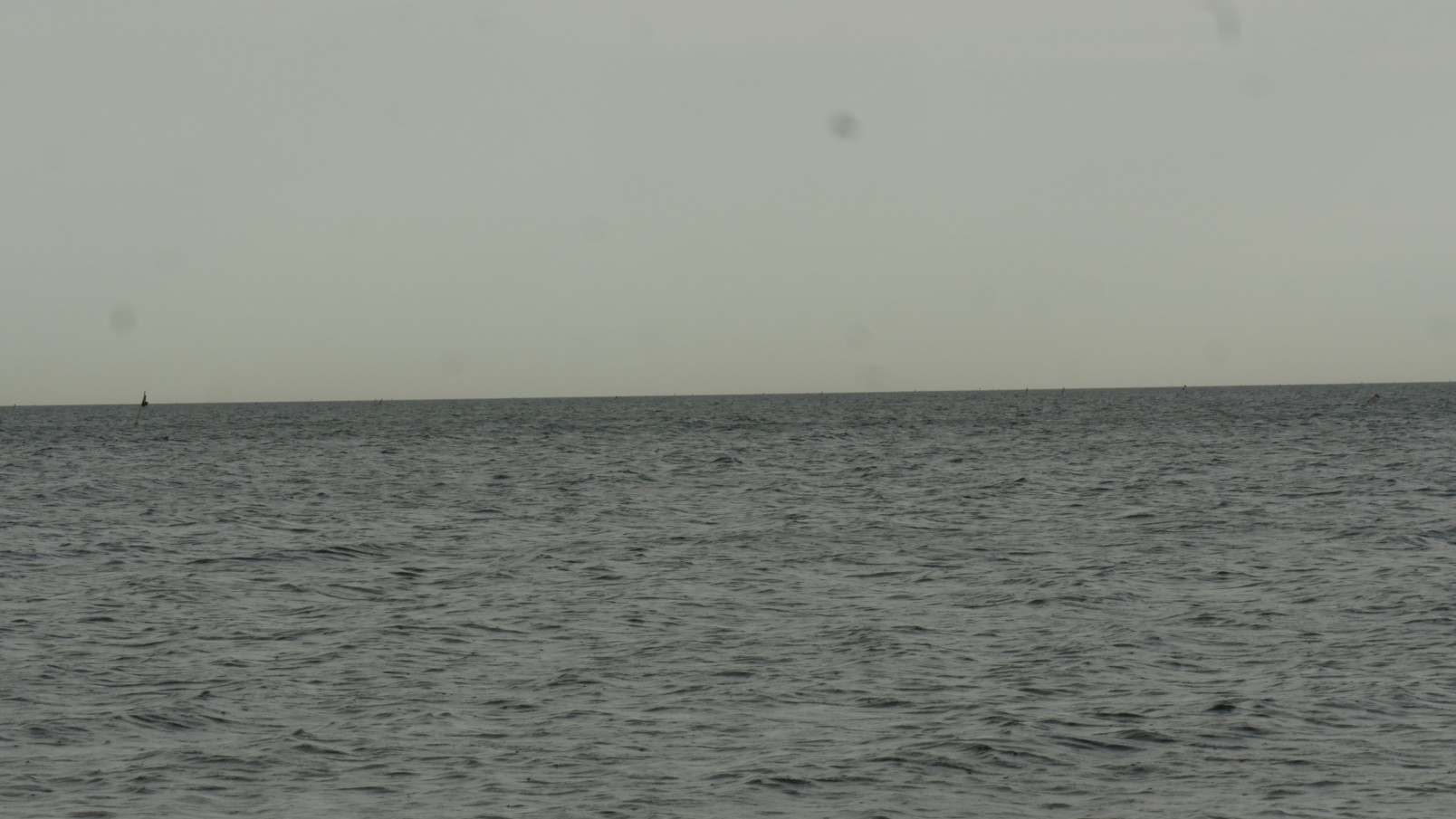
On Lido I walked straight across the island, heading for the beach, in opposite direction to the crowd returning from there, and already felt the first rain drops on my skin. As soon as I had found my way to the shore and placed my tripod in the sand the rain started. I managed to frame the image properly with the help of the zoom and stood there in the rain, clutching the tripod in the wind, recording a sequence of three minutes. When finishing I realized the camera had slowly moved downwards, the horizon was no longer exactly in the middle. I considered for a moment whether I should try to find shelter and wait for the rain to pass, but decided I could perhaps return the next day. Only in the vaporetto on the way back, looking at my “catch” did I realize the water spots on the lens in the video recording, and almost wanted to cry. The spots felt like some weird form of curse. Should I perhaps make these annoying disturbances part of the project? The biggest spot is clearly visible in the still photo taken with manual focus.
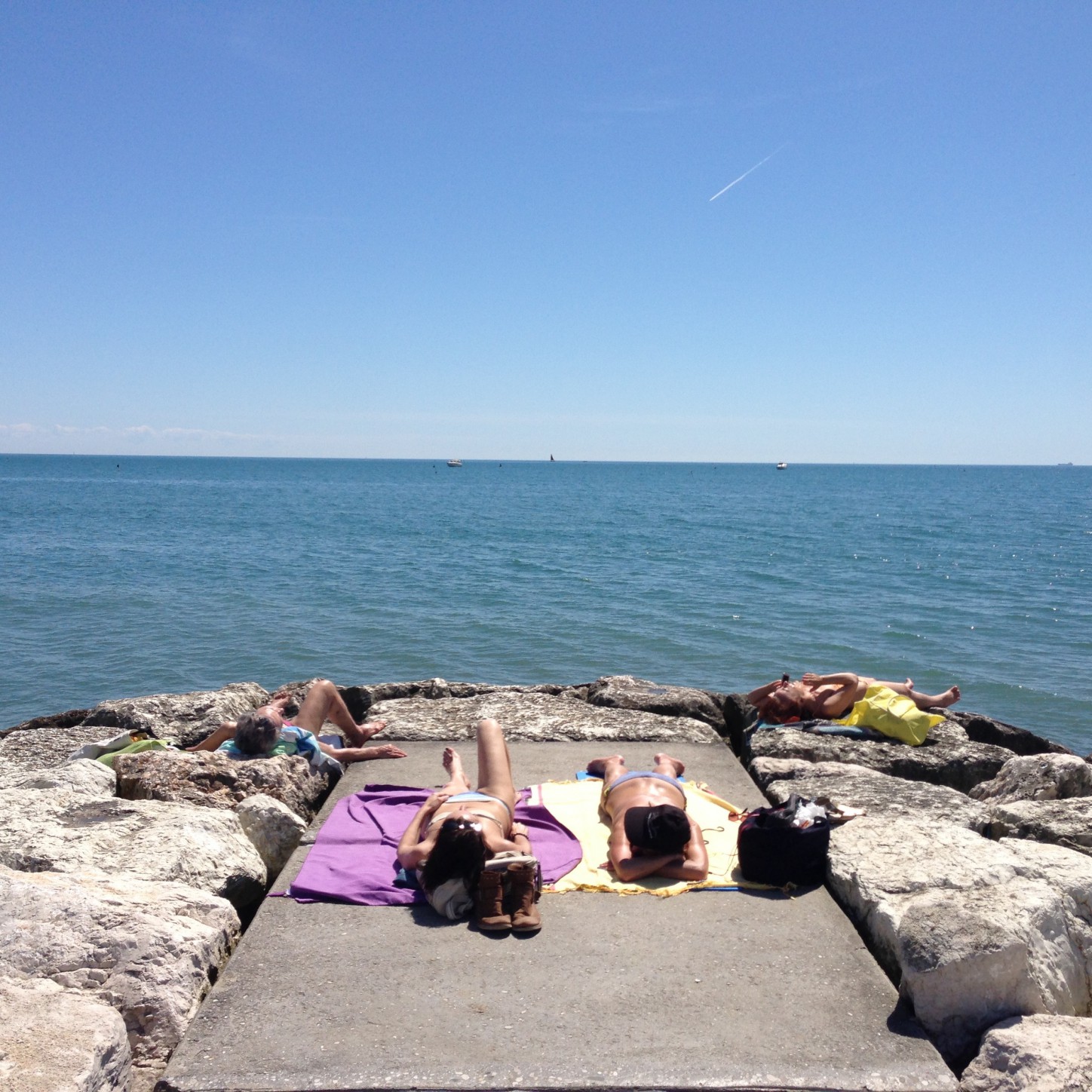
The next day I made a new attempt, returned to the same “free beach”, walked out on the rocky pier where people were sunbathing and placed my tripod at the edge. Everything was fine, although a woman nearby was speaking on the phone, which irritated me at first, but then I realized that might make quite a fascinating soundscape.

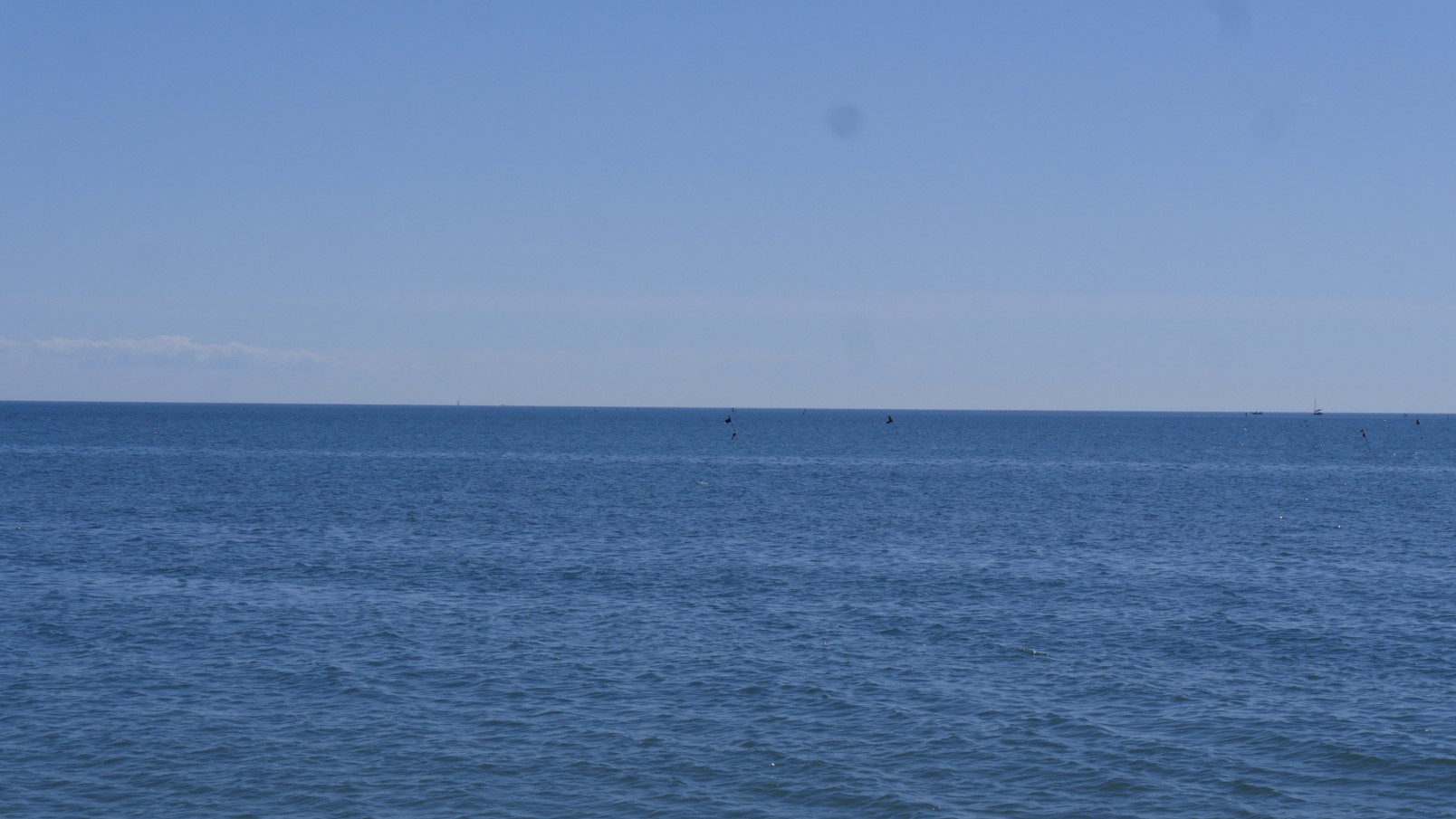
The sun was shining, life was smiling and the ice cream I picked up on the way back tasted delicious until I saw the results: the same spot was still there. Now all I can do is take the camera to be cleaned by a professional and hope for another chance to visit these shores. The idea of abstract minimalism is turned upside down on video, at least in my hands, so it seems.


Horisonten på hälft
Att hitta en öppen horisont i Helsingfors är inte så lätt, trots att stadens centrum ligger långt ute till havs jämfört med många andra kuststäder. Men i tjock dimma försvinner alla små öar och skär, alla fyrar och sjömärken. För ett par veckor sedan försökte jag banda in en bild från sydvästra stranden av Stora Räntan, men då var vinden så hård att regnet och vågorna piskades mot kameran och vattendropparna täckte bilden. Den här gången var det nästan vind stilla och jag stod fascinerad på stranden och lyssnade på båtarnas mistlurar som ljöd i den vita massan. En flock ejdrar hade samlats utanför ön och deras svagt ylande ljud var gåtfullt vemodiga och säregna jämfört med de sedvanliga skrikande måsarna och gläfsande gässen.
Då jag såg dimman skyndade jag mig iväg till ön för att försöka ännu en gång få en lämplig inledningsbild till den serie små videon med arbetsnamnet “After Sugimoto”. Att göra bilder med horisonten exakt vid halva bilden, med 50 % hav och 50% himmel var en idé som kom sig av balansmätaren i min nya kameran, en grön vågrätt linje tvärs igenom bilden. Men då jag stötte på de eleganta svartvita fotografierna av den berömda japanska mästaren Hiroshi Sugimoto, fanns det inget annat alternativ än att göra serien “After Sugimoto”. Hans seascapes är gjorda runt om i världen, och utgår från tanken att hav oh himmel är de samma överallt. Det är nästan den raka motsatsen till vad jag har hållit på med, då jag återvänt till samma plats varje vecka och försökt visa att allting förändras hela tiden, även samma plats är sig olik hela tiden.
I en video blir effekten givetvis en helt annan då rörelsen kommer med, och ljudet. Men i stillbilderna är släktskapen uppenbar, i synnerhet under en grå och dimmig dag, då bilden ter sig nästan svartvit. Minimalismen är krävande. Två droppar eller fläckar av något slag går lätt att urskilja i videobilden och i de bilder som tagits manuellt. Automatiken putsar synbarligen bort små orenheter, men tolkar också ljuset helt annorlunda. Suck. Ju mindre man försöker göra, desto svårare blir det…

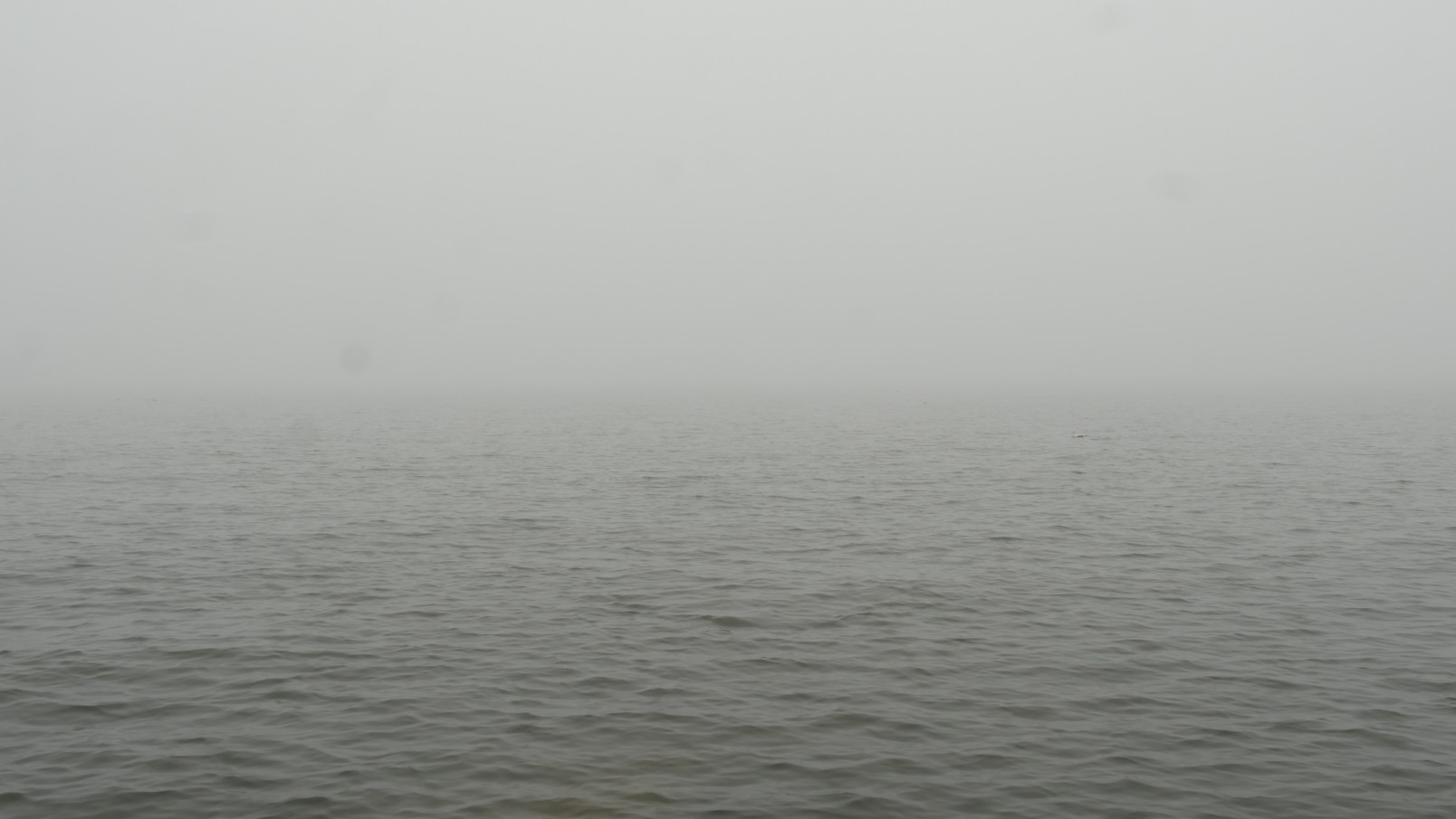

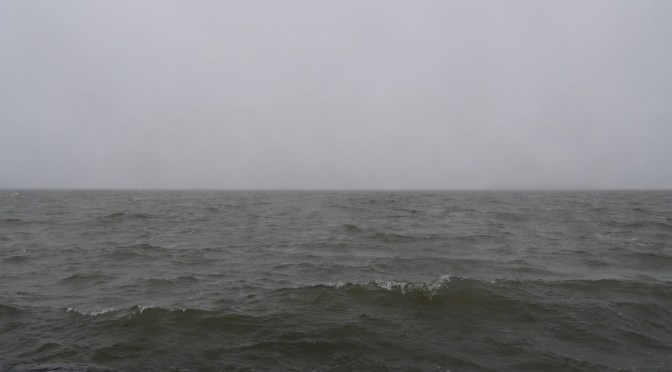
Sumuun häipyvä horisontti ja sateen sotkema kuva
Ajatukseni oli, että nyt kun en enää ole kiinni Eläinvuosissa, kerran viikossa kuvaamassani vuosien sarjassa, voisin yrittää kehittää projekteja, joita voisin kuvata eri puolilla maailmaa. Horisontin puolittamat merimaisemat, joita olen ryhtynyt kutsumaan työnimellä “After Sugimoto”, oli yksi sellainen. Japanilaisen valokuvaajan kuvaamat mustavalkoiset stillkuvat jossa puolet on taivasta puolet merta, mutta jota näyttävät abstrakteilta harmaan eri sävyjen pinnoilta tosin ovat idealtaan jotakin aivan muuta. Kuvattuani tyytyväisenä merimaiseman Biskajan lahdelta Bilbaosta pohjoiseen, ja huomattuani kotona, että kuvan reunassa näkyi tyrskyjä, puhumattakaan tahrasta objektiivissa, joka näkyi selvästi hyvällä tietokoneen näytöllä totesin kylmän rauhallisesti, että oli aloitettava uudestaan. Eilisen ihanan aurinkoinen ja lämmin kevätpäivä houkutteli ihmiset rannoille ja minut Harakkaan, ja niinpä etsinkin lounaisrannalta kalliota jolta saisi mahdollisimman avoimen näkymän. Saaria ja poijuja on joka puolella Helsingin edustalla, mutta Harmajan ja pari. Pikkusaaren välistä näkyy melko avoin horisontti. Löysin rantakalliolta paikan jalustalle, yritin painaa mieleen kolot jotta muistaisin ne, ja mietin myös miten rantakivet nousisivat näkyviin jos vedenpinta virlä laskisi. Kotona huomasin harmikseni, että linssissä näkyi edelleen tahra, kaikista putsausyrityksistäni huolimatta. Eli vielä kerran uusi alku!
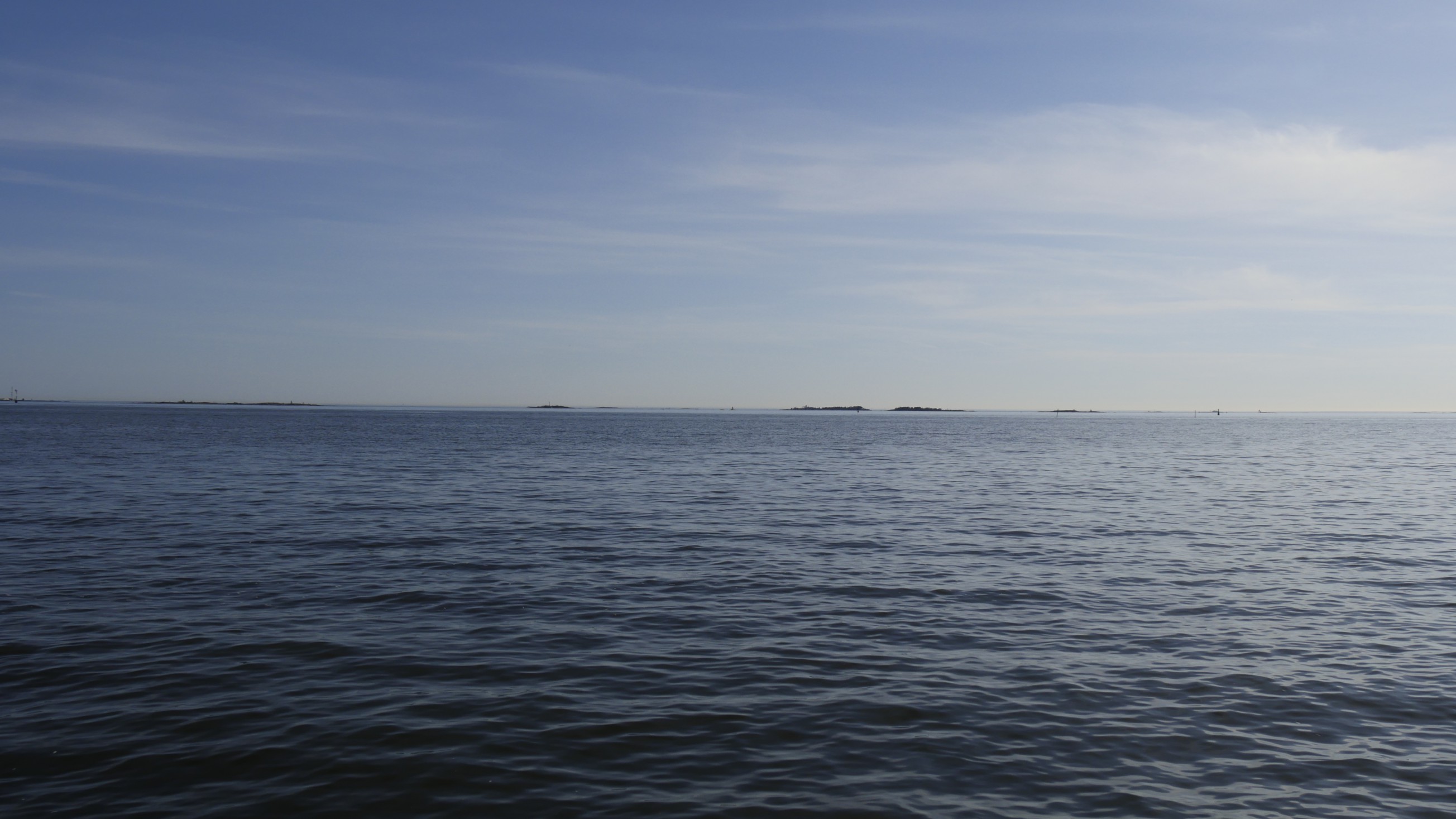

Sunnuntaiksi oli luvattu sadetta, mutta aamupäivällä sää oli poutainen, taivas utuisten pilvien peitossa. Kuulin että vuorovene kulkee jo, tunnin välein, ja yritin ehtiä yhden veneeseen, mutta myöhästyin. Olisin voinut soutaa, mutta lounaassa näkyi pilviä ja ajattelin, että voisin yhtä hyvin odottaa seuraava venettä etten joutuisi soutamaan takaisin sateessa. Hieno utuinen sumu horisontissa olisi ollut hieno alkukuva himmennettäväksi esiin valkoisesta, mutta sen ajan istuin kahvilassa odottamassa. Kun pääsin saareen sade oli juuri alkamassa, ja kiiruhdin kuvaamaan ennen kuin se yltyisi. Mantereelta käsin en tll ajatelleeksi länsituulen tuottamaa aallokkoa joka nyt paiskoi vettä rantakallioita vasten ja huuhtoi niiden yli niin vuolaasti etten voinut ajatellakaan asettavani jalistaa eiliselle paikalleen. Yritin asettua noin metrin lähemmäs rantaa, ja kastuin silti. Ja mikä pahempaa, myös kamera kastui. Paitsi sadepisarat myös aallokon tyrskyt piiskasivat kameran linssiä ja niin kuvasta tuli kaikkea muuta kuin sumuisen rauhallinen. Aallokko ja tyrskyt olisivat olleet hyvinkin dramaattinen aloitus omalla tavallaan, ellei ät pisarat olisi täyttänet kuvapintaa. Palasin sisään kuivattelemaan ja havaitsin ilokseni että kamera kyllä toipui vallan mainiosti.
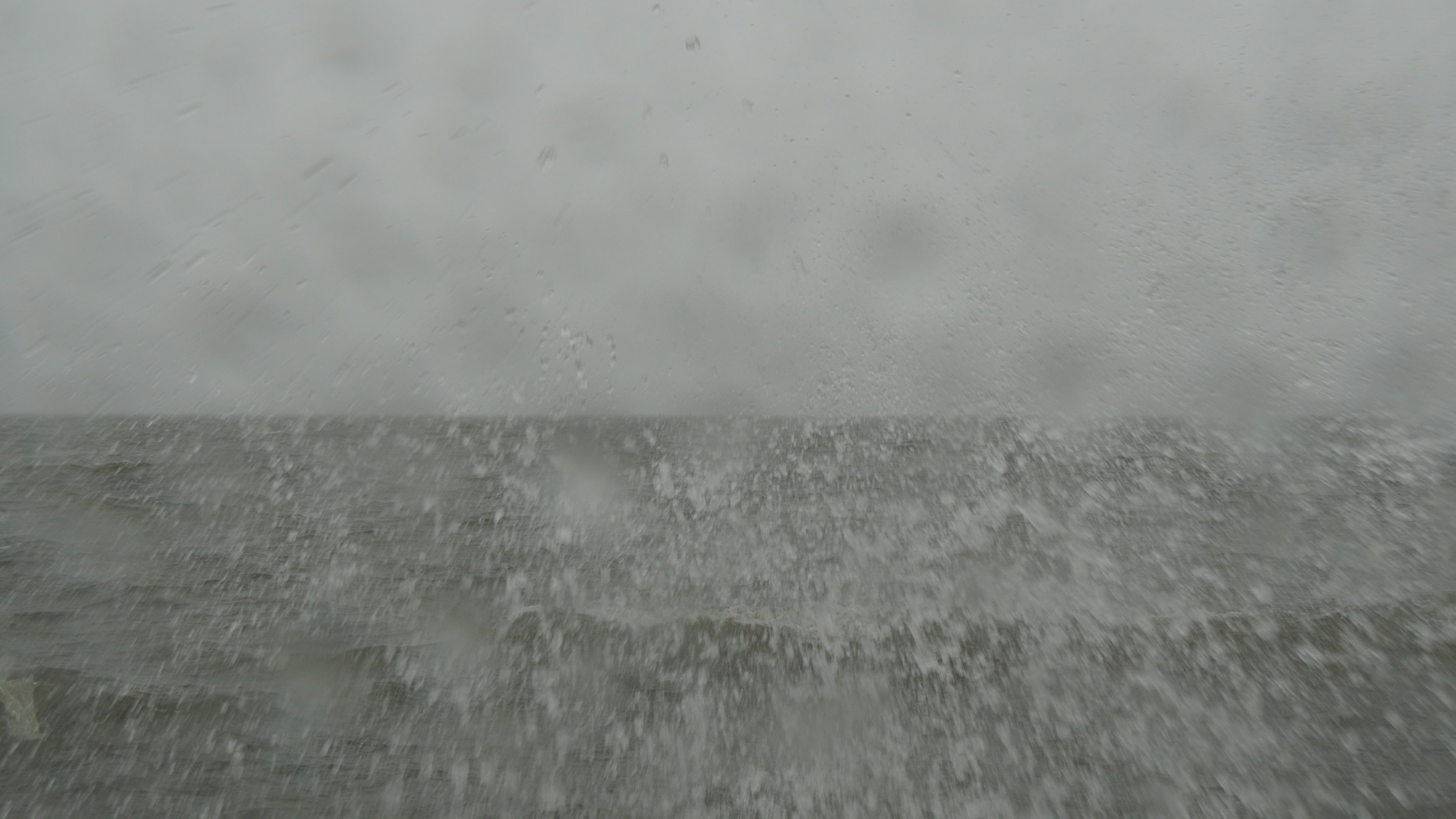

Parin tunnin päästä sade oli ohi, vain pieni tihkusateen tapainen kosteus tuntui ilmassa, mutta vesilätäköiden pinta pysyi tyynenä. Menin siis takaisin rantaan tavoitteen uusi yritys. Toki aallokko olisi ennallaan, mutta ehkä onnistuisin kuvaamaan sen niin etteivät pisarat osuisi linssiin. Pötyä, tietysti. Palasin varovaisesti samalle kalliolla, mutta aallokko oli voimistunut, ja tyrskyt heittivät kunnon saavillisen vettä niskaani, ja kameran päälle myös. Kuva täyttyi vesipisaroista entistä pahemmin, ja seison siinä kalliolla pitäen jalustasta kiinni niin tukevasti kuin kykenin, tietäen että vaikka kastun, meri ei kuitenkaan saisi minua työnnetyksi jaloiltani, vaikka kohti vyöryvien vesimassojen voima tuntuikin pelottavalta. Kaiken lisäksi akkukin loppui ennen kuin sain suunnitellut kolme minuttia kuvattua. Eli kaikesta päätellen edessä on vielä kerran uusi alku, tosin jonakin toisena päivänä.

Bilbaosta pohjoiseen
Jos Bilbaosta ajaa metrolla koiliseen päin ja jää pois pysäkillä nimeltä Bidezabal, voi löytää kävelytien, joka seuraa joen rantatörmää ja johtaa avormerelle, Punta Galeaan. Eikä siinä vielä kaikki, sieltä kävelytie jatkuu rantakallioiden harjalla itään huikeiden rantamaisemien halki. Täältä löysin kaipaamani avoimen horisontin, jota tarvitsen kuvatessani merta ja taivasta Sugimoton tapaan, mutta videolle. Toki muutama laiva makasi joen suulla ja välillä tyrskyt ja kalliot ulottuivat pitkälle avomerelle, mutta periaatteessa näkymä oli vapaa. Ensin kaikki oli harmaata, ja taivas pilvineen vielä kerroksittain tumma ja vaalea, mutta päivän mittaan sää kirkastui, ja viimeinen yritykseni kuvata kolme minuuttia merta ja taivasta videolle oli todella blue on blue.
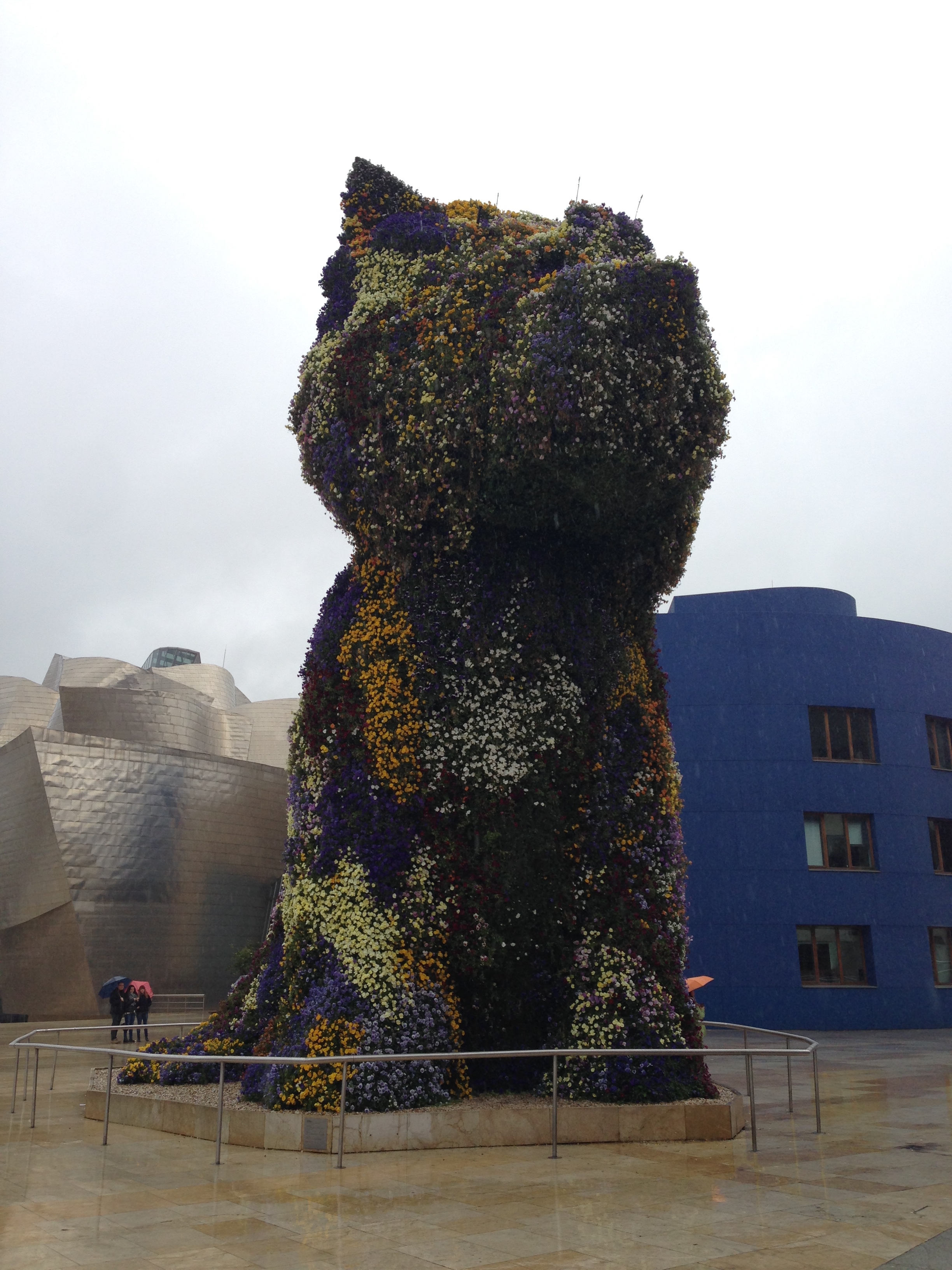
Bilbaossa päähuomio kohdistuu helposti taiteeseen, kuuluisan Guggenheim museon ansiosta. Ja täälläkin eläimet ovat nyt muotia. Rakennuksen toisella puolella vartioi Jeff Koonsin orvokeista koostuva koiranpentu ja joen puolella taas Louis Bourgeoisin huikea hämähäkki.

Meren lähistöllä maisema vie voiton. Eräänlainen leikeltyjen puiden reunustama kävelytie johtaa joen törmän harjalla avomerelle:


Sieltä tie jatkuu rannikkoa pitkin vaikka kuinka kauas. Käännyin surffareiden suosiman beachin luona takaisin päin tyytyväisenä saamaani annokseen avomerta.

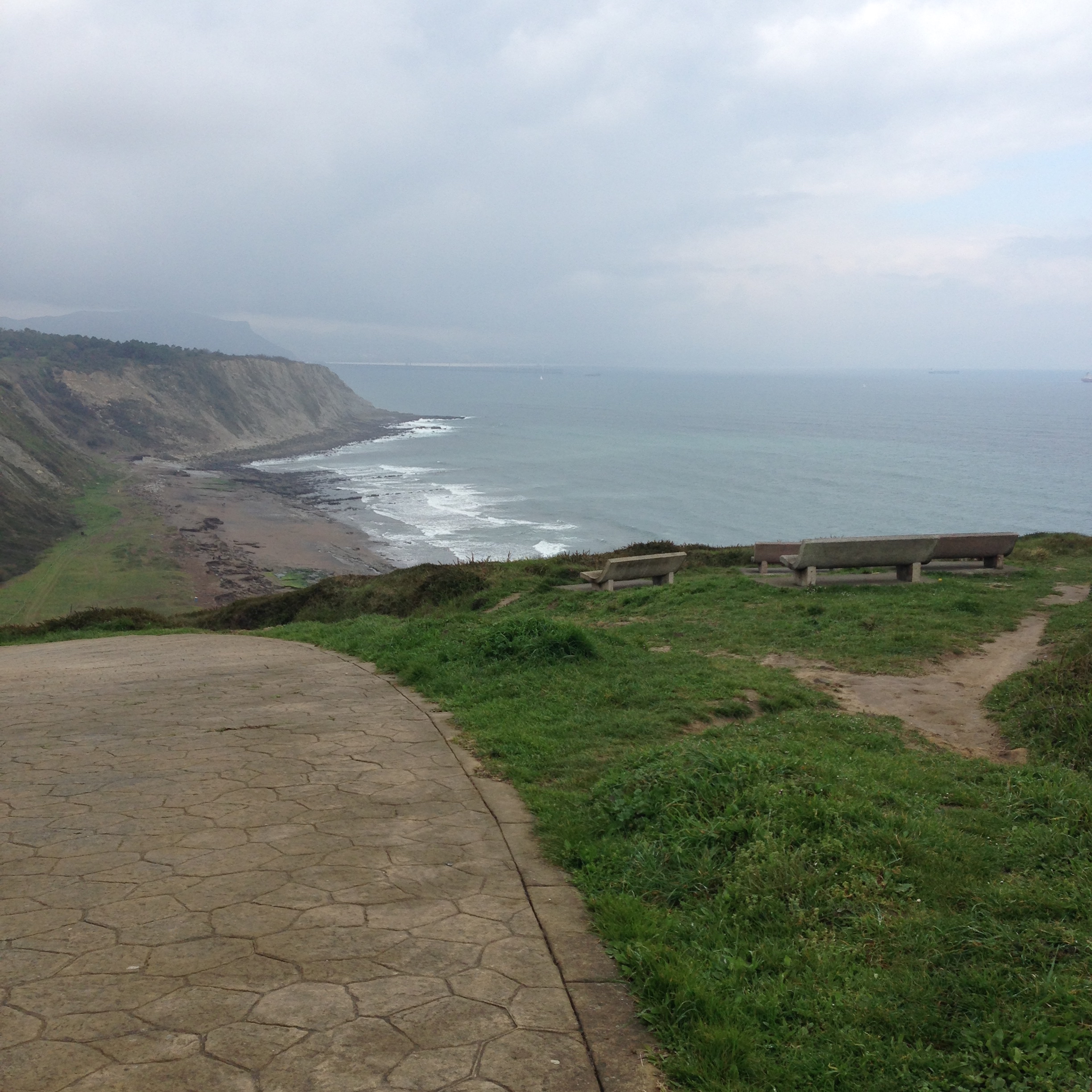
Ja vihdoin keksin myös zoomille käyttöä; rantatörmän ruohikon saa sen avulla kevyesti rajattua pois kuvasta ilman että joutuu astumaan liian lähelle jyrkännettä.

Horisonttia hakemassa
Vaikka Helsinki sijaitsee ulkosaaristossa, ei rannoilta silti ole helppoa löytää avointa horisonttia. Uunisaaresta katsottuna vain Harmaja ja pari luotoa on esteenä, mutta poijuja ja merimerkkejä ja laivoja on tietysti aina. Eiran rannastakin toki aukeaa näkymä saarien välistä, mutta ei edes Suomenlinnan eteläkärjestä aukea aivan avointa horisonttia. Syy miksi innostuin etsimään paljasta horisonttiviivaa on hissukseen käynnistämäni projekti, jossa hyödynnän uuden kamerani hienoa vaakatasapainon näyttävää vihreää horisonttiviivaa, joka muuttuu keltaiseksi heti kun kuva on aavistuksenkaan vinossa. Sen avulla on myös helppo löytää keskiviiva joka puolittaa kuvan: puolet taivasta ja puolet merta. Vastaavaa kuvakompositiota voi tietysti käyttää, vaikka kuvassa olisi paljon muutakin kuin meri ja taivas.
Innostuin leikkimään horisontin halkaisemalla maisemalla jo jonkin aikaa sitten, mutta törmättyäni japanilaisen valokuvaajan kuuluisiin minimalistisiin kuviin (Seascapes) en voi kuin todeta, että teen sarjani “After Sugimoto”. Hänen projektinsa kuvata maailman meret mustavalkoisina valokuvina, joissa puolet kuvasta on merta puolet taivasta, muistuttaa aivan liiaksi yritystäni jakaa kuva tasan kahtia horisontin avulla, jotten hyödyntäisi sitä, vaikka projektini tavoitteet ovatkin vaatimattomammat ja kyse on videoista. Videokuvan myötä idea on väistämättä toinen, kun liike ja muutos nousevat keskeiseen asemaan. Kuvittelin että voisin nimetä videoprojektin esimerkiksi “Blue-blue” mutta nyt ei oikein ole muuta vaihtoehtoa kuin juuri “Sugimoton jälkeen”. Lisäksi tajusin jo näiden ensimmäisten kokeilujen myötä, että mukana on aina paljon muitakin värejä.
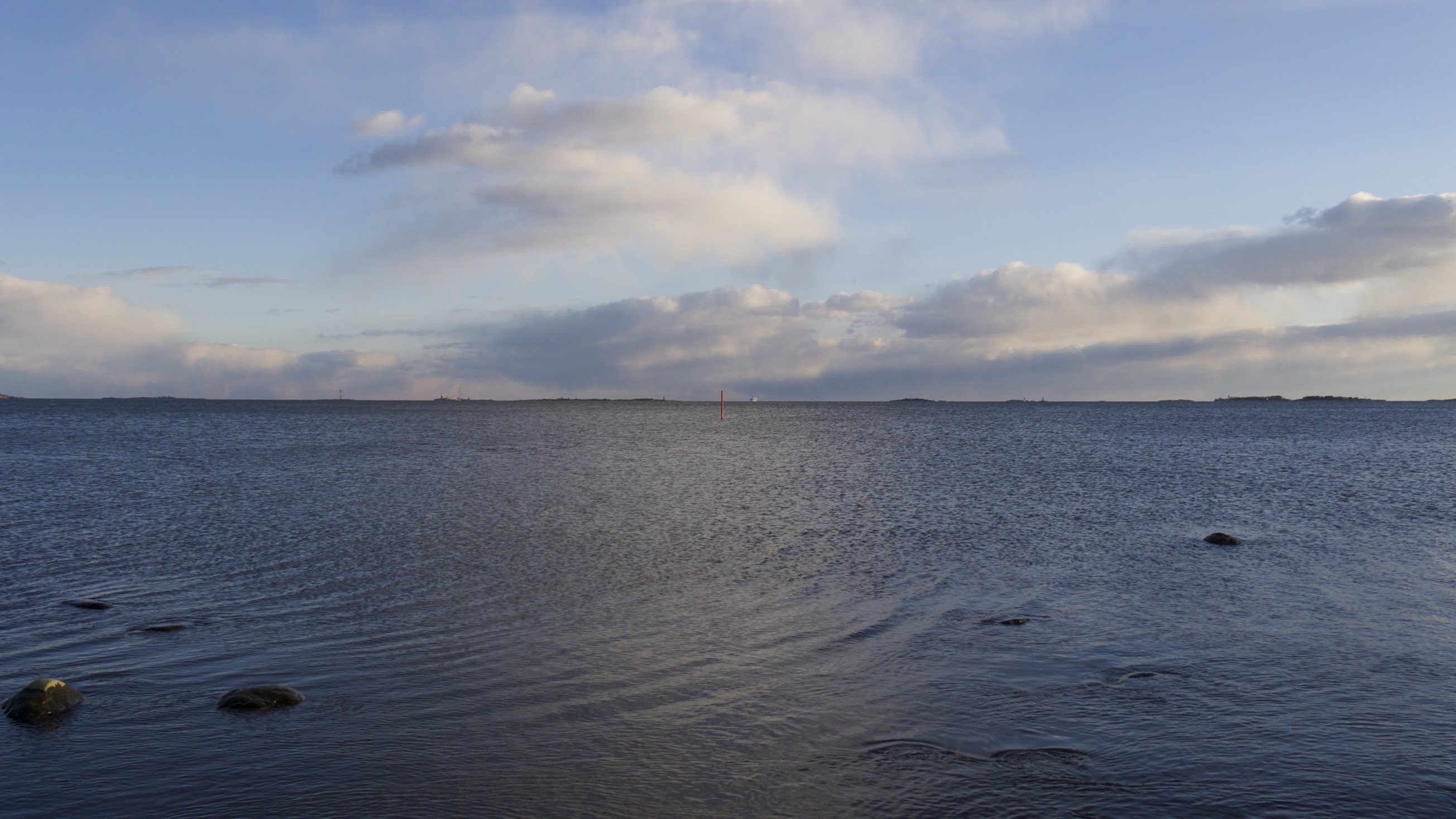
Kevätpäiväntasauksen aikaan on viimeinen hetki aloittaa, vaikka olenkin tehnyt erilaisia testejä jo aiemmin, joten kiiruhdin lauantaina 21.3 hyvissä ajoin ennen auringonlaskua Kaivopuiston rantaan, Uunisaareen (kun sinne vielä pääsee sillan yli) ja Eiran rantaan ottamaan ensimmäiset kuvat. Halusin nimenomaan irrottautua Harakan saaresta, jossa olen kuvannut viimeiset kaksitoista vuotta. Yhdessäkään paikassa horisontti ei ole täysin avoin ja kuvassa näkyy kaikenlaista sälää. Ehkä juuri “sälä” tekee projektistani jotakin joka on selvästi Sugimoton jälkeen.
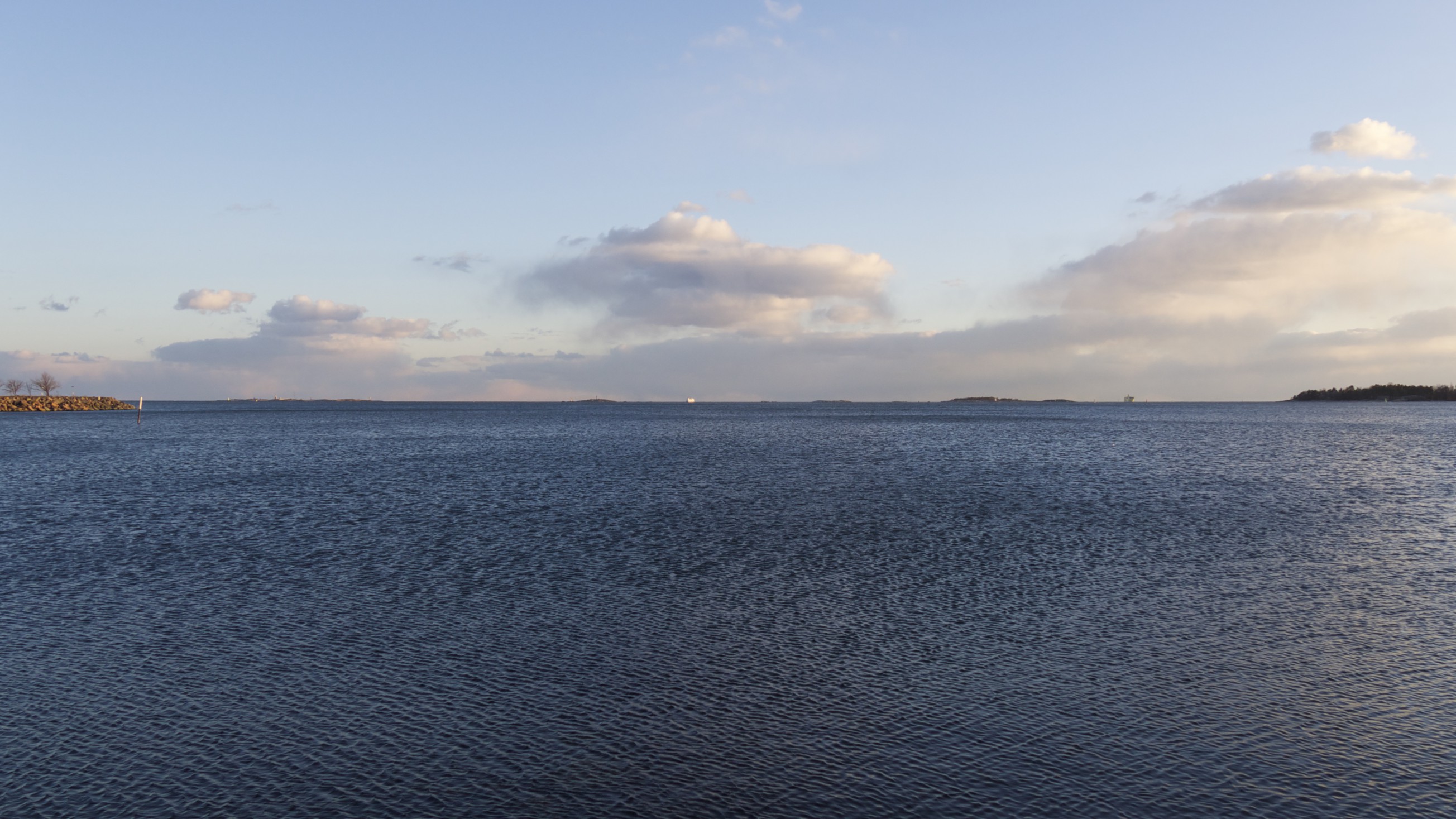
Kylmästä tuulesta piittaamatta lähdin silti uudestaan hakemaan avointa horisonttia Suomenlinnan Susisaaresta käsin sunnuntaina 22.3., vain hiukan paremmin tuloksin. Avomerelle olisi päästävä, tai ainakin avomeren äärelle ja tämä projektihan on mainio tekosyy matkustaa erilaisille rannoille horisonttia hakemaan. Aiempiin projekteihin verrattuna erotuksena on se, että nyt en palaa samaan paikkaan, enkä näytä miten maisema muuttuu vaihtuvien sääolosuhteiden mukaan, vaan siirryn paikasta toiseen. Mutta arvelisin että variaatioiden määrä on silti loputon, yhtäältä värisävyjen ja valon takia, toisaalta pienten muutosten, pilvien ja aaltojen liikkeiden myötä.
Suurin ero aiempiin projekteihini verrattuna on eittämättä se, että nyt en astu itse mukaan kuvaan. Variaatio, jossa kävelen kameran ohi rantaviivan suuntaisesti, kuten tein jo vuohen vuonna 2004, on itse asiassa täysin eri juttu. En tiedä mihin tämä horisontin hakeminen lopulta johtaa, ehkä se on vain harjoitus parempaa ideaa odotellessa. On silti hauska aloittaa projekti, joka on suhteellisen vapaamuotoinen, ei niin aikaan ja paikkaan sidottu kuin Animal Years. Mutta avoimen horisontin, tai edes melkein avoimen horisontin löytäminen on silti haasteellisempaa kuin kuvittelin. Sen hakeminen vaatii selvästi hiukan suunnittelua, ja matkantekoa…
Tur och otur i Tulum
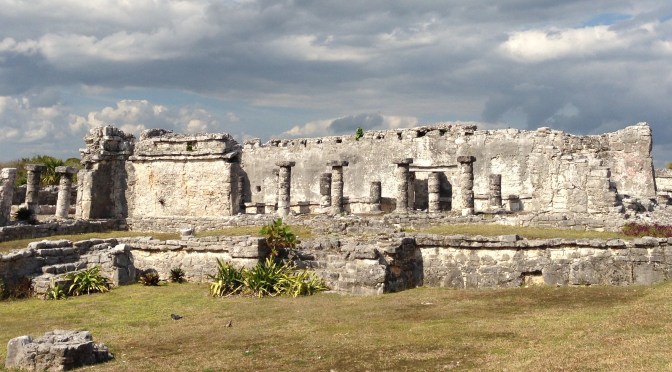
Efter nästan en vecka i en hektisk turistsump vid Riviera Maya i Mexico tog jag med mig min kamera på exkursion till den närbelägna orten Tulum för att besöka ruinerna av den mur-omringade staden. Tulum lär ska betyda mur på maya språket. För den som vill veta mera finns fakta här. Jag var förberedd på att det skulle vara fullt med folk och tänkte mig att jag kunde göra några videon med en ruin frontalt och i linje med bildens nedre kant och så helt enkelt gå igenom bilden från vänster till höger och låta alla andra mänskor också gick igenom bilden. Jag hade även med mig en sandgul sjal, som jag skaffade endast för sandstränderna här, men som jag ännu inte använt en enda gång. Så efter en veckas sölande och vila skulle jag nu äntligen försöka få något på band, eller snarare minneskort idag.
Jag åkte till Tulum med en kollektivtaxi och hamnade förstås i själva staden för jag visste ju inte exakt var jag skulle be om att bli avsläppt för att komma närmast ruinerna. Nåväl, en annan biltur ett par kilometer tillbaka var ju ingen fara, och inte heller promenaden till ingången där man köpte biljetter. Jag kände mig underligt svag i hettan och insåg att jag inte ätit lunch. Att dricka vatten hjälpte inte, och i biljettkön bestämde jag mig för att gå tillbaka till huvudvägen och äta något först. Det var ett gott beslut, för då jag återvände med några enchilladas i magen var kön kortare och min energi klart bättre. Jag bestämde mig för att ta det lugnt och se mig omkring, innan jag slog fast vad jag skulle välja att spela in. Så jag promenerade i sakta mak längs gångstigarna, knäppte en och annan snapshot med min telefon och gjorde mig ingen brådska. jag väntade på eftermiddagssolen som skulle ge form åt ruinerna. Uppe vid klippbranten mot havet stod en lämpligt placerad bänk ledig, och där skickade jag ett par av bilderna som en hälsning till en vän och vandrade sedan vidare mot utgången. Där vände jag tillbaka, grävde fram min riktiga kamera och stativet och återvände till de centrala ruinerna.
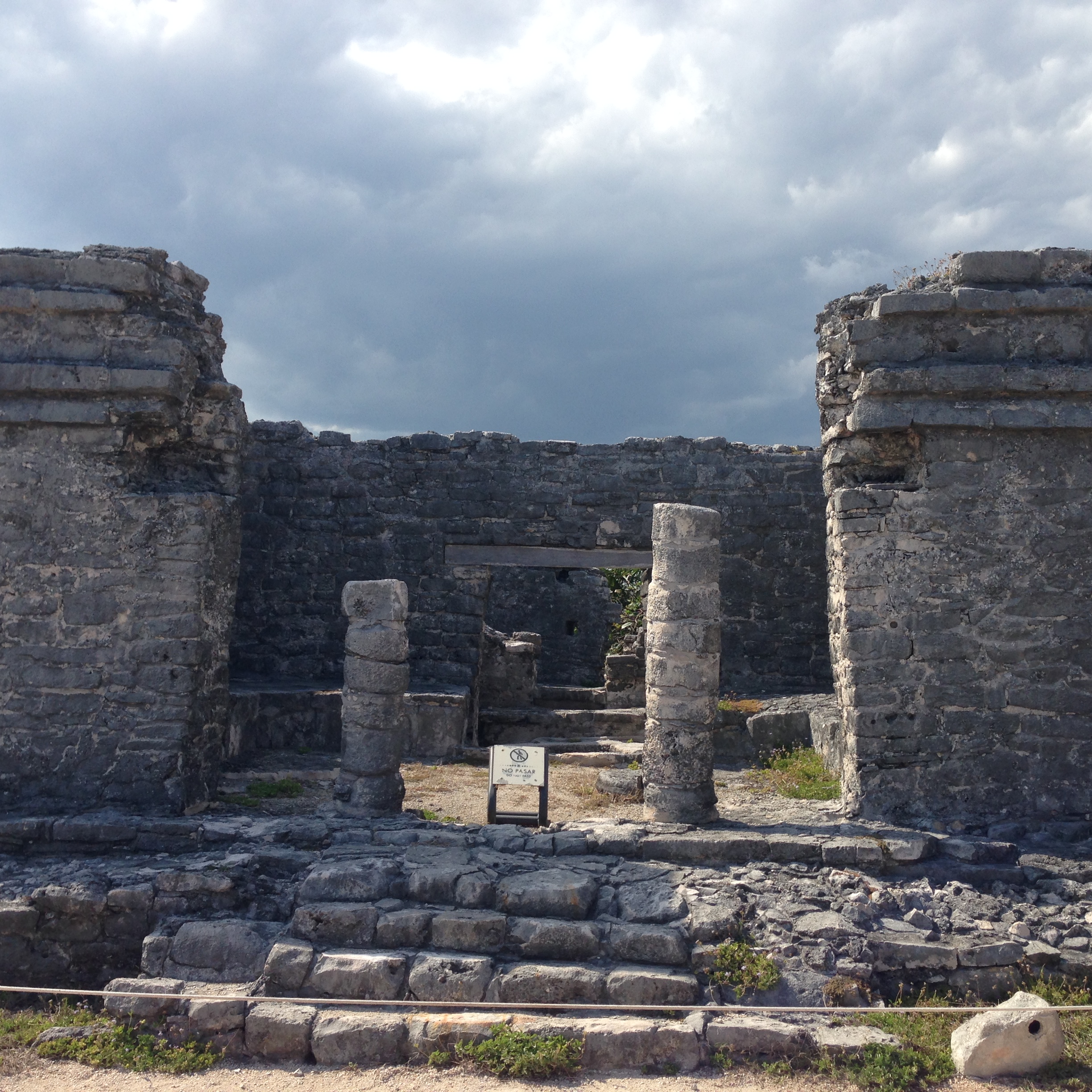
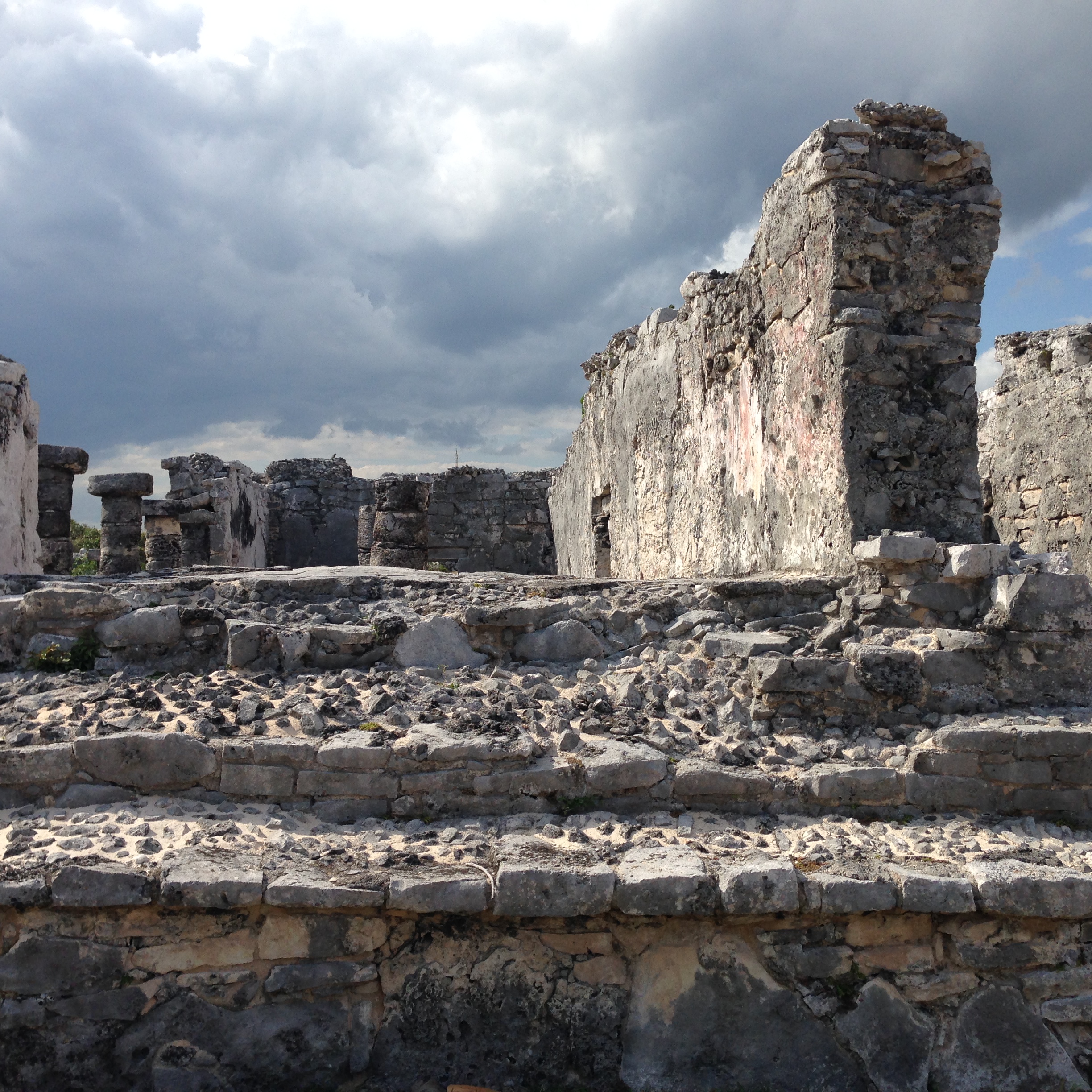

I det skedet hade ljuset förändrats något. Men samtidigt hade de grå dramatiska molnen som såg spännande ut som fond åt de grå ruinerna också försvunnit. Den lite snedare eftermiddagssolen som skapade starka kontraster var inte så spännande egentligen. Jag tvekade och kände mig oinspirerad men bestämde mig för att försöka ändå. Innan jag hann välja min första spelplats kom en vakt fram till mig och förklarade bryskt att det var förbjudet att använda stativ. Vansinne, tänkte jag, och bad om förklaring. Vakten påstod att det handlade om att förhindra folk att göra business med bilder utan tillstånd. Jag förklarade att jag använde stativ för att själv kunna gå in i bilden, men han höll fast vid att stativ var förbjudet. Okej okej, jag är ingen idiot, jag förstår nog, svarade jag irriterat, och tillade som ett tjurigt barn: då gör jag inga bilder då!
Visst är det rättvist att fotografer inte skall få fritt utnyttja mayafolkets kulturskatter, men varför inte meddela det på förhand eller sälja tillstånd. Och dessutom är det nog inte mayafolket som har någon nytta av att jag inte får använda stativ. Dessutom är det löjligt med tanke på bildkvalitén. Inomhus eller i skum belysning kan jag tänka mig att användandet av stativ kan vara avgörande, men en bra fotograf gör lika bra bilder utan stativ i starkt solljus. Det är ju inte för att använda långa tider jag använder stativ, utan för video, och för att själv kunna gå in i bilden. I princip kunde jag ju ha bett honom hålla i kameran, men det tänkte jag ju inte på just då.
På vägen ut bestämde jag mig, av ren ilska, på trots alltså, att ändå göra några bilder med min lilla rödmålade sten, som för att bevisa att man visst lika väl kunde göra något “kommersiellt” utan stativ. Och för att inte gå därifrån med helt oförrättat ärende. Så jag gick runt och placerade den lilla stenen med den röda pilen på olika staketpålar eller stenblock och försökte fånga både pilen och någon av ruinerna i samma bild. Mest blev det ju gräset mellan dem som kom att dominera, men jag hade lite skoj medan jag gjorde dem ändå. Det mest komiska är att jag behövde bli arg för att bli inspirerad eller uppeggad till att göra några bilder och att njuta av att göra dem.
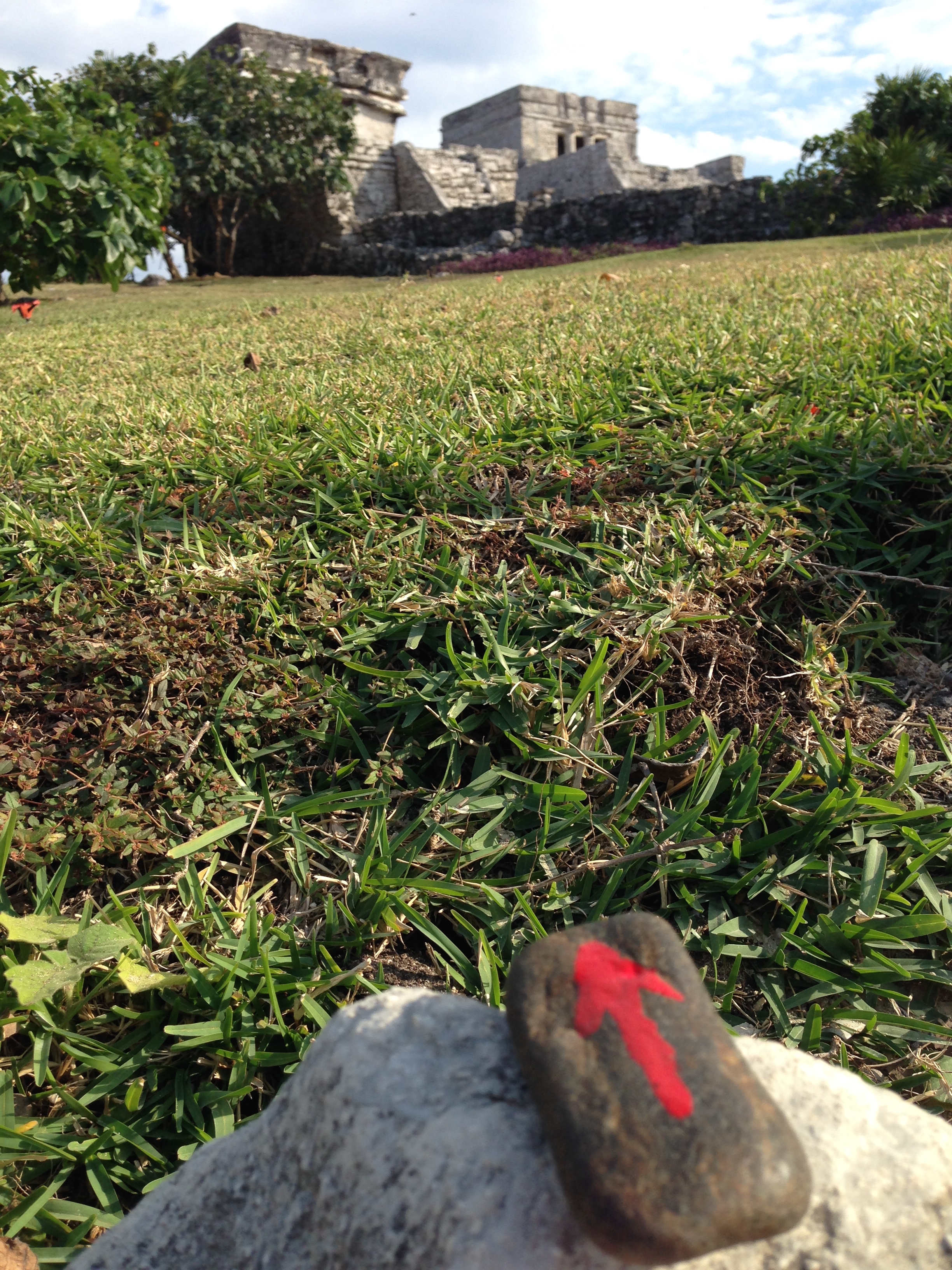
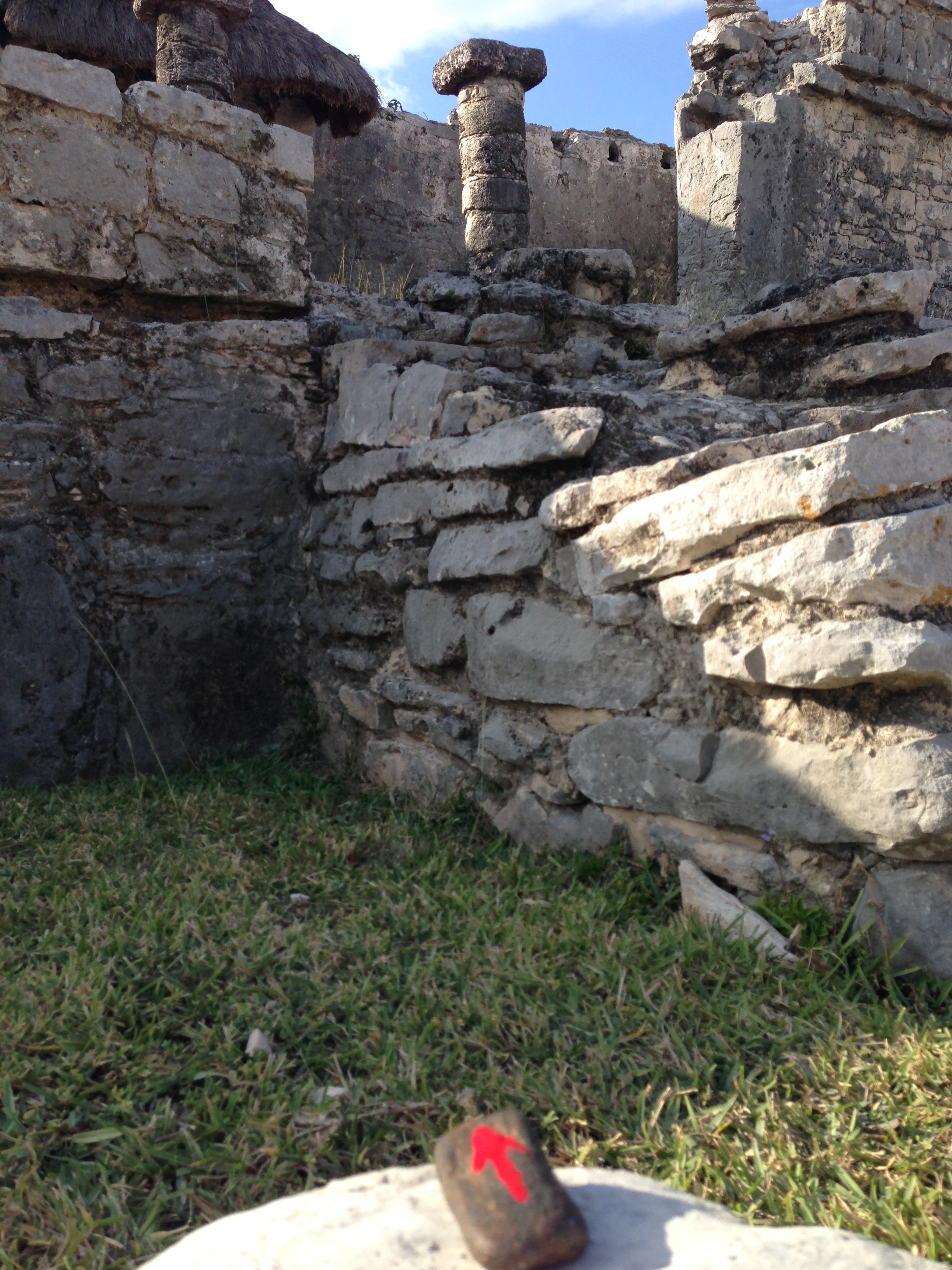

Efteråt, då jag tittade på bilderna är de nog inte särskilt lyckade eller intressanta. Några av dem är helt ok. Men de mest spännande bilderna, de enda med någon idé och stämning, är trots allt de bilder som jag tog i förbifarten som något slags minnesanteckningar, utan att egentligen ens riktigt se hur de såg ut. Att jag tog dem i kvadratformat var också en lycklig slump. De grå molnen spelar huvudrollen och gör sitt för att få ruinerna att leva. Naturen och landskapet bjöd synbarligen på sitt bästa då jag inte själv stod i vägen.
Through the Thick Skin of the Sea in January
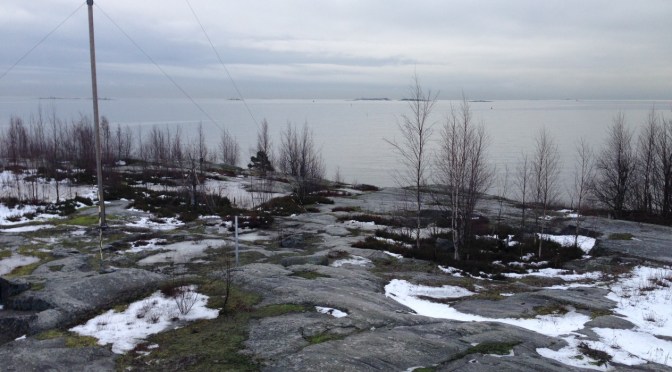
The sea was open when I came over to the island, but since there was no wind it felt like it could be freezing any moment. There was no thin layer of ice on its surface yet, but near the shores there was a sort of porous jelly that could turn into ice floes any minute. For a good ice to form it was not cold enough, though. I got a ride across to the island and went to perform, to stand and sit in front of the camera with my dark blue scarf on the hill towards west for the last time. This remake of my weekly performance during the year of the horse 2002, done once a month in 2014 ends here. The year of the goat will commence a month from now, at 19th of February. This remake is like an epilogue to “Animal years”, the twelve years I have documented on Harakka Island 2002-2014. There is a sense of endings in the air in other ways, too. I have bought a new camera and will start to use it for future projects, which means, among other things, that I will no longer be recording on tape. When I look at the small DV tape cover on my table, I can read the dates I have visited the hill and the rock below it: 6 February, 30 March, 12 April, 11 May, 2 June, 14 July, 12 August, 17 September, 11 October, 9 November and 14 December 2014. And now, today, on 19 January 2015.
The book by Laura U. Marks The Skin of the Film – Intercultural Cinema, embodiment, and the senses (Duke University Press 2000), which was recommended to me by a doctoral student who is interested in postcolonial memory, is the only work related to video or film I have recently read. Mark’s idea of haptic visuality is a concept I have long wanted to explore. She focuses on independent films describing diasporic experiences and places the phenomenon of intercultural cinema in a historical postcolonial context. To begin with she also mentions some formal and political precedents like the Third World News Reel tradition or Black British Cinema and describes the infrastructure for funding and producing such films as well as the specific audiences addressed and involved, that is, touched by the actual “skin of the film”. Her idea that many of these filmmakers try to evade objectifying visuality and work with the blurring of vision in order to evoke other senses is perhaps not connected to my work in any obvious way. After all, working with landscape as a view is very much about overlooking the scene and keeping a distance. But the idea of standing in front of the camera in the first image, clothed in a scarf, which covers and hides the landscape behind it, with the image showing mainly the texture of the scarf, might resonate with her ideas of tactility or haptic visuality. As does in some strange sense also the idea of repetition, of returning to the same place, showing the same thing over and over again, trying to grasp what exactly is happening there, waiting for the details of the landscape to come to life. The focus on diasporic experiences in her examples makes the application of her ideas to this work somewhat artificial, but her emphasis on other senses than vision does resonate with my experience of trying to convey the experience of a landscape. Perhaps that is something I should really focus on in the future: to look closer, to forget the view and direct my attention to the details, the small more or less living things everywhere in the environment…
While uploading the material to my computer I took a walk around the island, for the first time in more than a month, and noticed that two big trees in the northwest, a birch and a rowan, had fallen in a storm. And I also saw a thick soup of ice floes floating out through the Uuninsuu or “mouth of the oven”, as the strait between Harakka island and Uunisaari Island is called in Finnish. Where did they all come from, obviously somewhere in the northeast. As long as the stream keeps moving, we will be fine, but if the movement stops the ice might freeze and there we are – or here we are, stuck on the island.
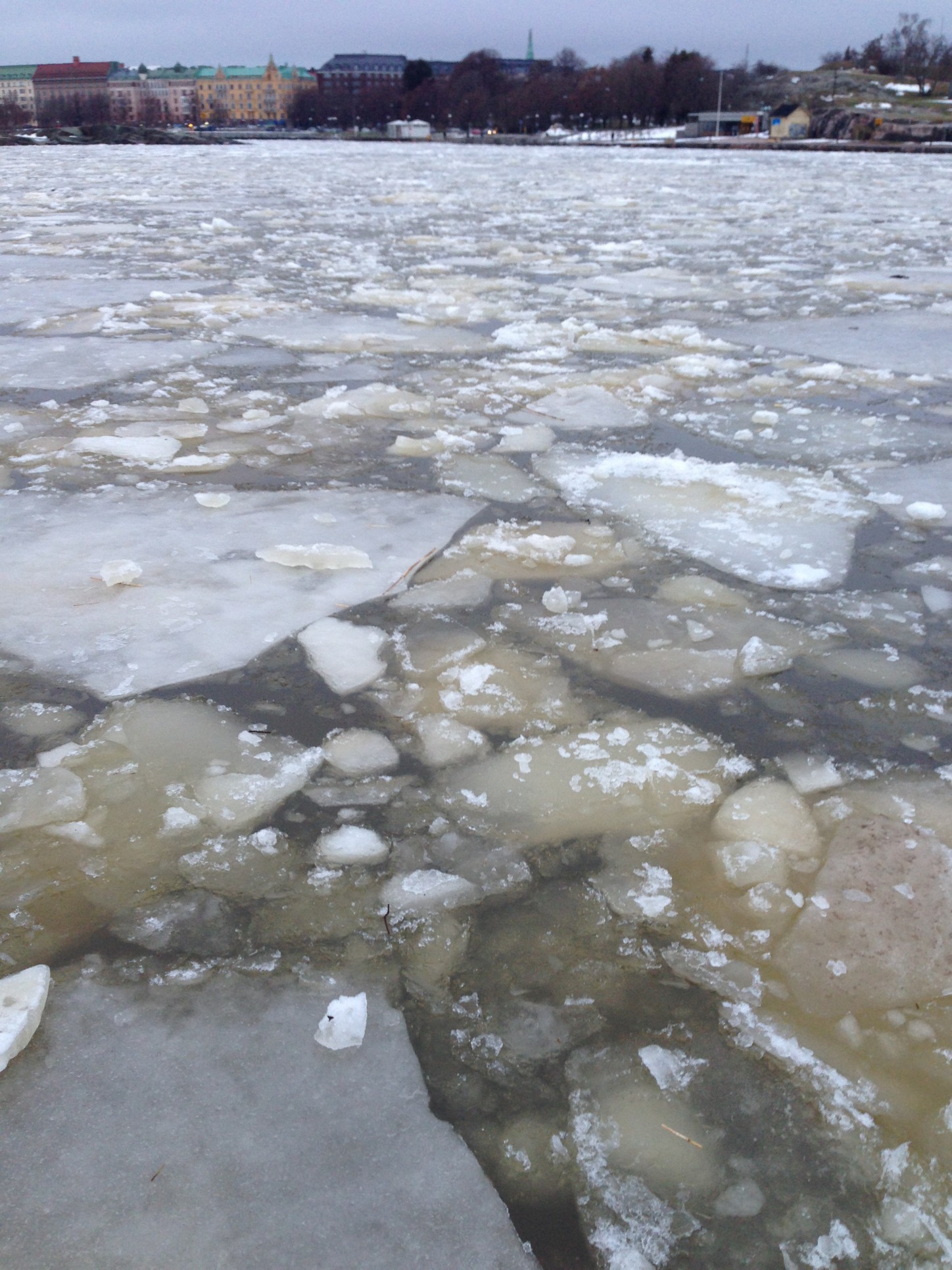
That was almost what happened. It was completely impossible to move through the ice in a small rowing boat. Luckily Saara came with her strong buster boat bringing her children home from the mainland, and agreed to try to take me across before nightfall. And the ride was exciting, to say the least. She brought me to the Ursula peer, since the skin of the sea seemed thinner in that direction. It was not possible to go around the floes; the soup was too thick for that. So she had to press the boat up on the floes, then back off if they did not break and try again. It was quite an achievement to get me ashore. And walking along the shore I saw her struggling back to her family on the island. I do admire her strength; what brave and tough woman she is.
Mutkitellen Massa joen suistossa
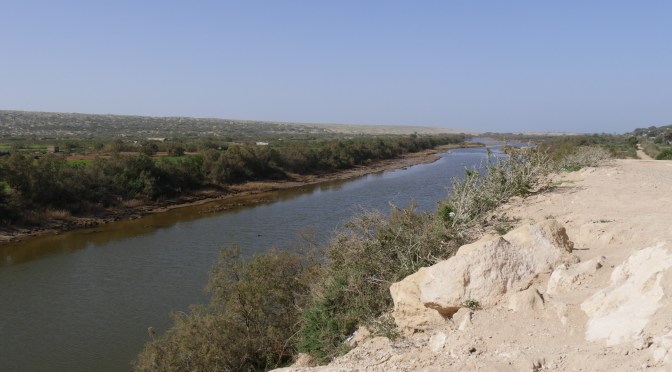
Oued Sousse ja Oued Massa jokien suistot ja niiden välille ja ympärille levittäytyvä rannikkoalue Marokossa, Souss-Massa kansallispuisto, on ainakin osittain suojeltua aluetta. Se on kuuluisa linnuistaan ja mm. kaljusta ibislinnusta joka pesii vain siellä. Alue on ainakin suhteellisen hyvin suojattu turisteilta, sillä rannikolle on erittäin hankala päästä vuokraamatta autoa tai osallistumatta retkelle. Sinnikkäälle sinne löytäminen voi onnistuakin, suosiollisten tähtien ja kanssaihmisten myötävaikutuksella, kuten minulle tänään. Eilen yritin päästä alueen laitamille, pieneen rantakylään nimeltä Tifnit hiukan Agadirista etelään, mutta päädyin paikallisen kimppataksin kyydissä kaupunkiin nimeltä Tiznit. Tänään päätin suosiolla ottaa kohteekseni Massa-nimisen pikkukaupungin, jonka lähistöllä on virallinen sisäänkäynti kansallispuiston alueelle. Matkustamiseen meni suurin osa päivästä, mutta ehdin kävellä suistoalueella sen verran, että maisemat ja rauha olivat vaivannäön arvoisia.
Matkanteko oli kiinnostavaa sekin. Kimppataksi on edullinen tapa liikkua ja siinä näkee ihmisiä, tai paremminkin tuntee, kun istuu ahdettuna heidän väliinsä. Parhaimmillaan takapenkillä oli neljä aikuista ja kaksi lasta. Hinnasta ei tarvitse tinkiä, tai reitistä neuvotella eikä huolehtia missä jäädä pois, sillä kaikki toimii sujuvasti kunhan tekee kuten muutkin. Eikä aikatauluista ole stressiä, auto lähtee kun se on täynnä, se pitää vain löytää. Agadirista ei esimerkiksi päässyt kimppataksilla suoraan Massaan, vaan ensin oli otettava auto Inezganeen, naapurikaupunkiin, joka on jonkinlainen eteläisen autoliikenteen risteysasema. Sieltä löytyi lopulta kyyti Massaan, ja Massasta sain sitten kahvilasta neuvon ottaa kolmas kimppakyyti kylään nimeltä Agbalou. Sieltä kävelymatkaa tienhaaraan, josta olisi käännyttävä puistoon oli vain pari kilometriä, ja tienhaarasta kyltin mukaan puiston portille enää kolme:

Tosiasiassa tie seurasi jokivarttta pitkin matkaa, ja olisin voinut kävellä enemmänkin ellen olisi halunnut palata takaisin hyvissä ajoin ennen auringonlaskua. Matkalla kohtasin vain kaksi portinvartijaa tai opasta, joista jälkimmäinen varsinaisen puiston portilla. Jos todella haluaisi nähdä lintuja opas olisi ehkä tarpeen, mutta minä halusin vain ihailla maisemia ja hiukan leikkiä uudella kamerallani. Kuvasin videolle kolme yritystä istua tien vierellä, työnimellä “Waiting for the Bald Birds”. Tässä alla videolta napatut pienemmät stillkuvat. Ensimmäinen kuva oli kivellä rinteessä ennen viimeistä pikkukylää, jonka nimi on luultavasti Sidi Berzane, vaikken sitä löydä kartalta. Sillä paikalla moni muukin oli pysähtynyt kuvaamaan, jalanjäljistä päätellen:
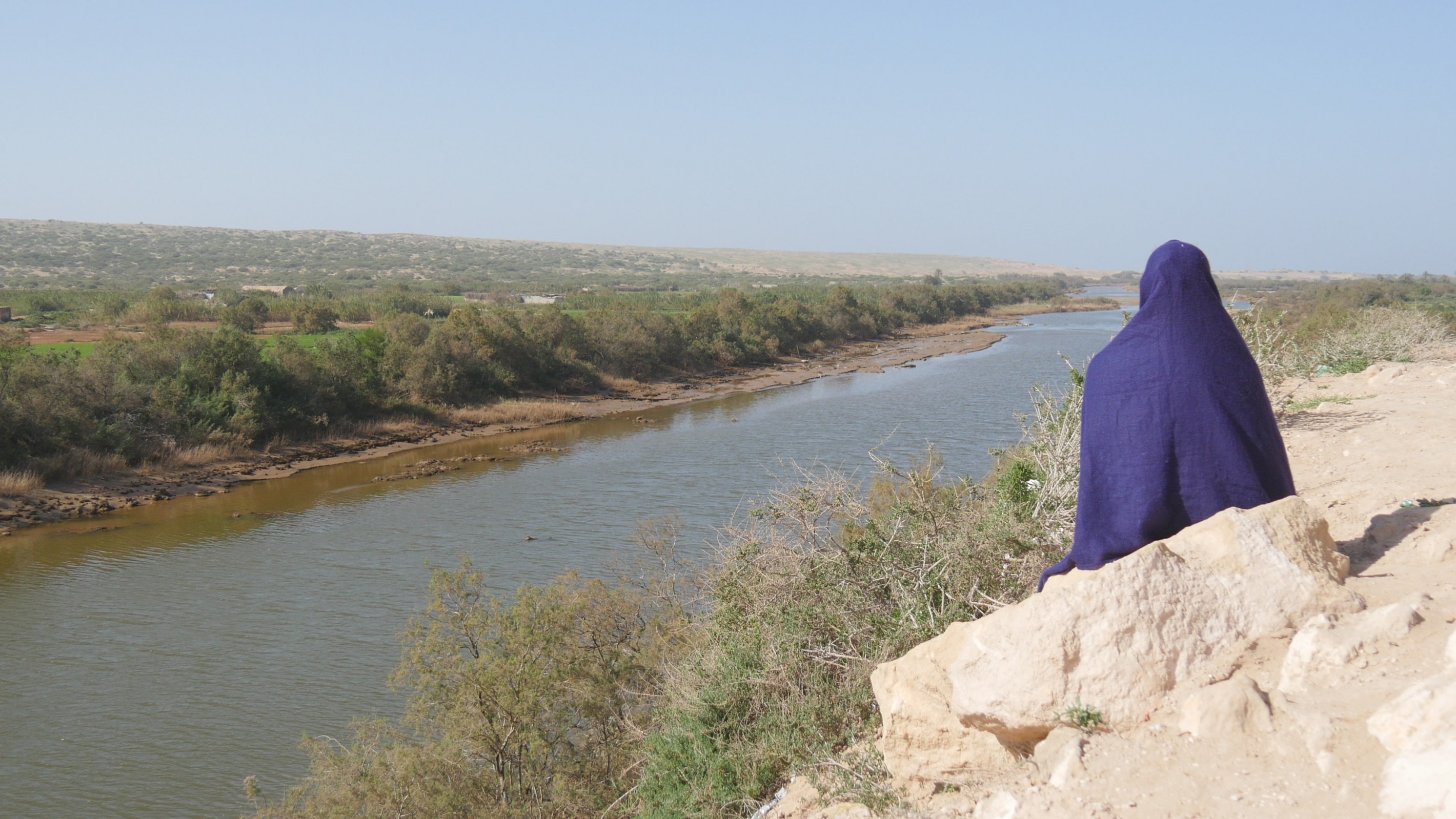
Toinen kuva oli puiston perukoilla, jonkinlaisen betonisammion reunalla istuen, melko lähellä merta:

Ja kolmas kuva oli vain pienen matkan päässä siitä rannassa, puoliksi maatuneen palmunrungon pätkällä:

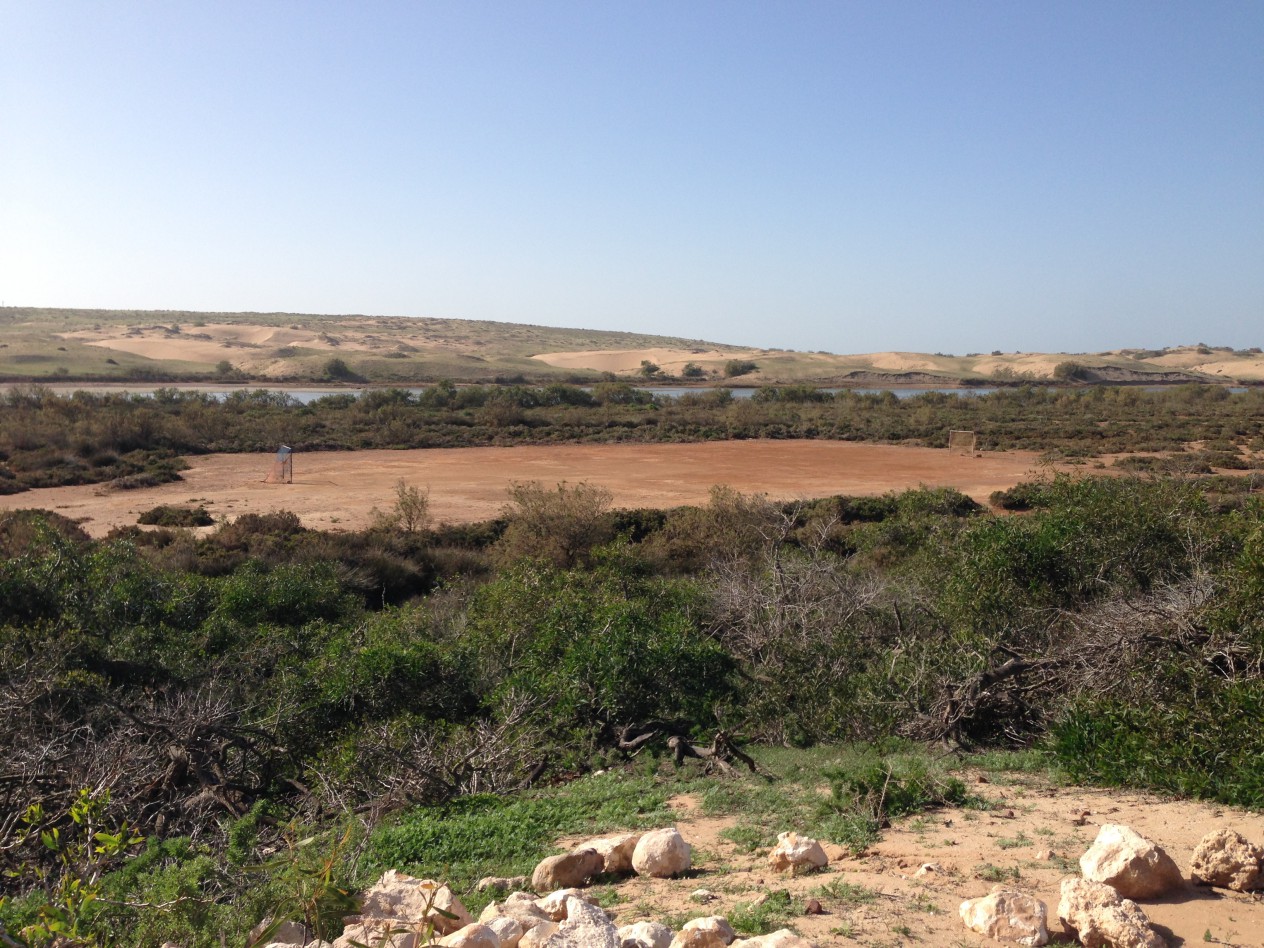
En nähnyt ensimmäistäkään ibislintua, en kaljua enkä muunkaanlaista, vaikka tuskin olisin sellaisen tunnistanut, jos se olisi osunut kohdalle. En tavannut muitakaan lintuja, paitsi pikkukylässä kujertaneet pulut ja takapihalla kiekuneen kukon, jonka tosin vain kuulin. Ehkä yllättävin näky oli hylätyn näköinen jalkapallokenttä hietikolla keskellä suojeltua suistoaluetta. Mietin oliko se unohtunut sinne kun paikka oli muutettu kansallispuistoksi, vai olivatko naapurikylän pojat virittäneet sen sinne hiljattain.
Takaisin kävellessäni kohtasin ensimmäiset kanssaturistit, neljä pikkubussillista ranskalaisia. Ehkä alueen ylellinen hiljaisuus ja rauha olikin vain iltapäivän helteen suoma poikkeuksellinen hengähdystauko, josta en ensin edes tajunnut olla kiitollinen. Ennenkuin pääsin Agbaloun, Massan ja Inezganen kautta iltaruuhkan läpi takaisin Agadiriin, oli jo pimeää ja hiljaisuudesta oli jäljellä vain muisto.
 Performing Landscape