
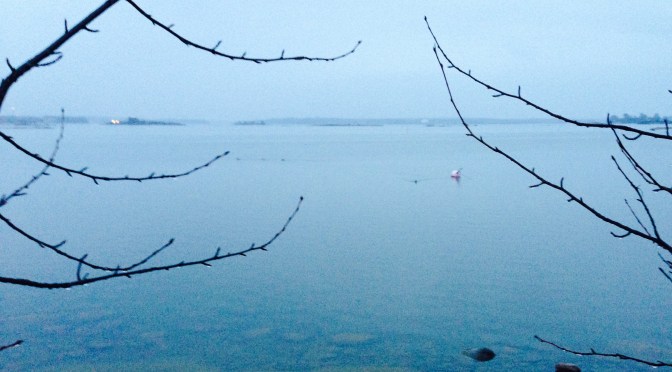
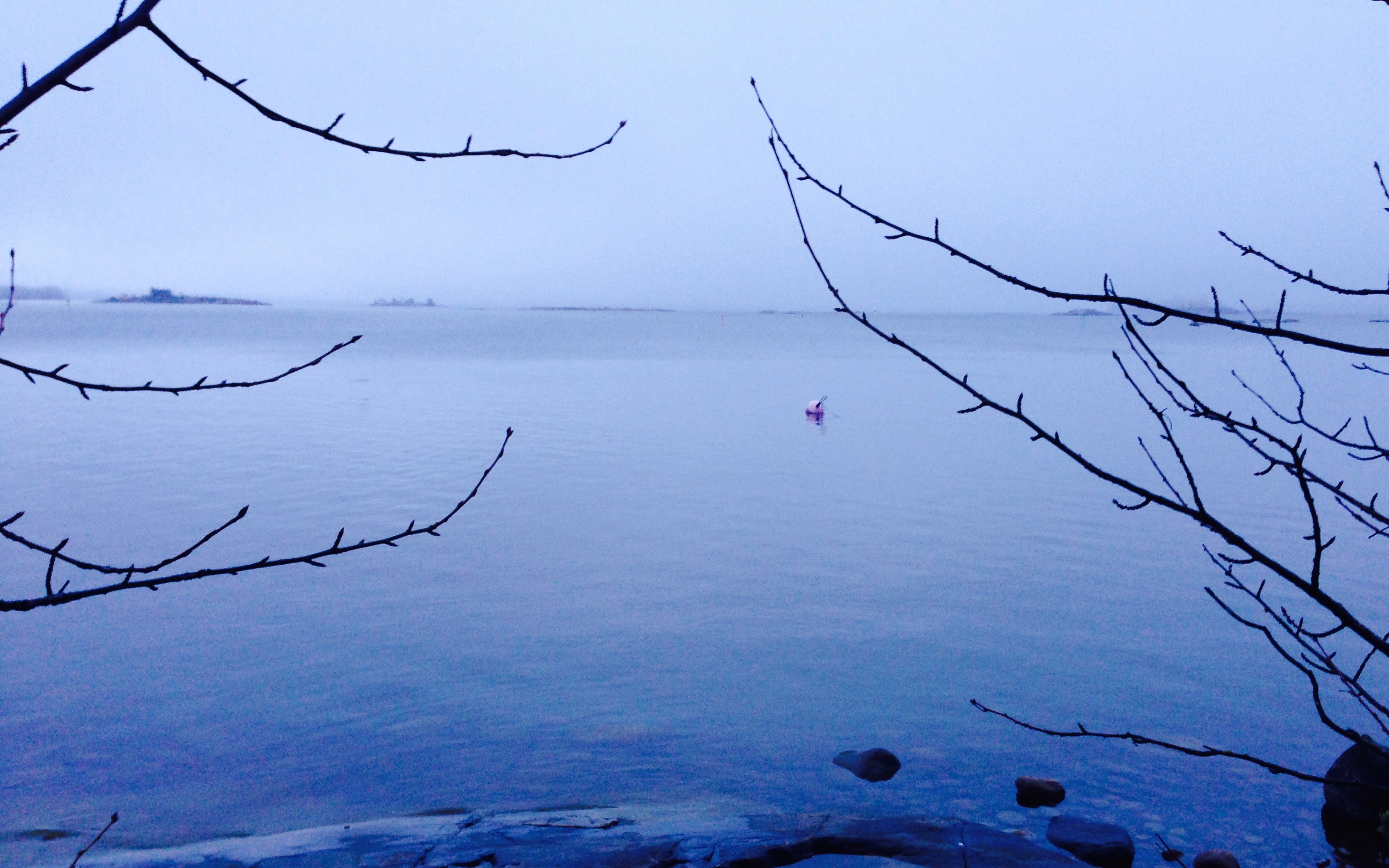
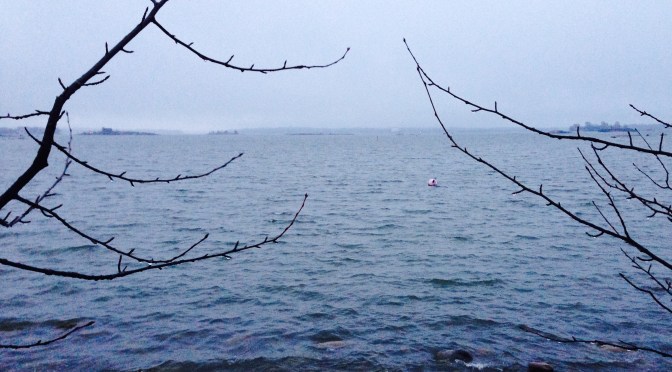
Ännu en regning morgon utan tillstymmelse till morgonrodnad, inte ens en skymt av en ljusstrimma i horisonten, bara ett ljusnande jämngrått molntäcke. Kameran ser skillnader i ljuset och tolkar dem i blått. Officiellt steg solen upp klockan 4.49 (eller 4.51, beroende på instans) i Helsingfors och så där 4.47, strax innan jag satte igång videokameran, tog jag en bild med min telefonkamera som visar en turkosblå värld (se ovan). Men redan ett par minuter senare, 4.52. då jag stängde kameran och tog ytterligare en stillbild, var världen blå med en lila nyans (se nedan). Det är fascinerande att nyanserna är nästan exakt de samma som igår. Det enda som skiljer är regnet, ett sakta duggregn, som hängde kvar i droppar på grenarna, och smattrade hörbart mot mitt paraply.
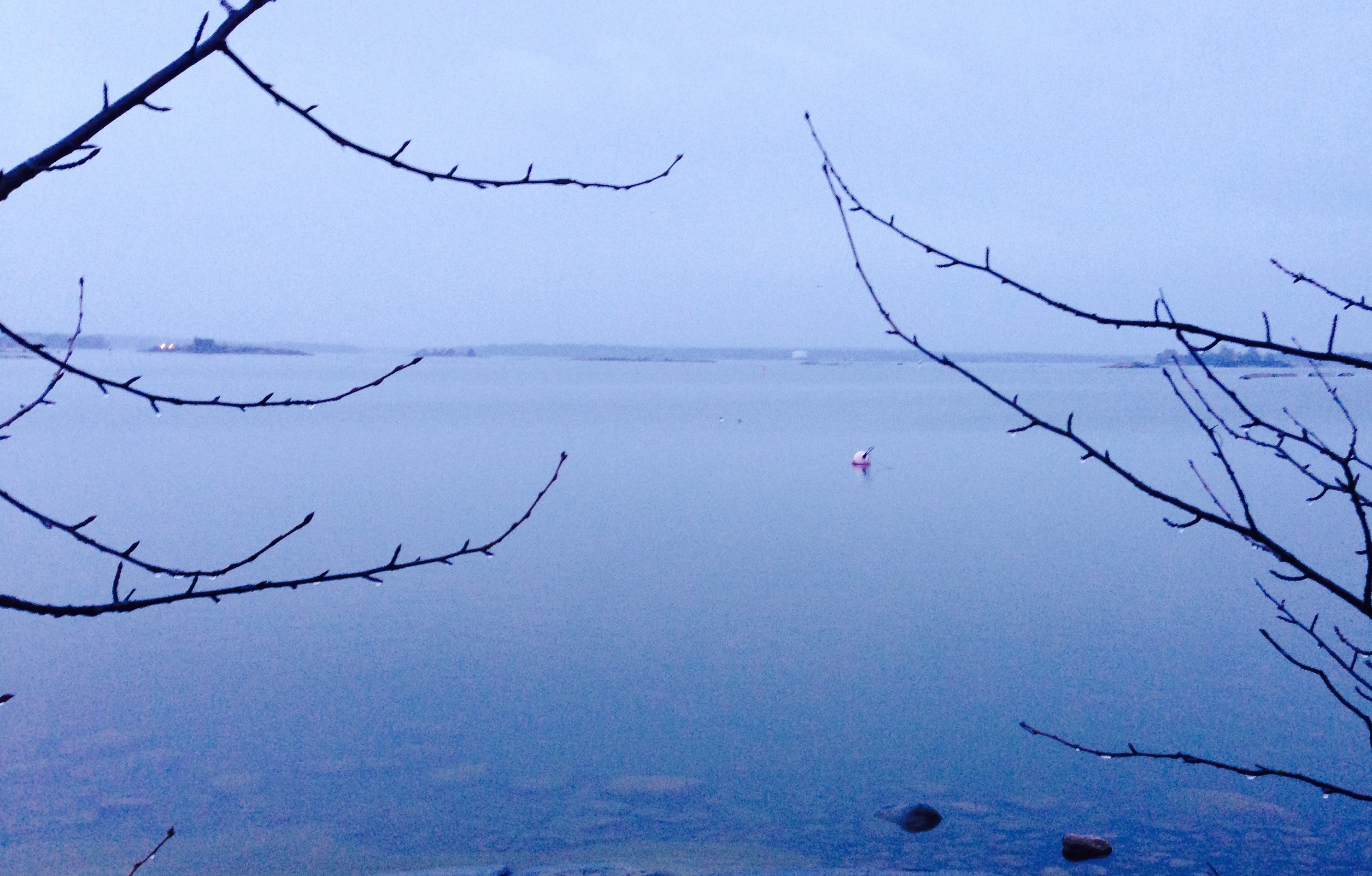
Någon gång på dagen igår tog jag en bild av stativet på stranden (se nedan), som ett slags dokumentation, för att visa omgivningen. Den orangefärgade tejpen, som håller fast en lapp “rör ej” på stativet, lyser i bilden. Det som inte syns är skjulväggen, eller gåsboet där intill. Men att björkarna redan har skira gröna blad kan man urskilja uppe till höger, medan asparna ännu är kala.
Det är morsdag idag, och det känns alltid vemodigt, för jag har ingen mor kvar i livet och är inte heller mor själv. Jag kom att tänka på en annan morsdag, våren 2004, för då inledde jag ett projekt som hörde ihop med utställningen Öga och Sinne (Vision and Mind) på Kiasma, ett av de få gånger jag gjort en performance för kamera mitt i stan. Då stod jag på bassängkanten intill Mannerheimstatyn mitt emot riksdagshuset 15 minuter varje söndag klockan ett, och editerade sedan en ny version av videon varje vecka för utställningen. Videon hade alltid samma längd, för den utgjorde ett par med en bild från Stora Räntan, men delades upp i allt flera delar under sommaren, för jag fortsatte med mina uppträdanden under hela utställningen.
Att jag kom att tänka på det nu, var kanske behovet att passa tiden. I allmänhet har jag inte varit särskilt noga med tidpunkten för mina uppträdanden för kamera, och inte heller med längden, hur länge jag fortsatt varje gång. Men den sommaren utanför Kiasma stod jag alltid med ett tidtagarur i handen, med ryggen åt kameran, förstås, så den inte syntes, och försökte förbli orörlig som en staty i femton minuter. Nyss på stranden, med paraplyet i ena handen och telefonen i den andra väntade jag också på det rätta klockslaget. Men nu var jag ju inte själv med i bilden.
Igår såg jag av en händelse en fin liten video performance i Stadsmuseets aula i Tennispalatset. Eeva-mari Haikalas “I Was Waiting for You (My Heart Will Go On)” byggde på idén att stå på en brygga mot havet och hålla upp armarna i nivå med horisonten så länge som möjligt. Enkelt och snyggt. Kanske jag tyckte så bra om den för att jag kände igen många gemensamma element, som havet och att stå med ryggen mot kameran. Mest fascinerades jag av det klassiska performance-konceptet att låta sin fysiska förmåga eller uthållighet bestämma tiden, att hålla på så länge man förmår, att följa sin kropp eller viljestyrka snarare än klockan. Det borde jag kanske pröva på i något sammanhang…
All posts by Annette Arlander

Shades of Blue
Rain and mist, a grey carpet covering the sky, not the slightest stream of light visible on the horizon, not a trace of the sun, simply a slowly increasing light evenly spread over the whole sky. The daybreak at 4.54 am, when the sun was supposed to rise in Helsinki, took place over a misty sea. According to forecasts there are no rose-colored sunrises to be expected these days. The recurring uniform grey, however, which seemed rather disappointing at first, turned out to contain a wealth of nuances and hues, ‘fifty shades of grey’ if seen by the naked eye, and many shades of blue, as seen by the camera.
The camera on my phone, which I use to take snapshots to add to this blog, and the video camera I use to document a few minutes of the sunrise, might of course look at the light and the colours differently. I use automatic functions on both of them. The two snapshots for today were taken before and after recording, with something like three minutes between them. In that time the rather turquoise shade (the image above) had transformed into a soft blue with the increasing light (the image below). That difference I would not notice while standing there on the ishore, and probably the slow change will be hard to notice on video as well.
The mist is fascinating, of course, because it transforms the landscape. Most of the thick mist or fog last night disappeared before morning, but some of it remained over the sea, hiding the details of the city on the horizon. There is nothing at middle distance in the view, except the small buoy perhaps, that would show the effect of the mist more clearly. The branches at close range would be visible even in rather heavy mist.
To my surprise the small aspen on the shore show no signs of leaves yet. The birches are already green, and a small rowan nearby has large leaves. The aspen are not dead, however, only more slow than the others. The tall aspen, too, are still bare. And when I think of it, last year, during the year of the snake, when I returned once a week to a the small swing attached to an aspen on the western shore the aspen had leaves rather late and all at once. Instead of the soft light green shimmer surrounding the birches the aspen burst into bloom, as it were, with huge yellowish brown buds. I am curious to see what happens with these small ones, and when.
Aamu vailla aamuruskoa
Sateessa hitaasti vaaleneva harmaus, asteittain lisääntyvä valo erilaisten keinovalojen ‘kellastuessa’, ei oikein korvaa aamuruskoa. Huomaan kaipaavani edes kirkasta viirua horisonttiin, jotakin, joka kertoisi että täältä aurinko nousisi, jos sen voisi nähdä pilvipeitteen alta. Mutta ei, ei minkäänlaista kajoa tai kajastusta. Vain aamuhämärä joka hiljakseen hälvenee sadepäivän harmauden tieltä.
Palatessani saareen eilen kolmen päivän tauon jälkeen, myrskyssä, huomasin heti kamerajalustan kaatuneen. Onnistuin kuitenkin löytämään sen vanhan paikan suhteellisen hyvin, tai ainakin rajaamaan kuvan niin, että se muistuttaa edellisiä. Tein sen jo illalla, kun tuuli oli tyyntynyt ja sade lakannut, sillä aamuksi oli luvassa sadetta ja oli helpompi säätää kaikki kohdalleen ‘hyvän sään aikana’. Tosiasiassa aamun sade ei ollut rankka, ja vaikka itätuuli oli yltynyt illasta, se oli vain hento vire eilisaamun myräkkään verrattuna. Silti tuuli varmaan paukutteli kameran mikrofonia, koska se osui suoraan kohti.
Auringon tarjoaman spektaakkelin puuttuessa huomaan miettiväni, onko järkeä kuvata merta ja horisonttia ilman minkäänlaista elettä tai tekoa, tai edes viittausta esiintyvään hahmoon. Aiemmissa töissäni olen lähes aina astunut itse mukaan kuvaan, jos ei muuta niin olkapäänä, kuten Hevosen vuoden (2002-2003) ensimmäisessä osassa tai Koiran vuonna (2007-2008) puussa istuessani. Ja vaikka joskus olen ollut pääosin näkymätön, kuten Kuusen alla sian vuonna (2008-2009) tai läsnä vain kellon äänenä, kuten Lohikäärmeen vuonna (2012-2013) olen ollut jollakin tapaa läsnä kuvassa. Olen tosin aina kuvannut myös ‘tyhjän’ maiseman, mutta se on tapahtunut rinnastuksena, ikään kuin kysymyksenä ‘ihmisellä vai ilman?’
En tietenkään ajattele ihmishahmon olevan jotenkin välttämätön kuvassa, päinvastoin, on kiinnostavaa ajatella muita hahmoja, tai koko maiseman esiintyvän itsekseen. Mutta huomaan epäröiväni, koska astun ikään kuin eri genreen kuvatessani ‘pelkkää’ maisemaa. En olekaan enää dokumentoimassa jonkinlaista performanssia tai elettä tai tekoa, vaan osallistun siihen loputtomaan maisemakuvien ja luontokuvien virtaan, jossa toinen toistaan taitavammat kuvaajat kilpailevat keskenään loistokkaista teknisistä suorituksista vangitessaan sensaatiomaisia hetkiä ja luonnonilmiöitä. Ja siihen virtaan en ole koskaan halunnut sukeltaa, siihen minulla ei ole asiaa.
Alunperin toisto, tai yleensä erilaisten sääntöjen asettaminen itselleen on ollut keino välttää kiusausta etsiä ‘kauniita kuvia’, tai ‘vangita hetkiä’. Toistoon ja automatiikkaan perustuvassa sarjassa sattuma saa tehdä osansa. Siten osa kuvista on kiinnostavia, ja osa ei ole. Eikä ole mitään syytä sulkea pois jälkimmäisiä sarjasta, jos ideana on nimenomaan moninaisuuden tai muutoksen dokumentoiminen. Tämä pätee tietysti myös näiden aamujen kohdalla, joten miksi huolehtia vain siitä syystä että ‘pääosan esittäjä’, aurinko, ei suvainnut tällä kertaa näyttäytyä lainkaan. Osa aamuista on harmaita, osa ei ole.
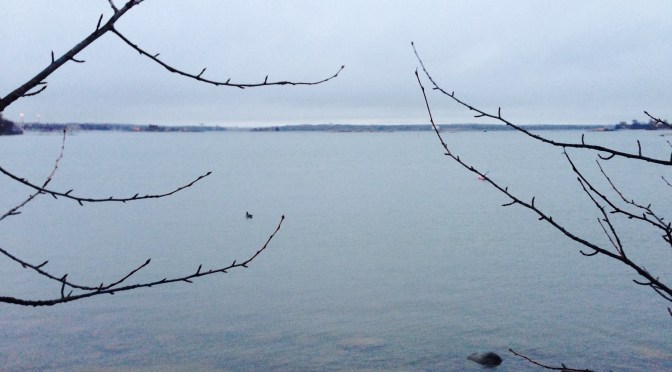
Morgon utan Rodnad
Efter fyra dagar av skira morgonrodnader med varierande rosa och rödgula nyanser kunde jag inte tro mina ögon i gryningen då jag mötte den jämnt blågrå horisonten som långsamt förvandlades till mer grå än blå. Inte den minsta rodnad eller ljusstrimma antydde att det var här som solen skulle ha visat sig ifall moln-täcket inte skymt den. Om jag inte vetat var solen steg upp igår, hade det varit svårt att avgöra riktningen. Den officiella tidpunkten för soluppgången var 5.06 eller 5.07 beroende på källan. Idag kändes det som om soluppgången uteblev, men det blev ljust, trots allt.
Då jag stod och väntade på den rätta tidpunkten, och på att den minsta strimma av ljus skulle markera dagbrottet, började det regna, ett stilla duggregn som snart förbyttes i slaskregn, med stora våta flingor som snabbt förvandlades till vatten. Maj med aprilväder! Besviken över den trista synen, gladde jag mig samtidigt åt tanken på variation. För det är ju hela vitsen med att hålla på med serier som den här, att allting ständigt förändras.
Jag bandar in åtminstone fem minuter eller mer varje gång, för i min otålighet startar ja ofta kameran alldeles för tidigt, för säkerhets skull. Men jag kommer antagligen att använda bara 20 eller 30 sekunder från varje morgon. I går editerade jag en förkortad version av Ormens år med fyra sekunder av varje bild, så att ett år förtätades till tre och en halv minut. Jag vet inte ännu vad jag skall göra med avbrotten. Nu blir det till exempel en paus på tre morgnar för att jag skall åka till Stockholm av och an. En möjlighet är att sätta in en kort nedtoning till svart vid varje hopp. I mina tidigare arbeten har jag struntat i att markera avbrotten, för ett två eller tre veckors hopp syns ofta tydligt i vegetationen. Kanske aspens grenar fått blad när jag återvänder.

Beginning a Rainy Day
The fourth morning in May was supposed to be rainy, but luckily the rain subsided before sunrise and remained only as drops on the branches and my tripod, waiting by the shore. Today the sun was to rise at 5.08 or 5.09 depending on the forecast, and I was ready at five. There was enough of a gap between the horizon and the clouds to show some colour, but at first it seemed like the sun had moved towards north, since the gap was wider there. Although I have decided to capture the moment before sunrise, the actual sunrise is spectacular for the naked eye, but the camera sees it differently and the bright light burns away the colours. I waited for the sunrise to end my recording and wondered whether my watch and phone had the time right. And then, a few minutes later, the red sun burst forth from behind the clouds, a true spectacle to behold. Actually the moment before is even more fascinating, since all the hues are more subtle and there is a sense of expectation. This morning, however, probably because of the clouds, the image turned exceptionally blue.
The sounds are perhaps the most interesting part of the experience of standing at the shore by daybreak. All the various birds are communicating, and today there were some birds I did not recognize, with a strange howling sound, but softer, almost like owls, and several of them. The usual seagulls were screaming of course, and the barking sounds of the omnipresent geese filled the air every now and then. The main difference to my previous experiences is the lack of wind. On Harakka Island it is always windy, and very often it blows from south-west, hitting the camera microphone and cracking all other sounds. In the early mornings, now, at the northeastern shore, where i am sheltered by the slope, the wind does not disturb and all the sounds can be distinguished more clearly. Today there was no wind anywhere on the island, only soft rain in the air.
After seeing some exhibitions with works referring to landscape yesterday, like the video with a strange artificial looking and regularly repeated lightning by Liisa Lounila, the handwritten word ‘landscape’ framed in a small round golden frame by Aleksi Linnamaa or the five hundred thousand dead bees on the floor in a piece called Nemesis by Timo Wright, all impressive in their own way, I cannot but wonder whether I am somehow missing the point by trying to capture these small changes in the landscape without irony or distance. I know landscape is a cultural construction, I know depicting landscapes has a loaded legacy in colonial overviews of territories, I know the romantic attempts at capturing the sublime and the spectacular still linger with us. And so does everybody else. I see no point in telling people that landscape is part of nature-culture. Today advertising provides us with all the pretty pictures we could dream of needing. Why would I make more of them, with or without reflexivity. So what am I doing then? Maybe I want to see the small changes, not the one spectacular image that captures the essence of what everybody expects to see, but the small non-spectacular shifts that happen from day-to-day. Or perhaps I am simply playing for time, practicing receiving what is given to me…
Morgnar i maj
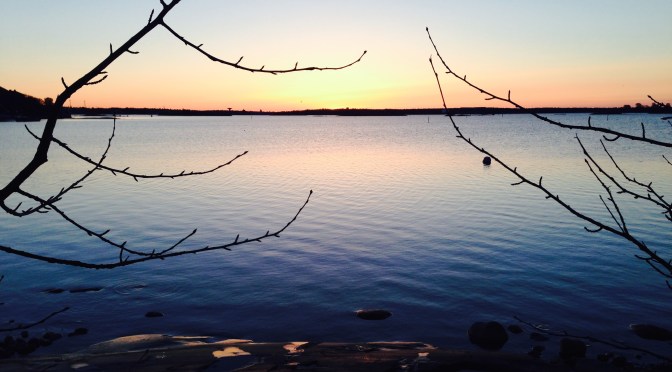
Den första maj påbörjade jag en serie som jag kallar Morgnar i maj, där jag dokumenterar ögonblicket innan soluppgången på stranden mot nordost på Stora Räntan utanför Helsingfors. I dag var den tredje gryningen då jag vaknade i en tältsäng på mitt arbetsrum klockan 4.30 för att vara nere vid stranden klockan fem. Officielt gick solen upp 5.12, dvs. några sekunder tidigare än i går. Det kommer att bli tidigare för varje dag ända fram till midsommar. Men så länge kommer jag inte att hålla på, en månad får räcka. Och det blir nog avbrott på grund av resor också. Tillsvidare har jag haft tur med vädret. Morgnarna har varit klara, så gott som molnfria. Regnskurarna har kommit och gått på dagtid.
Mina tidigare arbeten på Stora Räntan som dokumenterat ett år på samma plats en gång i veckan har oftast upprepats mot kvällen, som Råttans år (2008) innan solnedgången eller Harens år (2011) klockan tre på eftermiddagen. De flesta år har jag inte valt någon exakt tidpunkt, och av praktiska skäl har jag inte dokumenterat några morgnar tidigare. Nu då jag har tillfälle till det är det värt att göra ett litet experiment. Eller kanske jag borde kalla det en övning. Soluppgången är egentligen en omöjlig klisé att arbeta med, men fascinerande just därför, och visst är nyanserna av rosa och orange läckra. De tre första morgnarna har sett rätt lika ut, endast vindriktningen har varierat. Men ifall de små asparna, vars kala grenar syns i bilden, får löv under de närmaste veckorna, kommer bilden att förändras radikalt.
Mitt kamerastativ står färdigt placerat nere vid stranden, bakom skjulet med akvarierna, med en varningslapp: rör ej. Gåsparet som häckar intill väggen bara ett par meter längre bort vart helt lugnt idag, hanen kom inte ens för att kolla vad det är jag håller på med. Synbarligen har han lärt sig på ett par dagar att den underliga klumpiga figuren som ställer sig vid stranden vid soluppgången inte är något man behöver oroa sig för. Jag stod och lyssnade på de olika fåglarna och insåg att jag inte känner till många fågelläten utöver de allra mest bekanta som måsar, kråkor, gäss och den lilla havskatan. Det fanns många obekanta röster i luften och jag hoppas de kom med på videon för det var nästan vindstilla. Ofta täpper blåsten till mikrofonen så att man inte kan höra annat än dessa grova skräll.
Istället för att upprepa samma anteckningar på svenska, finska och engelska har jag tänkt skriva olika dagar på olika språk. Den första maj gjorde jag anteckningarna på engelska, den andra maj på finska och nu den tredje maj på svenska, men eftersom jag inlett med att presentera projektet innehåller de vissa upprepningar. Framöver kan jag kanske komma med större variation.
Toukokuun aamuja
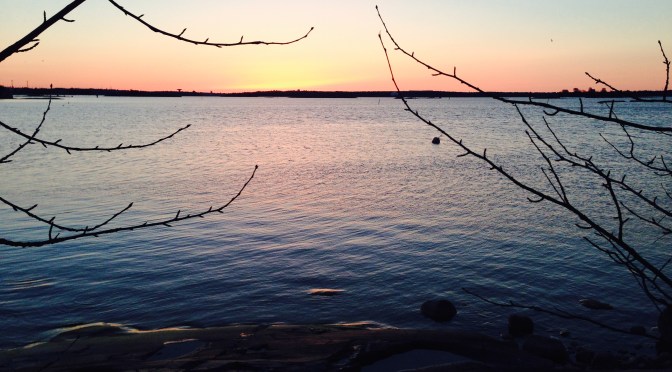
Toukokuun ensimmäisenä aamuna, eilen, aloitin uuden kuvasarjan, eräänlaisen kokeilun tai harjoituksen. Kuvaan auringon nousun Harakasta toukokuun ajan, niin monena aamuna kuin suinkin. Aiemmat työni Harakassa ovat painottuneet iltaan, kuten Rotan vuosi 2008, jonka kuvasin kerran viikossa ennen auringon laskua, tai Jäniksen vuosi katajan kanssa 2011, jonka kuvasin kolmelta sunnuntai-iltapäivisin. Nyt aion kerrankin kokea ja kuvata miltä Harakka näyttää varhain aamulla. Mutta vain kuukauden ajan. Ja välillä tulee väistämättä taukoja matkojen takia.
Aurinko nousee aikaisin, tänään virallisesti 5.15. Olin hyvissä ajoin koillisrannalla lähellä laituria, aivan akvaariovajan edustalla, paikalla jonka valitsin eilen. Taivas oli pilvetön, punertaen meren yllä, ja heikko tuulenvire luoteesta sai veden pinnan väreilemään. Kun merivartioston vene ajoi ohi heti viiden jälkeen, sen tuottamat mainingit loiskivat rantaan kohisten. Yön jäljiltä oli kylmä, ei kuitenkaan pakkasta. Olin jättänyt kamerajalustan eiliselle paikalle ja lähistöllä vajan seinustalla pesivä hanhipariskunta oli ilmeisesti tottunut siihen. Kun asetin kameran paikalleen ei koirasta näkynyt missään. Vasta kun odotellessani tein äkkinäisen liikkeen lämpimikseni, se ryntäsi tarkistamaan mitä oikein tapahtui, mutta rauhoittui pian kun seisoin liikkumatta. Se on onneksi aivan toisenlainen tyyppi kuin mäen rinteessä partioiva, tiellä jatkuvasti ohikulkijoille kaakattava hanhiukko, joka oli samalla paikalla kiukuttelemassa jo viime vuonna.
En vielä tiedä mitä tästä kuvasarjasta teen. Ehkä jotakin Harakan Vesikuvia-näyttelyyn, jonka avajaiset ovat toukokuun lopulla. Voi olla että kuvat ovat niin samankaltaisia, ettei niistä saa mitään kiinnostavaa, tai sitten juuri se tekee niistä kiinnostavia. Sen kuluneempaa aihetta kuin auringonnousu ei oikein voi kuvitella, tai ehkä auringon lasku olisi vielä tavanomaisempi. Voi myös olla, että kun haavat (mikäli oksat kuvassa todella ovat haapoja) puhkeavat lehteen, ne peittävät suurimman osan näkymästä. Ehkä epäröin vain koska en itse ole kuvassa mukana, joten kyseessä ei ole performanssi kameralle, vaan kuvasarjan pitäisi toimia sellaisenaan. Ja kameran automatiikka näyttää valon hyvin toisenlaisena kuin miten silmä sen näkee. Tällainen aamuharjoitus on joka tapauksessa kiinnostava kokeilu, eräänlainen “kuukauden residenssi”, sillä joudun heräämään yhä aikaisemmin joka aamu. Sikäli tämä on siis eräänlainen privaattiperformanssi, tavallaan.
Mornings in May
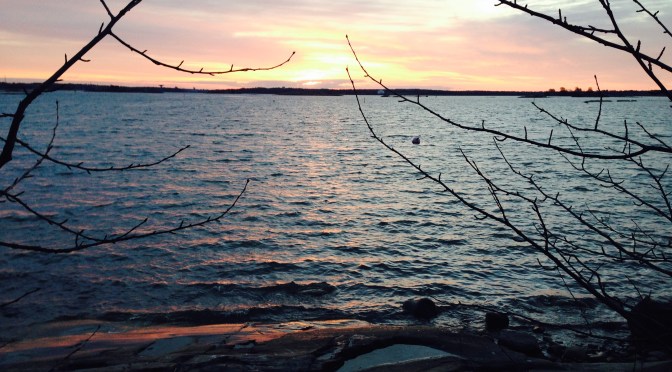
At the northeastern shore of Harakka Island at 5 am in the morning, watching the sky slowly turn red, waiting for the sunrise, freezing in the brisk wind (+ 4 degrees Celsius, but feeling colder) I tried to calm the Canada geese couple nesting nearby, close to the spot were I had placed my a tripod. I waited for sunrise; the official time was 5.17. Impatient I started my camera at ten past five, to have some extra material. And then, to my horror the camera started to warn: change the battery pack. For a moment I considered whether running up to my studio to fetch a new one would be an option, and then decided to wait and see how far the battery would last. And it lasted until 5.16. Fair enough for a start.
This was the beginning of a new experiment, or perhaps I should call it an exercise, Mornings in May (working tittle), that I decided to do now, when I have to opportunity to spend some time here. Most of my work on Harakka Island has been recorded in the afternoons or evenings. The Year of the Rat, for instance, was documented once a week before sunset, and Year of the Rabbit in the afternoon at three o’clock. Now I decided to focus on the mornings, but only for one month, at least to begin with, the month of May. In May the sun rises early in the south of Finland, earlier every day until midsummer and the first of May or May Day, which is a carnival here, is a good day to start.
Early spring is a beautiful time out at sea, when everything changes slowly at first, because the sea is still cold, and then bursts into bloom. Especially the old bird cherries here are amazing when flowering at the end of May. From the spot I finally chose at the shore you cannot see them, though; I wanted to have a clear view of the sky and the sea, and no foliage to hide the view later this month. The bare branches in the image are of small aspen, I think, more slow to grow than the birches, which have tiny leaves already. The aspen, too, will have big leaves soon.
I am not sure if I can make an image every morning, since I have some trips to do, but my aim is to have enough mornings to see how the spot where the sun rises moves towards northeast. It is actually rather hard to determine where exactly the sun rises, and ordinary calendars indicate only the exact time at each location. There were some clouds on the horizon this morning, but I think the sun was a little to the right in the image. That means it has space to move to the left, towards northeast.
Year of the Snake – Swinging
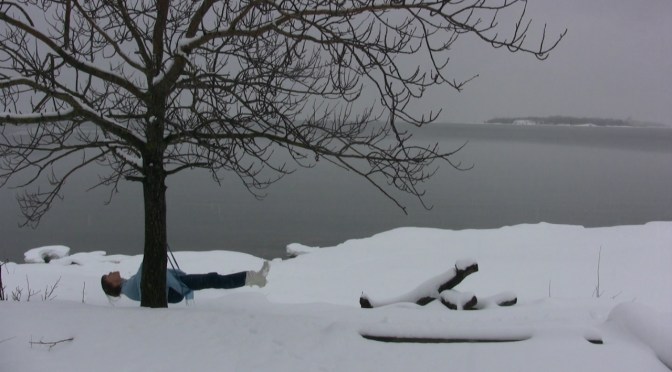
The outcomes of the Year of the Snake can now be viewed in my solo show at Muu gallery 3–25 May 2014 and in the group exhibition Vesikuvia [Water images] organised by Harakka ry 30 May – 19 June 2014. A taste of what is to come you can have from a miniature video Year of the Snake –Swinging (mini).
What do we see in the image? The movement of the swing catches attention and the swinger, someone like us, will perhaps awake our interest. The assemblage of a swing, a tree, a scarf and a swinger can be looked at as an homage to the swing, a small machine that enables a piece of wood and two plastic ropes tied to the branch of a tree to enable movement. What about the tree? A small aspen provided the setting and support for a swing, and showed in its foliage the shifting seasons and weather, without receiving credit for this enforced contribution. This type of hierarchical and utilitarian approach is illustrative of our relationship to vegetation. It also shows, however, in a very literal sense, our complete dependence on plants.
During the year of the snake, beginning with the Chinese New Year on February 10 in 2013, I fastened a small blue swing into an aspen that grows on the western shore of Harakka Island, next to the remains of the stone base of an old sauna. More or less once a week, I videoed myself swinging, wearing a light blue scarf, while keeping the position of the camera on a tripod and the framing of the image as constant as possible. On the same occasions I also sat next to the stub of another aspen that once grew nearby ¬– it used to be possible to fasten a hammock between them – looking out at sea with my back to the camera. And in another image I sat on a small pile of rocks looking at the expanding Helsinki harbour on the opposite shore. Thus I tried to produce “souvenirs” of what the landscape looked like during this year on the northern shore of the Finnish Bay.
“Year of the Snake Swinging” is the last part in a series of twelve one-year projects performed for the camera on the same island, exploring the question how to perform landscape today. The series, which I began in 2002, is based on the Chinese calendar and its cycle of twelve years, with each year named after a specific animal. This way of working is based on the traditions of performance art, video art and environmental art, moving in the borderland between them. Each year I have chosen a new perspective on the landscape, a new aspect of the environment and a new kind of relationship between my body and the place.
This year I focused on the movement of a small swing, a manmade element added to the landscape. Although a swing can be an impressive sculptural element, as in the works of Monica Sand, for instance, this swing is on a child’s scale. The aspen on the shore is small of stature as well. It carried without problems, however, the weight of all visitors. I experimented with sharing the experience of swinging and changing the performer in the image, by inviting colleagues from the island as well as temporary visitors to swing for a while. These performances I documented on video and in a tri-lingual blog, adding a still image from each performance, either of the visitor or of myself, to each blog note. Sharing an activity like swinging, I chose in order to end the series, with its focus on showing the passing of time, on a more light-hearted note. I took the swing with me on my travels, too, and tied it to trees growing on various shores.
Ormens år i gungan
Produkterna från Ormens år finns att beskåda både på min privatutställning i Muu galleriet 3–25.5.2014 och på Harakka rf.s grupputställning Vesikuvia [Vattenbilder] 30.5. – 19.6. Ett litet smakprov kan man få med hjälp av miniatyrvideon Year of the Snake – Swinging (mini).
Vad ser vi i bilden? Gungans rörelse fångar blicken och den som gungar, vår like, väcker kanske vårt intresse. Hopsättningen av gungan, trädet, sjalen och den gungande kan också betraktas som en hyllning till gungan, en apparat som får en träbit och två rep av plast fästa vid en trädgren att möjliggöra rörelse. Och trädet då? En liten asp erbjuder bakgrund och stöd för gungan och visar årstidernas och vädrets växlingar i sitt lövverk, utan att få någon kredit för detta betvingade bidrag. Detta slags hierarkiskt och utilitaristiskt förhållningssätt är beskrivande för vår relation till växtligheten. Samtidigt visar det helt bokstavligt vårt fullständiga beroende av växterna.
Under ormens år, från och med det kinesiska nyåret den 10 februari 2013 fäste jag en liten blå gunga i en asp som växer på den västra stranden av ön Stora Räntan vid resterna av den gamla bastugrunden. Ungefär en gång i veckan videofilmade jag mig själv gungande, iklädd en ljusblå sjal, och försökte hålla kamerastativets plats och bildbeskärningen så konstanta som möjligt. Vid samma tillfällen satt jag också vid stubben av en annan asp som brukade växa intill – tidigare kunde man fästa en hängmatta mellan dem – och tittade ut mot havet med ryggen mot kameran. Och i en annan bild satt jag på ett litet stenrös och betraktade den växande Helsingforshamnen på den motsatta stranden. På så sätt försökte jag skapa ”souvenirer” för hur landskapet såg ut under detta år på Finska Vikens norra strand.
”Ormens år i gungan” är den sista delen i en serie på tolv årslånga projekt, som har uppförts för kamera på samma ö och utforskar frågan hur uppföra landskap idag. Serien som jag inledde 2002 grundar sig på den kinesiska kalendern med dess tolvåriga kretslopp, där varje år är benämnt efter ett djur. Det här arbetssättet grundar sig på performance konstens, video konstens och miljökonstens traditioner och rör sig i gränsmarkerna mellan dem. Varje år har jag valt ett nytt perspektiv på landskapet, en ny aspekt av miljön och ett nytt förhållande mellan min kropp och platsen.
Det här året koncentrerade jag mig på den lilla gungans rörelse, ett konstgjort element som tillförts landskapet. Även om en gunga kan vara ett imponerande skulpturelement, som till exempel i Monica Sands arbeten, är den här gungan hållen i barnets skala. Aspen på stranden är också liten till växten. Den tålde dock utan problem alla besökares tyngd. Jag experimenterade med att dela min upplevelse av att gunga och byta den uppträdande i bilden genom att inbjuda kolleger från ön eller tillfälliga besökare att gunga en stund. Dessa uppföranden dokumenterade jag med video och i en trespråkig blogg, och bifogade en stillbild från varje uppförande, antingen av besökaren eller av mig själv, till varje text. Jag valde gungandet som en aktivitet att dela, för att avsluta serien i en glättigare stämning. Dessutom tog jag med gungan på mina resor och fäste den i träd på olika slags stränder.
 Performing Landscape