

Today on Sunday 24 September I finally decided to visit one of the pine trees up on the dunes every two-hours for a day, creating a time-lapse video in the manner I have done in other places. I decided to start at eight in the morning, after sunrise, and finish at eight at night, after sunset. And here I intend to write some notes of each session. So, it is time to begin….
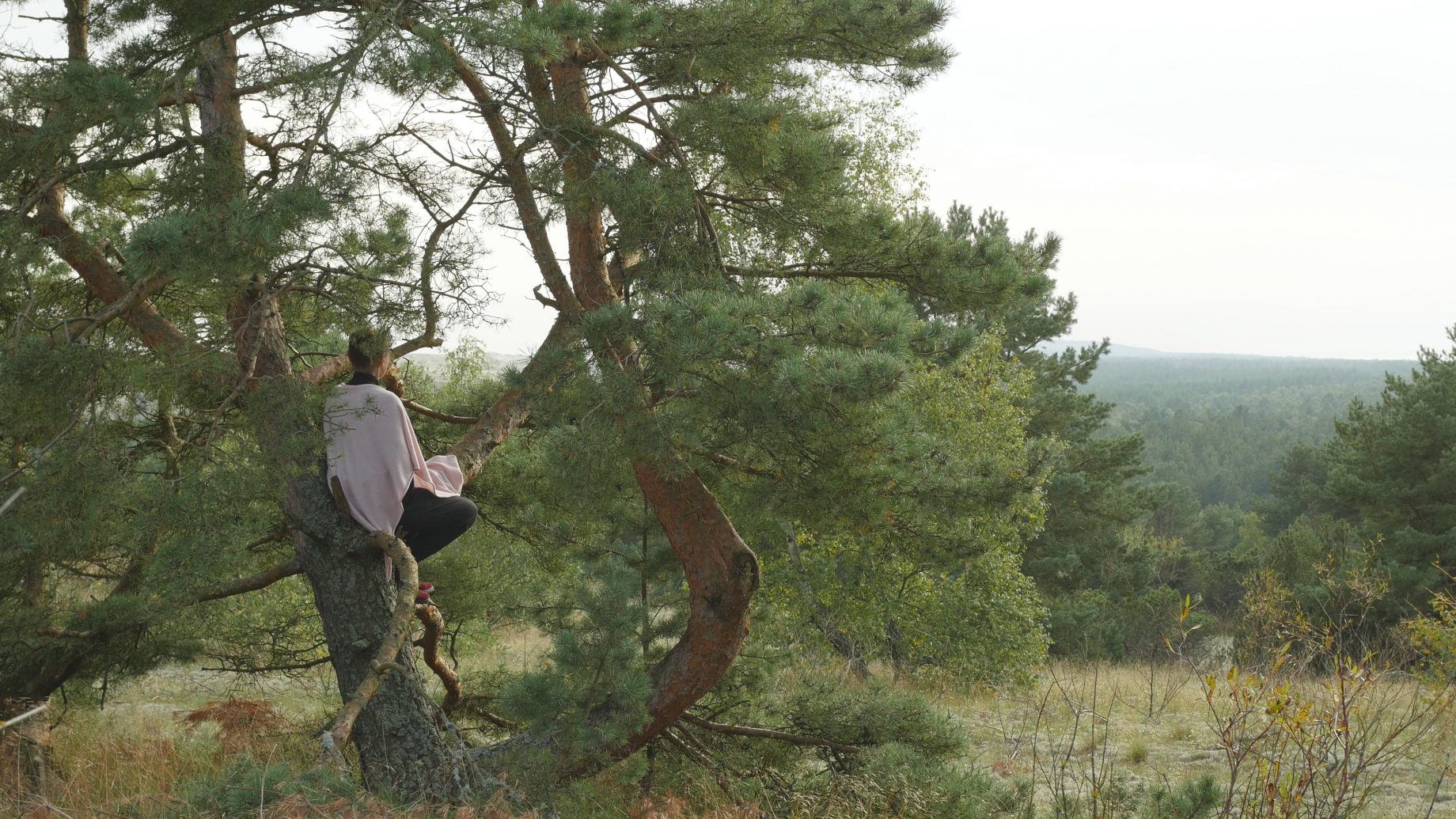
First image. Fresh morning, quiet, empty parking lot on the hill (one car that has stayed there from yesterday), the parasols of the souvenir stands all tight and shut. I am early; finding the spot for the camera tripod is easy, framing the image is relatively easy, too. The sun is only a yellow colouring in the east, showing only as a vague glow on the tree trunk. It is quarter to eight, I climb up in the tree and sit there for approximately five minutes, enjoying the silence and the wind. Then climbing down, packing my things and returning downhill to the colony. The rays of the sun are turning brighter behind the trees.
Quarter to ten, the first bus stands on the parking lot, with a few cars around; all the souvenir stalls are up. A couple with bicycles rests on the bench by the road on the way up. The sun is high, brightening the surroundings. Suddenly the yellow leaves in the small birches stand out. I repeat my routine – second time and it is already a routine – sit in the tree and enjoy the view. I am aware of cramping my thighs around the branch unnecessarily, but if I try to relax I immediately feel unstable. The sun is not really warm and there is a chilly wind from the east; the morning is still, fresh and new.
Quarter to twelve, noon, and sun shine. It is warm, now. The bus is gone, replaced by lots of private cars; I can hear the car doors banging while sitting in the pine. An ant is moving towards me on the branch, I hope it finds a way around me, and choose not to wipe it away. I have learned how to get up on the branch and how to get down with relative ease, but I still have not found a way to sit comfortably. What feels OK to begin with soon becomes uncomfortable, and I do not want to move in the image. After all, I am sitting there only five minutes at a time.
Quarter to two, midday to afternoon, warm like summer. A woman is walking in bare feet past the tree when I arrive with my camera bag. While sitting in the tree, in its shade, I hear voices of children behind me, adults laughing, speaking Russian or Lithuanian or both. Later, when I return to the camera it has turned black; the battery? No, when I turn the camera on, it has recorded 7 seconds, and then stopped, why? Well, there is nothing else to be done but to climb up in the tree again. This time I wait to see that the camera continues working at least 30 seconds. I have no idea what happened, but this was a good reminder not to take any of my collaborators for granted. At least there were less noisy humans around the second time…
Quarter to four, almost hot, lots of traffic. The guy selling souvenirs closest to the slope looks at me with suspicion; why is she here again? Or then I am the suspicious one. The sun is no longer above me, but luckily not straight in my face either, or in the face of the camera, that is. Only two more sessions after this one; time passes so quickly it is almost scary. The walk up and down the slope feels like nothing, especially the walk down the slope, except for the constant stream of cars and huge coaches. I uploaded the clips on my computer and tried to combine the ones recorded so far. The image jumps quite a lot between each session, probably because the tripod sinks into the sand a little different each time.
Quarter to six, evening is approaching. In the forest below the hill it is already chilly, although the sun is still high in the sky when viewed from the dunes. It is hard to believe that it will set in less than two hours. There are no more coaches in the parking lot, one came down while I was on my way up the hill. Most of the souvenir stalls have closed, but there are plenty of private cars still. The pine looks really beautiful in the evening sun. This was the next to last session; the last one will be right after sun set and I am already worried that it will be too dark, for the camera to record anything and for me to find my way back. But for now everything is glowing bright and beautiful with warm evening colours.
Quarter to eight, after sunset, or actually a few minutes before, I guess, because I hurried up the hill, scared of the approaching darkness. But no problem, the light lingers on and up among the dunes the sand reflects the light, too. There were two cars left on the hill, and while returning down I still had no need for a torch. The view from the pine, with a pale violet sky and a thin crescent moon was so beautiful; what a pity that the camera sees it so very differently. I had to make all possible adjustments to let it record something, and it did. So now my Sunday with the pine is over, and it passed so very, very quickly.

Category Archives: English

Back in Nida
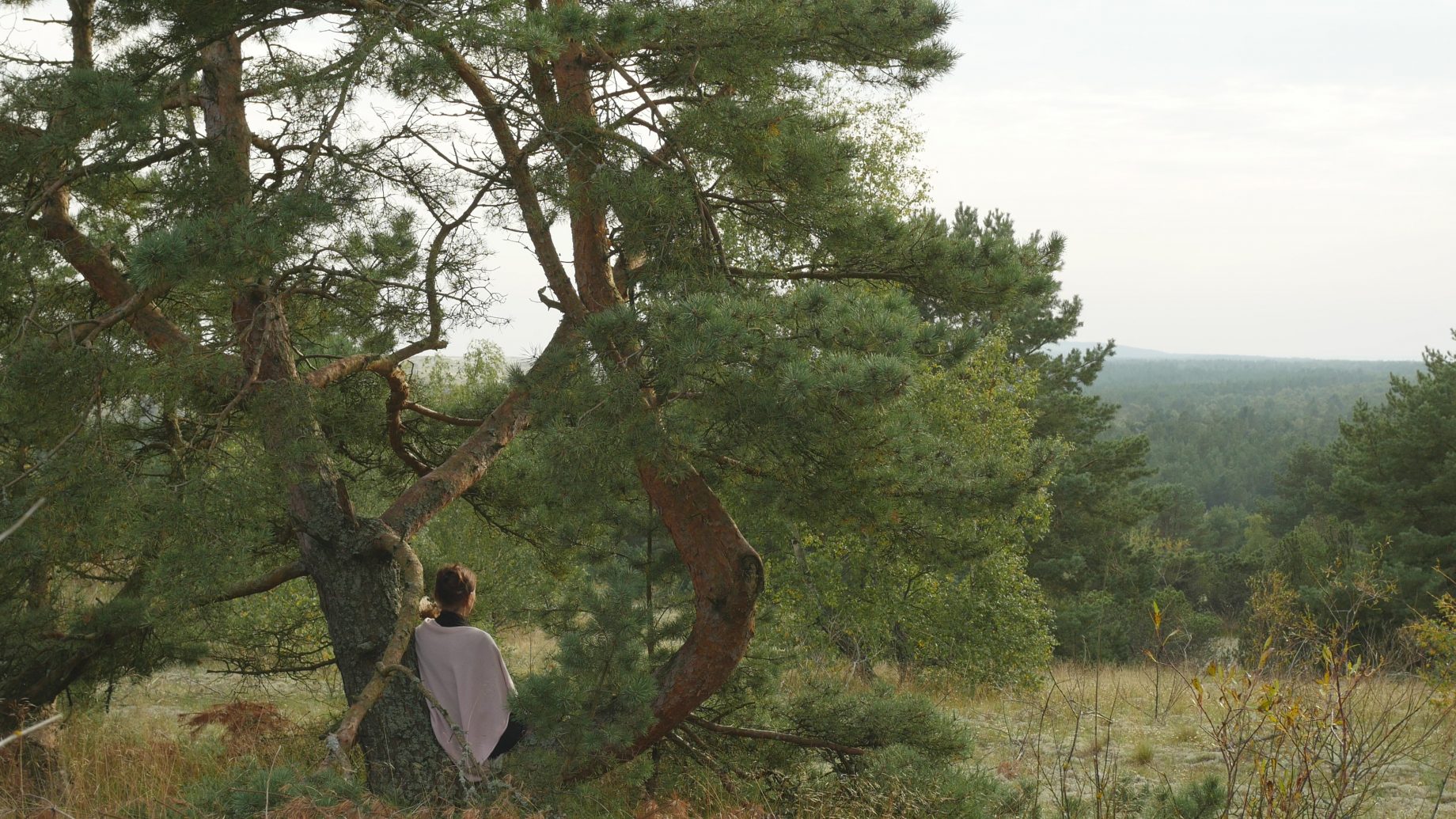
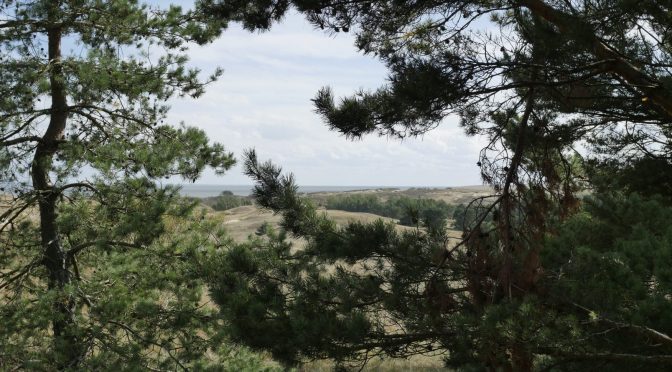
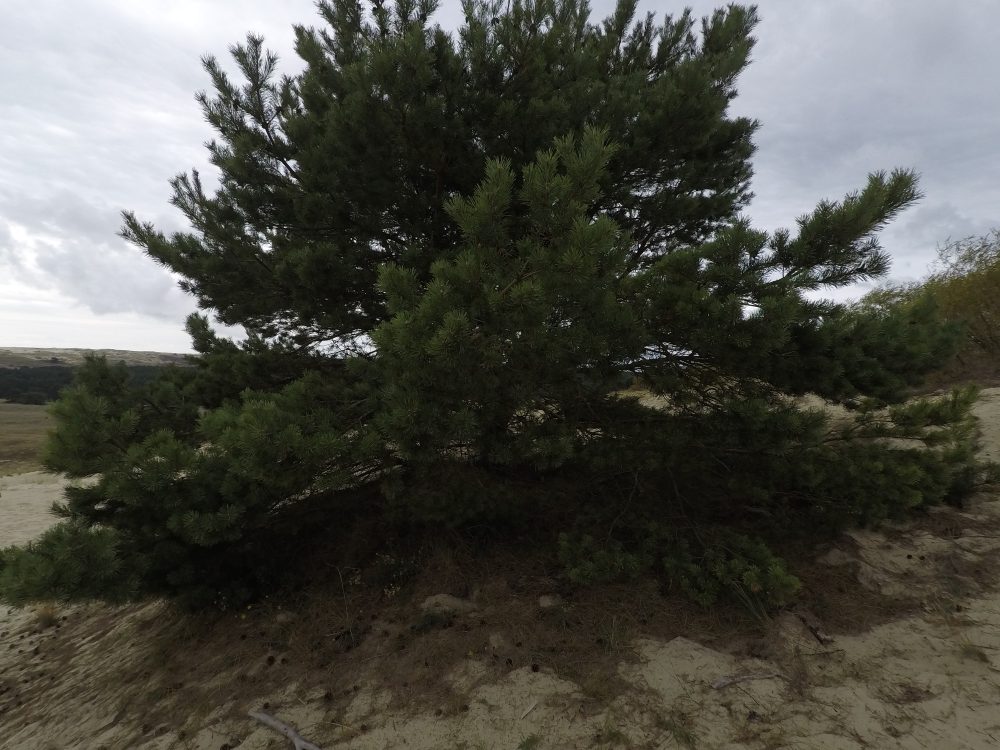
After a hectic visit to Helsinki, Stockholm and Oslo, it has been wonderful to calm down in Nida for a few days with the knowledge that almost a week still remains of my time here. There are too many things to do, other than finding ways of performing with the trees here, editing texts, preparing presentations, planning upcoming teaching and trying to consider alternative constellations of the works to be shown at the exhibition at Muu gallery, which opens on 6 October. Regardless of all these future worries, I have walked on the beach, playing with my little gopro camera without really finding the right way to use it. And then, today, when the weather suddenly cleared and a beautiful sunshine made everything look interesting again, I realized I should perhaps try to make one rough time-lapse session with a pine tree and my ordinary equipment after all. And if I would do it tomorrow, on Sunday, I could show it during the Open Studio on Monday. I found a potential pine partner near the beach, but perhaps too far to return to every second hour, so I walked up to the parking lot near the dunes and chose a pine tree with low and relatively bare branches. Most of the pines on the dunes are spreading their branches to create impenetrable green mounds, but this one (see image above) seemed easy and inviting. So I made a brief session as a try out, sitting up in the tree and on the branch almost touching the ground. (see images below). I managed to find a place for the camera on the slope that enabled a framing with the horizon approximately in the middle of the image, and I tried to mark the place by sticks in the sand. Leaving the tripod there for the whole day is probably not a good idea, because it is quite close to the parking place and there are lots of visitors on the weekend. Concerning the schedule starting and finishing at eight could be ok, the sun rises something like half past seven and sets around half past seven in the evening, but there is probably enough light at eight to end with a fadeout… Well, tomorrow is tomorrow, at least I have something to show for today:
Vine in September
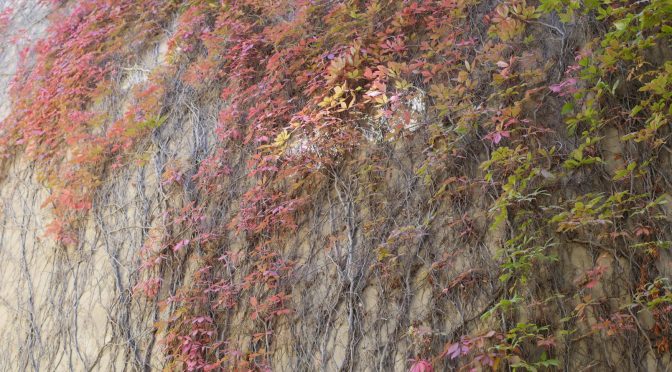
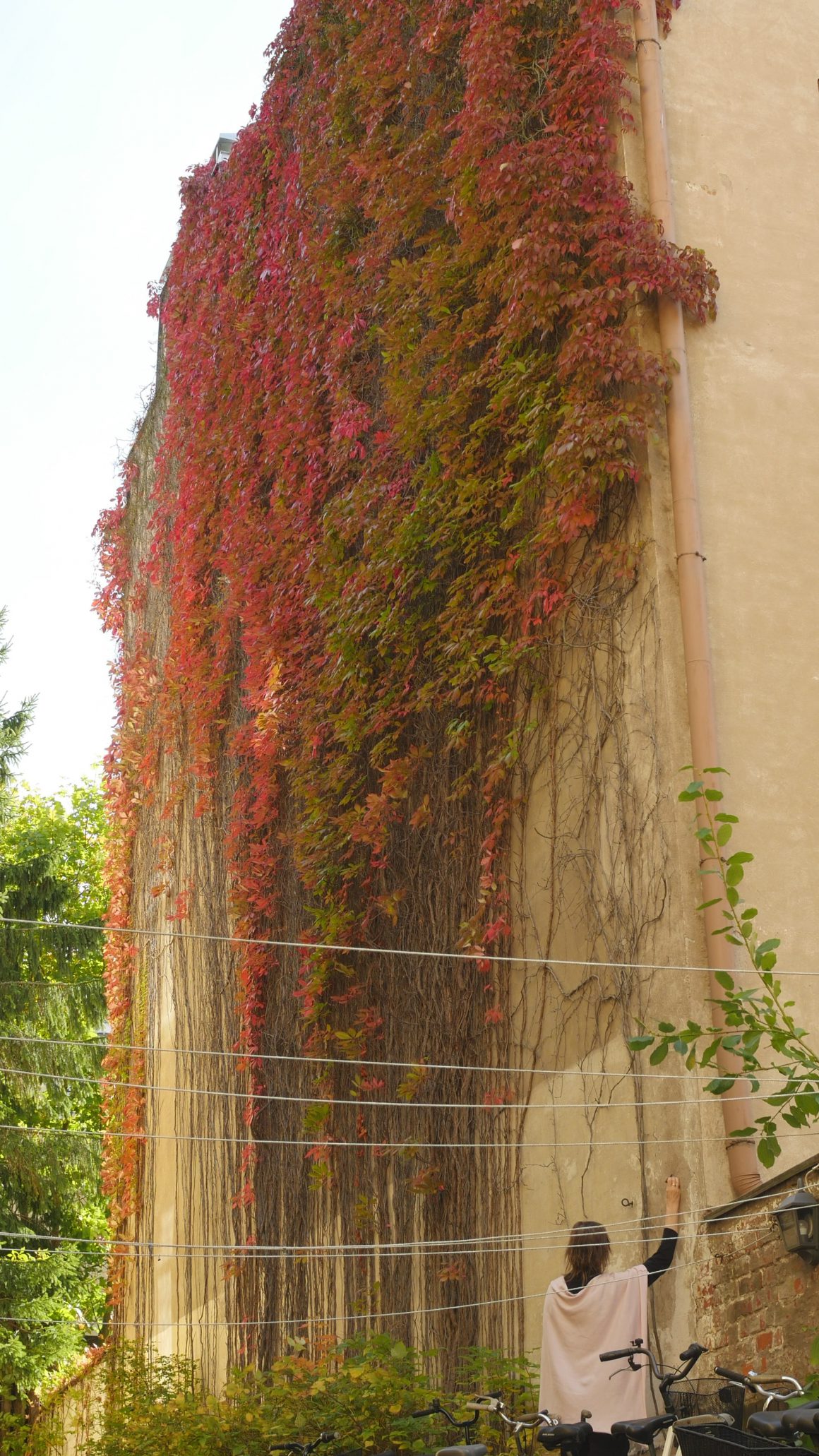
The month of the vine in the Celtic tree calendar extends from September 2 to September 29, at least according the version of the calendar that I have decided to follow for my attempt at creating a brief video with the tree of each moth, in Helsinki. The place is a crucial restriction, since not all of the trees or plants in the calendar grow in Helsinki. Besides the holly, which I found in a botanical garden, the vine and the ivy are posing problems. It is possible to grow grape vines in southern Finland, and I looked up a potential site in Helsinki, the Annala Garden. Before I learned about the possibility of finding grape vines in Helsinki I had thought of the popular creeper or vine called “villiviini” (or wild vine) in Finnish. In the backyard of the house where I live there is a huge vine or actually a whole group of vines climbing up the wall of the neighbouring house, and I have considered the possibility of trying to somehow record them for quite a while. Today when returning from my regular visit to the trees (the alder and the elm) in Kaivopuisto Park I decided to take a look. After all, I had my black clothes on and my camera and tripod with me, and I had an hour before I would have to leave for the airport, so why not? When I saw that the vine had already turned red I realized this was the moment to do it; two weeks later when I would be back from my trip it might be too late.
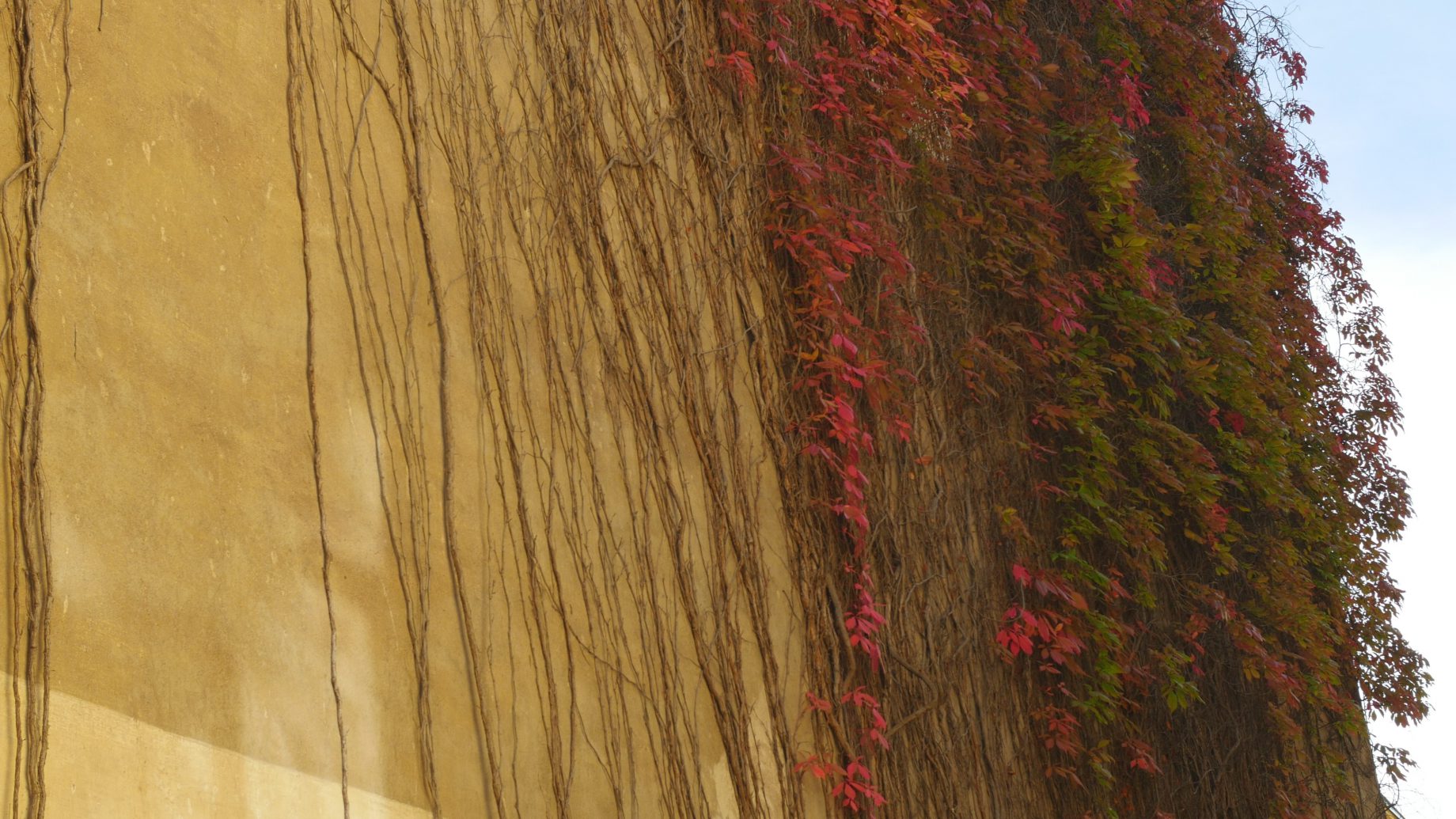
My first attempt was unsuccessful, I did not even manage to enter the image. The leaves of the vine are concentrated rather high up on the wall, and the stems closer to the ground are bare. A further complication is the narrow space between the two walls. After some experimenting I found an angle for the camera, where I would be visible in the lower right hand corner, if I stood on top of the bicycle supports. By rotating the camera for a vertical image, I could get the whole wall with the vine, or most of it, into the image frame. I knew from before that trying to create vertical video resulted in numerous problems, although it was so easy with still photos, but it was not impossible. You simply had to use a monitor or flat screen instead of a projector, and rotate the screen for the display. So I decided to forget about Annala garden and spend some time clinging to the wall. The final video is brief, 5 min and 15 seconds, (see Vine in September), but that is sufficient for the tree calendar.
More Pines to Rest With
Yesterday I returned to the dunes where I saw the first pines with strong and spread out branches suitable to sit on, and found more than enough of possible partners. The pines look special because they grow individually and not in thickets as further up on the spit and they spread out their lowest branches on top of the sand, as if to keep it there, under their skirt hem as it were. I tried to find ones that would let some of the view to be seen through their needles, and to have the light in a nice angle. The first one is taken with the camera on the slope so it looks like I would be sitting very low. The two others are taken with the camera below, but a little bit too close. The human figure is again fairly large compared to the tree. In any case I edited the material into three small videos, and added them to the RC together with the previous ones, here.
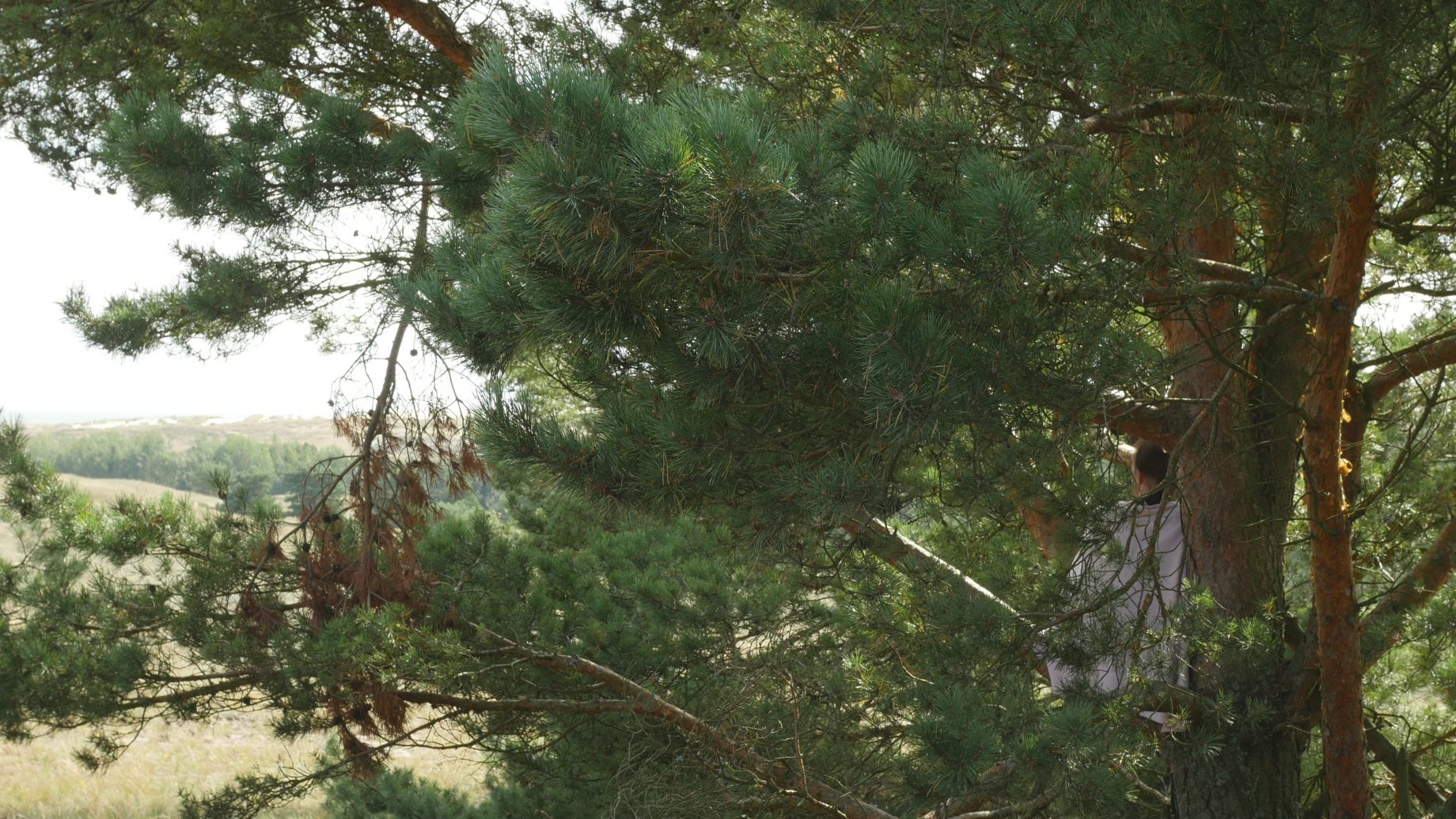
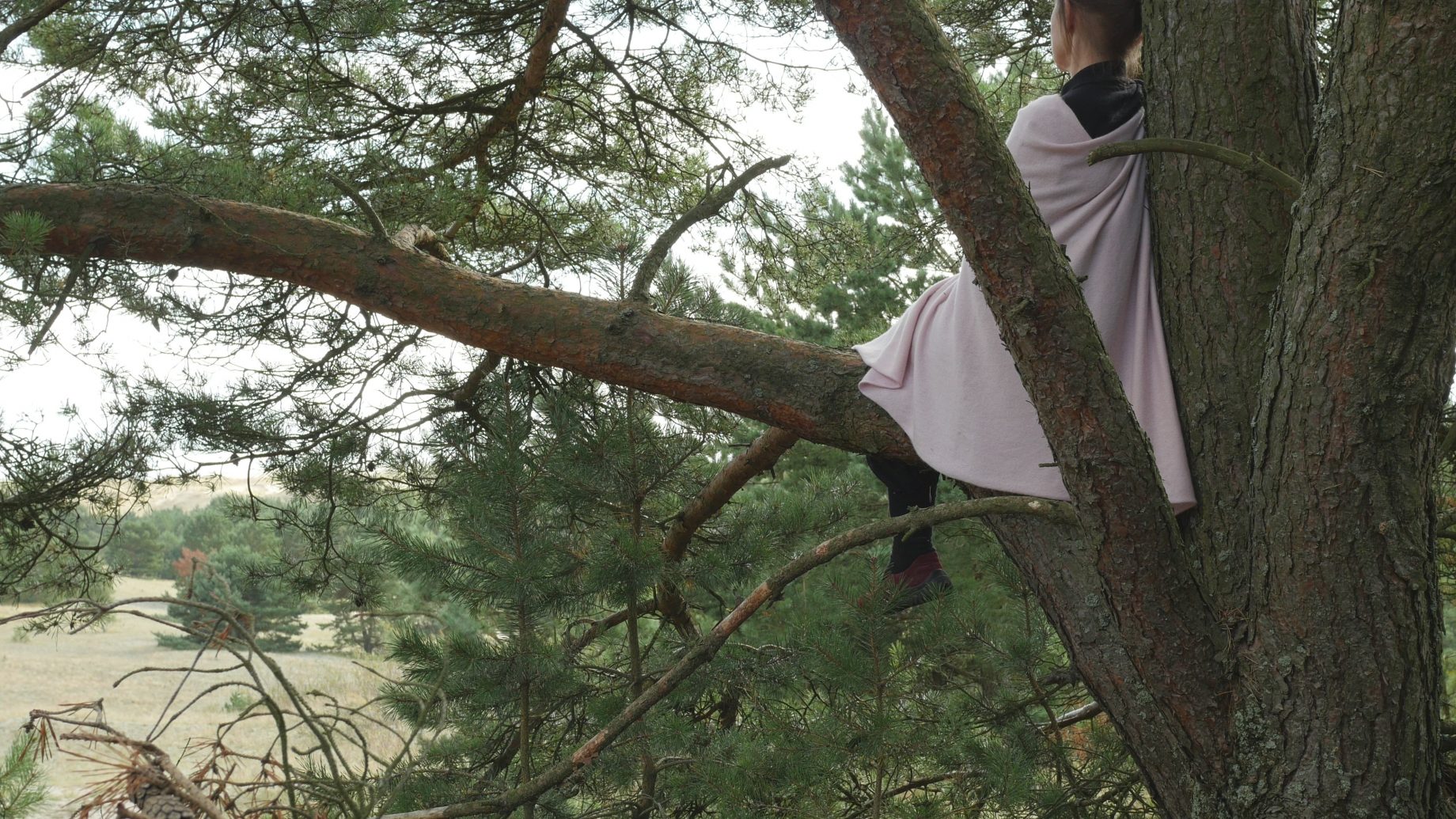
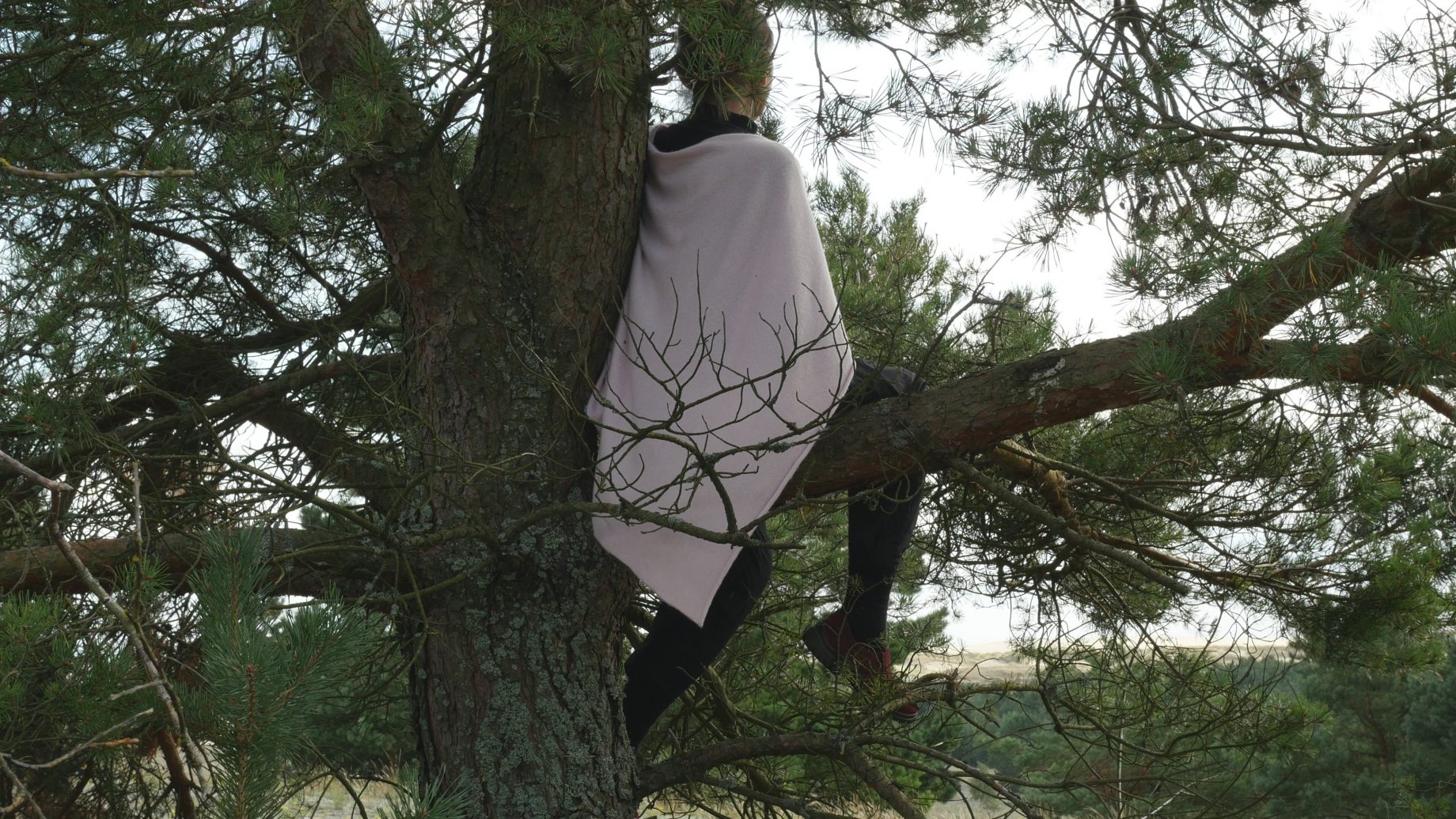
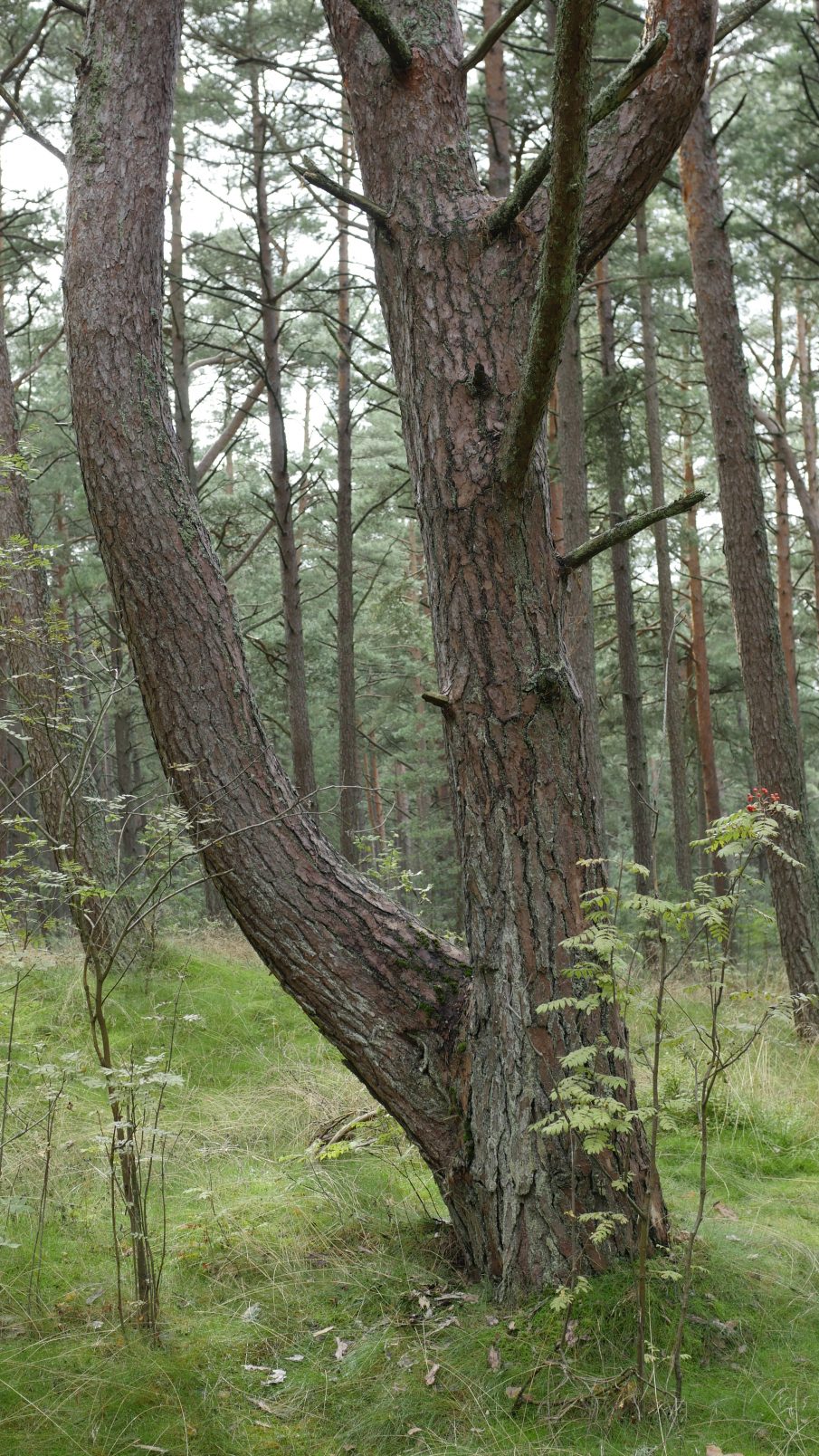
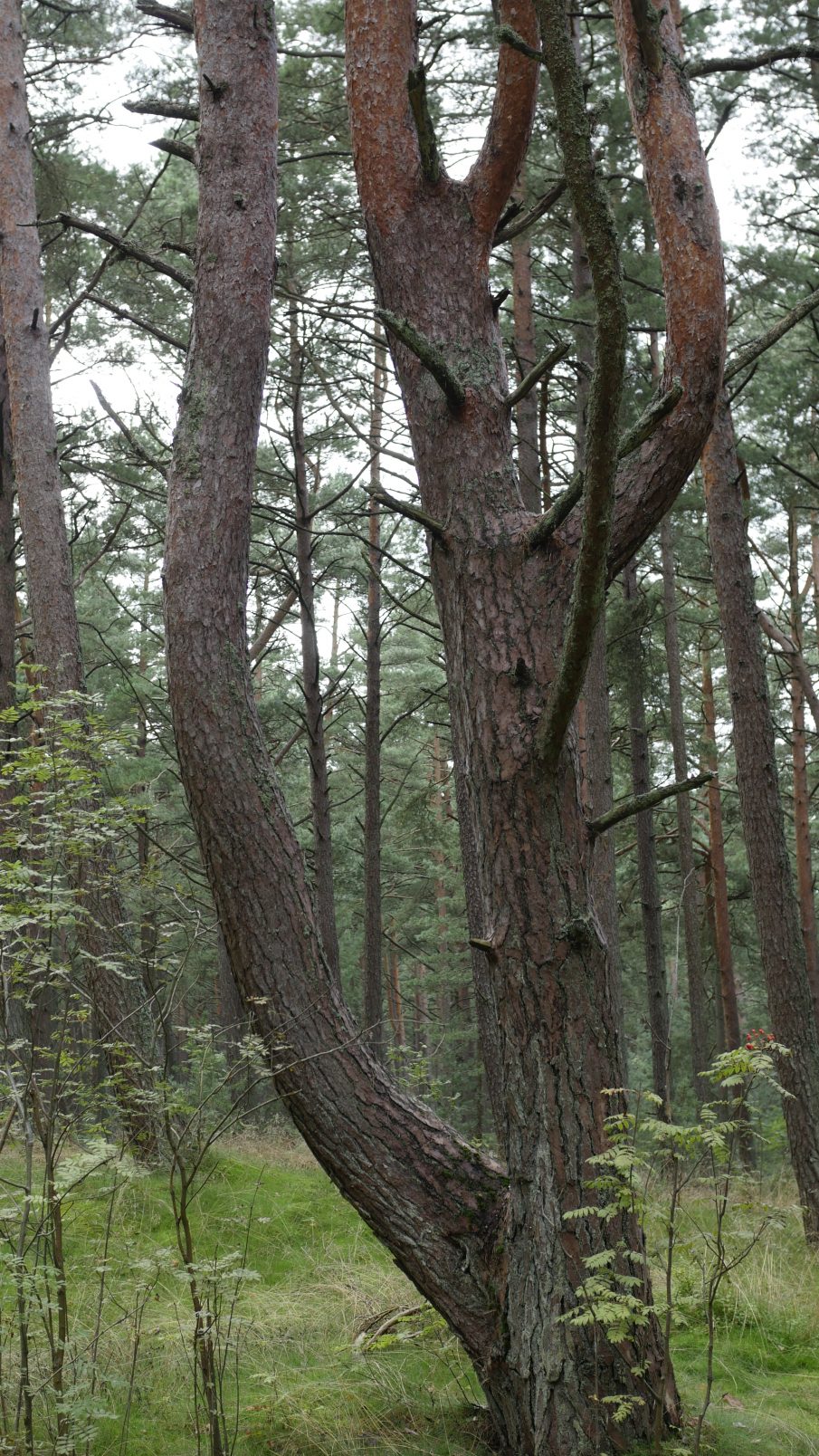
These pines on the dunes where nevertheless relatively easy to capture in landscape format images compared to the pine I ran into the day before, on 12 September. After a rather long walk on the forest paths north of the colony I suddenly saw a pine tree by the path which looked inviting, because it was divided in two fairly close to the ground. It turned out to be somewhat of an illusion, though, and not so easy to climb up to. But I finally managed to straddle it, like a horse, and sit there leaning against the wet trunk for a while.
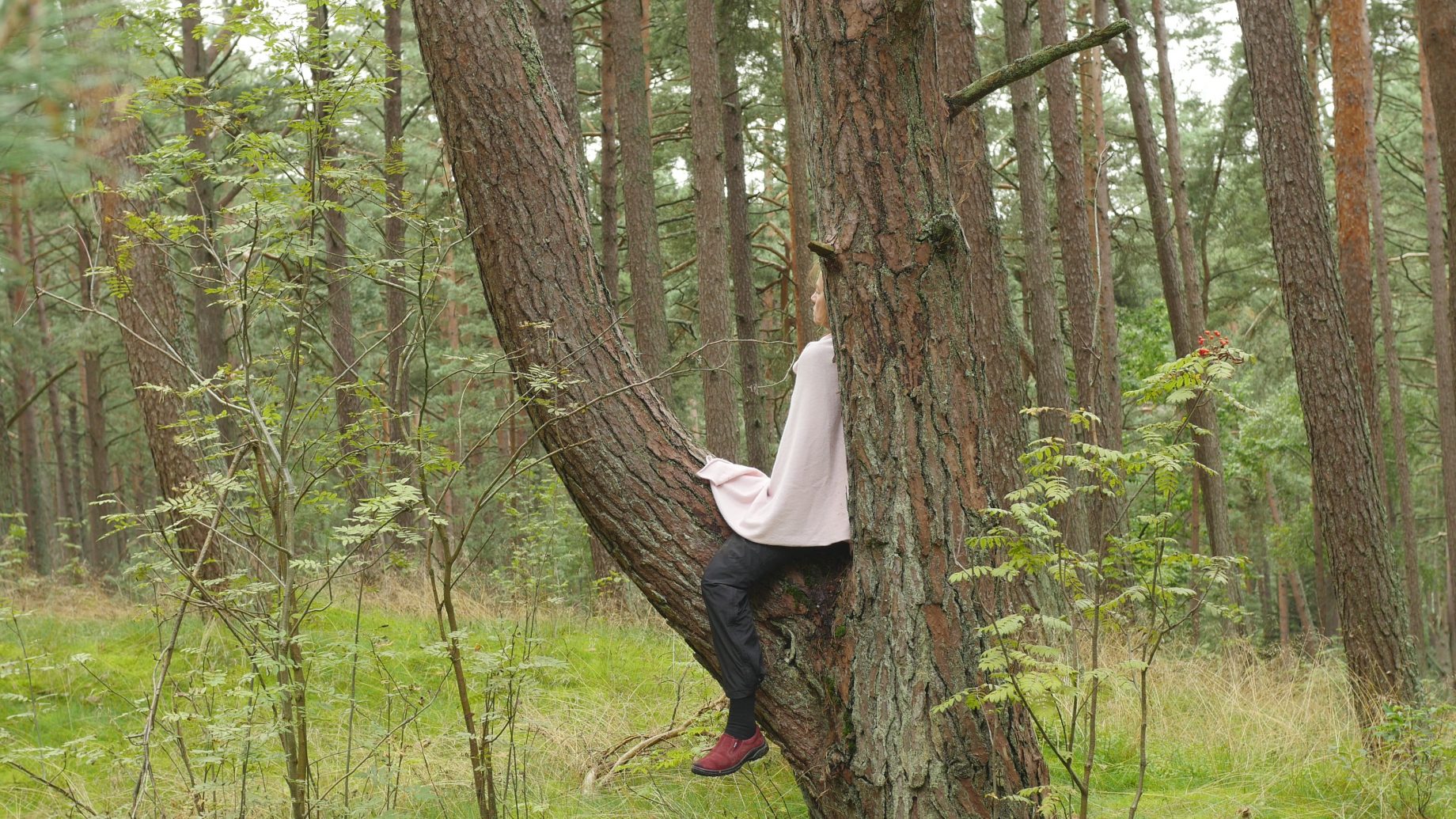
The image looks fairly comfortable, but it is so very misleading with regard to the tree. The beautiful form of the trunk needs a vertical image to come to the fore:
Walking in Nida
Exploring movement has been my main challenge during this week in Nida, because I brought with me my small action camera that I have not used at all, in order to start familiarizing myself with it. A few days now I have been walking on the straight paths that cross the forest south of the main road and today I made the first experiments editing the material. After some unnecessary half-fabricated stuff that took ages to export, I finally tried to put all the images in one frame. The longest sequence, which was actually the last one, from today, served as the basic image with sound, and five others were inserted as small frames within it. And because they were all of different length I simply took as much as was needed from the beginning and added it to the end. So instead of speeding up the material, a sense of speed or action is created by several simultaneous images. The eyes are jumping from one small frame to the next, without being able to follow them all, a kind of speed that too. But the five small frames within the larger frame also form a decorative pattern, where the individual images lose their importance. I uploaded a very small file of the work on the research catalogue, here. Well, it is perhaps not so exciting or interesting, or anything new, but at least it is something I have not done before.
The problem of the moving camera, the moving image, literally, is not solved by these experiments, though. I have been interested in the small movements generated by the wind, the waves, the clouds crossing the sun and so on, registered by a static camera, so why could not the movement of the camera be minimal as well? What if I walk really slowly, trying to keep the camera movement as minimal as possible? Or perhaps I should simply stand or sit and see if my breath will show as movement? Or perhaps record the view to the side, like looking out of the window of a train or car? – I tried that by the beach this morning, and this is the result, a horizon in diagonal! The same phenomenon, my gaze turning my head downwards, probably, is visible also when walking on the forest path up from the beach (see image at the top). Obviously some more experiments and adjustments are needed….

Resting with a Pine
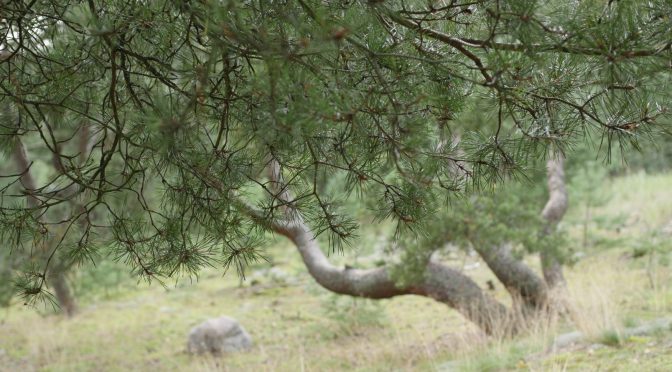
After a few days of walking back and forth on the sandy forest paths on the pine-covered dunes of Nida I have realized that in contrast to the usual proverb, I cannot see the trees for the forest. Today I found a pine growing on the slopes toward the sea that I could somehow make myself sit in, (see image below) and another one bent so low in the forest north of the main road that it could be quite comfortable to sit on. (See image above) Something in the environment suggest moving on the paths rather than sitting in one place, so I played with my little Gopro action camera and tried to see what could be done with it. At first I walked with the camera in my hand and tried to record the shifting quality of the ground while walking. That did not look interesting and the movement was rather disturbing actually. I tried my head-gear instead, a strap to hold the camera like a head lamp. After a few attempts I found an angle that resembled normal eyesight, although walking made the movement slightly bumpy and thus confusing. Am I so accustomed to smoothly gliding cameras in Hollywood movies that everything else makes me dizzy? When I looked at the material it was enjoyable when speeded up ten times, a sports documentary quality artificially created. An action camera is fun, yes, but if you are not engaged in very energetic action, then what to do with it? And how can you perform with or for a moving camera. The whole idea of using a camera on tripod has been to be able to step in front of the camera, too. But how to do that with movement? A camera on tripod is necessarily static. If I attach the camera on my moving body the resulting image is necessarily unstable and bewildering. My initial idea was to combine the two, to walk on the path with an action camera while my old camera would record the walk from a distance. Perhaps I will, try that out tomorrow…. hm.
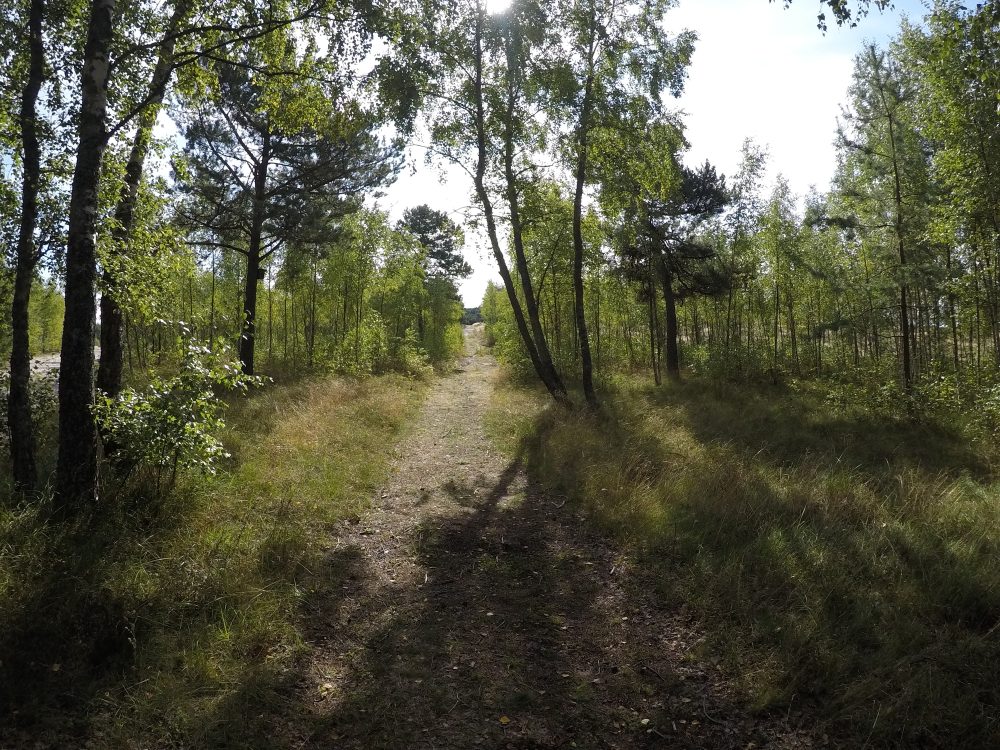


Today I walked with my action camera again, up and down two of the paths, but was not very impressed by the result. Perhaps I should combine all these walks on one screen, as small squares inserted into one image? The forest is full of pine trees, all fairly straight and tall, or then small mountain pines that form impenetrable thickets. Finding a suitable partner is not an easy matter, so I decided to return to the pine with the branches bending low that I saw yesterday and to try to make a session with it. In the afternoon I changed to my black “performance outfit”, took my camera, tripod and scarf, and set out to find the pine. The pine was near to the path, so finding it was no problem. Finding an interesting viewpoint or camera angle was more difficult. I wanted to avoid possible passers-by on the path and to find a reasonably stable point for the tripod. In the end I found two ways of framing the image that were somehow interesting. The first one with the pine branches in close up covering the whole upper part of the image and the second one with the sculptural shape of the branches crossing each other. I sat for approximately ten minutes for each image and was rather lucky in having that part of the forest for myself for a while.
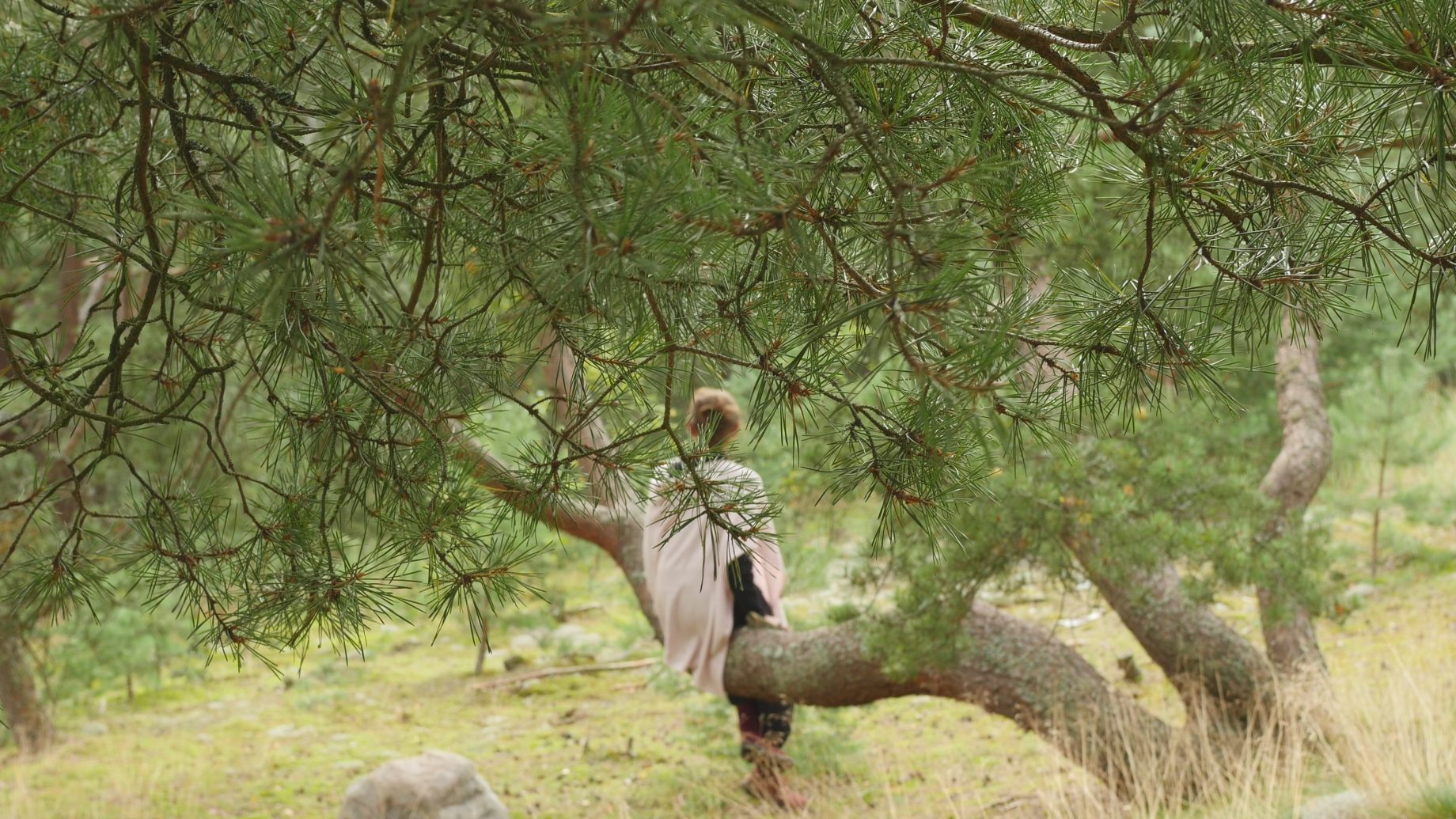

When I looked at the material and edited the short videos, I found the second one less interesting, although the branches cross each other in a peculiar way; perhaps because my face is visible, when I am sitting in profile. The first one is quite beautiful actually, because the camera focuses on the pine needles in the foreground and the human figure in the background remains soft and unfocused, a vague shape. The image is very romantic in some way, but at least a little different from my other sittings in trees. So now I have something to show for my first week in Nida! I will continue playing with the action camera, however, because I want to try something different. These small videos I called “Resting with a Pine” and that is exactly what they are about. But what about the action?
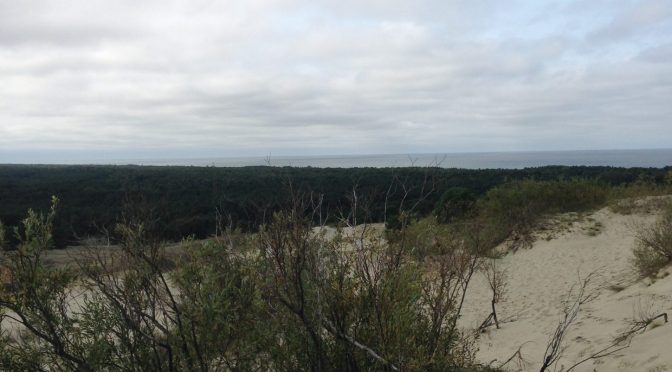
First Stop Vilnius… on the way to Nida
Vilnius airport is rather close to the actual centre of Europe, they say, although from my point of view its is rather far in the east, which relates to the fact that it is the eastern border of the European Union, which is of course something else than the geographical “continent”. I tend to forget that Russia has a large European part, in the same way as people living further south in Europe tend to forget the actual extent of the territories of the nordic countries. On the north-south axis the centre of Europe is somewhere in southern Sweden (Karlskrona). This is my first trip to Lithuania, and only this morning did I realize that I can use euros here. The reason for my trip is a short residency at Nida Art Colony at the coast, in what used to be called Courland, on the narrow strip of land crossing over the bay, the Curonian Spit, actually rather near to the Russian border and Kaliningrad. It sounds exotic and exciting. My first stop, Vilnius Airport, was fairly ordinary. Some form of pastry filled with chicken (yes?!) tasted rather Russian, but perhaps it is one of my prejudices, too. Or a situation resembling the weird similarity of greek coffee and turkish coffee, despite all the differences. And now the shuttle bus is moving, heading towards Kaunas first, and then the next stop, Klaipeda!
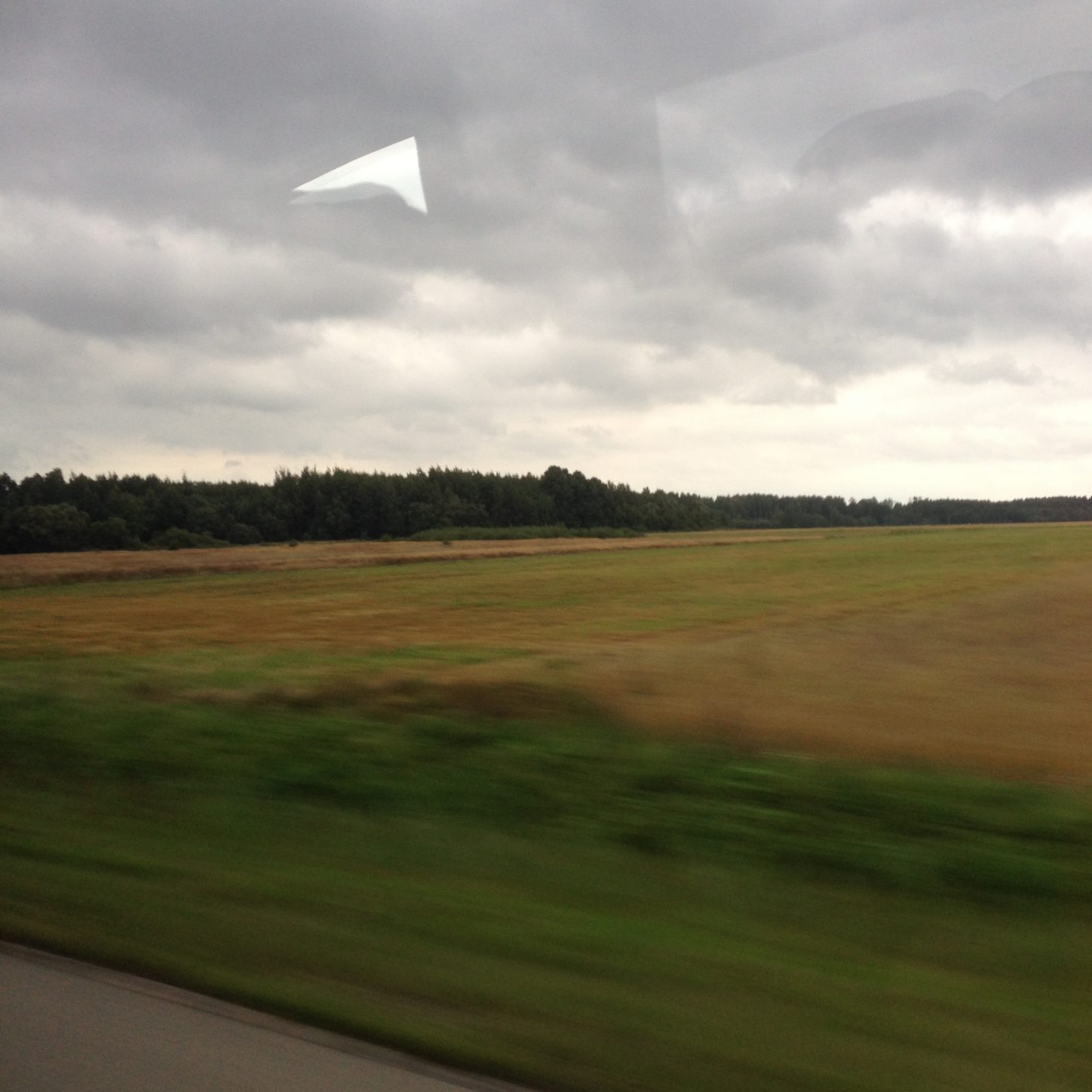
Well, actually I am sitting in Smilthyne now. Klaipeda passed quickly, because there was a cab with my name on a paper in the window right where the shuttle bus parked, so I just transferred my bag from one car to the next. A silent oldish and rather fat man drove me to the harbour and charged 4 euro for it, which is decent, I suppose. And the ferry ticket, which I managed to purchase, despite placing one euro in the wrong place first, where it got stuck, but anyway, granted me access to the ferry which was to leave in five minutes. I remember from the travel plan that I was to take the ferry at six, and the bus at ten past six, but it felt stupid not to go on the ferry, since the opposite shore looked so much nicer. Well, it looked nicer, but everything was closed, because it is off-season, of course. So I started following the signs, walking along the shore, after finding the bus stop and confirming the time-table. And after dragging my bag for a while along the flat shore – everything seems rather flat around here – I found this harbour cafe that is open, with a few clients, and enjoyed a bruschetta with gorgonzola, fig jam and a slice of pear with my tea. Not bad. I can imagine this as a real tourist paradise in summer months. They say it has been popular especially with germans since the beginning of last century. Anyway: Next stop Nida!

And yes, Nida really looks like a place with more than hundred years of experience in tourism – picturesque, clean, cosy and peaceful but a little lively too, in the right corners. A friendly guy, the manager, was there to meet me for the bus, suggested we go shopping first, because he had a car and the walk to the colony is about 20 minutes. After packing up, organising my stuff, making the bed and so on and so on, and after I put my feet up for a moment, I was ready for a walk down to the local pub or bar, and found the first one next to the market. The walk down the slope is no problem, but the way up with heavy grocery bags can be something else, of course. Despite my legs still hurting, I am a walker, so I look forward to some nice evening walks…
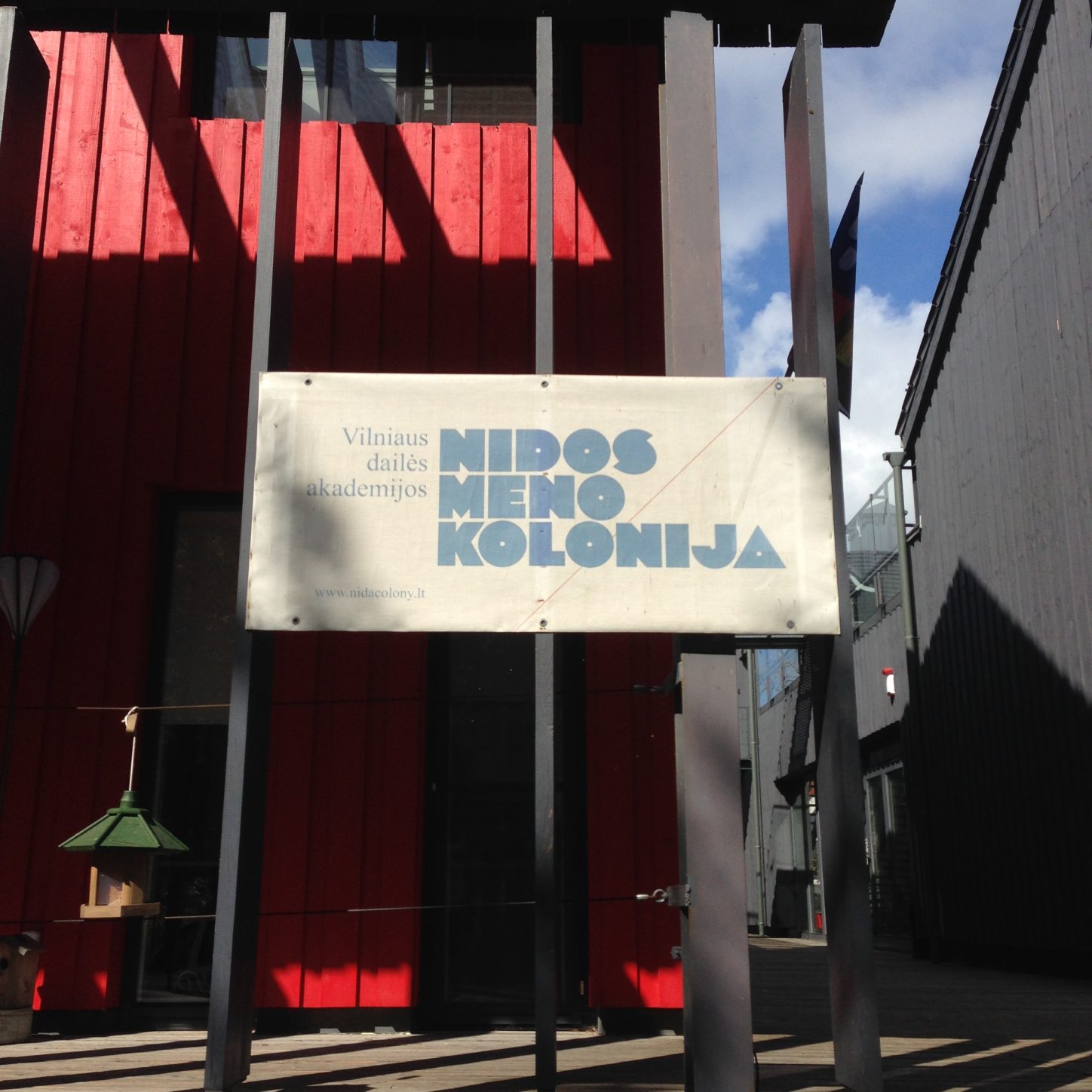
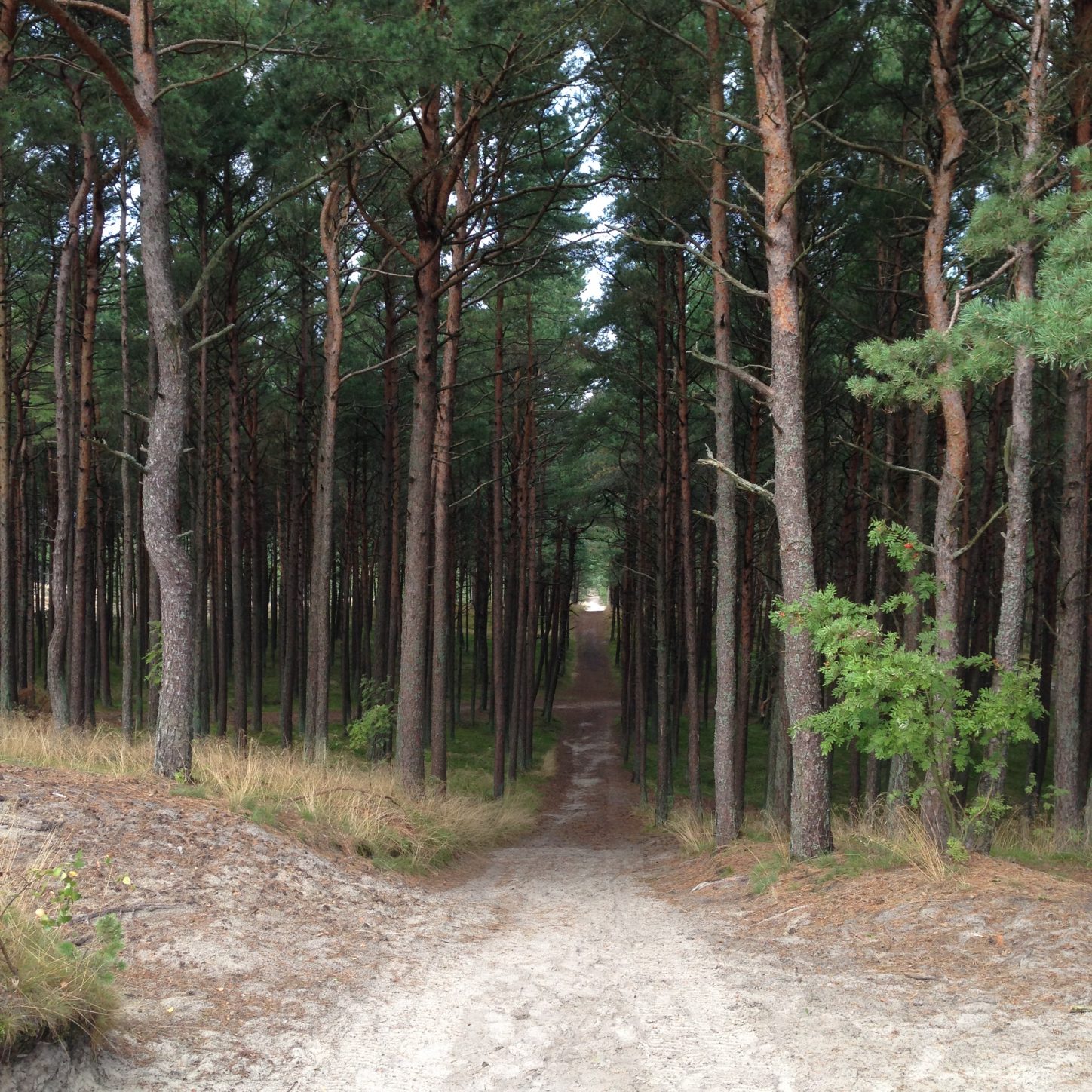
After spending two days in Nida, meeting the other artists-in-residence, enjoying a meal and sauna together, I have been walking in the forest, among the dunes, between the sea and the lagoon, looking for special trees. But they are all beautiful and fairly similar. So far I have not been able to see the trees for the forest. Fortunately there is still time….

Sense it – don’t tell it
The most stressful moments are the most calm sometimes… I am sitting in an apartment in Odense, Denmark, listening to the quiet sound of the refrigerator and the regular ticking of the clock by the entrance, waiting for my poor little computer to render a video, or not even render it but export it non-rendered. There is 1 hour and 50 minutes of export time left and the participatory performance is supposed to start in an hour in a park at the other end of town. I have all equipment here with me, and it is too far to walk there and make everything ready and then come and fetch the computer. And I do not even have a car… and, and. Luckily Danish people are fairly relaxed, but they also like their comforts, so I guess nobody wants to stay up one or two hours extra simply for the joy of swinging with an image projected on a tree. Well, well.
The first part of the performance went well, the sun was shining, the swing was nice and well placed, and quite a few people were interested in swinging and seemed to enjoy it. That is one reason why I am late, the video is more than 30 minutes long. And I have not even had the chance to see it yet. Wow. I thought of walking across town with the computer open on my arm, in order to be able to prepare the projector and the rest while the program is exporting the material, but then I am afraid that the electricity there will not work, or that the power runs out in the middle of the walk or whatever. So I just have to wait patiently…


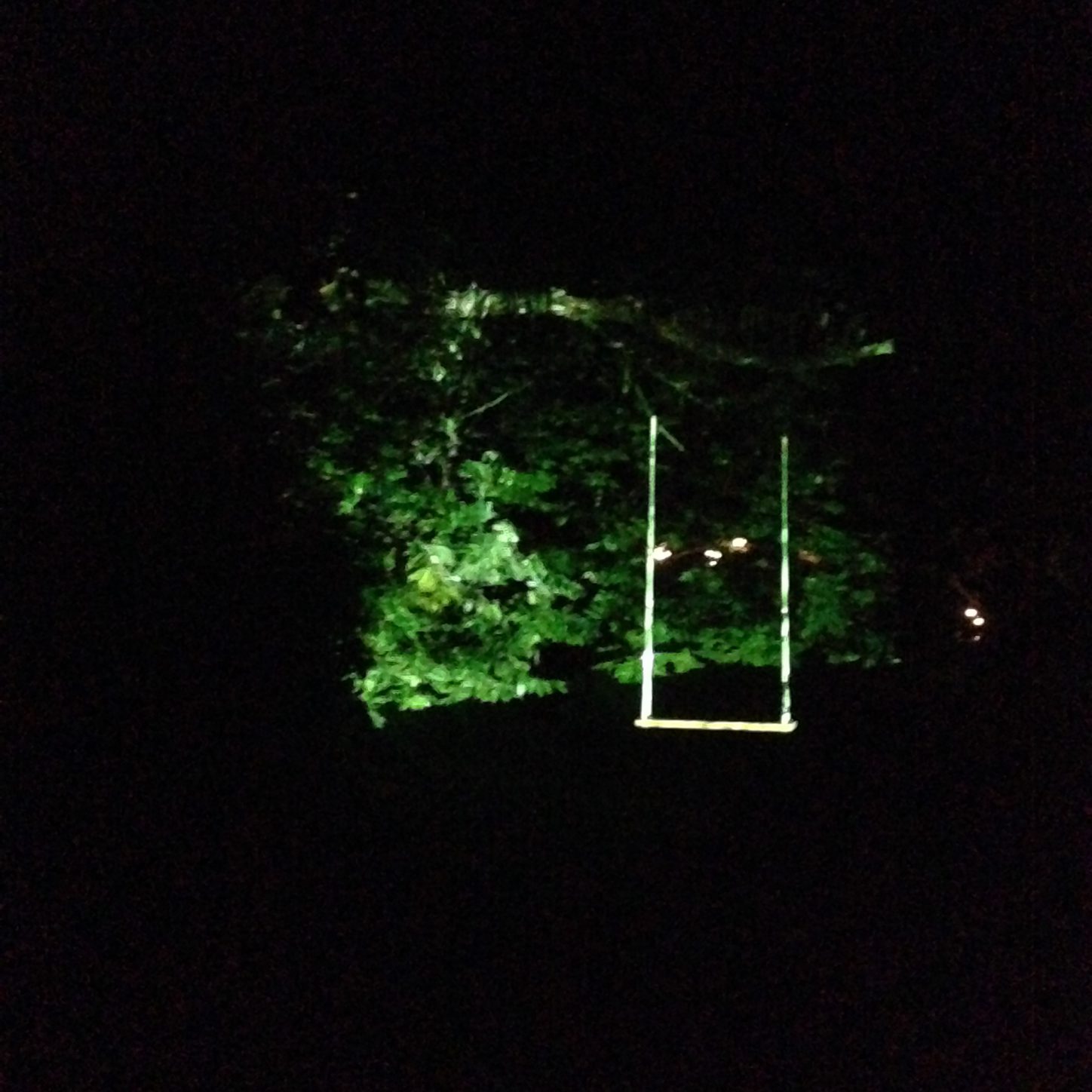
I got a ride to the park and there were other things happening so people did not have to wait too long, and everybody was very helpful giving light with their phones as torches – what an idiot I was not to take my headlamp with me, it would have made life easier in the darkness. But then again, the darkness was good for the projection. No time to experiment or try out things, I just dragged the cable to a spot left of the swing and placed the tripod with the camera in line with the swing, at least somewhere in the vicinity where it had been during daytime. I had nothing to put the projector on, except its own bag, and the same with the computer. Miraculously everything found the right place, somehow, and the swinging movement was visible on the foliage and the swing was hit by the light of the projector sufficiently to be distinguished and so on. Some people were trying out the swing and I would have liked to run through the whole half hour film, but people were tired. I suggested that I could just stay in the park, because I would have liked to film the whole thing on the foliage, perhaps swinging there myself. But the electricity cables could not be left there, and they wanted to pack them away, so I had to stop it before it even really began. Well, people liked the image, and I have a few moments on video, although not much is visible in the darkness. And the photos are completely dark, really. So not much remains to show of this afterwards, but it was an experience and for me a learning experience for sure…
Because I was editing the video all day I missed the rest of the program of the first day of the seminar “Sense it … don’t tell it” in Odense 1-2. September, organised by Nordic Performance Art – reaching a new audience, an organisation that specialises in new music theatre, despite its name. The second day I joined in and had my talk amongst the other presentations and exercises. It was very interesting and fun although more about relational aesthetics or what seemed like participatory strategies in working with theatre and performance than about the environment, so in some sense I was quite out of place. Hopefully my small contribution about process and performance – based on the text for the coming book edited by Emma Meehan and Hetty Blades – was at least somewhat relevant to some of the participants, who seemed to represent a broad scope of practices from children’s theatre to dance, from music theatre to socially engaged art practices and more. And as you could expect in contexts linked to theatre it was all about doing, improvising, moving together, and of course sharing emotional exercises, which was engaging, but exhausting, too.
Back in town and busy
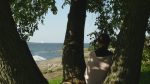
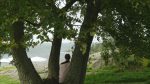
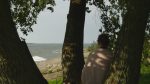
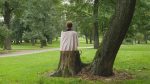
Only two visits to the trees in Helsinki this week, on Tuesday and Wednesday morning. My plan was to include Thursday, too, but I chose to go to CARPA 5 – colloquium on artistic research in performings arts, where I have a small installation running nonstop for the duration of the event. One reason was the rainy weather, I have to admit. And I had to make preparations for a trip to Odense in Denmark, where I am participating in an event organised by Nordic Performance Art, facilitating a participatory performance with swinging and also speaking at the seminar. So my thoughts were everywhere else except wih the trees. On Tuesday I was preparing for a busy day, but the weather was calm. On Wednesday the wind was strong, but the direction was such that the camera on the tripod was not under direct attack. The only incident I remember was an alder leaf falling gently down on my head while sitting on the stub, a surprise and a strange feeling, a sign of autumn.

It seems like everything is happening at the same time this weekend. Besides Carpa 5 there is the Art in the Environment Nordic symposium 2017 in Vartiosaari. I managed to see the end of one performance by Anna Rubio at HIAP in Suomenlinna, which is part of the symposium, that is all. Then there is the event I am performing at in Odense, organised by Nordic Performance Art (a slightly misleading name, I guess). Moreover, one of my videos is shown as part of a screening curated by Leena Kela at an event called Meetings – Video and performance art festival in Mid- and western Jutland in Denmark on the same day. And then there is probably many other interesting things going on, but as one cannot be everywhere at once, one has to trust that anywhere is the right place for that moment…
August – Month of the Hazel
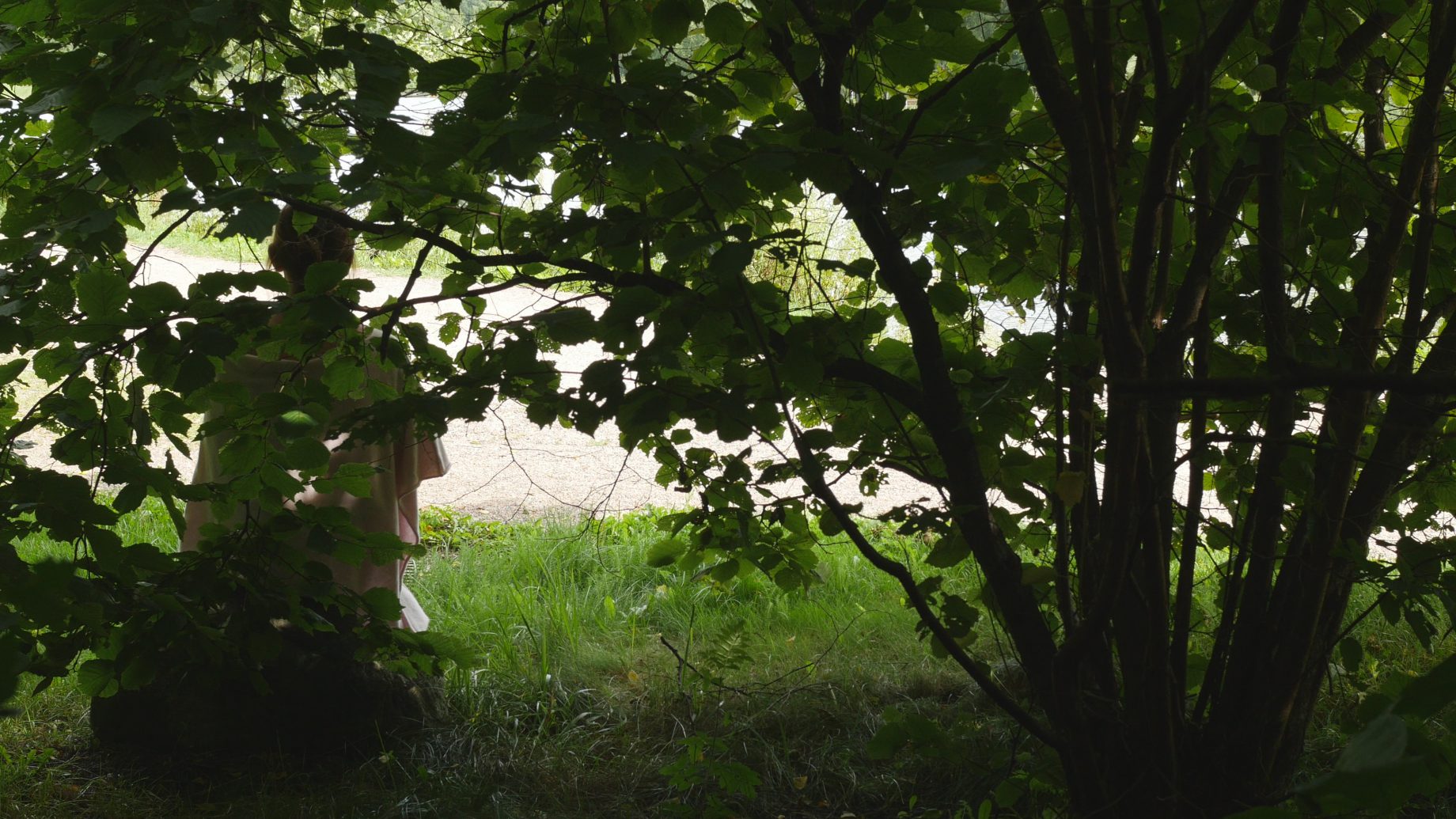
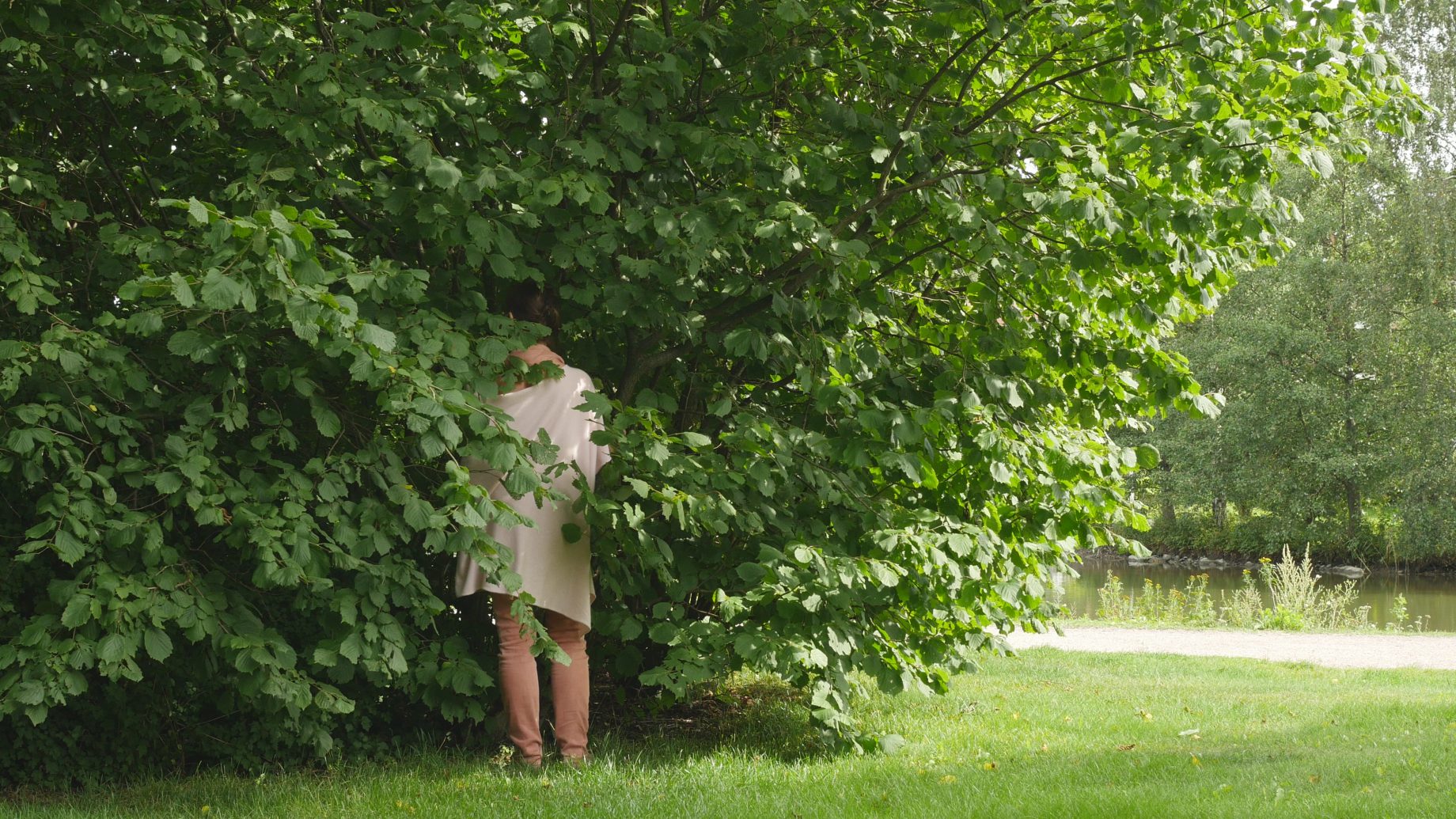
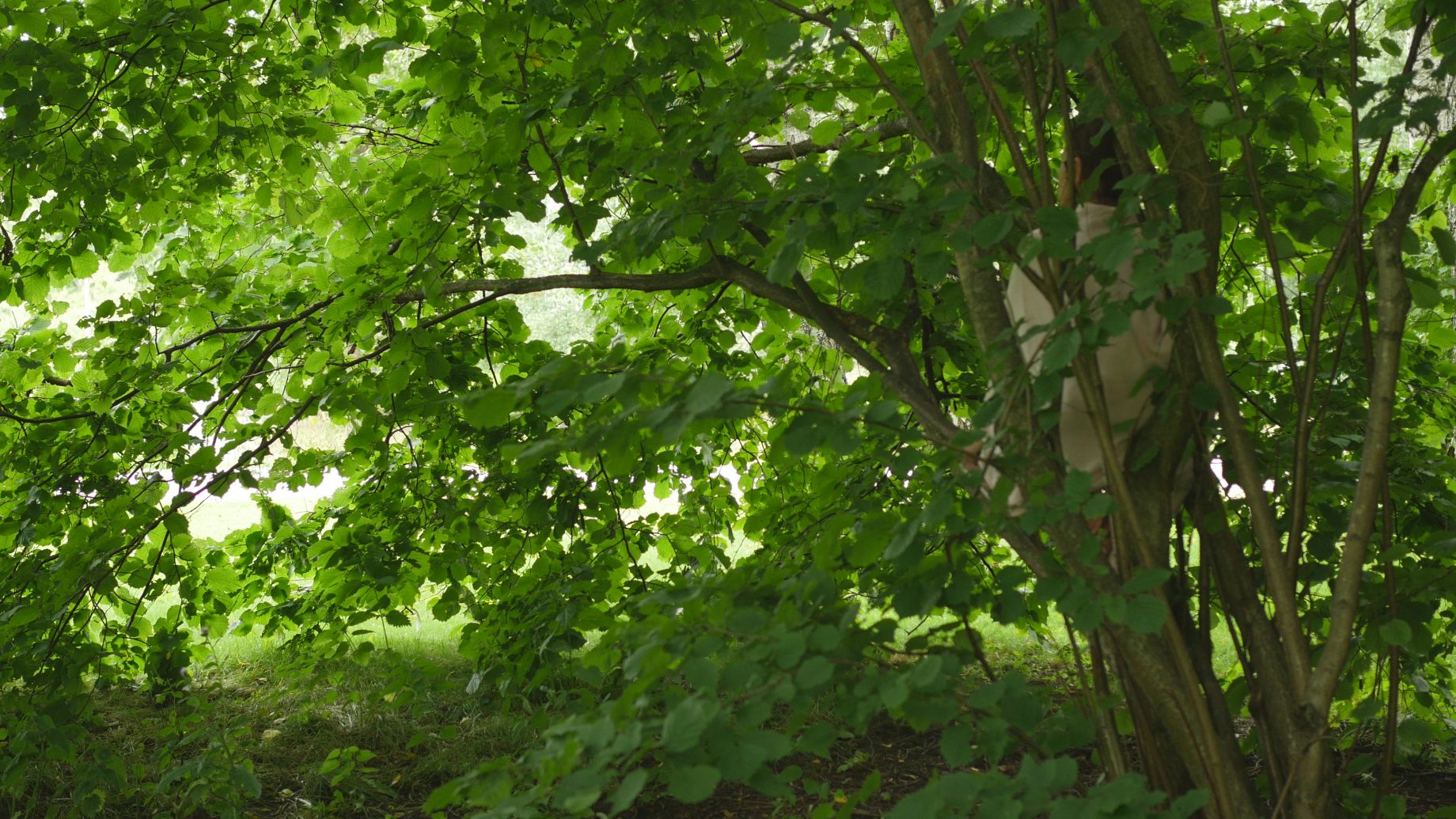
For once it was easy to find the tree of the month for my tree calendar – based on the ancient celtic tree calendar – namely the hazel, whose month (according to one version of the calendar) is from 5 August to 1 September. I found a nice group of hazels growing next to the path following the shore near Herttoniemi Manor from a map on the internet that listed fruit trees and bushes with berries in Helsinki. These hazels did not have any nuts, though, or hardly any traces of them, really. But they looked thriving and there was no doubt they were representatives of the common hazel, Corylus Avellana. I walked among them and tried to find a suitable framing for the image, including some water but not the houses. At first I sat on a rock next to one of the hazels near the path, and placed my camera in the middle of the bushes. Then I tried to find animate with more space and placed the camera on the lawn, standing in or amongst the branches holding on to one of the thicker stems. In Finnish there is a satin “kolmas kerta toden sanoo”, meaning something like “the third time is the real one”. And that proved correct this time. For the third image I found a bush with several stems bowed in a way that I could venture to sit on them, actually sitting in the small tree, and that version seemed like the nicest one, despite the darkening of the sky towards the end. Only when I left the park and walked back towards the metro station, returning to the city centre, did the rain start.
The material is now edited into three videos, Hazel in August 1 (10 min. 40 sec.), Hazel in August 2 (10 min. 10 sec.) and Hazel in August 3 (9 min. 35 sec.) and I still think the third version is the “real” one.
 Performing Landscape