
A small booklet that I received at a seminar in Tallinn a few years ago, Solarities by After Oil Collective ended in my handbag because of its small size and I now finally read it. The many short texts bring forth different aspects of the turn from fossil fuels to solar energy and all the hopes for another kind of society that the transition includes. Solarity without solidarity does not change much. I picked up the fragments directly related to plants, of course, and obviously the focus and basis of vegetal life, and thereby life for the rest of us is the sun.In the chapter Solarity as solidarity the writers quote Natasha Myers and “the photosynthetic ones – those green beings we have come to know as cyanobacterial, algae and plants”, noting how “‘those sun worshippers and world conjurers’ reveal another mode of engaging with the sun – through nothing short of magic, they transform the world to a hime for the rest of us.” (p 27) They quote Robin Wall Kimmerer’s point that “plants tell their stories not by what they say, but by what they do”, and note that “plants are world creators in all senses and across scales. They weave and endless symphony from sunlight, water, and air, alchemically communing with one another and with insects, birds, and other animals that live with and among them.” (p 27)
In the chapter Decolonial and Feminist Solarities the writes “If solarities are to be just rather than unjust, they must be generated from below rather than from above; solar energy must be dispersed as the sun’s rays, refusing the kind of concentration that petrocapitalism has engendered.” (p 40) And they state the obvious: “Light and heat come freely from Earth. They are the basis for planetary life. /–/ Left to itself the sun models an economy based on abundance, on gifting, on interconnection, on multi species flourishing. This is an economy of cycles, diurnal and seasonal.It is a dynamic economy of constant circulation…” (p 40) The writers note that there can be scarcity, like in seasons without rain, and competition, as between light seeking saplings in the forest. “But at its core, the solar economy is one of a abundance and renewal, of plenty.” (p 40)
In the chapter on The Work of Solarity the writers emphasise that liberal political theory has no answer to scale. “Yet many of us hang on to the little gestures of agency that liberalism offers” (page 58) Yet they make clear that this is not enough. “Solarity in the age of global warming (if it is to carry forward the project of democracy) requires something different, something to meet scale with scale, something to level this uneven playing field /– solidarity must scale up.” (p 58-59) They insist that “Solarity means that we matter only by relation.” (p 59)
In the chapter Storytelling and Worldmaking, the writers turn to Donna Haraway and suggest that we look beyond work and labour towards games and play. (p 65) “If the promise of solarity is a promise of better relations between different humans and nonhumans, it must be accompanied by stories, arts, tools and crafts that celebrate and sustain collective flourishing.” (p 65) They further note that we must learn to listen, to admit that we will make mistakes. “We require stories that move away from solitary individual heroes to multi species stories that are grown over time, stories that are intertwined wit other beings and celebrate not individual feats but the the mutual creation of new ecosystems. To thrive collectively requires listening, learning and making collectively.” (p 66).
Touché! But, that is easier said than done, at least for people like me who are impatient and like to work on their own. It is not impossible, though…
After Oil Collective. Ayesha Vemuri and Darin Barney, editors. Solarities – Seeking Energy Justice. University of Minnesota Press, Minneapolis, London 2022.
All posts by Annette Arlander
Kudzu vine – friend or foe?
An interesting online lecture in the series Plant Lives – Critical Plant Humanities organised by Wits University in Johannesburg featured a talk by Yota Batsaki titled “The Plant at the End of the World: Invasive Species in the Anthropocene”. It was based on the paper we could read in advance “The Plant at the End of the World: Precious Okoyomon’s Invasive Art” in Critical Inquiry vol 50. The article is a real treasure in terms of references to classics related to plants. It is interesting in its focus on the changes in the relationship to a specific plant, the kudzu vine both geographically, over time and in a contemporary art installation. The relationship to kudzu in the cotton belt in USA and the changes from possible solution to pest is fascinating to read. And the issue of invasive species overall, how to define and understand them, combat them or live with them is fascinating. The use of the exuberant proliferation of a living plant to create an immersive installation is a great topic, too, although not contextualised as thoroughly as the history of the vine. The subtitles give an idea of the width of the discussion, where descriptions of the artworks of the Nigerian-American artist Precious Okoyomon are framing and alternating with a historical account of the plant in the cotton belt. After a lengthy introduction comes “Invading the Gallery: Earthseed (2020)”, then “A Cultural History of Kudzu in the American South” and finally “Beyond the Apocalypse: To See the Earth before the End of the World (2022)”. To include at least one quotation, I add here the last words of the article: “By giving a plant invasive free reign in the gallery, institutionalizing its growth where it doesn’t belong, Okoyomon instantiates a new aesthetic that takes shape around uncontrolled abundance, troubles notions of home and belonging, and generates new landscapes that may or may not be hospitable to human presence — imagining new potentialities and coexistences.” (Batsaki 2024, 609)
From the discussion after the talk I remember the usual question: what happened to the plants after the exhibition (they were burned), and also a reference to the idea of invasive species as the new wild, the solution to damaged soils and the beginning of new ecosystems slowly evolving. The two time perspectives, the deep time of evolution and the historical time of human culture coexist, but can be difficult to relate to. Even though the idea that life will continue evolving over deep time can be a consolation, it cannot remove the grief, guilt and shame for the destruction of lifeworlds and the loss of species that we have brought about and continue with at a growing speed.
Yota Batsaki (2024) The Plant at the End of the World:
Precious Okoyomon’s Invasive Art. Critical Inquiry, volume 50, number 4, Summer 2024. Published by The University of Chicago Press. https://doi.org/10.1086/730350 (p 585-609)
The Diminishing Darkness
Now when spring is approaching, or already here, with increasing light, it feels strange to mourn the diminishing of darkness. It is not the changes in light through the natural cycles of the seasons that is dimin fishing, but our ability to witness it fully due to manmade artificial illumination. In the Darkness Manifesto – Why the world needs the night, first published in Swedish as Mörkermanifestet (2020), Johan Eklöf describes the many ways that the diminishing darkness is detrimental to plants and animals and whole ecosystems. His main topic is bats, which of course are night creatures, but many insects, too, and the plants they pollinate are dependent on darkness. Especially the disappearance of the stars and the night sky in many places, for human eyes, stayed in my mind. And the need for some time of darkness or semidarkness for human eyes to get accustomed to seeing in the dark, which takes place with different receptors than the ones distinguishing colours in bright light. One can actually see quite a lot at night outdoors, in areas without streetlights, provided one does not use a torch, which blinds those other receptors. One has to get quite a distance outside the city, to get rid of all human lights that are reflected in the clouds. I remember walking on Örö Island in the dark and experiencing the feeling of total darkness around the bright light of a torch, in contrast to walking in twilight, letting the eyes adjust to the darkness slowly.
The book consists of short chapters and is written, and translated, in a reader-friendly way. The only chapter I have marked is called False summer, and deals with the problems plants face when illuminated, like illuminated trees in cities, which do not shed their leaves in autumn. Eklöf tells about the poet Robert Hunt (1807-87), with one foot in art and the other in science, who studied photography and “discovered that different parts of the light spectrum affected plants in different ways. The shorter wavelengths of sunlight, the blue and violet light, are usually the ones signalling to seeds to germinate, while redder light with longer wavelengths normally initiates the flowering phase.” (p 83) The ‘phytochrome’ pigments or proteins that control this process were discovered only in the twentieth century. (ibid). The context affects how they react, of course, and “plants react to both intensity and colour”. (ibid) LED lights are usually white or bluish, resembling morning sun, while older streetlights are more yellow like afternoon light. When specific plants do not bloom at their usual time because of the lights, they do not attract the usual insects, which do not provide food for the birds that usually feed on them and so on in a detrimental chain reaction. The book is full of concrete examples from various parts of the world, including the sea, but the main point is clearly to wake us up to protect darkness and to be careful with the light we so easily spread around also when unnecessary. Like pollution and smog can dim the sun, light pollution hides the starry sky and deprives us of the experience of the immensity of the universe.
Johan Eklöf: The Darkness Manifesto – Why the road needs the night Vintage. Penguin Random House 2023
Tree spaces as holding spaces
I encountered the text “‘A Holding Space’ – Emergence and Entanglement in Tree Spaces” by Victoria Hunter because I had my text in the same book. Participating in Routledge Companion to Site-Specific Performance edited by Victoria Hunter and Cathy Turner was an honour, although I am not so proud of my own contribution “Trees as experts in Site-specificity”. Other writings from Örö, like the old text which was peer reviewed and rejected several times “Writing with a Pine: Addressing a Tree as Audience” (2023) and the recent text “Pondering with Örö Pines: Talking with Trees as an Undisciplinary Method” for Plant Perspectives were also made in collaboration with the pines on Örö, but they are more carefully maintaining a balance between theoretical references and my own reflections, I think. The handbook is certainly an interesting collection of texts and the section related to ecological themes where my contribution is placed as well ends with Vicky Hunter’s chapter ‘Holding Space’, which I was immediately interested in. The focus on a participatory dance performance as a healing experience after the traumatic lockdown experiences during Covid makes it more distant to my concerns. The strong emphasis on touching and being touched and especially the idea of ancient yew trees providing an example of another kind of temporality I could immediately relate to. To my delight she mentions my old work Tree Calendar together with Nigel Stewart’s piece The Dusk Wood with Ellen Jeffrey as a performer in a footnote to complement some recent outdoor performance works. She does not refer to any publication, though, not even “Becoming a Tree with a Tree” published in JDSP, Journal of Dance and Somatic Practices, which might have had some relevance. Or then not. Site dance is probably a world of its own, as is the UK scene of site-specific performance, at least to some extent. It is funny to think how that discourse has evolved during my time in scholarly contexts. In the 1990’s when I searched for the term site-specific for my doctoral work the only thing I found was a text about street theatre and buskers. And now, after years of much site-work, emphasising the physical site seems almost old fashioned when many scholars focus on virtual reality, migration and digitalisation. The key observation by Hunter that trees provide a ‘holding space’ is nevertheless relevant, I think. She writes:
The notion of a holding space stems from Donald Winnicott’s (1958, 1960) work in psychotherapy and describes the entwined, subjective and objective mother-child relationship. According to Winnicott, the mother holds a space in which the child is nurtured and makes discoveries whilst contained within a safe, nurturing (yet not overly controlling) environment. Whilst there has been a subsequent feminist critique of Winnicott’s work and its essentialising approach to mothering (Barlow 2004; Hollway 2011), the model of a holding space is useful to describe a temporary, malleable and ongoing space of process in which relationships are forged and self-identity and self-awareness fostered. (Hunter 366)
She further notes:
In this project, a holding space refers to the encounter between body and site in a tree space demarcated by the temporary form of the trees and the clearings made as part of their natural formation.The living form of the tree is defined by its ongoing-ness; trees are not static entities; however, tree time is so slow that their evolution is not overtly perceptible, and the slow evolution and retrenchment of trees are not always apparent./–/ Tree time sits in opposition to human-made measurements of time… as Sumana Roy observes ‘it [is] impossible to rush plants, to tell a tree to hurry up’ (Roy 2017: 3). Tree time is both ancient and evolving… (Hunter 366-367)
Yes, tree time… Perhaps I should turn to Sumana Roy’s book next. The title at least is alluring: How I became a Tree.
References:
Arlander, Annette. 2025. “Trees as experts in Site-specificity”. In Hunter, Victoria and Cathy Turner (eds.) Routledge Companion to Site-Specific Performance, London & New York: Routledge, 318-328.
— 2025. “Pondering with Örö Pines: Talking with Trees as an Undisciplinary Method”. Plant Perspectives. https://doi.org/10.3197/WHPPP.63845494909748
— 2023. “Writing with a Pine: Addressing a Tree as Audience.” Näyttämö Ja Tutkimus, 9, 103–120. Retrieved from https://journal.fi/teats/article/view/127615
— 2022. “Becoming a Tree with a Tree”. Journal of Dance & Somatic Practices Vol. 14 Number 2 2022, p.231-248. https://doi.org/10.1386/jdsp_00081_1
Hunter, Victoria. 2025. “‘A Holding Space’ Emergence and Entanglement in Tree spaces”. In Hunter, Victoria and Cathy Turner (eds.) Routledge Companion to Site-Specific Performance, London & New York: Routledge, 361-373.
Roy, Sumana. 2017. How I became a Tree. New Delhi: Aleph Book Company.

Joining Junipers
When my three-year project Pondering with Pines officially ended at the end of the year I was already fairly sure that junipers would be my next companions, and I started a small tumblr-blog called Joining Junipers. I’m not going to form any other separate blog for junipers, but I did create a media archive with the same name on the RC platform, Joining Junipers. Although this is not a formal project I will gather material about my encounters with junipers there. I’ve already chosen three junipers to have conversations with, two in Helsinki and one in Stockholm. With the juniper in Stockholm I speak Swedish, with the Juniper on Harakka Island Finnish and with the one in Suomenlinna English, in a series called With the Juniper in Suomenlinna. The project as a whole is called Joining Junipers, because Joining the Junipers would assumably mean linking together junipers rather than me joining them.

Enig med enar
Då mitt treåriga projekt Funderar med furor officiellt avslutades vid årsskiftet var jag redan ganska säker på att enar skulle bli mina kumpaner härnäst, och jag grundade en liten tumblr-blog med namnet Joining Junipers. Någon annan separat blog har jag inte tänkt starta för enarna, men jag har gjort ett media-arkiv med samma namn på RC-platformen, Joining Junipers. Även om det här inte är frågan om något projekt i egentlig bemärkelse skall jag där samla material om mina möten med enar. Jag har redan valt tre enar att samtala med en gång i månaden i år, en i Stockholm och två i Helsingfors. Med enen på Sveaborg talar jag engelska och med enen på Stora Räntan talar jag finska. Med enen i Stockholm talar jag svenska i en serie som jag kallar Hos Enen på Fredhällsklippan
Vad hela projektet kunde heta på svenska vet jag inte riktigt ännu: Enad med enar, Enig med enris, eller då Enig med enar?

Katajien kannalla
Kolmivuotisen hankkeeni Miettii mäntyjen kanssa virallisesti päättyessä vuodenvaihteessa olin jo melko varma, että katajat olisivat seuraavat kumppanini, ja käynnistin pienen tumblr-blogin nimellä Joining Junipers. Muuta erillistä blogia en ole aikonut katajille käynnistää, mutta RC-alustalle tein media-arkiston samalla nimellä, Joining Junipers. Vaikka kyse ei ole mistään varsinaisesta hankkeesta, kerään sinne materiaaleja kohtaamisista katajien kanssa. Olen valinnut kolme katajaa, joiden kanssa keskustelen kerran kuussa tänä vuonna, yhden Tukholmassa ja kaksi Helsingissä. Suomenlinnan katajan kanssa puhun englantia ja Harakan katajan kanssa suomea, sarjassa jonka olen nimennyt Hitaat jäähyväiset – Harakan katajan kanssa. Mikä koko hankkeen nimi voisi olla suomeksi, siitä en ole ihan varma: Katajien kannalla vai Katajien kumppanina vai pelkästään Katajien kanssa?
Performance-writing / Performance-lecture
In the latest issue of Performance Philosophy Journal (vol 9) Theron Schmidt writes about the problem of the online lecture and refers to performative writing and performance writing in ways that reminded me of ‘the problem of the performative text’ and the book that Pilvi Porkola edits, where I am supposed to write about my Sundays with a Pine. In the following I am thus not referencing the main points of the text but pick some quotes of interest for my concerns.
Schmidt defines performance as “that which attempts to hold that within which it itself is held”, and “may take the form of an explicit theatricality, foregrounding and reflecting upon the conditions of being seen and being heard”, with “both dramatic as well as political dimensions.” This leads him to Hannah Arendt’s descriptions of ‘spaces of appearance’, which predate a formal constitution of the public realm. “‘Living things make their appearance like actors on a stage set for them. The stage is common to all who are alive’ (Arendt 1978, 21).” Since this stage is not common, one definition of politics could be a distinction between what is and what is not common to all. This brings him to Judith Butler, who writes that “certain actors and actions are deemed ‘prepolitical’ or ’extrapolitical’; ‘they break into the sphere of appearance as from the outside’ (Butler 2015, 78)”. Butler “argues that ‘any conception of the political has to take into account what operation of power demarcates the political from the prepolitical’ (Butler 2015, 205). This, in turn, leads him to “Jacques Rancière’s provocations around the distribution or apportionment of what is and isn’t sensible”.
Schmidt states that “the appearance of politics is dependent upon a politics of appearance, one that attends to the conditions that make politics possible”. Following Butler, he notes that “the claiming of the right to appear is a performative politics, where the performative is that which generates the conditions that allow the performative to be recognized as such.” He thereby suggests “that a self -reflexive attention to the conditions of appearance — the stage that supports certain kinds of speech and action —is, or at least can be, a political domain.” According to him “words and gestures that are explicitly framed as ‘performance’ can also reach outside their frame from within, claiming the circumstances under which they are produced as the material of the performance itself.”
Schmidt uses as an example a piece of performance writing using the page as a stage, which is “performative in that it not only describes these dimensions and affordances of the printed page, but also enacts those encounters. It is bound up in its own material conditions even as it analyses them.” Performance-writing is characterised by “its self-reflexivity about the context in which it appears.” Schmidt quotes Della Pollock, who notes that
“Performative writing is thus no more or less formally intelligible than a road sign or a landmark: its styles may be numbered, taught, and reproduced, but its meanings are contextual. It takes its value from the context – map in which it is located and which it simultaneously marks, determines, transforms.” (Pollock [1995] 1998, 79)
Schmidt suggests that all writing could be performance-writing. “To describe a thing is to give it a context, and the context shapes the meaning; or, to put it another way, how we talk about the work is the work (Schmidt 2018).” Moreover, “discourse, description and performance, are not ontologically distinct from each other, but mutually constitutive”.
Whereas performance writing plays with the page as contextual frame, “the performance lecture takes not only the conditions of textuality but also those of the apparent liveness of speech, and the claims to authority of the lecture, as both its subject and its terms of interrogation.” He notes with Clio Unger (2021), that “the ways in which the lecture-performance both thematizes the politics of representation and also enacts those very politics make it a useful tool for marginalized voices to intervene within hierarchies of knowledge production.”
Schmidt further suggests that in a smilar way as “all writing might be considered performance-writing”, we could claim that “all lectures are lecture-performances” and every lecture “reproduces a performance of what a classroom is: what counts as knowledge, what learning looks like, and what forms of relationship and responsibility are demanded of those present.” And “the ‘problem’ of the online lecture might be a chance to think these qualities anew.”
Well, the relevance of context is a theme I never get past, it seems. But if context is so relevant and defining, it might be worthwhile to try to change context, too. The idea of the lecture performance, however, is not so familiar, although I have been interested in it for a while. Somehow I never come to really explore it, all lecture performances I plan tend to end up as video essays instead. But I guess much of what Schmidt notes about performance writing and performance lectures could be transposed to video essay as well.
Theron Schmidt “By the Time you rad this it is already too late. The problem of the online lecture.” Performance Philosophy Journal vol 9 no 1. (2024)
https://www.performancephilosophy.org/journal/article/view/435
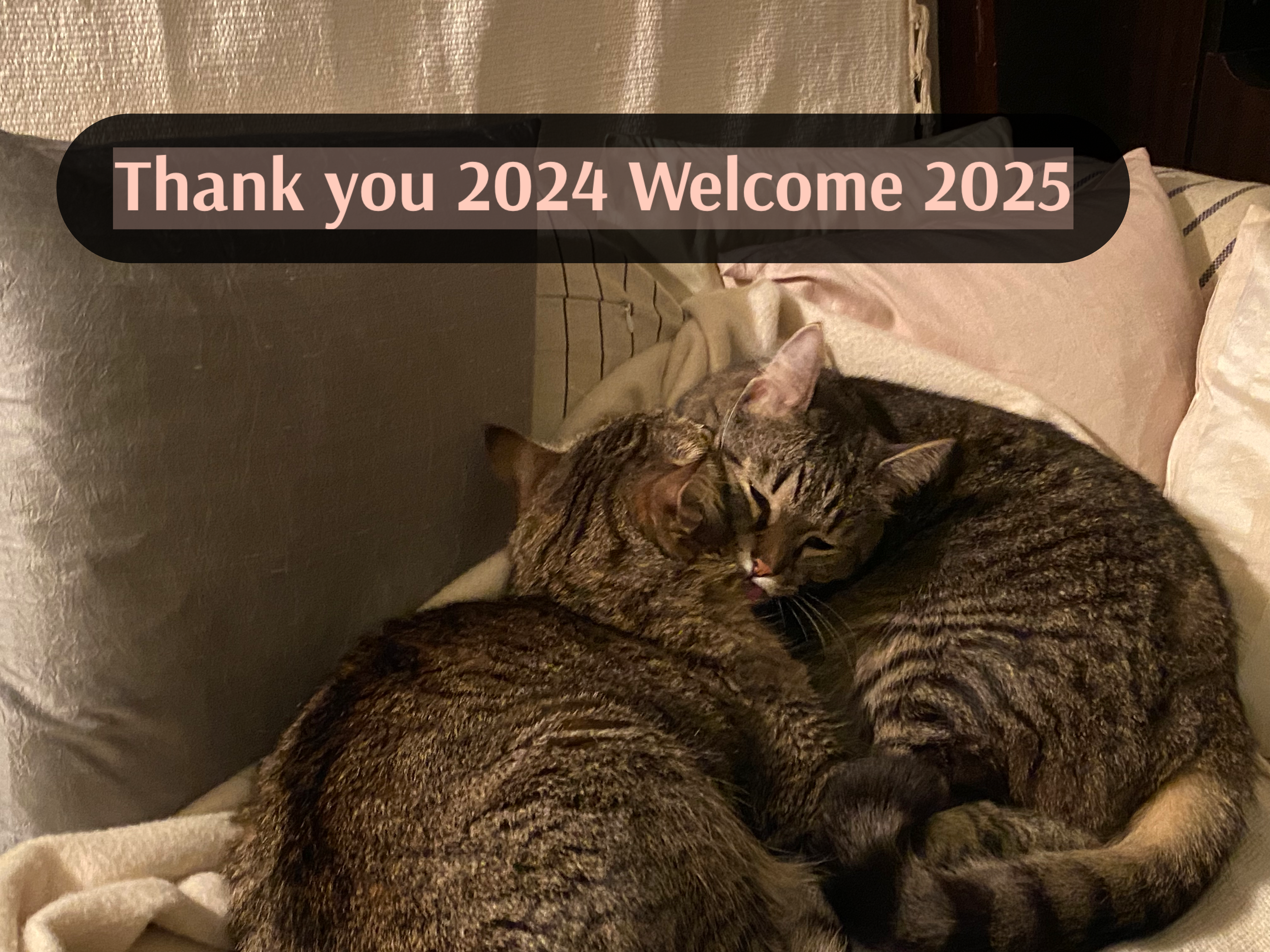
Thank You 2024 – Welcome 2025
The most important thing that happened to me during this year of wars and disasters are the two cats Pipo and Pompe that came into my life in July and radically changed my days. There were other exciting things, too, old and new projects and people, some of them listed below, but nothing as overwhelming as these two characters whose wellbeing I am now responsible for and whose constant benign presence I can enjoy.
Projects and ongoing events in 2024
As an auspicious start for the year I was elected honorary member of Artists’ Association MUU (2024-), see here, and an interview in Finnish, here.
Pondering with Pines – Miettii mäntyjen kanssa – Funderar med furor (2022-2024), my main concern and a development and continuation of my previous projects related to trees was concluded this year, although I will continue working with the materials. See presentation in English at Uniarts website, the three-lingual blog here and the archive on the RC, here. One example is The Pine of the Year – The year of the Pine, see here.
I have had the opportunity to participate in the project Gifts from the Sentient Forest, which will continue in 2025, see project website and my personal archive on the RC.
The podcast Talking with Trees – Puhetta Puille – Talar med Träd on Soundcloud, here will continue in some manner.
Animal Years via qr codes on location on Harakka Island, see map here was temporarily out of function, but will be repaired in the Spring.
Exhibitions, events and performances in 2024
Tala om det för Tallen (Tell it to the Pine) in Hippolyte studio 1-24.11.2024. See here.
With the Pine in Kaivopuisto Park 2-3-1 at Muu Mediataidetori 17-21.10.2024.
Männyn kanssa – With a Pine – Med en fura, Telegraf gallery on Harakka Island 20.8.-1.9.2024. Se here.
Citizen Pine, installation as part of City is sound, city is quicksand 21-23.5.2024.
Screening of With the Master Pine – mix and Dearest Pine Tree in pop-up exhibition, Yögalleria 10.4.2024.
Rakas Kuusi (Dear Spruce) in the compilation Tuhon ja tunteiden metsä or Trees and Destruction by AV-arkki at the Tampere Film Festival 7 and 9.3.2024. See program book.
Day with Pine in the MUU Gala compilation at Taidekeskus Itä, Lappeenranta 17.2.2024.
Listening with a Pine (mix) as part of the program The Strolling Creatures of Light at MUU Helsinki Contemporary Art Centre 27.1.2024.
Performing in Auringonvihreä – hommage to poet Gunnar Björling by Sanna Kekäläinen at the Helsinki Observatory 25-27.1.2024.
Pondering with Pines – Conversation in Three Languages, exhibition at Muu Helsinki Contemporary Art Centre 7-21.1.2024. See info. Small review in Finnish here.
Publications in 2024
How to Do Things with Artistic Research – Animal Years Revisited. Acta Scenica 65, University of the Arts Helsinki, 2024. See here.
Arlander, Annette, Barton, Bruce, Householder, Johanna and Man, Michelle. 2024. “The Work of Sharing: Discussing Performance in the Mode of Performance”.Performance Philosophy Journal Vol.9 No.1 (2024): Performance Philosophy Problems, 121-135.
“Workshop with a Pine” in Mend-Blend-Attend: Advancing Artistic Research, Proceedings of the 13th SAR International conference on Artistic Research, 86-95.
“Revisiting the Rusty Ring: Ecofeminism Today?” A video essay from 2020 reprinted in Special Retrospective Issue of PARtake: The Journal of Performance As Research, 6(2). See here.
“Writing to Trees with the Trees – experiments in NIROX and Mustarinda” in Taub, Myer (ed.) Forests and Fences, London & New York: Routledge, 2024, 29-47.
”’Kertaa ja koosta’ – työmenetelmä ja julkaisumuoto” [Upprepa on sammanställ – arbetsmetod och publikationsformat] in Järvinen, Hanna (ed.) Miten tehdä esityksellä [How to do things with performance], Tampere: Vastapaino 2024, 191-223.
Conversation in Jatun Risba, Daniele J Minns, O.Pen Be: “Queering ecologies to cultivate unity”, Antennae issue 64, 2024, 165-176.
“Practicing with Trees” in Sondra Fraleigh and Shannon Rose Riley (eds.) Geographies of Us: Ecosomatic Essays and Practice Pages, Routledge 2024, 219-224.
Talks, presentations and academic tasks in 2024
Opponent for Alexandra Ianchenko, “Estranging Trams: Atmospheres of Trams in Art”, Tallinn University 12.11.2024.
Lecture in the course Research through Art and Design, Aalto Arts 7.11.2024.
“Pondering with a Pine in the Park”, Metsäsuhdeklubin iltapäivä [Human-Forest Relationship Research Club] Metsä, kestävyys ja dialogi at Forest science’s day 23.10.2024, see here
“In Assemblage with a Pine” at PSi#29 Assemble in London 20-23.6.2024.
“Pondering with a Pine Near You” for the Artistic Research Working Group of PSi at PSi#29 Assemble in London 20-23.6.2024, see working group blog
”Miettii mäntyjen kanssa – miten kohdata puu subjektina taiteellisen tutkimuksen kontekstissa” [Pondering with Pines – how to encounter a tree as a subject in the context of artistic research], see <program for seminar in Lusto 27-28.5.2024.
Performance and response at Artistic Research Working Group online meetings 19.4. and 3.5.2024.
Presentation “Repeat, revisit, recreate – Revisit, recreate, reflect” at Helsinki Photomedia conference 11-14.4.2024.
Seminar with MA students of Contemporary Dramaturgy and Performance Research at Uniarts Helsinki 5.4.2024.
Seminar on autotheory, autofiction, autoetnography and performative writing for doctoral students at Uniarts Helsinki with Hanna Järvinen and Pilvi Porkola (2023-2024).
Seminar on Documentation and Sharing for doctoral candidates in Oslo 7-8.2.2024.
Lecture on documentation for MA students at SKH (Stockholms Konstnärliga Högskola) 2.2.2024.
Conversation with Karoliina Lummaa and Olga Cielemecka at Muu Helsinki Contemporary Art Centre 13.1.2024 See info
Thank you
for all these opportunities to collaborate with fascinating people and beings of all kinds, and best wishes for the coming year 2025!
Kiitos 2024 – Tervetuloa 2025
Tärkeintä mitä minulle on tapahtunut tänä sotien ja sekasorron vuonna on kaksi kissaa, Pipo ja Pompe, jotka saapuivat elämääni heinäkuussa ja muuttivat arkeni tykkänään. Oli toki muitakin jännittäviä asioita, vanhoja ja uusia hankkeita ja ihmisiä, joista osa on lueteltu tässä alla, muttei mitään niin mullistavaa kuin nämä kaksi tyyppiä, joiden hyvinvoinnista nyt olen vastuussa ja joiden jatkuvasta, hyväntahtoisesta läsnäolosta saan nauttia.
Hankkeita ja jatkuvia tapahtumia vuonna 2024
Hyväenteisenä aloituksena vuodelle minut valittiin taiteilijajärjestö MUU ry.n kunniajäseneksi (2024-), katso täältä<, ja pieni haastattelu suomeksi, täällä.
Pondering with Pines – Miettii mäntyjen kanssa – Funderar med furor(2022-2024), pääasiallinen kiinnostuksen kohteeni, jatko ja kehittely aiemmille puihin liittyville hankkeilleni päättyi tänä vuonna, mutta jatkan kyllä työskentelyä keräämäni materiaalin parissa. Katso esittely suomeksi Taideyliopiston sivuilla, kolmikielinen blogi ja arkisto RC-alustalla. Yksi esimerkki on vuoden puu, The Pine of the Year – The year of the Pine, katso täältä.
Minulla oli tilaisuus osallistua hankkeeseen Gifts from the Sentient Forest, joke jatkuu vuonna 2025, katso hankkeen verkkosivut ja henkilökohtainen arkistoni RC-alustalla.
Podkasti Talking with Trees – Puhetta Puille – Talar med Träd Soundcloudissa, täällä jatkuu jossakin muodossa.
Animal Years tai eläinvuodet QR koodien kautta kuvauspaikoilla Harakan saarella, jkatso kartta oli tilapäisesti epäkunnossa, mutta korjataan keväällä.
Näyttelyt, tapahtumat ja performanssit vuonna 2024
Tala om det för Tallen (Tell it to the Pine) Hippolyte studios 1-24.11.2024. Katso esite.
With the Pine in Kaivopuisto Park 2-3-1 näyttelyssä Muu Mediataidetori 17-21.10.2024
Männyn kanssa – With a Pine – Med en fura, Lennätingalleria Harakka 20.8.-1.9.2024, katso esite.
Citizen Pine, installaatio tapahtumassa City is sound, city is quicksand 21-23.5.2024.
With the Master Pine – mix ja Dearest Pine Tree pop-up näyttelyssä, Yögalleria 10.4.2024.
Rakas Kuusi (Dear Spruce) AV-arkin koosteessa Tuhon ja tunteiden metsä Tampereen elokuvajuhlat 7 ja 9.3.2024. Katso ohjelmakirja.
Day with Pine MUU Gaala koosteessa Taidekeskus Itä, Lappeenranta 17.2.2024.
Listening with a Pine (mix) ohjelmassa Vaeltavia valo-olentoja MUU Helsinki Nykytaiteen keskus 27.1.2024.
Esiintyjänä Sanna Kekäläisen esityksessä Auringonvihreä – kunnianosoitus runoilija Gunnar Björlingille, Helsingin observatorio 25-27.1.2024.
Miettii mäntyjen kanssa – keskusteluja kolmella kielellä näyttely Muu Helsinki Nykytaiteen keskus 7-21.1.2024. Katso info. Pieni maininta suomeksi täällä.
Julkaisut vuonna 2024
How to Do Things with Artistic Research – Animal Years Revisited. Acta Scenica 65, University of the Arts Helsinki, 2024. Katso täältä.
Arlander, Annette, Barton, Bruce, Householder, Johanna & Man, Michelle. 2024. “The Work of Sharing: Discussing Performance in the Mode of Performance”.Performance Philosophy Journal Vol.9 No.1 (2024): Performance Philosophy Problems, 121-135.
“Workshop with a Pine” teoksessa Mend-Blend-Attend: Advancing Artistic Research, Proceedings of the 13th SAR International conference on Artistic Research, 86-95.
“Revisiting the Rusty Ring: Ecofeminism Today?” Video essee vuodelta 2020 julkaistiin uudelleen erikoisnumerossa Special Retrospective Issue of PARtake: The Journal of Performance As Research, 6(2). Katso täältä.
“Writing to Trees with the Trees – experiments in NIROX and Mustarinda” teoksessa Taub, Myer (trim.) Forests and Fences, London & New York: Routledge, 2024, 29-47.
”’Kertaa ja koosta’ – työmenetelmä ja julkaisumuoto” teoksessa Järvinen, Hanna (toim.) Miten tehdä esityksellä, Tampere: Vastapaino 2024, 191-223.
Keskustelu artikkelissa Jatun Risba, Daniele J Minns, O.Pen Be: “Queering ecologies to cultivate unity”, Antennae issue 64, 2024, 165-176.
“Practicing with Trees” teoksessa Sondra Fraleigh & Shannon Rose Riley (trim.) Geographies of Us: Ecosomatic Essays and Practice Pages, Routledge 2024, 219-224.
Luennot, esittelytekstin ja akateemiset tehtävät vuonna 2024
Vastaväittäjä Alexandra Ianchenkon työlle, “Estranging Trams: Atmospheres of Trams in Art”, Tallinn University 12.11.2024.
Luento kurssilla Research through Art and Design, Aalto Arts 7.11.2024.
“Pondering with a Pine in the Park”, Metsäsuhdeklubin iltapäivä Metsä, kestävyys ja dialogi Metsätieteen päivässä 23.10.2024, katso ohjelma
“In Assemblage with a Pine” konferenssissa PSi#29 Assemble, Lontoo 20-23.6.2024.
“Pondering with a Pine Near You” työryhmässä Artistic Research Working Group of PSi PSi#29 Assemble konferenssissa, Lontoo 20-23.6.2024, katso työryhmän blogi
”Miettii mäntyjen kanssa – miten kohdata puu subjektina taiteellisen tutkimuksen kontekstissa”, Metsäsuhdeklubin kevätseminaari, Lusto 27-28.5.2024. Katso ohjelma .
“Performance and response” työryhmän Artistic Research Working Group verkkotapaamisissa 19.4. ja 3.5.2024.
“Repeat, revisit, recreate – Revisit, recreate, reflect” Helsinki Photomedia konferensissa 11-14.4.2024.
Seminaari Contemporary Dramaturgy and Performance Research -ohjelman MA-opiskelijoiden kanssa Taideyliopistossa 5.4.2024.
Seminaar autoteoriasta, autofiktiosta, autoetnografiasta ja performatiivisesta kirjoittamisesta tohtoriopiskelijoille Taideyliopistossa yhdessä Hanna Järvisen ja Pilvi Porkolan kanssa (2023-2024).
Seminaari “Documentation and Sharing” tohtoriopiskelijoille, Oslo 7-8.2.2024.
Luento dokumentoimisesta MA-opiskelijoille Tukholman Taideyliopisto 2.2.2024.
Keskustelu Karoliina Lummaan ja Olga Cielemeckan kanssa Muu Helsinki Nykytaiteen keskus 13.1.2024. Katso info.
Kiitos
kaikista näistä mahdollisuuksista tehdä yhteistyötä kiinnostavien ihmisten ja kaikenlaisten olentojen kanssa ja kaikkea hyvää tulevalle vuodelle 2025!
 Performing Landscape