

When my three-year project Pondering with Pines officially ended at the end of the year I was already fairly sure that junipers would be my next companions, and I started a small tumblr-blog called Joining Junipers. I’m not going to form any other separate blog for junipers, but I did create a media archive with the same name on the RC platform, Joining Junipers. Although this is not a formal project I will gather material about my encounters with junipers there. I’ve already chosen three junipers to have conversations with, two in Helsinki and one in Stockholm. With the juniper in Stockholm I speak Swedish, with the Juniper on Harakka Island Finnish and with the one in Suomenlinna English, in a series called With the Juniper in Suomenlinna. The project as a whole is called Joining Junipers, because Joining the Junipers would assumably mean linking together junipers rather than me joining them.
All posts by Annette Arlander

Enig med enar
Då mitt treåriga projekt Funderar med furor officiellt avslutades vid årsskiftet var jag redan ganska säker på att enar skulle bli mina kumpaner härnäst, och jag grundade en liten tumblr-blog med namnet Joining Junipers. Någon annan separat blog har jag inte tänkt starta för enarna, men jag har gjort ett media-arkiv med samma namn på RC-platformen, Joining Junipers. Även om det här inte är frågan om något projekt i egentlig bemärkelse skall jag där samla material om mina möten med enar. Jag har redan valt tre enar att samtala med en gång i månaden i år, en i Stockholm och två i Helsingfors. Med enen på Sveaborg talar jag engelska och med enen på Stora Räntan talar jag finska. Med enen i Stockholm talar jag svenska i en serie som jag kallar Hos Enen på Fredhällsklippan
Vad hela projektet kunde heta på svenska vet jag inte riktigt ännu: Enad med enar, Enig med enris, eller då Enig med enar?

Katajien kannalla
Kolmivuotisen hankkeeni Miettii mäntyjen kanssa virallisesti päättyessä vuodenvaihteessa olin jo melko varma, että katajat olisivat seuraavat kumppanini, ja käynnistin pienen tumblr-blogin nimellä Joining Junipers. Muuta erillistä blogia en ole aikonut katajille käynnistää, mutta RC-alustalle tein media-arkiston samalla nimellä, Joining Junipers. Vaikka kyse ei ole mistään varsinaisesta hankkeesta, kerään sinne materiaaleja kohtaamisista katajien kanssa. Olen valinnut kolme katajaa, joiden kanssa keskustelen kerran kuussa tänä vuonna, yhden Tukholmassa ja kaksi Helsingissä. Suomenlinnan katajan kanssa puhun englantia ja Harakan katajan kanssa suomea, sarjassa jonka olen nimennyt Hitaat jäähyväiset – Harakan katajan kanssa. Mikä koko hankkeen nimi voisi olla suomeksi, siitä en ole ihan varma: Katajien kannalla vai Katajien kumppanina vai pelkästään Katajien kanssa?
Performance-writing / Performance-lecture
In the latest issue of Performance Philosophy Journal (vol 9) Theron Schmidt writes about the problem of the online lecture and refers to performative writing and performance writing in ways that reminded me of ‘the problem of the performative text’ and the book that Pilvi Porkola edits, where I am supposed to write about my Sundays with a Pine. In the following I am thus not referencing the main points of the text but pick some quotes of interest for my concerns.
Schmidt defines performance as “that which attempts to hold that within which it itself is held”, and “may take the form of an explicit theatricality, foregrounding and reflecting upon the conditions of being seen and being heard”, with “both dramatic as well as political dimensions.” This leads him to Hannah Arendt’s descriptions of ‘spaces of appearance’, which predate a formal constitution of the public realm. “‘Living things make their appearance like actors on a stage set for them. The stage is common to all who are alive’ (Arendt 1978, 21).” Since this stage is not common, one definition of politics could be a distinction between what is and what is not common to all. This brings him to Judith Butler, who writes that “certain actors and actions are deemed ‘prepolitical’ or ’extrapolitical’; ‘they break into the sphere of appearance as from the outside’ (Butler 2015, 78)”. Butler “argues that ‘any conception of the political has to take into account what operation of power demarcates the political from the prepolitical’ (Butler 2015, 205). This, in turn, leads him to “Jacques Rancière’s provocations around the distribution or apportionment of what is and isn’t sensible”.
Schmidt states that “the appearance of politics is dependent upon a politics of appearance, one that attends to the conditions that make politics possible”. Following Butler, he notes that “the claiming of the right to appear is a performative politics, where the performative is that which generates the conditions that allow the performative to be recognized as such.” He thereby suggests “that a self -reflexive attention to the conditions of appearance — the stage that supports certain kinds of speech and action —is, or at least can be, a political domain.” According to him “words and gestures that are explicitly framed as ‘performance’ can also reach outside their frame from within, claiming the circumstances under which they are produced as the material of the performance itself.”
Schmidt uses as an example a piece of performance writing using the page as a stage, which is “performative in that it not only describes these dimensions and affordances of the printed page, but also enacts those encounters. It is bound up in its own material conditions even as it analyses them.” Performance-writing is characterised by “its self-reflexivity about the context in which it appears.” Schmidt quotes Della Pollock, who notes that
“Performative writing is thus no more or less formally intelligible than a road sign or a landmark: its styles may be numbered, taught, and reproduced, but its meanings are contextual. It takes its value from the context – map in which it is located and which it simultaneously marks, determines, transforms.” (Pollock [1995] 1998, 79)
Schmidt suggests that all writing could be performance-writing. “To describe a thing is to give it a context, and the context shapes the meaning; or, to put it another way, how we talk about the work is the work (Schmidt 2018).” Moreover, “discourse, description and performance, are not ontologically distinct from each other, but mutually constitutive”.
Whereas performance writing plays with the page as contextual frame, “the performance lecture takes not only the conditions of textuality but also those of the apparent liveness of speech, and the claims to authority of the lecture, as both its subject and its terms of interrogation.” He notes with Clio Unger (2021), that “the ways in which the lecture-performance both thematizes the politics of representation and also enacts those very politics make it a useful tool for marginalized voices to intervene within hierarchies of knowledge production.”
Schmidt further suggests that in a smilar way as “all writing might be considered performance-writing”, we could claim that “all lectures are lecture-performances” and every lecture “reproduces a performance of what a classroom is: what counts as knowledge, what learning looks like, and what forms of relationship and responsibility are demanded of those present.” And “the ‘problem’ of the online lecture might be a chance to think these qualities anew.”
Well, the relevance of context is a theme I never get past, it seems. But if context is so relevant and defining, it might be worthwhile to try to change context, too. The idea of the lecture performance, however, is not so familiar, although I have been interested in it for a while. Somehow I never come to really explore it, all lecture performances I plan tend to end up as video essays instead. But I guess much of what Schmidt notes about performance writing and performance lectures could be transposed to video essay as well.
Theron Schmidt “By the Time you rad this it is already too late. The problem of the online lecture.” Performance Philosophy Journal vol 9 no 1. (2024)
https://www.performancephilosophy.org/journal/article/view/435
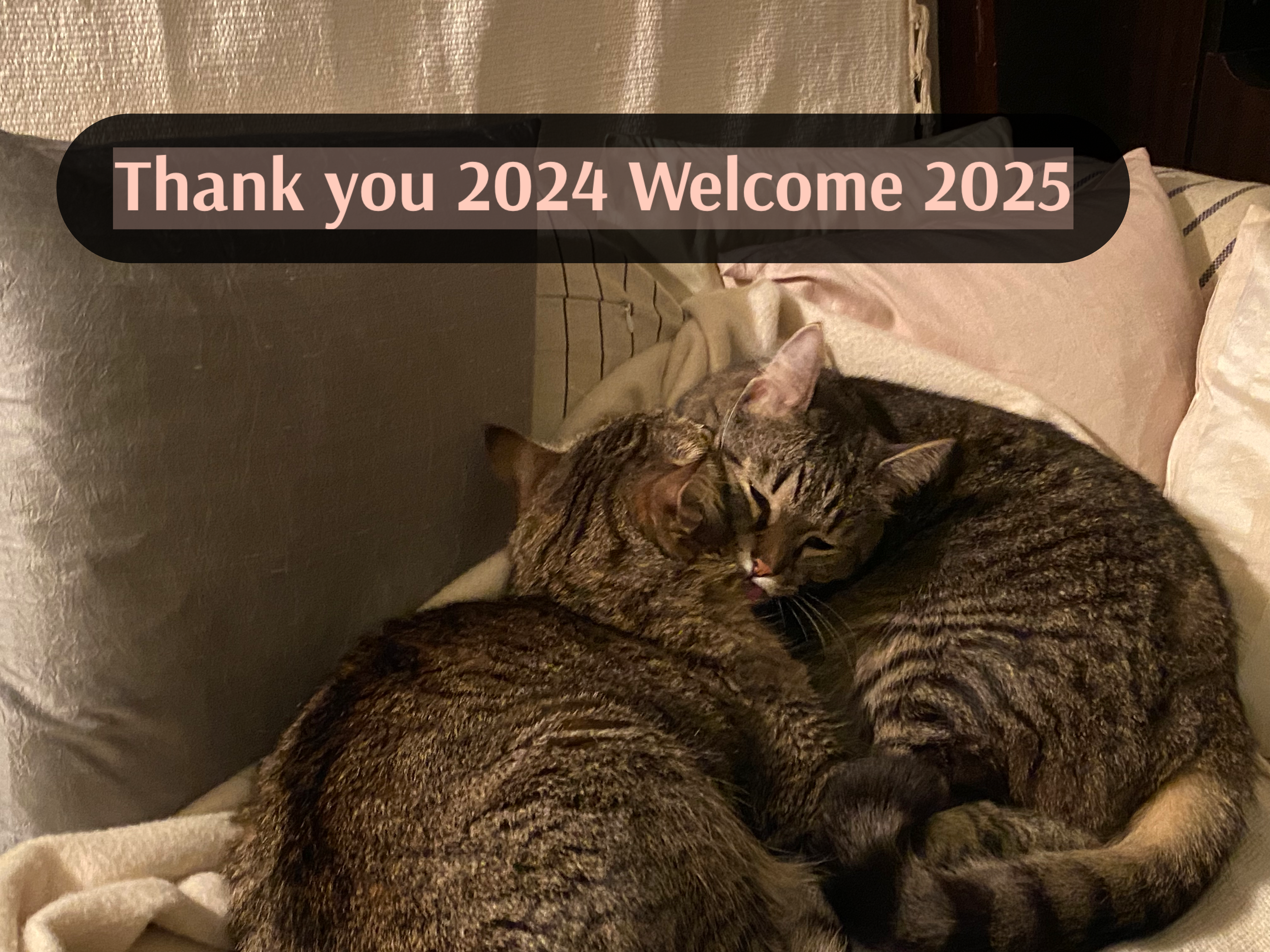
Thank You 2024 – Welcome 2025
The most important thing that happened to me during this year of wars and disasters are the two cats Pipo and Pompe that came into my life in July and radically changed my days. There were other exciting things, too, old and new projects and people, some of them listed below, but nothing as overwhelming as these two characters whose wellbeing I am now responsible for and whose constant benign presence I can enjoy.
Projects and ongoing events in 2024
As an auspicious start for the year I was elected honorary member of Artists’ Association MUU (2024-), see here, and an interview in Finnish, here.
Pondering with Pines – Miettii mäntyjen kanssa – Funderar med furor (2022-2024), my main concern and a development and continuation of my previous projects related to trees was concluded this year, although I will continue working with the materials. See presentation in English at Uniarts website, the three-lingual blog here and the archive on the RC, here. One example is The Pine of the Year – The year of the Pine, see here.
I have had the opportunity to participate in the project Gifts from the Sentient Forest, which will continue in 2025, see project website and my personal archive on the RC.
The podcast Talking with Trees – Puhetta Puille – Talar med Träd on Soundcloud, here will continue in some manner.
Animal Years via qr codes on location on Harakka Island, see map here was temporarily out of function, but will be repaired in the Spring.
Exhibitions, events and performances in 2024
Tala om det för Tallen (Tell it to the Pine) in Hippolyte studio 1-24.11.2024. See here.
With the Pine in Kaivopuisto Park 2-3-1 at Muu Mediataidetori 17-21.10.2024.
Männyn kanssa – With a Pine – Med en fura, Telegraf gallery on Harakka Island 20.8.-1.9.2024. Se here.
Citizen Pine, installation as part of City is sound, city is quicksand 21-23.5.2024.
Screening of With the Master Pine – mix and Dearest Pine Tree in pop-up exhibition, Yögalleria 10.4.2024.
Rakas Kuusi (Dear Spruce) in the compilation Tuhon ja tunteiden metsä or Trees and Destruction by AV-arkki at the Tampere Film Festival 7 and 9.3.2024. See program book.
Day with Pine in the MUU Gala compilation at Taidekeskus Itä, Lappeenranta 17.2.2024.
Listening with a Pine (mix) as part of the program The Strolling Creatures of Light at MUU Helsinki Contemporary Art Centre 27.1.2024.
Performing in Auringonvihreä – hommage to poet Gunnar Björling by Sanna Kekäläinen at the Helsinki Observatory 25-27.1.2024.
Pondering with Pines – Conversation in Three Languages, exhibition at Muu Helsinki Contemporary Art Centre 7-21.1.2024. See info. Small review in Finnish here.
Publications in 2024
How to Do Things with Artistic Research – Animal Years Revisited. Acta Scenica 65, University of the Arts Helsinki, 2024. See here.
Arlander, Annette, Barton, Bruce, Householder, Johanna and Man, Michelle. 2024. “The Work of Sharing: Discussing Performance in the Mode of Performance”.Performance Philosophy Journal Vol.9 No.1 (2024): Performance Philosophy Problems, 121-135.
“Workshop with a Pine” in Mend-Blend-Attend: Advancing Artistic Research, Proceedings of the 13th SAR International conference on Artistic Research, 86-95.
“Revisiting the Rusty Ring: Ecofeminism Today?” A video essay from 2020 reprinted in Special Retrospective Issue of PARtake: The Journal of Performance As Research, 6(2). See here.
“Writing to Trees with the Trees – experiments in NIROX and Mustarinda” in Taub, Myer (ed.) Forests and Fences, London & New York: Routledge, 2024, 29-47.
”’Kertaa ja koosta’ – työmenetelmä ja julkaisumuoto” [Upprepa on sammanställ – arbetsmetod och publikationsformat] in Järvinen, Hanna (ed.) Miten tehdä esityksellä [How to do things with performance], Tampere: Vastapaino 2024, 191-223.
Conversation in Jatun Risba, Daniele J Minns, O.Pen Be: “Queering ecologies to cultivate unity”, Antennae issue 64, 2024, 165-176.
“Practicing with Trees” in Sondra Fraleigh and Shannon Rose Riley (eds.) Geographies of Us: Ecosomatic Essays and Practice Pages, Routledge 2024, 219-224.
Talks, presentations and academic tasks in 2024
Opponent for Alexandra Ianchenko, “Estranging Trams: Atmospheres of Trams in Art”, Tallinn University 12.11.2024.
Lecture in the course Research through Art and Design, Aalto Arts 7.11.2024.
“Pondering with a Pine in the Park”, Metsäsuhdeklubin iltapäivä [Human-Forest Relationship Research Club] Metsä, kestävyys ja dialogi at Forest science’s day 23.10.2024, see here
“In Assemblage with a Pine” at PSi#29 Assemble in London 20-23.6.2024.
“Pondering with a Pine Near You” for the Artistic Research Working Group of PSi at PSi#29 Assemble in London 20-23.6.2024, see working group blog
”Miettii mäntyjen kanssa – miten kohdata puu subjektina taiteellisen tutkimuksen kontekstissa” [Pondering with Pines – how to encounter a tree as a subject in the context of artistic research], see <program for seminar in Lusto 27-28.5.2024.
Performance and response at Artistic Research Working Group online meetings 19.4. and 3.5.2024.
Presentation “Repeat, revisit, recreate – Revisit, recreate, reflect” at Helsinki Photomedia conference 11-14.4.2024.
Seminar with MA students of Contemporary Dramaturgy and Performance Research at Uniarts Helsinki 5.4.2024.
Seminar on autotheory, autofiction, autoetnography and performative writing for doctoral students at Uniarts Helsinki with Hanna Järvinen and Pilvi Porkola (2023-2024).
Seminar on Documentation and Sharing for doctoral candidates in Oslo 7-8.2.2024.
Lecture on documentation for MA students at SKH (Stockholms Konstnärliga Högskola) 2.2.2024.
Conversation with Karoliina Lummaa and Olga Cielemecka at Muu Helsinki Contemporary Art Centre 13.1.2024 See info
Thank you
for all these opportunities to collaborate with fascinating people and beings of all kinds, and best wishes for the coming year 2025!
Kiitos 2024 – Tervetuloa 2025
Tärkeintä mitä minulle on tapahtunut tänä sotien ja sekasorron vuonna on kaksi kissaa, Pipo ja Pompe, jotka saapuivat elämääni heinäkuussa ja muuttivat arkeni tykkänään. Oli toki muitakin jännittäviä asioita, vanhoja ja uusia hankkeita ja ihmisiä, joista osa on lueteltu tässä alla, muttei mitään niin mullistavaa kuin nämä kaksi tyyppiä, joiden hyvinvoinnista nyt olen vastuussa ja joiden jatkuvasta, hyväntahtoisesta läsnäolosta saan nauttia.
Hankkeita ja jatkuvia tapahtumia vuonna 2024
Hyväenteisenä aloituksena vuodelle minut valittiin taiteilijajärjestö MUU ry.n kunniajäseneksi (2024-), katso täältä<, ja pieni haastattelu suomeksi, täällä.
Pondering with Pines – Miettii mäntyjen kanssa – Funderar med furor(2022-2024), pääasiallinen kiinnostuksen kohteeni, jatko ja kehittely aiemmille puihin liittyville hankkeilleni päättyi tänä vuonna, mutta jatkan kyllä työskentelyä keräämäni materiaalin parissa. Katso esittely suomeksi Taideyliopiston sivuilla, kolmikielinen blogi ja arkisto RC-alustalla. Yksi esimerkki on vuoden puu, The Pine of the Year – The year of the Pine, katso täältä.
Minulla oli tilaisuus osallistua hankkeeseen Gifts from the Sentient Forest, joke jatkuu vuonna 2025, katso hankkeen verkkosivut ja henkilökohtainen arkistoni RC-alustalla.
Podkasti Talking with Trees – Puhetta Puille – Talar med Träd Soundcloudissa, täällä jatkuu jossakin muodossa.
Animal Years tai eläinvuodet QR koodien kautta kuvauspaikoilla Harakan saarella, jkatso kartta oli tilapäisesti epäkunnossa, mutta korjataan keväällä.
Näyttelyt, tapahtumat ja performanssit vuonna 2024
Tala om det för Tallen (Tell it to the Pine) Hippolyte studios 1-24.11.2024. Katso esite.
With the Pine in Kaivopuisto Park 2-3-1 näyttelyssä Muu Mediataidetori 17-21.10.2024
Männyn kanssa – With a Pine – Med en fura, Lennätingalleria Harakka 20.8.-1.9.2024, katso esite.
Citizen Pine, installaatio tapahtumassa City is sound, city is quicksand 21-23.5.2024.
With the Master Pine – mix ja Dearest Pine Tree pop-up näyttelyssä, Yögalleria 10.4.2024.
Rakas Kuusi (Dear Spruce) AV-arkin koosteessa Tuhon ja tunteiden metsä Tampereen elokuvajuhlat 7 ja 9.3.2024. Katso ohjelmakirja.
Day with Pine MUU Gaala koosteessa Taidekeskus Itä, Lappeenranta 17.2.2024.
Listening with a Pine (mix) ohjelmassa Vaeltavia valo-olentoja MUU Helsinki Nykytaiteen keskus 27.1.2024.
Esiintyjänä Sanna Kekäläisen esityksessä Auringonvihreä – kunnianosoitus runoilija Gunnar Björlingille, Helsingin observatorio 25-27.1.2024.
Miettii mäntyjen kanssa – keskusteluja kolmella kielellä näyttely Muu Helsinki Nykytaiteen keskus 7-21.1.2024. Katso info. Pieni maininta suomeksi täällä.
Julkaisut vuonna 2024
How to Do Things with Artistic Research – Animal Years Revisited. Acta Scenica 65, University of the Arts Helsinki, 2024. Katso täältä.
Arlander, Annette, Barton, Bruce, Householder, Johanna & Man, Michelle. 2024. “The Work of Sharing: Discussing Performance in the Mode of Performance”.Performance Philosophy Journal Vol.9 No.1 (2024): Performance Philosophy Problems, 121-135.
“Workshop with a Pine” teoksessa Mend-Blend-Attend: Advancing Artistic Research, Proceedings of the 13th SAR International conference on Artistic Research, 86-95.
“Revisiting the Rusty Ring: Ecofeminism Today?” Video essee vuodelta 2020 julkaistiin uudelleen erikoisnumerossa Special Retrospective Issue of PARtake: The Journal of Performance As Research, 6(2). Katso täältä.
“Writing to Trees with the Trees – experiments in NIROX and Mustarinda” teoksessa Taub, Myer (trim.) Forests and Fences, London & New York: Routledge, 2024, 29-47.
”’Kertaa ja koosta’ – työmenetelmä ja julkaisumuoto” teoksessa Järvinen, Hanna (toim.) Miten tehdä esityksellä, Tampere: Vastapaino 2024, 191-223.
Keskustelu artikkelissa Jatun Risba, Daniele J Minns, O.Pen Be: “Queering ecologies to cultivate unity”, Antennae issue 64, 2024, 165-176.
“Practicing with Trees” teoksessa Sondra Fraleigh & Shannon Rose Riley (trim.) Geographies of Us: Ecosomatic Essays and Practice Pages, Routledge 2024, 219-224.
Luennot, esittelytekstin ja akateemiset tehtävät vuonna 2024
Vastaväittäjä Alexandra Ianchenkon työlle, “Estranging Trams: Atmospheres of Trams in Art”, Tallinn University 12.11.2024.
Luento kurssilla Research through Art and Design, Aalto Arts 7.11.2024.
“Pondering with a Pine in the Park”, Metsäsuhdeklubin iltapäivä Metsä, kestävyys ja dialogi Metsätieteen päivässä 23.10.2024, katso ohjelma
“In Assemblage with a Pine” konferenssissa PSi#29 Assemble, Lontoo 20-23.6.2024.
“Pondering with a Pine Near You” työryhmässä Artistic Research Working Group of PSi PSi#29 Assemble konferenssissa, Lontoo 20-23.6.2024, katso työryhmän blogi
”Miettii mäntyjen kanssa – miten kohdata puu subjektina taiteellisen tutkimuksen kontekstissa”, Metsäsuhdeklubin kevätseminaari, Lusto 27-28.5.2024. Katso ohjelma .
“Performance and response” työryhmän Artistic Research Working Group verkkotapaamisissa 19.4. ja 3.5.2024.
“Repeat, revisit, recreate – Revisit, recreate, reflect” Helsinki Photomedia konferensissa 11-14.4.2024.
Seminaari Contemporary Dramaturgy and Performance Research -ohjelman MA-opiskelijoiden kanssa Taideyliopistossa 5.4.2024.
Seminaar autoteoriasta, autofiktiosta, autoetnografiasta ja performatiivisesta kirjoittamisesta tohtoriopiskelijoille Taideyliopistossa yhdessä Hanna Järvisen ja Pilvi Porkolan kanssa (2023-2024).
Seminaari “Documentation and Sharing” tohtoriopiskelijoille, Oslo 7-8.2.2024.
Luento dokumentoimisesta MA-opiskelijoille Tukholman Taideyliopisto 2.2.2024.
Keskustelu Karoliina Lummaan ja Olga Cielemeckan kanssa Muu Helsinki Nykytaiteen keskus 13.1.2024. Katso info.
Kiitos
kaikista näistä mahdollisuuksista tehdä yhteistyötä kiinnostavien ihmisten ja kaikenlaisten olentojen kanssa ja kaikkea hyvää tulevalle vuodelle 2025!
Tack 2024 – Välkommen 2025
Det viktigaste som hände mig under detta år av krig och förödelse är de två katter, Pipo och Pompe, som kom in i mitt liv i juli och som har grundligt förändrat min vardag. Det har skett andra spännande saker också, gamla och nya projekt och mänskor, några av dem uppräknade här nedan, men inget så överväldigande som dessa två karaktärer vars välmående jag nu ansvarar för och vars ständiga, välvilliga närvaro jag får njuta av.
Projekt och pågående aktiviteter 2024
Som en gynnsam start på året blev jag vald till hedersmedlem i konstnärsföreningen MUU (2024 -), se här, och en intervju på finska, här.
Pondering with Pines – Miettii mäntyjen kanssa – Funderar med furor (2022-2024), min huvudsakliga verksamhet och en vidareutveckling och fortsättning på tidigare projekt kring träd avslutades i år, även om jag kommer att fortsätta arbeta med materialen. Se presentationen på svenska på Uniarts websida, den trespråkiga bloggen här och arkivet på RC, här. Ett exempel är årets tall, The Pine of the Year – The year of the Pine, se här.
Jag har också haft möjlighet att delta i projektet Gifts from the Sentient Forest, som kommer att fortsätta år 2025, se projektets websida och mitt personliga arkiv på RC.
Podden Talking with Trees – Puhetta Puille – Talar med Träd på Soundcloud here kommer att fortsätta i någon form.
Animal Years via qr koder på inspelningsplatserna på ön Stora Räntan, se kartan, var tillfälligt ur bruk, men kommer att repareras på våren.
Utställningar , performance och evenemang 2024
Tala om det för Tallen (Tell it to the Pine) i Hippolyte studion 1-24.11.2024. Se här.
With the Pine in Kaivopuisto Park 2-3-1 på Muu Mediataidetori 17-21.10.2024.
Männyn kanssa – With a Pine – Med en fura, Telegraf galleriet på Stora Räntan 20.8.-1.9.2024. Se här
Citizen Pine, installation som en del av City is sound, city is quicksand 21-23.5.2024.
Visning av With the Master Pine – mix och Dearest Pine Tree i pop-up utställningen på Yögalleria 10.4.2024.
Rakas Kuusi (Dear Spruce) i AV-arkivets sammanställningen Tuhon ja tunteiden metsä eller Trees and Destruction på Tampere Film Festival 7 och 9.3.2024. Se programboken.
Day with Pine i MUU Gala sammanställningen på Taidekeskus Itä, Willmanstrand 17.2.2024.
Listening with a Pine (mix) i programmet The Strolling Creatures of Light på MUU Helsinki Contemporary Art Centre 27.1.2024.
Uppträdde i Auringonvihreä – hommage to poet Gunnar Björling av Sanna Kekäläinen i Helsingfors Observatorium 25-27.1.2024.
Utställningen Funderar med furor – samtal på tre språk på MUU Helsinki Contemporary Art Centre 7-21.1.2024. Se info. En liten notis på finska here.
Publikationer 2024
How to Do Things with Artistic Research – Animal Years Revisited. Acta Scenica 65, University of the Arts Helsinki, 2024. Se here.
Arlander, Annette, Barton, Bruce, Householder, Johanna & Man, Michelle. 2024. “The Work of Sharing: Discussing Performance in the Mode of Performance”.Performance Philosophy Journal Vol.9 No.1 (2024): Performance Philosophy Problems, 121-135.
“Workshop with a Pine” i Mend-Blend-Attend: Advancing Artistic Research, Proceedings of the 13th SAR International conference on Artistic Research, 86-95.
“Revisiting the Rusty Ring: Ecofeminism Today?” Videoessä från år 2020 publicerats pånytt i Special Retrospective Issue of PARtake: The Journal of Performance As Research, 6(2). Se här.
“Writing to Trees with the Trees – experiments in NIROX and Mustarinda” i Taub, Myer (red.) Forests and Fences, London & New York: Routledge 2024, 29-47.
”’Kertaa ja koosta’ – työmenetelmä ja julkaisumuoto” [Upprepa on sammanställ – arbetsmetod och publikationsformat] i Järvinen, Hanna (red.) Miten tehdä esityksellä [How to do things with performance], Tampere: Vastapaino 2024, 191-223.
Samtal i Jatun Risba, Daniele J Minns, O.Pen Be: “Queering ecologies to cultivate unity”, Antennae issue 64, 2024, 165-176.
“Practicing with Trees” i Sondra Fraleigh & Shannon Rose Riley (red.) Geographies of Us: Ecosomatic Essays and Practice Pages, Routledge 2024, 219-224.
Föredrag, presentationer och akademiska uppdrag 2024
Opponent för Alexandra Ianchenko, “Estranging Trams: Atmospheres of Trams in Art”, Tallinn University 12.11.2024.
Föreläsning på kursen Research through Art and Design, Aalto Arts 7.11.2024.
“Pondering with a Pine in the Park”, Metsäsuhdeklubin iltapäivä [Mänskan och skogen -klubbens eftermiddag] Metsä, kestävyys ja dialogi [Skogen, hållbarhet och dialog] på skogsvetenskapsdagen 23.10.2024, se här.
“In Assemblage with a Pine” vid PSi#29 Assemble i London 20-23.6.2024.
“Pondering with a Pine Near You” för arbetsgruppen Artistic Research Working Group of PSi vid PSi#29 Assemble i London 20-23.6.2024, se arbetsgruppens blogg
”Miettii mäntyjen kanssa – miten kohdata puu subjektina taiteellisen tutkimuksen kontekstissa” [Funderar med furor – hur bemöta ett träd som ett subjekt inom konstnärlig forskning], Metsäsuhdeklubin [skogsrelationsklubbens] vårseminarium i Lusto 27-28.5.2024. Se href=”https://metsatiede.org/uncategorized/metsasuhdeklubin-kevatseminaari-27-28-5-2024-punkaharju/” rel=”noopener” target=”_blank”>programmet på finska.
“Performance and response” i Artistic Research Working Group arbetsgruppens online möten 19.4. och 3.5.2024.
Presentationen “Repeat, revisit, recreate – Revisit, recreate, reflect” vid Helsinki Photomedia konferensen 11-14.4.2024.
Seminar med MA studenter i Contemporary Dramaturgy and Performance Research vid Uniarts Helsinki 5.4.2024.
Seminar om autoteori, autofiktion, autoetnografi och performativt skrivande för doktorander vid Uniarts Helsinki tillsammans med Hanna Järvinen och Pilvi Porkola (2023-2024).
Seminar om “Documentation and Sharing” för doktorander i Oslo 7-8.2.2024.
föreläsning om dokumentering för MA studenter vid SKH (Stockholms Konstnärliga Högskola) 2.2.2024.
Samtal med Karoliina Lummaa och Olga Cielemecka på Muu Helsinki Contemporary Art Centre 13.1.2024 Se info.
Tack
för alla dessa tillfällen till samarbete med fascinerande mänskor och all slags varelser, och allt gott för det kommande året 2025!
Other Blogs
Joining Junipers
Pondering with Pines – Miettii mäntyjen kanssa – Funderar med furor
Old completed Blogs:
Artistic Research in Stockholm
How to do things with performance?
Meetings with Remarkable and Unremarkable Trees
Year One With Plants
Year Two With Plants
Year Three With Plants
Meetings with Trees
Pondering with Pines
Katajan kanssa – With a Juniper
Lohikäärmettä kutsumassa – Att kalla på draken – Calling the Dragon
Käärmeen vuosi keinutellen – Ormens år i gungan – Year of the Snake Swinging
Doing something?
Prompted to read a text I had downloaded earlier, “On the ‘doing’ of ‘something’” by Teemu Paavolainen, I was fascinated by the discussion on performativity, although the context, performative protests, is not that familiar to me. The text begins with the statement that the essay “grows from the simple observation that ‘performative’ or ‘performativity’, in protest as elsewhere, have a plurality of conflicting meanings.” (p 38) He summarises the duality “between explicitly positive and negative conceptions of performativity as a function of novelty or normativity: active subversion or passive submission, effective doing or theatrical dissimulation”. (p 38) He references Judith Butler’s Notes toward a Performative Theory of Assembly (2015), where she “insists that ‘performativity describes both the processes of being acted on and the conditions and possibilities for acting’, and cannot be understood without both dimensions (2015: 63)”. He summarises the situation: “people do something, and it begins to look like some thing. (Think of verbs and nouns: protesting becomes ‘a protest’, behaviour comes to suggest ‘character’.)” (p 39) Later he speaks of and for “the unsettled duality of performativity as both making and maintaining, and on the ways these intertwine.” (p 43) The article contains examples of various protests and the different tactics utilized, from violence to clowning and also notes: “While the estrangement of the present is relatively easy … imagining new futures is substantially harder, even if many of their ingredients are already present in the present. Perhaps the most that any protest can prefigure is an adjectival sense of a world more open and more openly performative.” (p 45) The text ends by suggesting a possible dynamic for the performativity of protests: “in all cases, there is a doing of things that have real effects both outside the done and back again on the doers. Effectively, the performativity lies in the cyclical relation between the doing and the done: whether consecutive or concurrent, there is an aspect of making and an aspect of maintaining (hence production, approximation/ compulsion, dissimulation). Perhaps, it is simply the balance between the efficacy of the doing and the artificiality of the done that also gives us the more positive and negative connotations of ‘performative protest’?” (p 46)
Probably it is this relation between the doing and the done that interests me because it is applicable and relevant in all kinds of creative contexts while trying to do things differently. As is the difficulty of imagining new futures. If I keep talking to trees it is on the one hand suggesting a manner of treating trees with respect as a prefiguration of another kind of coexisting with the vegetal world and on the other hand it is simply maintaining an old folk tradition of humans talking to trees when in distress. But we could ask what exactly is the ‘something’ that is thereby done.
Teemu Paavolainen (2022) On the ‘Doing’ of ‘Something’, Performance
Research, 27:3-4, 38-46, DOI: 10.1080/13528165.2022.2155394
Posthuman phenomenology?
Finally I read a text I have planned to read for a while – there are many of them lying around on my computer desktop and various files – a text on posthuman phenomenology by Tyson Lewis and James Owen, published already 2019 in Qualitative Inquiry. Although I was very much inspired by Merleau-Ponty when working on my doctoral dissertation Performance as Space in the 1990’s phenomenology has not been my focus since then. It is nevertheless central for many of my colleagues, especially those working with dance and somatic practices, and therefore posthumanism related to phenomenology immediately incited my curiosity. Interestingly, the authors suggest that their approach could be understood as a branch of performance philosophy. “To press the phenomenological tradition beyond its humanist roots, one must commit a radical reorganization of the body and of sensation, and the best way to accomplish this is through the esthetic reinvention of one’s own bodily apparatus.” (p 2)
The subtitles describe the main trajectory of the text: Unsettling the Human-Centeredness of Phenomenology, From Imaginative Speculation to Embodied Entanglements, Performing the Posthuman, Posthuman Performance: A Case Study, and Conclusion: Toward the Landscape. What is not so evident by the subtitles is the importance of Jakob van Uexküll’s idea of Umwelt and various ‘life bubbles’ for their argument. Uexküll uses an oak tree to exemplify how the same object can have different perceptual “tones” (Uexküll 2010, 129). For a fox living in a hollow at the base of the tree “the oak possesses neither the use tone from the forester’s environment nor the danger tone from the little girl’s environment, but only a protection tone” (Ibid). Rather, “in accordance with the different effect tones, the perception images of the numerous inhabitants of the oak are configured differently” (Uexküll 2010, 130).
The authors describe various imaginative experiments based on Uexküll’s ideas before introducing experiments in embodiment, arguing that “a more efficacious starting point for a posthuman phenomenology of the non-human animal can be found in performance philosophy.” (p 4) They suggest that “through embodied imitation of non-human animals, the body can begin to think differently.” (p 5) This they exemplify with some experiments by Charles Foster, who tried to live like a badger and develop his fingertips to sense somewhat like the whiskers of an otter. After discussing the ethical problems in such experiments they refer to Merleau-Ponty and note how “there is always already a chiasmic intertwining of self and other in all forms of touching” (Merleau-Ponty 1968 143), and “in this touching the human cannot remain untouched, producing an intercapture through mimetic performance.” (p 6) For the authors “there is an interface that enables bubbles to cohabitate and potentially touch one another” and which “is revealed through performance”, a “necessary, shared commonwealth between worlds that make such touching possible”, a shared interface they call landscape. (Ibid) They write: “The landscape is not reducible to any given world (any given bubble) or to a form of subjective intelligence but is, to use phenomenological language, the clearing that enables bubbles to appear and potentially touch/contaminate one another. Without the attempt to perform (rather than to merely imagine), posthuman phenomenology would not have succeeded in exposing this realm that exists alongside our worlds but is not reducible to worlds.” (Lewis & Owen 2019, 6)
The idea of performing as a way of exploring through imitation is closer to theatre and performance groups like Other Spaces and not at all what I have been trying to do. Or perhaps there is something related in my attempt at remaining still with trees or shrubs, breathing together with them, sharing their relative immobility in some manner. Landscape as a common ground for various life-worlds or bubbles resonates better with my aspirations, I guess. I’m also reminded of Emanuele Coccia’s claim that there are no separate niches or life-worlds, because we are immersed in the worlds of others. “Being in the world means to exercise influence especially outside one’s own space, outside one’s own habitat, outside one’s own niche.” (Coccia 2019, 43) According to him, “the world is by definition the life of others: the ensemble of other living beings”.(Ibid) And yes, we are breathing in the air others are breathing out. Following Lewis and Owen we could ask, however, how could we understand those others. And as they suggest, besides trying to imagine, we can also try to do something, not necessarily to imitate but to perform in some manner.
Tyson E. Lewis and James Owen. 2019. Posthuman Phenomenologies: Performance Philosophy, Non-Human Animals, and the Landscape. Qualitative Inquiry Volume 26 issue 5, p 1 –7.
Coccia, Emanuele. 2019. The Life of Plants: A Metaphysics of Mixture. Cambridge: Polity Press.
Texts referenced by Lewis and Owen:
Foster, C. (2016). Being a beast: Adventures across the species divide. New York, NY: Metropolitan Books.
Merleau-Ponty, M. (1968). The visible and the invisible (A. Lingis, Trans.) Evanston, IL: Northwestern University Press.
Uexküll, J. (2010). A foray into the worlds of animals: With a theory of meaning. Minneapolis: University of Minnesota Press.
 Performing Landscape