
After spending a few days in Kassel, Germany, experiencing Documenta 14, it was a pleasure to return to the trees in Helsinki for three mornings in a row. Two of them sunny and bright and the third, this morning, a grey day with drizzle. Not that visiting Documenta would not have been a pleasure, but it was exhausting, too, especially on Saturday, when everybody seemed to have decided to go there and the queues were long. The amount of people everywhere felt unfamiliar to somebody living in Finland, where we tend to look for crowds to get close to each other for a moment, for festivals and the like, and then quickly retreat to a safe distance afterwards, with plenty of emptiness around, if possible. Not many people passed by in the park these mornings; a group of small children from the nearby Kindergarten.
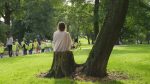

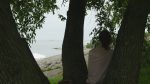
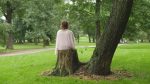
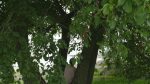
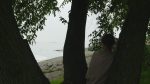

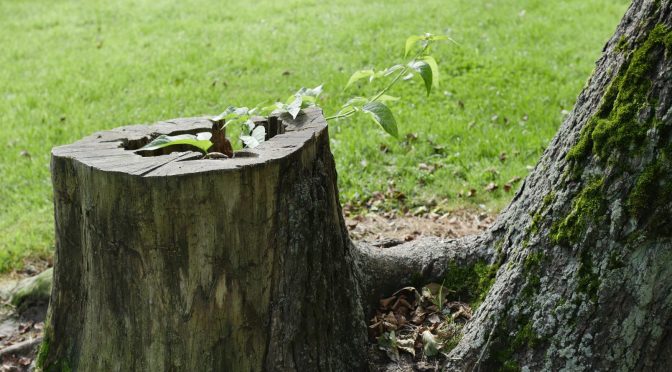
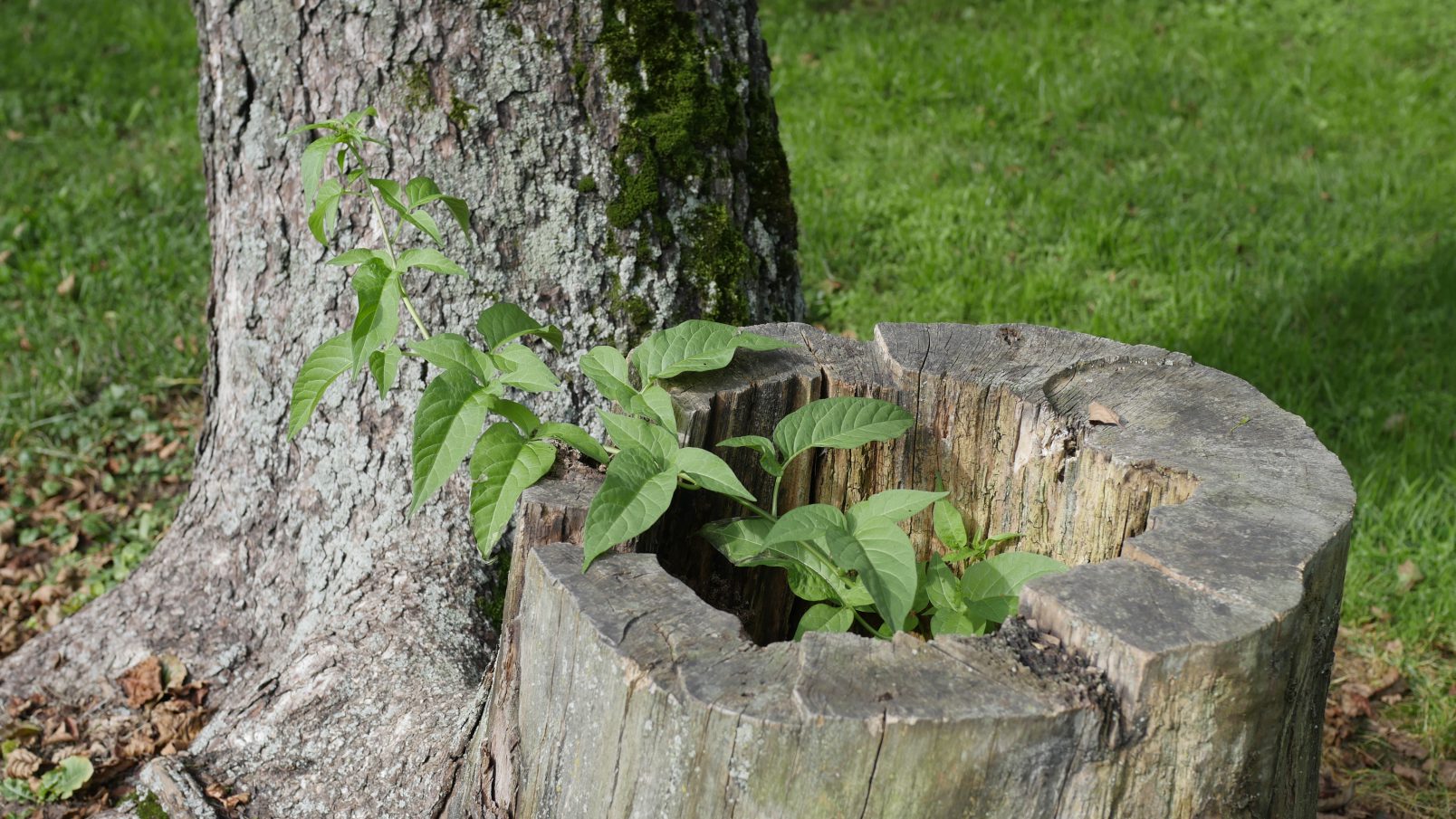
The plant growing from the hollow stub of the alder has gained in vigour and is now reaching far beyond its cosy base (see image above, and below).
But what about Documenta and plants? There were Beuys’ Oaks, of course, and in the current exhibition in Kassel, in Documenta Halle, Aboubakar Fofana from Mali had assembled plenty of living indigo plants as part of his work Fundi (Uprising). There might have been others, I could not see everything, in the overabundance of art works, but it seemed otherwise plants were present mainly as materials, or as representations.
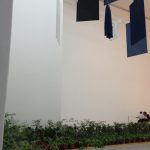
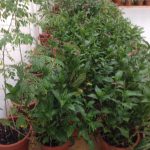
There were three different plants that had been used to produce traditional indigo dye, Indigofera arrecta, Polygonum Tinctorium or Japanese indigo and Isatis Tinctoria or woad, which all contain indigotin and where a source of wealth and misery in colonial times, before synthetic methods for dyeing were developed. I remember reading a beautifully written ethnographic study about indigo, I suppose it was Indigo: the Indelible Colour That Ruled the World by Catherine McKinley, but I am no longer sure. And as a child I read a strange novel from the thirties or forties, called Aniliini in Finnish, which described the background to the chemical inventions related to textile colours, which has stayed in my mind more as vague atmosphere than any story as such. These thoughts never occurred to me while strolling in Kassel, I did not even think the art work in question was so special. But now, in retrospect, I am fascinated by the world it opens up. And similarly, various worlds could be entered via each and ever art work, uh! It is just too much…
Category Archives: with trees
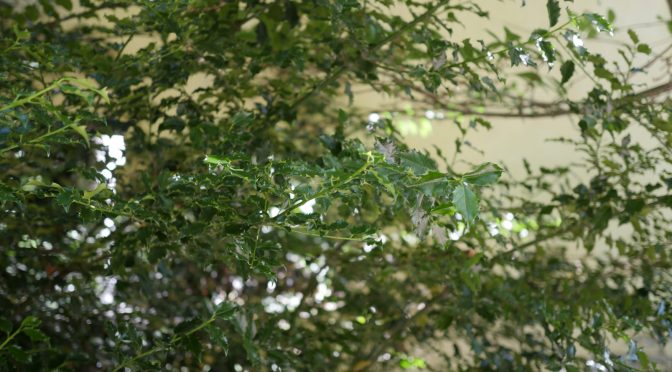
July – Month of the Holly
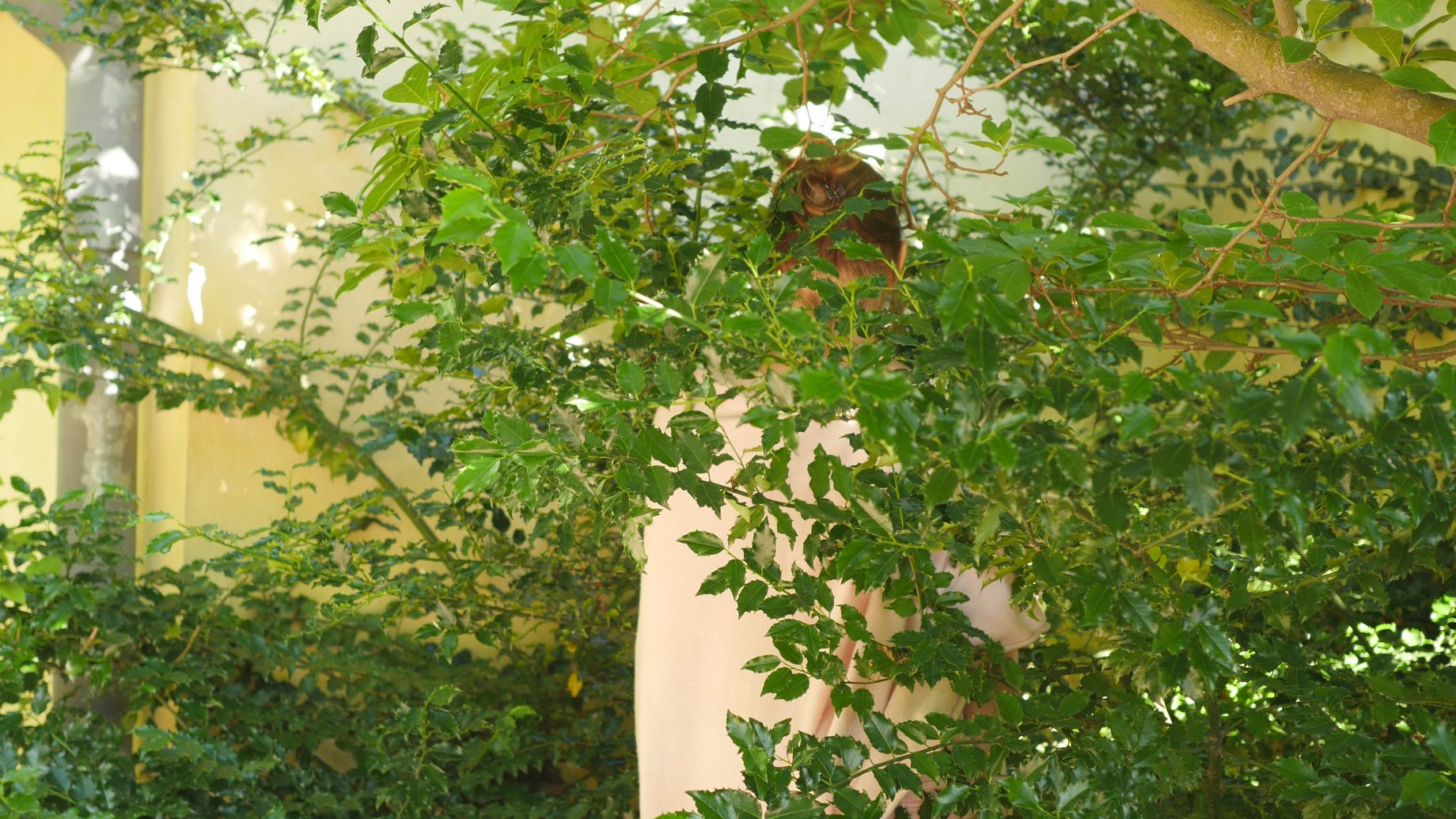
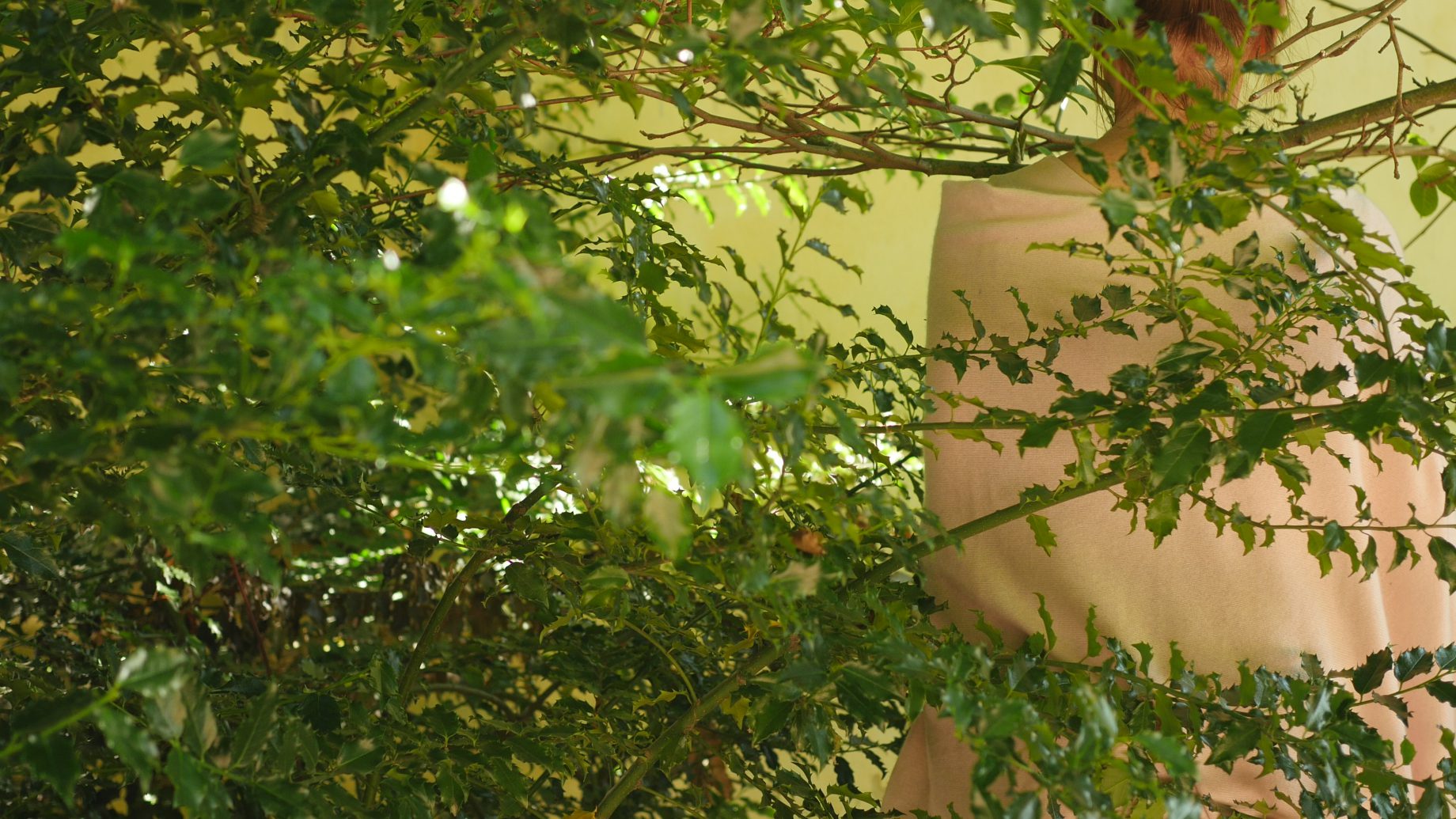
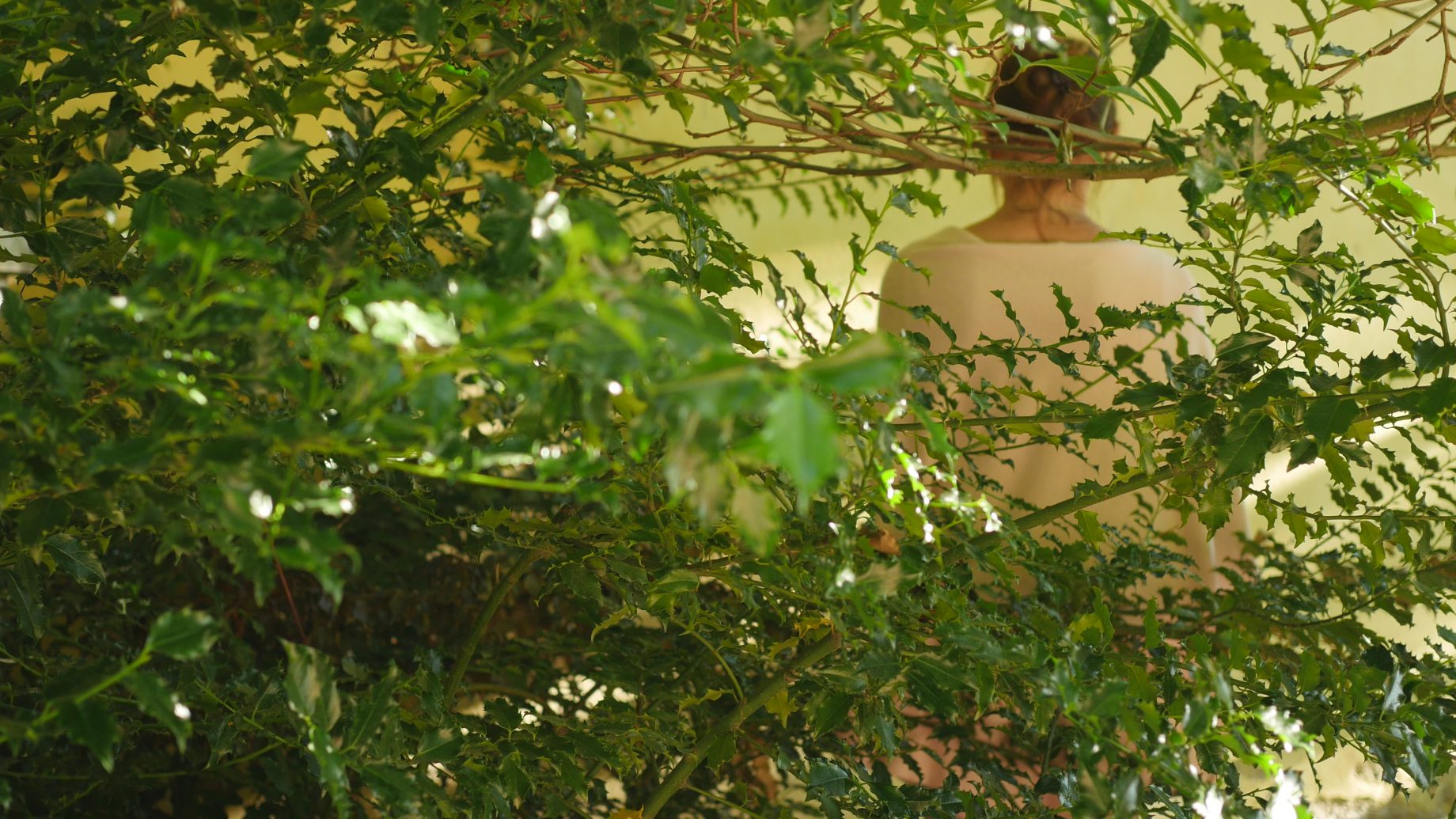
Finding a holly (Ilex aquifolium) in Helsinki is no easy matter, but there are some hollies here, although they have trouble surviving the winter and need a protected spot to grow in. Hybrids between the usual holly, which grows as far up north as Denmark, and another relative (Ilex rugosa) have been created to survive here (Ilex x meserveae), although their leaves are not as sharp, they say. The holly is the tree (or shrub) for the 9nth lunar month in the Celtic Tree Calendar from July 8 to August 4, and one of the most difficult ones from a Finnish perspective. My original idea was to find trees for the tree calendar on the shores of Helsinki, but some compromises are necessary. At the end of the Töölönlahti bay there are some thriving hollies, but they are completely mixed with other shrubs and growing in a narrow area between the footpath and the main road, thus difficult to perform with. The holly that I decided to begin with I found in the Kajsaniemi Botanical Garden, growing in a corner next to some Magnolias. At first I thought it completely impossible to do anything with the hollies there, since they were cramped in a corner, against a wall and he area was so limited, but then that proved an asset. Instead of sitting on the ground next to them, as I planned at first, I framed the image so that the signs describing their names remade out of sight below the frame and stepped “inside” the shrub, standing amongst the branches. I made three attempts, and in the last one I am actually standing next to the wall, behind the holly, as it were. I tried to stand immobile for approximately ten minutes each time, and it was relatively easy, except in the first image when some of the sharp leaves tried to get into my eyes so I had to keep them closed for most of the time. That image is probably the nicest, though, since I am almost completely covered by the leaves. The last image is probably the most beautiful in a conventional sense, because of the sunlight playing on the wall. Anyway, I think I am happy with these first attempts, although they have very little in common with the first images of the calendar, when I tried to find trees by the sea shore. The three sessions resulted in three videos, Holly in July 1, Holly in July 2 (9 min 22 sec.) and Holly in July 3 (10 min 20 sec.). The third one is fascinating, because after a few minutes the camera decided to focus on the leaves in the foreground rather than the human being in the background, probably waiting in vain for the human to continue to move. And when the leaves move in the wind, they then get the attention they deserve.
Holidays as a Gallery Guard
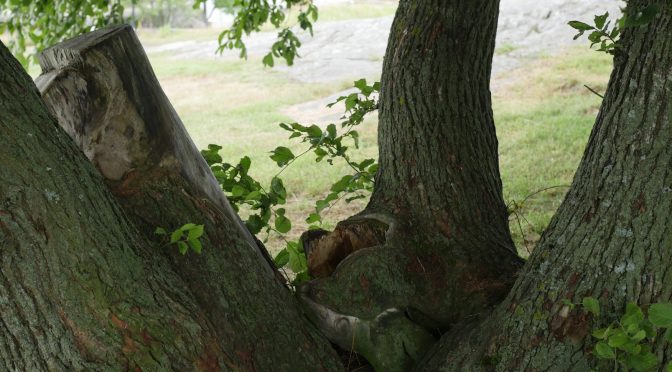
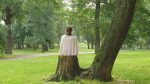
Now that the grass around the elm tree is cut the stubs of the two trunks that accompany the three growing ones are more visible. One of them is completely hollow, and was perhaps cut down because it was rotting from the inside, while the other is cut rather high and looks like it was a quite healthy when cut off. Anyway, they all grow from the same root, so when I say I am sitting in the elm tree I am actually not describing the situation clearly. I am sitting under the elm trees or at the foot of the elm trees or, well? – Most of the time these (holi)days I am actually sitting in the former telegraph on Harakka Island, as a gallery guard of sorts.
Spending time as a gallery guard is a nice form of holiday activity, especially when the gallery or exhibition space is a small wooden house built at the end of the 19th century to serve as a telegraph for the Russian military, and situated on an island with nature preservation areas. And of course it helps if the exhibition you are taking care of is your own. Well, Harakka Island is very close to the centre of Helsinki and I have my studio there in the former Chemical Research Laboratory of the Armed Forces, together with quite a few other artists, so this is actually a working place for me. In summertime, however, the place feels almost like a summer cottage. Perhaps moving down the slope from the big main building to the little wooden house creates the feeling of cottage life. So here I sit and drink tea and chat with the occasional visitors, who are not very many I must confess.
The exhibition is called Cami de Cavalls and shows two works recorded on the horse path with that name on Menorca in July 2015, as well as a small work recorded in Stockholm in 2016, Summer at Söder. For more information about the exhibition, please look at Cami de Cavalls. And because the exhibition is open on from noon to 5 pm, I have plenty of time to visit the trees in the Kaivopuisto Park in the mornings.
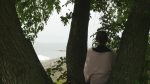
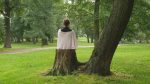
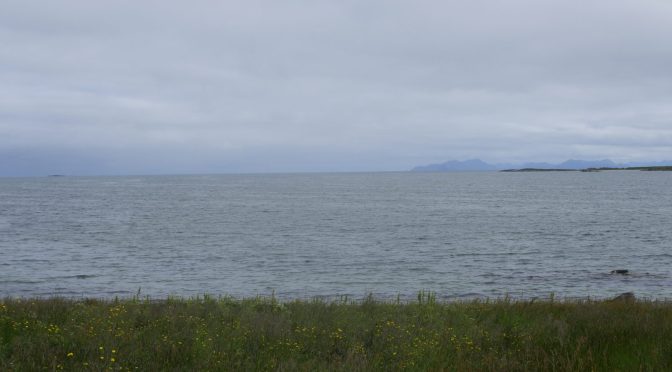
Grey Day in Rekdal
On thursday 20 July 2017 it is high tide (190 m) at 10.30 am in Rekdal, a village on the northern coast of Vestvågoy on Lofoten. I am planning to record the view on the shore together with a small birch every hour during this day, starting with high tide at 10.30 am (190 cm) and continuing through low tide at 4.50 pm (48 cm) to the next high tide at 11.10 pm. (198 m), hoping for shifting weather, that is, some bursts of sun shine amidst the grey clouds, and it looks hopeful. There have been sunny moments this morning already. Changes in light conditions make it worthwhile; the shifts of the tide are not that visible since the sea is not very shallow in the spot I have chosen. I am eager to get out, but there is one more hour to go before the first image. A close-up of the birch to begin with:
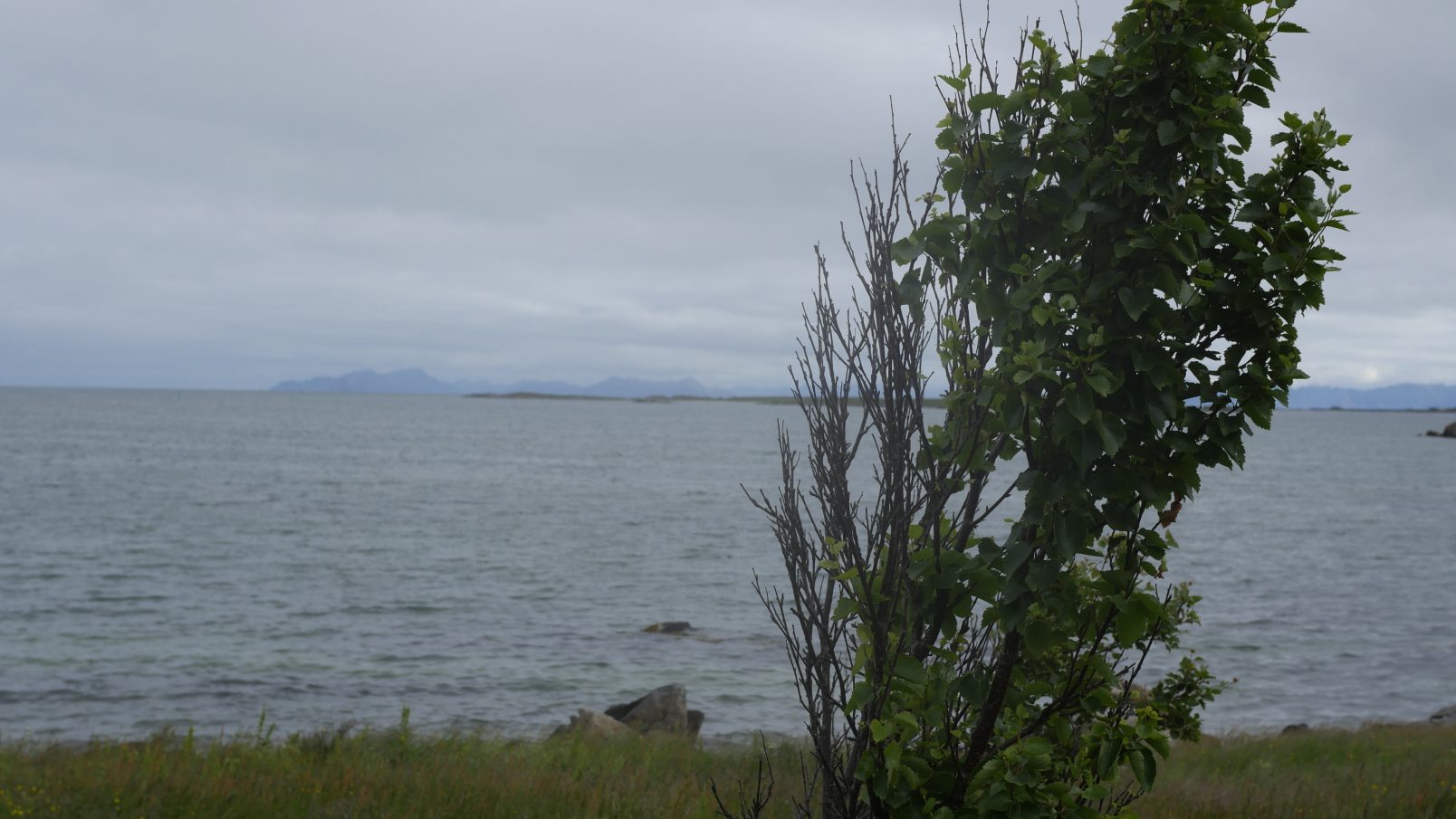
10 am (or a few minutes before) – grey, grey, grey. Wind from the north, no sun any longer, half an hour before high tide, the top of the rock near the shore is still visible above water. No traffic on the road, but far away the sound of a motor boat heading out; I can see it as a small dot. Approximately three minutes with the tree is enough, I assume. There is already a path across the meadow formed by my repeated comings and goings between the camera and the tree. For a moment I think I should try to walk outside the frame to keep the grass intact in the image, but decide to let it be. Before I go to stand with the birch I take a few still images of it. And then, afterwards, I only turn the camera and the microphone off and leave them standing on the tripod out there on the shore. Hopefully they will not attract the interest of seagulls or other birds.

11 am, the same view, the same sea, the same sky, the same tree and the same grass. It is past high tide but I cannot see the difference. Perhaps the mountains on the horizon are a little bluer, but I could be imagining. The camera will register the nuances, though. Some seagulls pass by, and a caravan drives past behind me on the road, otherwise nothing is happening during my moment with the birch. Even the wind seems to have calmed somewhat. A long day ahead, monotonous, but pleasant as long as it does not rain…
Noon, the sun is shimmering through the clouds in the south, enough to create a shadow in the grass when I walk to the shore, enough to brighten the green on the grass and to strengthen the blue shade of the grey sea. The tide should be going out now, but I cannot see it in the bay with the tiny birch; on the other side of the cliffs the beach is more shallow and the seaweeds are now showing up above the water. I wish for more sun, for the warmth it gives and for the contours it creates in the landscape. The wind from the north is not strong but chilly; it is hard to imagine that there is nothing but the arctic sea in that direction; next stop Svalbard.
1 pm, grey again. The pale sun hides behind the clouds that seem to have grown thicker again. The tide is slowly going out. A small white boat is coming across the bay, stopping behind the cliffs to the left, perhaps the neighbours were out on a tour. I am no longer expecting surprises, this seems to be a grey day throughout, only minute changes in the quality of light. No directions, no shadows, no stripes of sun moving across the mountains. Subtle shifts rather than dramatic effects. And I did choose a very generic piece of shore with no high cliffs or steep slopes in view, nor any of the features that make the landscape in this area so exciting. And now I cannot change my mind any longer.
2 pm, the weather as before, the wind a soft breeze now, the tide going gout, slowly. The sun shines through the clouds, not enough to give shadow, but enough to brighten the colours. The meadow is very still, so quiet that I could hear somebody closing a car door on the road behind me. I would like to make some close-ups of the rocks here, they have strange curved shapes, formed by the sea. But I have left my camera standing on the tripod in order to get the images as alike as possible. With these subtle changes it is even more important that the framing stays constant. Here in the north it would have been fascinating, and easy, to record a full day and night, because the site is so close to the house, and there is light all night, too. For some reason I was tied to the idea of the tide and of making a companion piece to The Tide in Kan Tiang, which was only one day, and not even all the way to sunset actually. The Tide in Rekdal does not sound as good as a name, but this little valley and village is called Rekdal, so I should stick to that. Because the tide is hardly distinguishable in the images, I could of course rename the work to Grey Day in Rekdal, for instance.
3 pm, a pale sun shimmering from behind the clouds, warming my neck as I stand with the birch on the shore. The cliffs in the bay are lit by the sun for a moment, but they are outside the frame of the image. The tide is rather low now, revealing the pebbles and the seaweed on the shore, but the camera cannot see them, because of the high grass. The day is moving fast now, it is already afternoon, but the evening will be long due to the light. At some point the sun will hide behind the mountain but will hopefully be visible again when it slides closer to the horizon in the north. These are the last days of the midnight sun here, they say.
4 pm, the wind is increasing again, the pale sun has moved towards west as expected, the tide is even lower now. For the camera the shore looks the same. Funny that I chose a spot where the tide is the least visible. Although I can see the shoreline change where I stand by the birch, the camera cannot. Absurd to speak of the tide in Rekdal, when no tide whatsoever can be distinguished in the image. A slice of blue sky, however, has opened amidst the clouds, like a brush stroke of colour across the sky. And some white foam appears in the bay, where some underwater rocks are closer to the surface at low tide and cause the waves to break there. Basically this image I am repeating is so unspectacular that I wonder how I can relate to it or write to it, with it, for it… Or then I will not. There is no need for all recordings to become works.
5 pm, the tide is turning; there is more blue in the sky and the sea is thus more blue as well. Seagulls are screaming, the waves have foam when they reach the shore. In the image the sky looks divided in two parts, a grey part and a blue part. In the unframed world around me, there are all kinds of clouds moving around. The mountains on the other side of the bay are decorated by their shadows. The zipper of my crimson sweater is not working well, not yet broken, but problematic. So far I have chosen to struggle with it until I could close it before entering the image. In the worst-case scenario, I might have to leave it open or close it around me by my left hand. So there might be some action after all…

6 pm, partly cloudy, sun on the mountains on the other side of the bay. Now the wind is cold, the tide is coming in, but the water is still low. The rocks covered in seaweed look like lumps of old wet rags abandoned on the beach. Repeating the same image every hour gives very small shifts between the images, and also very little time to do something else between the sessions. Walking down to the shore and back up into the house takes some time, as does writing these quick notes after each image. When I look out the window I see a dozen or more of images worthy of repeating. But it was my choice to find a small tree alone on the shore, as a reminder or repetition of the one on the beach in Kan Tiang. Todays images have nearly nothing in common with that work, but the idea of creating a companion piece got me going. If I had more time I would probably transform this to something else, find another place and try to recognise what is the special thing to record in this landscape…
7 pm, cold wind, evening approaching. It is full day light at this hour up in the north, but the feeling of evening is here nevertheless. The mountains on the other side of the bay look bright and seem very near, but the meadow on the shore is in the shadow of the mountain behind me. I have managed to edit some other video works between my visits to the shore. Moving between the images on the screen in front of me and the images I can see through the window, both fascinating in their own way, makes for a strange duality. The work I am editing is called Cami de Cavalls and recorded two years ago on Menorca, while walking on a dusty path in the heat of the Mediterranean Summer, a world as distant from this one as it can be. I wonder where I will be editing this cold cool minimalist view – the image I am creating is rather different from the rest of the surroundings, which are spectacular and aw-inspiring.
8 pm, cold and windy. This time I had to do the session twice because the memory card was full and the first session was thus too short. I also realized the battery might be finished soon, so for the last two sessions I had better carry a battery with me. I would prefer not to change the battery now, however, because removing the camera from the tripod involves of risk of disturbing the image. It would very likely mean a slight shift in the framing, and that would be silly now, at the end of the sequence. Wondering whether the sun will come out on the other side of the mountain before I am finished; it might do so only around midnight, and I have decided to finish at ten. If the tide would be visible I could go on until high tide at 11 pm as planned, but as it is, that is rather pointless. Some sunlight to finish this video would not hurt, however.
9 pm, windy as before. The sun will probably appear from behind the mountain later tonight, but so far the meadow is in shadow and it is getting rather cold. Luckily we are having a picnic by the boathouse with the remaining artists and one of the neighbours, a barbecue of whale meat (!), controversial but delicious. I was sitting and chatting away with a glass of red wine when I realised that it was time to take the next to last image and hurried to the camera. I cleared away the material from yesterday from the memory card and hoped that the battery would last. And it did.
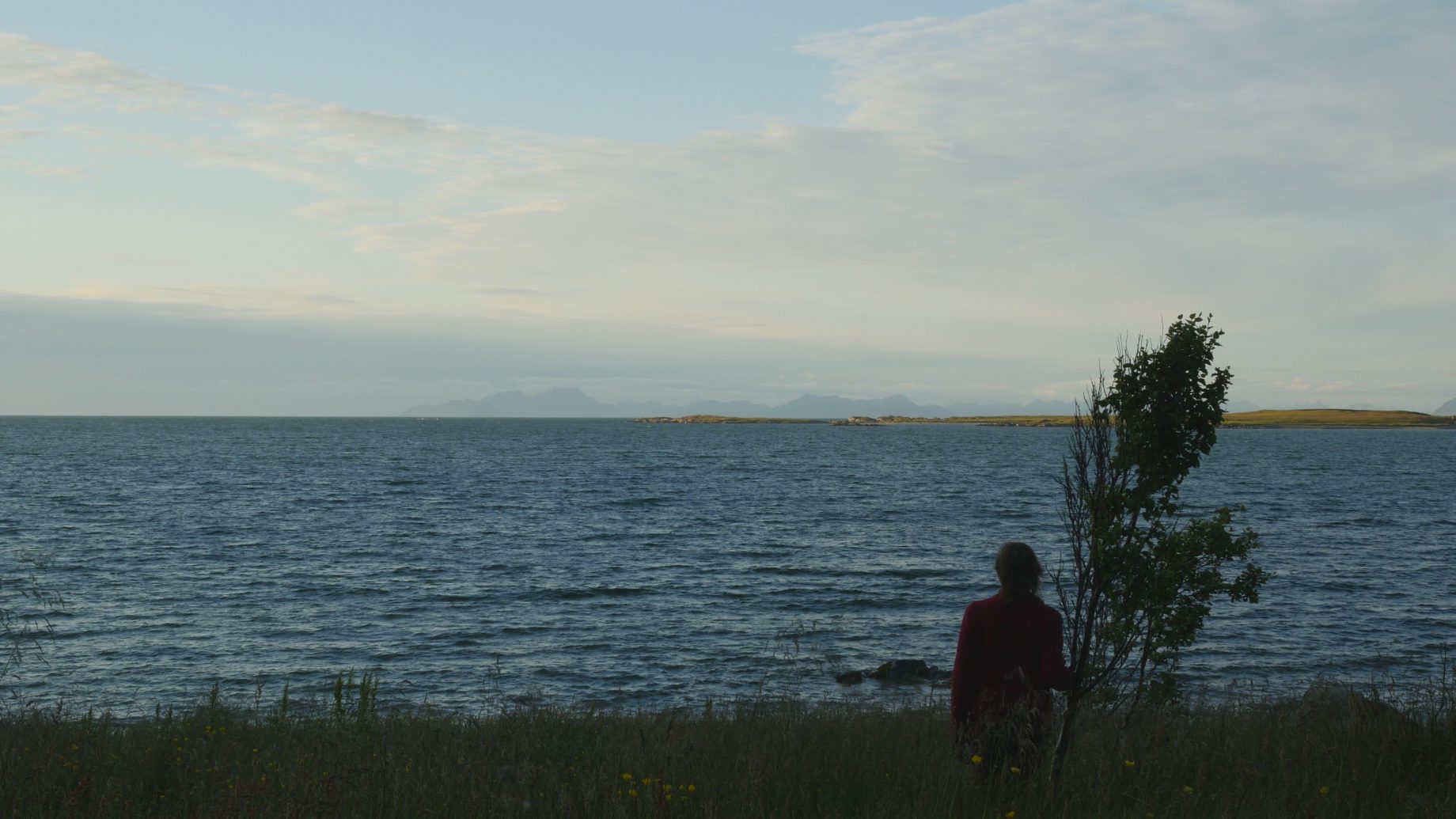
10 pm, the last image. The tide is fairly high now, covering most of the rocks and coming further in still. It is cold despite the light and I decide not to make an extra image at 11 pm hoping for the sun. At the moment of writing this it is eleven o’clock, and there are blue clouds all over the sky in the northwest and the north, so no direct view of the sun. Good that I did not wait; enough for now. I am eager to see what the images actually look like when taken together. Here is the last one:
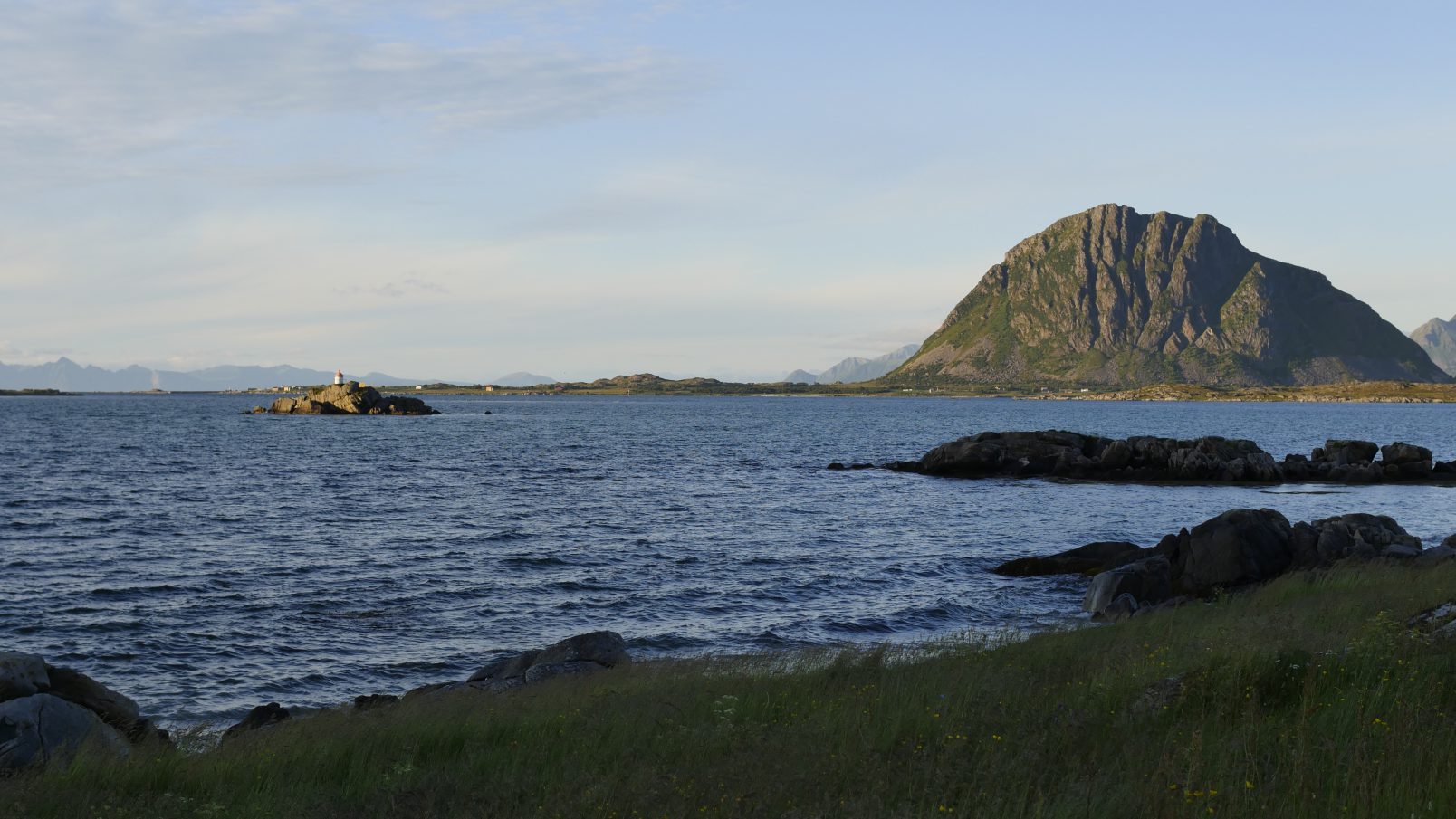
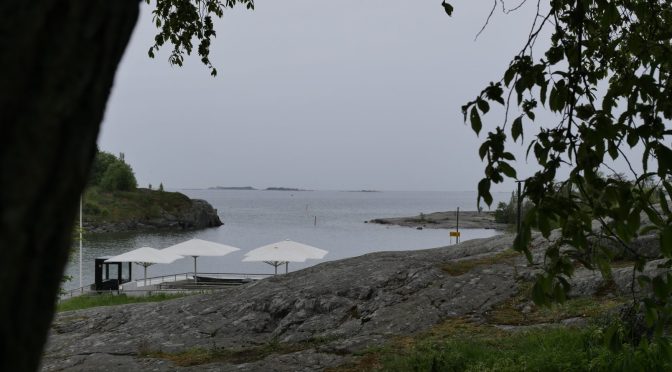
While the surroundings looked like this:
Rainy Day in Rekdal
Participating in the event Between Sky and Sea: Tourist organised by Performance Art Bergen in Kvalnes, Lofoten, I gave a talk there, “Between Sea and Sky with a Tree”, and used an old work, The Tide in Kan Tiang as an example. Seeing the magnificent landscape I immediately thought of creating a companion piece to that work, perhaps recording the tide here with a tree for a day or a day and night. Yesterday I set out to look for suitable trees – most of them are small rowans with some sturdy mountain birches in between them, and look more like bushes. I wanted to find one relatively near the house where I am staying to make the repeated visits easier, but did not find anything inspiring.
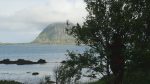
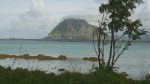
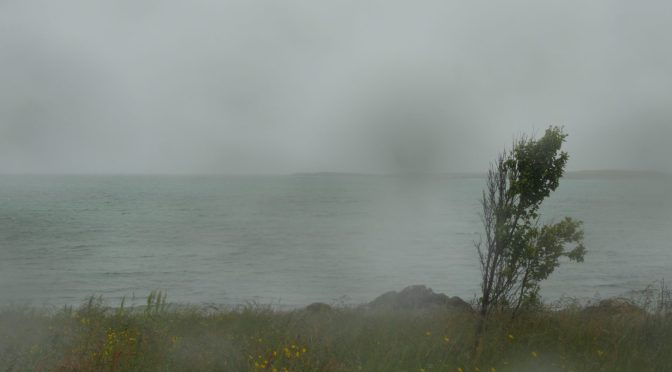
Today, relaxed after my talk last night, I headed out again despite the rainy weather and decided to try a really small birch on the shore, which could be framed to stand there on its own with the sea in the background. While I was placing the tripod next to a rowan it started to rain more, and I tried to cover my clothes with my raincoat while entering the image. My spontaneous plan was to record a long enough sequence to use together with the other work, which is 11 min 52 sec. It was cold and wet, but bearable after all. The surprise awaited me when I looked at the material. The raindrops really covered the image, both me and the tree, at times, and although the overall image is rather bland and grey, these sudden blobs might make for an interesting video.
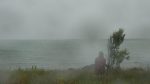
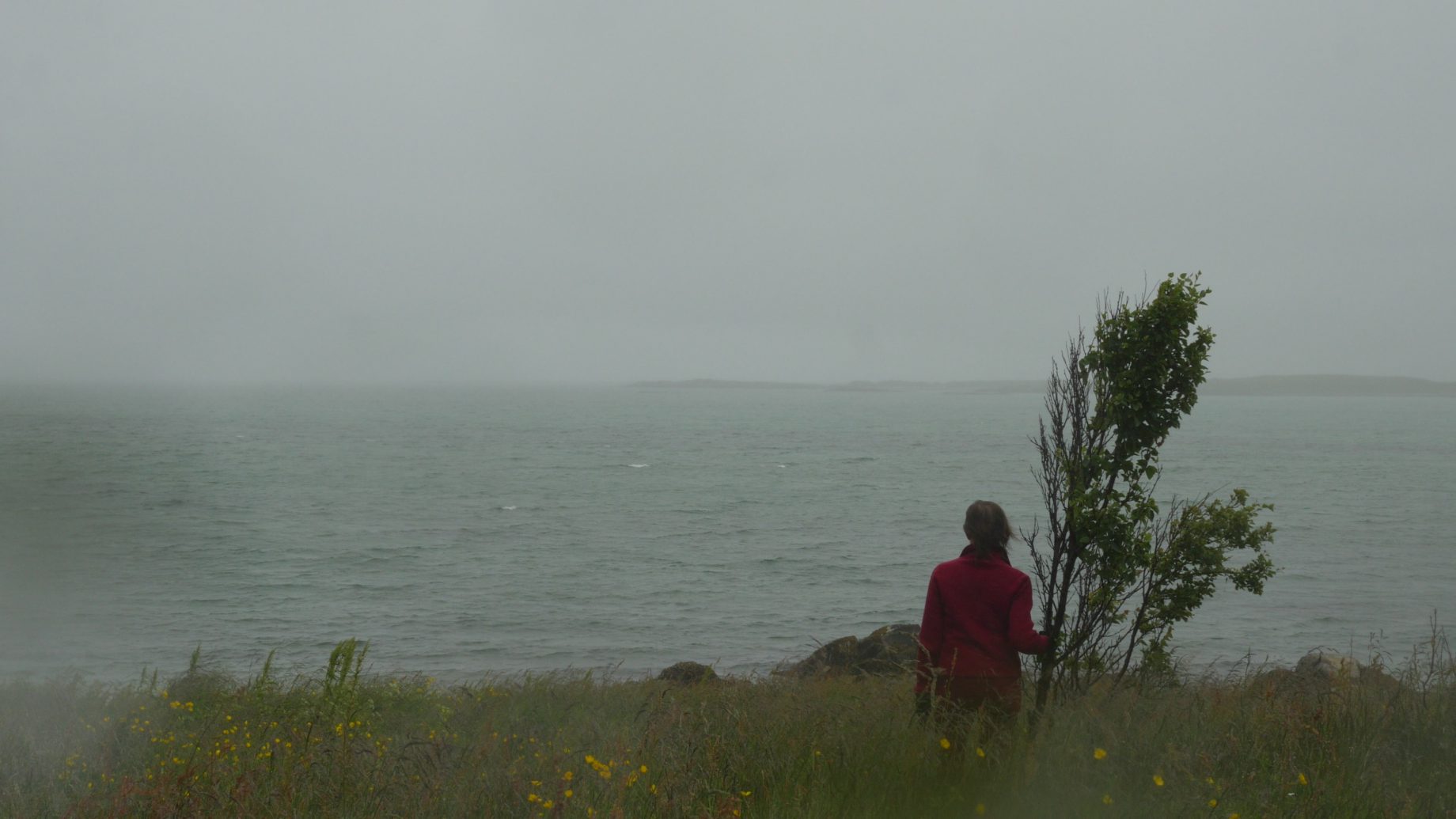
There was a moment towards the end, when the raindrops washed the lens clean, and a sudden sharp image of the tree and me on the shore looks almost normal. I include it here below to give an idea of the situation, although a series of still images with the white or grey blobs might well be more interesting. And probably more interesting than the video as well. I am happy I did not wear my usual pale pink scarf, because my ordinary dark crimson clothing suites the environment much better. But I am slightly worried that the sound might be really bad because of the wind. While I was only planning to do some test images, I did not bother to use the external microphone with wind protection. Perhaps I will return to the little birch tomorrow and revisit it with one or two-hour intervals for a day, although I guess the bay is fairly deep there, so the tide is perhaps not so visible. If the weather clears up a little bit the changes in light might be worth recording, perhaps even the midnight sun…
By the Lake in Parque Ibirapuera
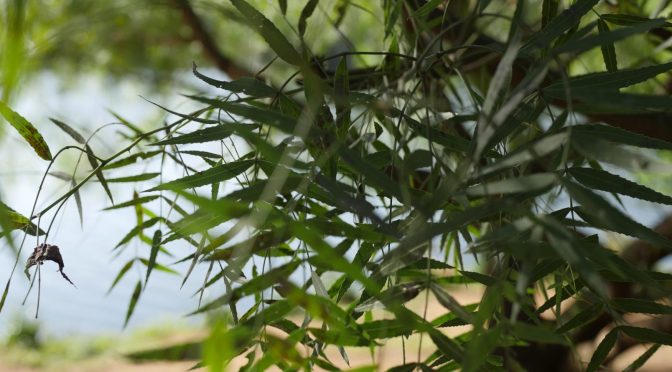
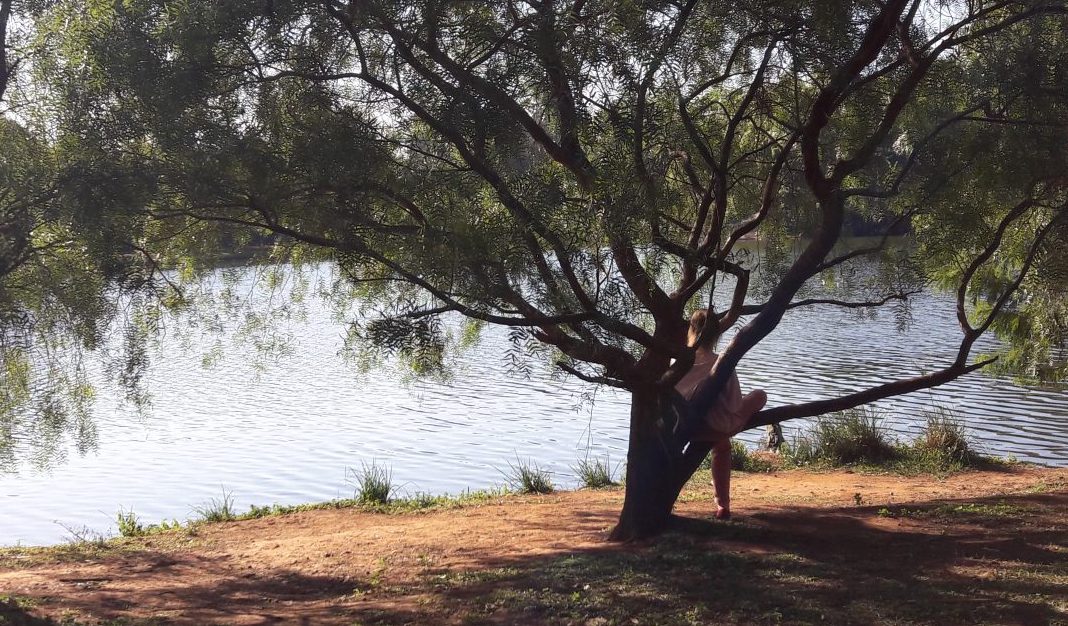
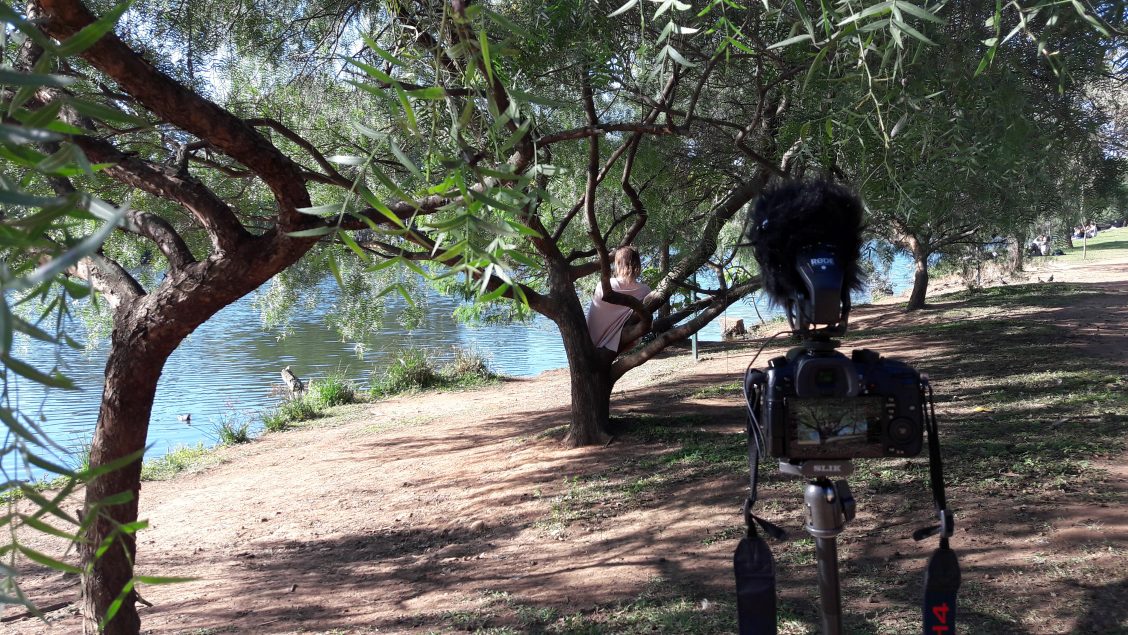
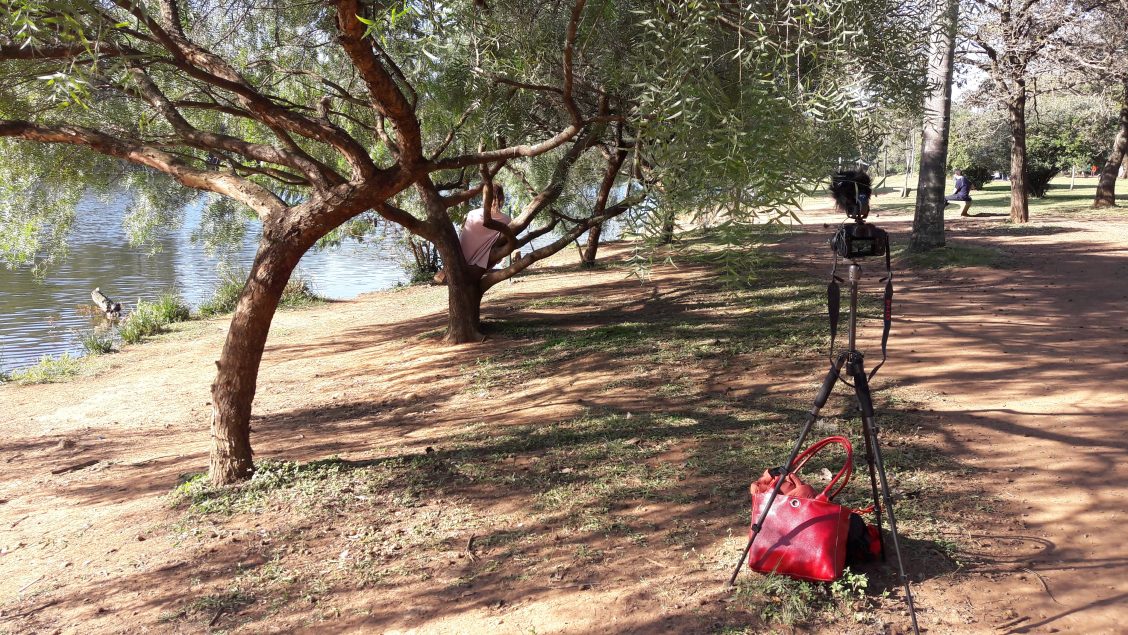
A visit to the famous Parque Ibirapuera in Sao Paulo was part of the preliminary tourist activities in connection to participating in the IFTR (International Federation for Theatre Research) conference next week. Together with Pilvi Porkola I followed Tero Nauha, who had been in Sao Paulo before, on a long and winding walk to the Ibirapuera park with the aim of visiting some of the museums there, and also perhaps sitting in a tree if a suitable one would show up. I imagined Sao Paulo to be a place where I would not want to walk away from my camera and leave it alone behind my back, but the park turned out to be calm and peaceful with strolling families. Almost immediately upon entering the park we saw some small trees by the lake, and although it seemed strange to jump on the first one, it proved clever, because most of the other trees where big and beautiful but nothing to climb in with my skills and limited strength. I invited Tero and Pilvi as my assistants to relax on the grass and keep an eye on the camera, while I tried to find a comfortable place in the small tree by the lake. That proved easier said than done. Of my repeated attempts I actually edited an additional video called “Finding a place in Ibirapuera Park”. The main work, that is, the version where I sit still on the lowest branch of the tree, called “By Lake Ibirapuera” looks rather peaceful, which is an illusion, because the position was extremely uncomfortable. This small and beautiful tree which resembled an acacia, but quite definitely was not an acacia, proved rather unwelcoming despite its low branches. It provided a perfect place to watch life on the shore, however, and in the water, too, which housed big fish coming to the shore, perhaps expecting to be fed, and beautiful black birds.
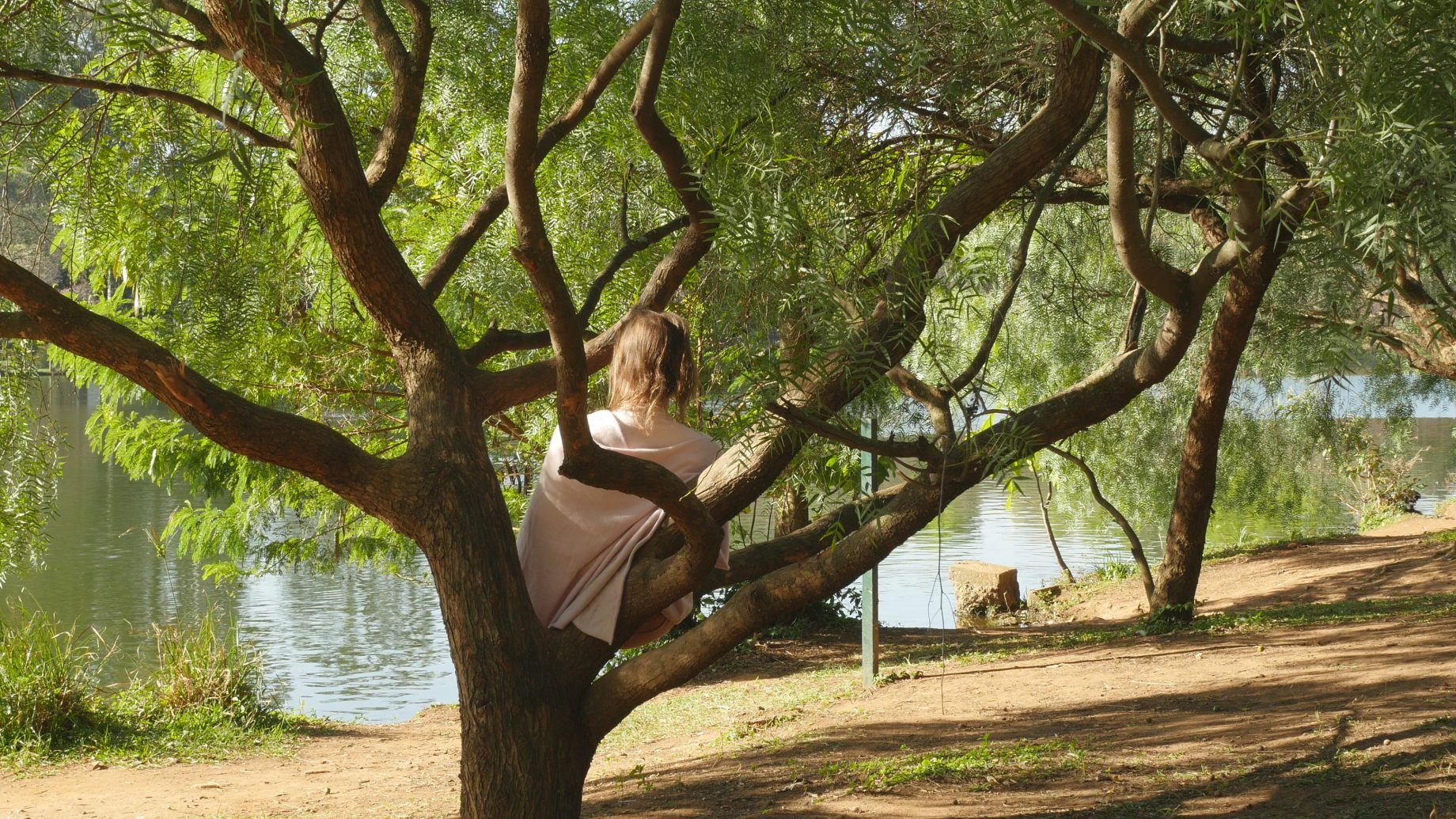
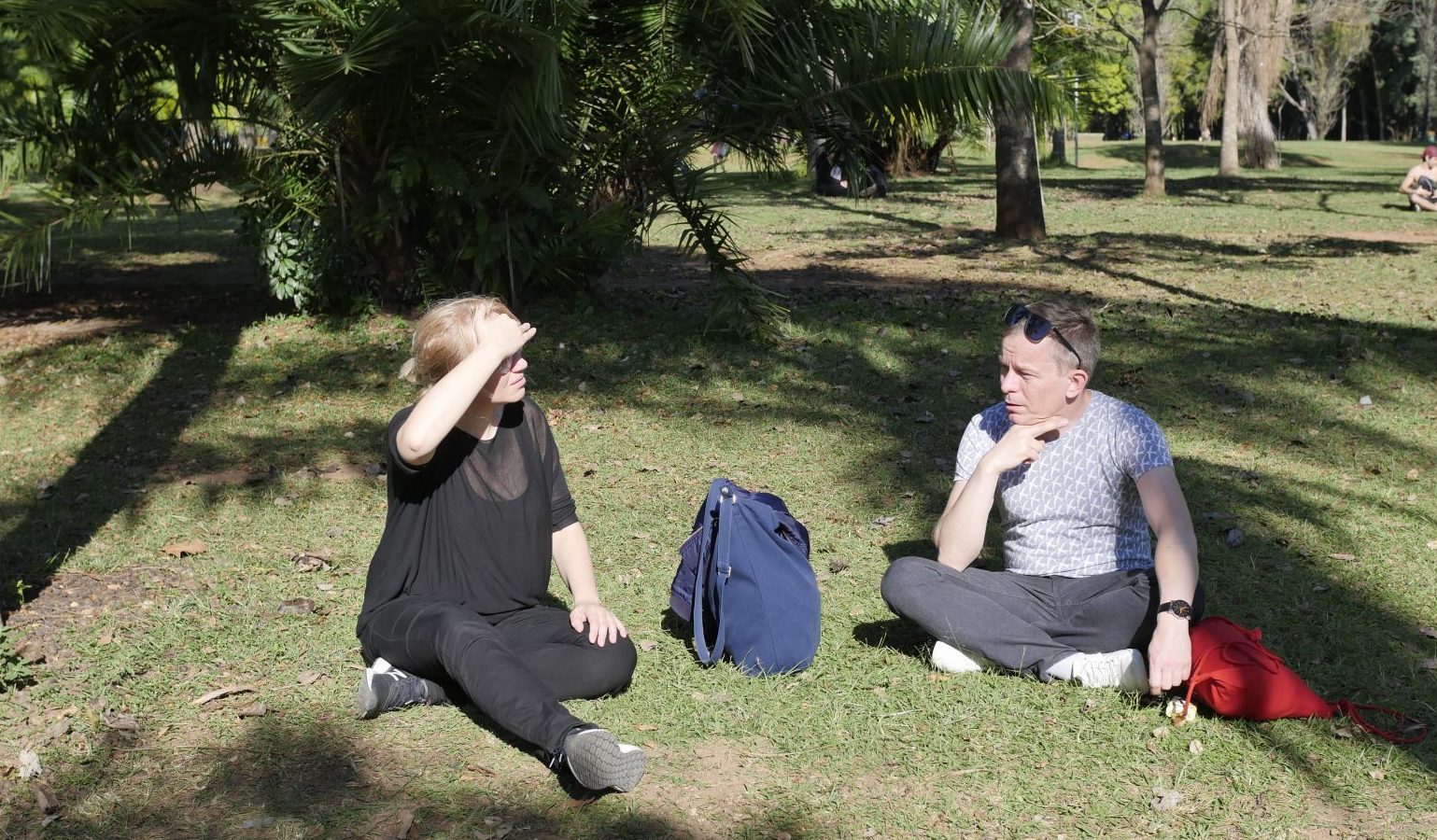
Pilvi took some images as documentation, which show the situation better than the video stills:
Rain, rain, rain
There was no chance to wait for nicer weather, this Monday morning was the only time, in the coming two weeks or more, I could visit the trees in Helsinki because of travel. So nothing to do but to go out and hope that the camera would survive the drizzle. I put my phone in one of the pockets of the bag and the keys in the other, and realized only half way down the stairs that I needed my purse, too, if I wanted to take the boat to Harakka Island to water the plants in my studio before the trip. I began with the alder, and then continued up to the elm on the hill. The foliage of the elm provided some protection for the rain, but the drops were becoming bigger and the drizzle turned to rain. The camera was collaborative, however, no problem, so I finished both images and walked down to the pier to wait for the boat. Only one the way did I look for my phone, and realized to my horror that the pocket of the bag was empty, and so was the other one, no phone, no keys! Should I turn back and search for them by the trees; they had probably fallen out without my noticing, that is, not get off on the island, but take the ride back? And what if I did not find my phone, could I travel to Sao Paulo in the afternoon without a phone? Or should I take the chance that I could find somebody to let me in to the building on the island? Yes, I would try. So I jumped off and let the boat continue to Särkkä without me. I expected the exhibition in the old telegraph building to be open, but the doors was closed. Through the window I saw Virpi and went in to ask her for the keys to the house. And at that very moment I put down my bag, and realized it had pockets on both sides. There they were, the phone and the keys. I laughed and excused myself with my age and went up to water the plants as planned.

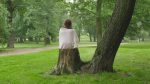
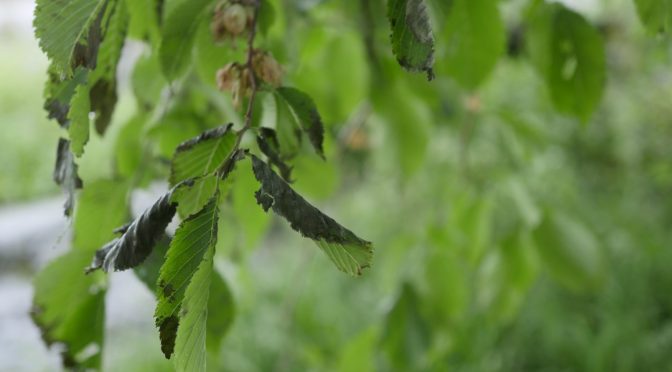
On the way back I thought about this pseudo-drama and the way everyday life is full of such incidents. The real drama, however, might be taking place in silence before my very eyes. The elm is suffering of an attack by some strange fungi or perhaps insects, something that destroys its leaves…


June – Month of the Oak
The image that I had in mind for the oak in the tree calendar was of an old oak tree with a rough bark and some strong branches extending almost horizontally from the trunk. Oaks tend to grow that way, and they can get very old, too. The other requirement was that my ideal oak partner would grow somewhere in the eastern shores of Helsinki, as a counterpoint to the birch, rowan and alder, which have all been on the western shores. Although I already recorded the Hawthorn as the tree of June I would add the oak for June as well, because the month of the oak stretches from June 10 to July 7, at least in one of the versions of the calendar, and I would not be here in the beginning of July. Most oaks in Finland are planted, although there are oak forests in the southern parts. Last week I made a trip to the Arabianranta area near the Vantaa falls, and found only one oak in the park there. It was growing in the midst of shrubs and did not look like an ideal partner at all, so I let it be. Today I decided to take the metro to Brändö – Kulosaari, an island and old villa area east of the centre, to see if I could find any old oak trees there. And funny enough, I found exactly one in the Eugen Schauman Park. It is not very old and it has no branches to sit on or even hang from, but I decided this would be my partner and so be it. I tried to reach the lowest branch but did not get enough of a grip to hang from it and could not stand the stretch for long. I tried with the other arm as well, but in the end I realized the right thing to do was to lean against its rather slender trunk and relax. So I did just that.


The following day I edited the simple version, leaning against the oak, into a video work called Oak in June (8 min. 10 sec.). But I wanted to document my attempts as well, and compiled them into Oak in June – testing (3 min. 32 sec.) Both can be found in the research catalogue as Oak in June.
June – Month of the Hawthorn
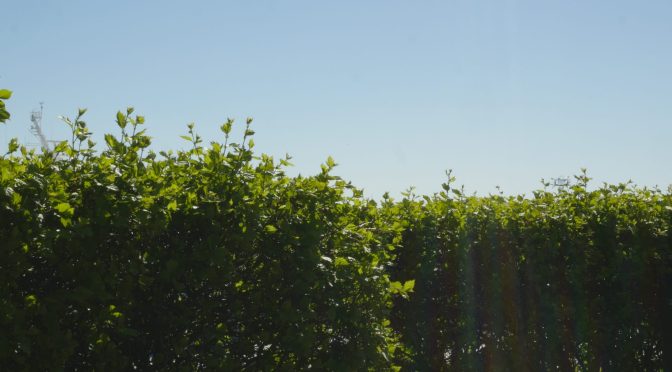
After spending quite some time trying to find alternatives to the old hawthorns in the Observatory park I nevertheless decided to perform the image of June for the Tree calendar there. I remembered the hawthorns from 2010 when I was preparing the small audio work In the Shadow of a Hawthorn for Olohuone (Living Room) urban festival in Turku. (The work is fairly well documented on the Research Catalogue). At that time I read all I could find about the various types of hawthorns growing in Finland. Thus I was quite sure I would still recognise a hawthorn even before they were in bloom. Of the four types of hawthorns that I chose to work with in Turku at that time at least two could be found in the park in Helsinki now. The small old hawthorn trees on the slope with their twisted trunks were of the species Crataegus Rhipidophylla, I suppose, while the hawthorns that formed a hedge on the panorama spot were probably of the common type used in hedges, Crataegus Grayana. Some hawthorns of that type were growing uncontrolled on the slope near the street to the south of the park, and there I also found a beautiful small tree or actually a large bush with several trunks growing from the same root, right by the sidewalk, an example of Crataegus Monogyna, as far as I could judge. I chose that one and the hedge as my partners on Tuesday evening and decided to return in the morning when there would be less people in the park and a better light.

On Wednesday morning, after visiting the elm and the alder as usual, I walked up to the panorama spot in the park and placed my camera on tripod in such a manner that neither the nearby tree on the left or the rubbish bin on the right were inside the image frame. To my great surprise the huge boat that had arrived into the harbour below was not visible in the image. I made a few try-outs to find the right spot to stand in, on the steps in the opening of the hedge, placed my weight evenly on both feet and took hold of a branch of the hawthorn with my right hand, ready to stand there for ten minutes or so. But of course some groups of people appeared from nowhere and wanted to go down to the terrace below. Luckily I was standing close to the hawthorn so they could pass behind my back.
The other hawthorn was not as easy to pose with. I did not find a comfortable way to sit on it or lean on it but placed myself between the trunks somehow, keeping myself there by pressing my feet to he ground and my back to one of the trunks, avoiding the thorns. I tried to stay there in a half laying position, looking at the confused tiny ants climbing up and down along the trunk. I could not hold that position very long, for although it looks comfortable in the image it was rather painful to maintain. And this time, too, there were some passersby entering the image, while using the tiny path behind the hawthorn: a woman with a dog seemed to park there for ever. But perhaps some passersby are refreshing, after all. While editing I have to see whether the image is more interesting with or without these “intruding” figures. The important thing is that I managed to create something before the end of the month of the hawthorn, 12 of June, at least following the variation of the calendar that I have used so far.
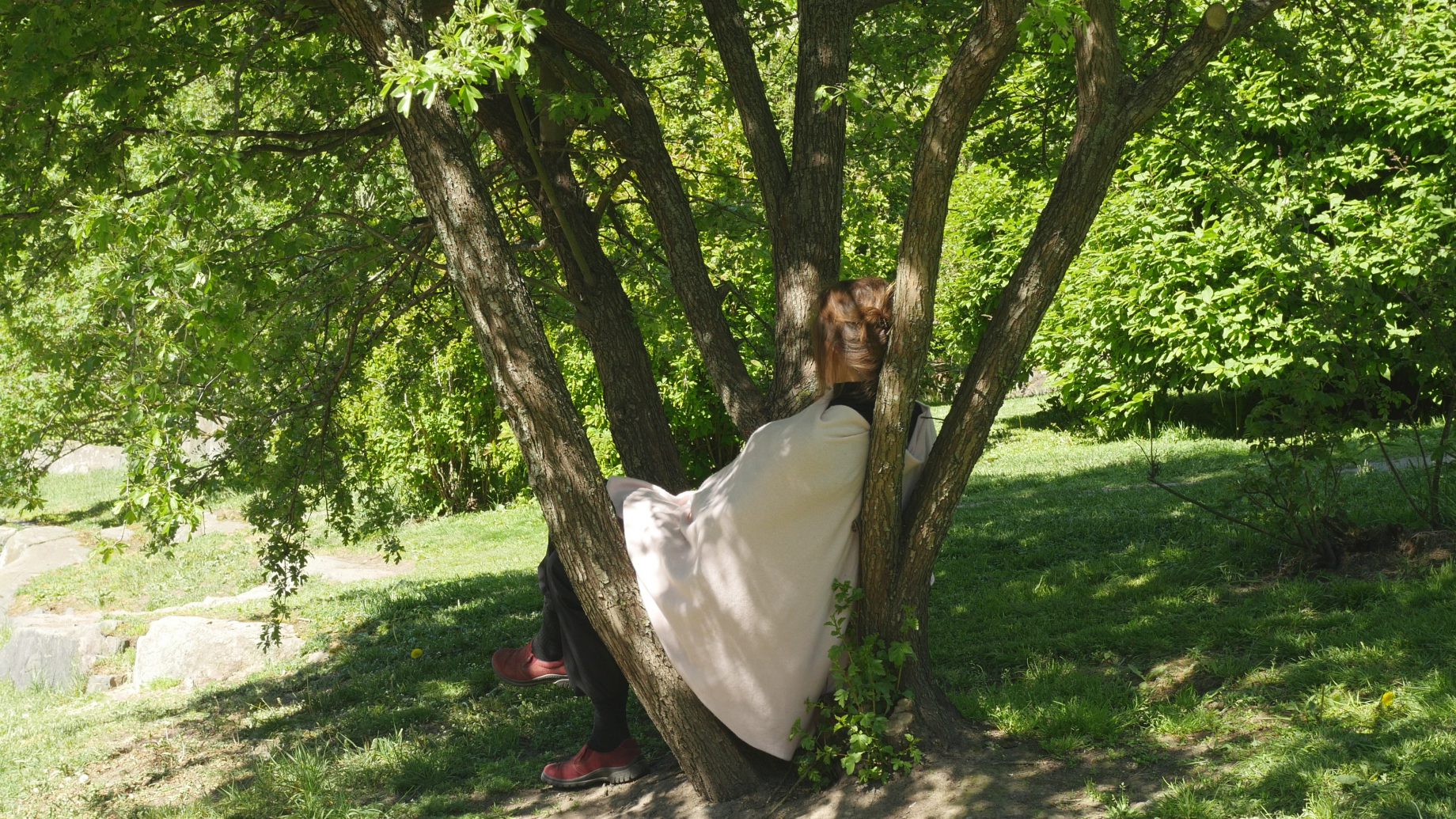
Returning to edit these notes in Hamburg, after an enjoyable and exhausting PSi (Performance Studies International) conference on the theme of Overflow in the premises of the legendary Kampnagel, that morning with the hawthorns only a few days ago feels strangely distant. Already tomorrow, however, I will return to the vicinity and take up my practice of visiting the trees again.
Excess and Overflow of Artistic Research
Three mornings in Helsinki, sun on two of them, which is not so bad after all. Tis is one of the most previous times of the year, “mellan hägg och syren”, as they say in Swedish, literally between bird cherries and lilacs. Not all bird cherries are blooming yet, but most of them, while the lilacs are only opening slowly. On Monday morning in rainy weather I was fascinated by the difference in the view from my place under the elm ( see image above) and the view for the camera from the place for the tripod, either up on the slope or then next to the rock closer the elm. But on Tuesday and Wednesday when the sun was shining I forgot all about it and simply enjoyed the season.

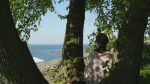
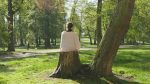

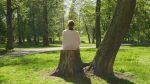
The leaves of the elm are hanging low and really hide me well in the first image, which is alright and gives some variation to the series, although i did not plan it. On Wednesday there was a woman in a red cap sitting and drawing on the rocks, and she inevitably came to perform in these images, too. My thoughts were on the trip to Hamburg later in the afternoon, to join PSI #23 Overflow there. The Performance Studies International conference is a yearly occurrence somewhere in the world, and for some years now I have been engaged in the Artistic Research Working Group with Johanna Householder and lately also with Bruce Barton. We are going to have three sessions with short presentations by artists and researchers, titled Excess and Overflow of Artistic research, and I am going to present this project there as well. I actually made a compilation of all the snapshots I have posted on tumblr so far in the blog of images called Year one with plants. There I take one image of a plant each day, and in the winter months it was harder than I expected. But this time of year there is a profusion of vegetation everywhere, the difficulty is in choosing.
 Performing Landscape