
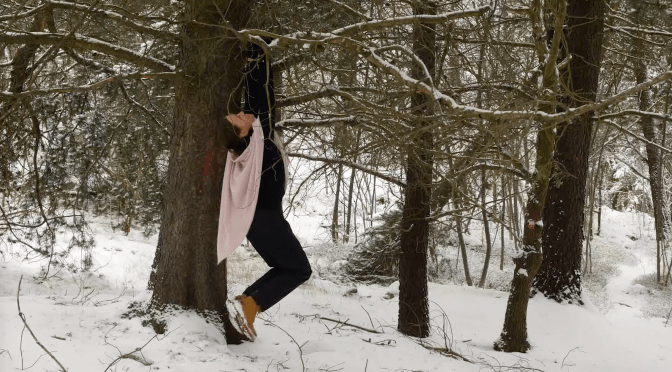
Participating in the performance philosophy biennial Intervention – Intoxication in Amsterdam inspires me to write a brief note about my presentation, titled Hanging in a pine tree or appearing with plants. Most of my blog posts these days are written on my Stockholm blog, and in Swedish, related to the project ”Performing with Plants” at Stockholm University of the Arts. And actually my presentation, performance lecture or video essay in Amsterdam today was directly linked to that project as well. But perhaps because I have not participated in any performance philosophy events since the one in Helsinki related to citizenship many years ago, this occasion seems somehow relevant, inspiring and challenging at the same time. And probably partly because I had and article published in the latest issue of Performance Philosophy Journal, Resting with Pines in Nida – attempts at performing with plants, which I am quite proud of, after all. Other reasons for being excited enough to write this, are the inspiring presentations I have witnessed today, and some of them directly linked to my interests, such as Ingrid Vranken’s performance lecture Rooted Hauntology Coworking lab – being with plants/ infiltration and especially Laura Cull’s paper in the panel Thinking with Non-Human Animals & Autistic People: Intervening in Anthropocentrism and Neuronormativity.
Originally I proposed a performance lecture, and really tried to device one, based on the video Hanging in a Pine, the longer version (19 min 31 sec), which has the perfect duration to fit the 20 minute slot. But I ended up recording all the spoken parts as a voice over, and leaving the mini-projector, which I planned to use to show a distorted image of the swinging version with, as well as the main performative prop, the rather large pine branch, at home. That was probably the right decision; trying to create a performance would have been clumsy and difficult, because of my lack of experience and the setting too – not even the lights could be shifted between the three parts of the session to make the video more visible, so what with an extra cable for electricity for the projector, huh? Thus, showing a mere video essay was OK. But of course that excludes all possibility of including comments to previous contributions or other adjustments to the context. The two other presentations in the same panel were interesting in their own way, particularly the last one, discussing the use of Latour’s idea of the parliament of things as inspiration for a local theatre project involving the North Sea, although the idea of theatricality and representation where not my main concerns. I would have been more interested in discussing the possibility of and difference between performing and appearing. – The video essay form is somehow fascinating and challenging, something to explore further. I still think that the artwork, the videos, like the actual performances that produce the material for them, must be nonverbal, but the possibilities of the video essay, such as including a text that is not only academic, but contains poetic and imaginative parts, are worth exploring further in the future.
 Performing Landscape
A Deep Dive into Plant-Human Performance: A Response to “Hanging in a Pine Tree or Appearing with Plants”
Annette Arlander’s exploration of plant-human performance in her presentation “Hanging in a Pine Tree or Appearing with Plants” is a fascinating and thought-provoking piece. Her work challenges traditional notions of performance and invites us to consider the agency and subjectivity of non-human entities.
The Power of the Video Essay
Arlander’s decision to present her work in a video essay format was a wise one. This medium allows for a more nuanced and layered exploration of the topic, enabling her to combine visual and auditory elements to create a rich and immersive experience. By choosing to focus on the video essay, she was able to delve deeper into the conceptual and aesthetic dimensions of her work, without being constrained by the limitations of a live performance.
Performing with Plants: A Philosophical Inquiry
The central question of Arlander’s work – how can we perform with plants? – is a profound one. It invites us to rethink our relationship with the natural world and to consider plants as potential collaborators in artistic and philosophical endeavors. By engaging with plants in a performative context, Arlander challenges anthropocentric perspectives and opens up new possibilities for interspecies communication and collaboration.
The Role of the Performer and the Plant
In her video essay, Arlander explores the delicate balance between the human performer and the plant. She highlights the importance of listening to the plant, respecting its agency, and allowing it to contribute to the performance. This approach challenges traditional notions of performance, where the human performer is often seen as the sole creator and controller of the experience.
Future Directions
Arlander’s work raises several intriguing questions for future research and exploration:
By continuing to experiment with new forms of plant-human interaction, artists and performers can contribute to a more sustainable and equitable future.
I am excited to see how Arlander’s work continues to evolve and inspire others to explore the boundaries of performance and plant-human relationships.