
While preparing for the online meeting of the Artistic Research Working Group of PSi (Performance Studies international) on my way home from the meeting of the Performance as Research Working Group at the conference of IFTR (International Federation for Theatre Research) in Cologne, I came upon an interesting text. The author, Vanessa Watts, was mentioned by Denise Ackerl whom I am supposed to respond to. I had downloaded a text by her, and on the train from Cologne to Frankfurt I had finally a chance to read it. The text deals with the distribution of agency in the human and non-human world from an indigenous perspective, and provided an eye-opener for me, because I have not read much about indigenous thought, although I have encountered the creation story of Sky Woman. The idea of place-thought seemed important; plants and place are connected and through them we can learn about place, I thought.
In her article Watts goes much further and writes: “Place-Thought is the non-distinctive space where place and thought were never separated because they never could or can be separated. Place-Thought is based upon the premise that land is alive and thinking and that humans and non-humans derive agency through the extensions of these thoughts.” (Watts 2013, 21) She argues that “habitats and ecosystems are better understood as societies from an Indigenous point of view; meaning that they have ethical structures, inter-species treaties and agreements, and further their ability to interpret, understand and implement. Non-human beings are active members of society.” (Watts 2013, 23) She compares the Christian origin story with Eve, the apple and the serpent with the story of Sky Woman, the birds and the turtle and shows how they lead to very different relations to the non-human world. “In the latter, the relationship between animals and this female is regarded as sacred and ritualized over generations” and “becomes the foundation for future clan systems, ethics, governance, ceremonies, etc.” (Watts 2013, 25) By contrast, “In the former, the female becomes responsible for all the pain of childbirth and resentment for being cast out of paradise” resulting “in shame and excommunication from nature. Additionally, future dialogue and communication with animals becomes taboo and a source of witchcraft.” (ibid).
Watts also analyses western feminist attempts at rethinking agency for example by Donna Haraway, Stacy Alaimo and Vicki Kirby and notes that there is a hierarchy of agencies. “These levels of agency are a product of the epistemology-ontology paradigm” and “the idea of human ownership over non-human things, beings, etc.” (Watts 2013, 30) For example, “although the dirt/soil has been granted entrance into the human web of action, it is still relegated to a mere unwitting player in the game of human understandings.” (ibid) Watts explains that “if we think of agency as being tied to spirit, and spirit exists in all things, then all things possess agency.” Because spirit is contained in all parts of nature “we, as humans, know our actions are intrinsically and inseparably tied to land’s intentionality” and this is “quite a counter position from notions of diluted formulations of agency.” (ibid) She further analyses the problem of essentialism in combining the feminine with land in an interesting way. And she concludes with a call to indigenous scholars by asserting the “need to continue to resist the growing tendency to both be subsumed into de-essentialized epistemological spaces as well as fight against the dislocation of our thoughts from place.” (Watts 2013, 32-33)
As a non-indigenous woman thoroughly steeped in western epistemology and ontology I cannot claim that land is speaking to me and I find it hard to understand spirit literally. When talking to trees I am not addressing a tree spirit but a tree subject of a kind. Thinking of spirit as the breath and life of a being might be one way to avoid the split into matter and spirit that is so deeply ingrained and so difficult to resist. In any case I cannot simply try to appropriate indigenous thinking nor can I easily reclaim the folklore of my Finnish and Swedish ancestors. But I can note the need to study and learn from other forms of thinking including pre-colonial thought.
Watts, Vanessa. 2013.”Indigenous place-thought & agency amongst humans and non-humans (First Woman and Sky Woman go on a European world tour!)” in Decolonization: Indigeneity, Education & Society Vol. 2, No. 1, 2013, pp. 20-34.
Category Archives: City as Stage

The City as Stage 1 and 2
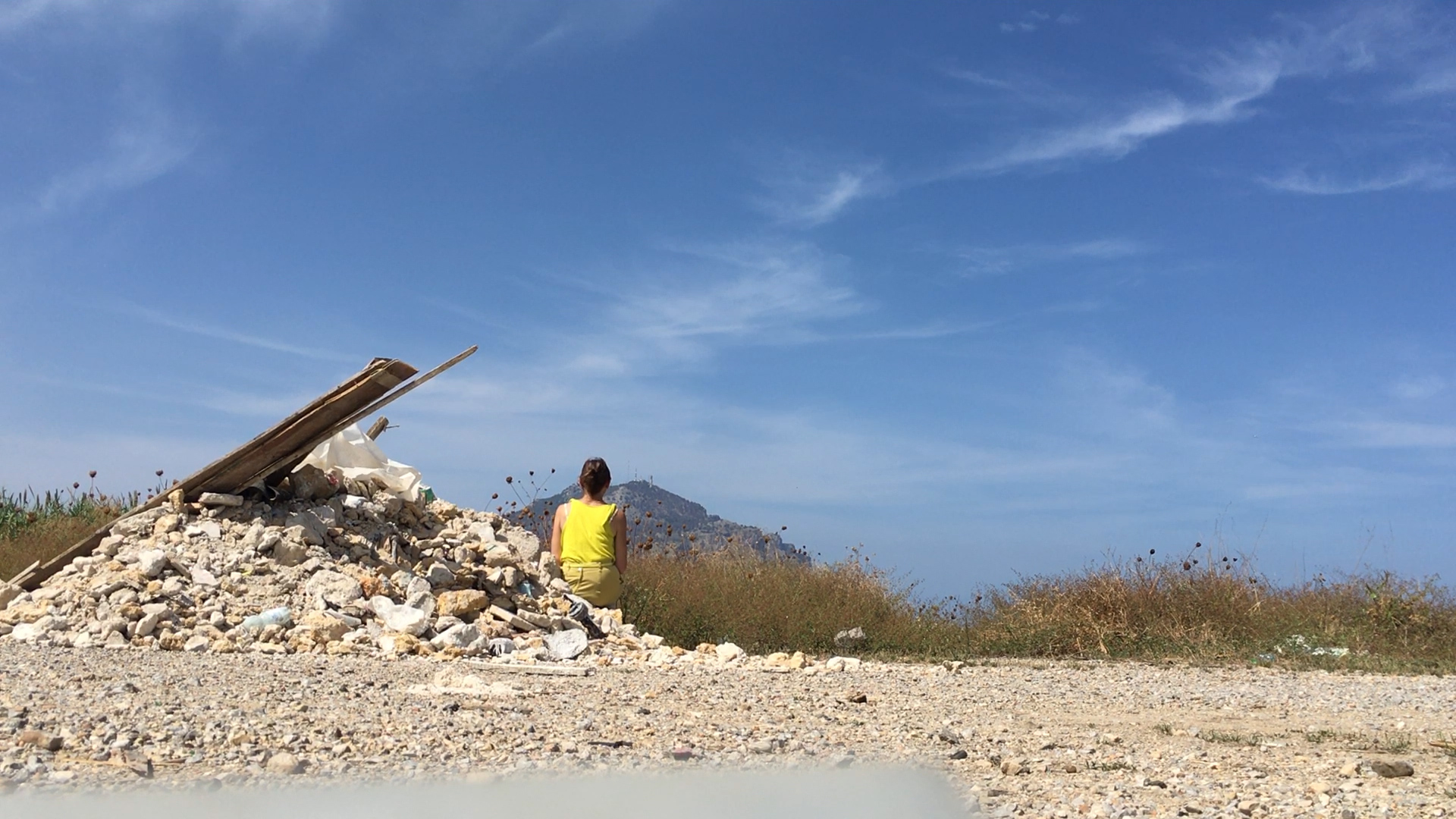
On my last day in Palermo, visiting Manifesta 12 a few weeks ago, I walked all the way to see one work from a bridge by the sea, at the outskirts of the city. And there I also made a short video, inspired by the title of the series City on Stage, which I misread ”city as stage”. I though that could be developed into a once-a-week type of series, made with my iPhone, and my little tripod, of handbag size, which I did not have with me in Palermo, of course. The rough sketch made with the iPhone leaning on my handbag shows a blurry shadow in the lower part of the image. I liked, however, the idea of simple and quick sketches made at the outskirts of cities or in places that I happen to visit. I edited three versionS of the small work: one where my movement into and out of the image is included (1a) one with the still pose only (1b) and one with a slow crossfade between the image with the human figure and the one without, a slow disappearance (1c). Here are stills from a and b:

Today in Bergen, Norway, I made another attempt, a quick sketch while waiting for the bus to the airport, placing my phone with the tripod on top of a rubbish bin and simply walking into the image, inspired by the presentations and discussions at the Artistic Research Forum I had enjoyed. And this time the city really served as a stage, because there were some passers-by performing with me. While waiting for the plane at the airport I edited two versions of the work, one with my movement included (2a) and one without (2 b). Here are stills from both of them:


Now, when I have made two sketches, in two cities, and when I know that with the right equipment it is rather easy, I can confirm that this is something I can try to keep up as a practice, at least while visiting various cities. The first video clips are available on the RC, here. This is not at all related to my project performing with plants, but rather linked to my previous attempts at performing landscape. There is something unpretentious in this way of making improvisatory notes that I like, anyway…
 Performing Landscape