
The book Mattering Voices, edited by Laasonen Belgrano, Tarvainen and Tiainen starts with a dedication: “To Voice as Nothing, All and always More-Than…” It is divided in three parts, I Voicing Ontologies, II Voicing Intra-active human agencies and III Voicing the more-than-human. The subtitle of the introduction reveals the aim of the collection: How to let a crossroads emerge between (the study of) voices and new materialism? And many of the articles are dealing with those crossroads, not all of them with music or singing.
The section that I found most interesting due to my own concerns was of course the third part, which contains four very different approaches. Julianna Preston writes in “Motor-mouthing” among other things of her own performance RPM hums “where voice made the life force of electric motors palpable” (p 149) and refers to Laura Levin’s idea of ‘performing ground’. Tero Nauha refers to the non-standard thought of François Laruelle in his chapter “The non-standard performance with the singing theremin”. Jennie Tiderman-Österberg describes ‘kulning’ a specific practice of voicing with cows in her text “Cow choirs – Singing-with-more-than-human herds”. She refers to music philosopher David Rothenberg’s idea that “we cannot make any kind of music without sensing its resonance in an environment” (Rothenberg 2001, p 4, quoted on p 2003). In her concluding remarks she further notes how “we should not think ‘what is the point’, but ‘this is the point where I depart into something new’. (p 203) In the last chapter “Speaking of atmospheres – More-than voice and voice of the more-than” Norie Neumark refers to Gernot Böhme’s idea of atmospheres and Ben Anderson’s ‘affective atmospheres’ when describing some artworks. First I am sitting in a courtroom, 2017, by Joel Stern, then Rubber Coated Steel, 2016, by Lawrence Abu Hamdan and finally several versions of their own work with worms.
The afterword by Laura Cull brings in further dimensions in the form of echoes, ontological echoes of a new spiritualism and interspecies echoes of intersectional solidarities. In short: a very rich and thought provoking book even for an artist-scholar like me, with no particular interest or experience in voice or the study of voice. But I am talking to trees, so perhaps I should think about that in terms of voice, too.
Laasonen Belgrano, Elisabeth, Tarvainen, Anne and Tiainen, Milla (eds.) Mattering Voices – Studying Voice Through New Materialism. Routledge 2025
All posts by Annette Arlander
Interpretation – a key concept?
In the beginning of the year I read a small book, easy to carry around, with brief texts, easy to read in a coffee break, but did not remember to make any notes: Interpretation in Qualitative Research – Key concepts in Qualitative methods. The reason why I found, rather surprisingly, a book on key concepts of qualitative methods in my hands, was that we contributed a small text to the collection with Pilvi Porkola. Our concept was “Performance” (pp 75-79), although performance as research would have been a more apt title. When trying to remember my reading experience the two texts on diffraction seemed most useful; “Diffraction” by Vivienne Bozalek and Michelins Zembylas (pp 32-34) and “Diffractive analysis” by Kathryn Storm and Shakhnoza Kayumova (pp 35-39).
The first one focuses on reflexivity, diffraction and interpretation, and tries to understand and even overcome the differences. “Although diffraction and reflection differ both as methodologies and as practices, being grounded in different ontologies, epistemologies, and ethics, there is some continuity in relation to certain forms of interpretation.” (p 34).
The second one focuses on diffractive analysis and interpretation as a practical methodology. ” As a methodological orientation, then, the theoretical ideas and goals of diffraction are quite clear. What this looks liken translated into actual methods and analytic processes, however, varies widely (and should, since diffraction is fundamentally about complexity, difference, hybridity and emergence from local conditions). (p 36) They mention diffractive studies that “think-with” data, others are reading data “through” each other to produce interpretive pattern of difference, and many are decentering the human while deliberately including the researcher as part of the process. They note that “diffractive methods enable us to examine how boundaries of differences are produced in our knowledge-making practices” and quote Barad’s point that “knowing [does] not come from standing at a distance and representing but rather from direct material engagement with the world” (Barad 2007, 49, quoted on p 38).
A handbook to return to, when brief clarifying or explanatory quotes are needed…
Karin Murris & Mirka Koro (eds.) Interpretation in Qualitative Research – Key concepts in Qualitative methods, New York: Routledge 2025
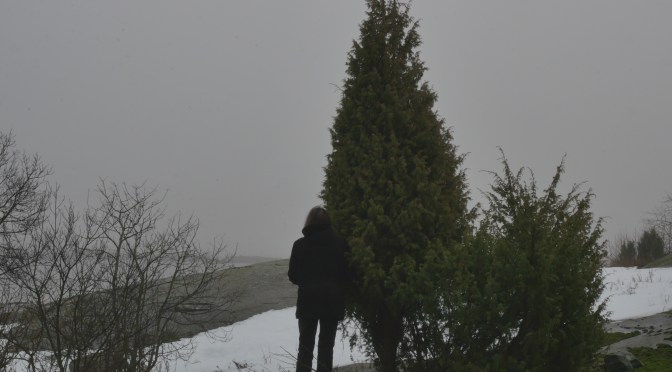
The Slow Goodbye
The Slow Goodbye – With the Juniper on Harakka
video works by Annette Arlander
Telegraph Gallery on Harakka Island
12 -17. May 2026, open noon to 5 pm
Hitaat jäähyväiset
Hitaat jäähyväiset – Harakan katajan kanssa
Annette Arlanderin videoteoksia
Harakan Lennätingalleria
12-17.5.2026 avoinna klo 12 -17.00
Långsamt avsked
Långsamt avsked – Med enen på Stora Räntan
Annette Arlanders videoarbeten
Telegrafgalleriet på Stora Räntan
12.-17.5.2026 öppet kl 12-17.00
Ecosomatic Essays and practice pages
It is already quite a while ago I read the book Geographies of Us. Ecosomatic Essays and Practice Pages edited by Sondra Fraleigh and Shannon Rose Riley (Routledge 2024) The reason I started reading it is because I contributed a small text as one of the practice pages and wanted to know it what kind of context it ended up in. If I would have understood the scope of the book I would have included a bit more theory and reflection, but anyway, the book is a fascinating collection and I am happy that Shannon Rose Riley invited me to join. She edited with Lynette Hunter one of the first books about performance as research, Mapping Landscapes for Performance as Research – Scholarly Acts and Creative Cartographies (Palgrave Macmillan 2009) which I contributed to as well. Geographies of US is a strange title, which probably refers to the attempt at taking a global rather then US-centric view. Most of the contributions are linked to dance and to philosophy, the main interests of Sondra Fraleigh, a well known figure even outside the dance world, but span across indigenous approaches, de-colonial awareness and place thought, with texts by Adesola Akinleye, philosopher Edward S. Casey and many, many others, all in all 20 chapters divided into four parts with fascinating titles: Part I Enworlding, Rewinding, Decentering, Transit/Pluraling, Performing, Attending to, Dancing; Part II Horse, Lion, Queer Animal, Skin; Part III Tree, River, Carbon, Stone and Part IV Place, Plasma, Pluriverse, Potato.
The text I found most affinities with is, unsurprisingly Riley’s “Moving with Cats” (158-182), not only because of the focus on performing with cats and lions and post-human theory but also because of an explicit reference to performance as research as methodology. I did, however, turn some corners in the article by Casey, “Awe and Empathy” (316-332) to remember terms like co-implacement, the idea that “place in the natural realm is never entirely isolated” but “exists always and only in relation to other places” in a “composition made up of a set of contiguous places”. (319) And “affect transmission”, a term used by Cynthia Willett, that takes place in animal communication as clusters of affects “that together signify entire states of emotional being” and “become building blocks of entire animal societies”. In the case of trees or fungi he prefers to speak of “significant forms of intra-species and interspecies semiosis” rather than affect (328).
I should have turned more corners, though. The book is filled with different ways of combining body and place, site and identity and movement and many of the practice pages included exercises or suggestions.
Fraleigh, Sondra & Riley, Shannon Rose (eds.) Geographies of Us. Ecosomatic Essays and Practice Pages Routledge Studies in Theatre, Ecology, and Performance. London and New York: Routledge 2024.
My seventieth year
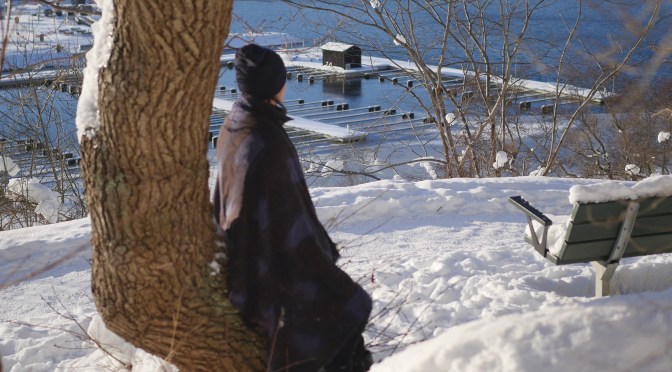
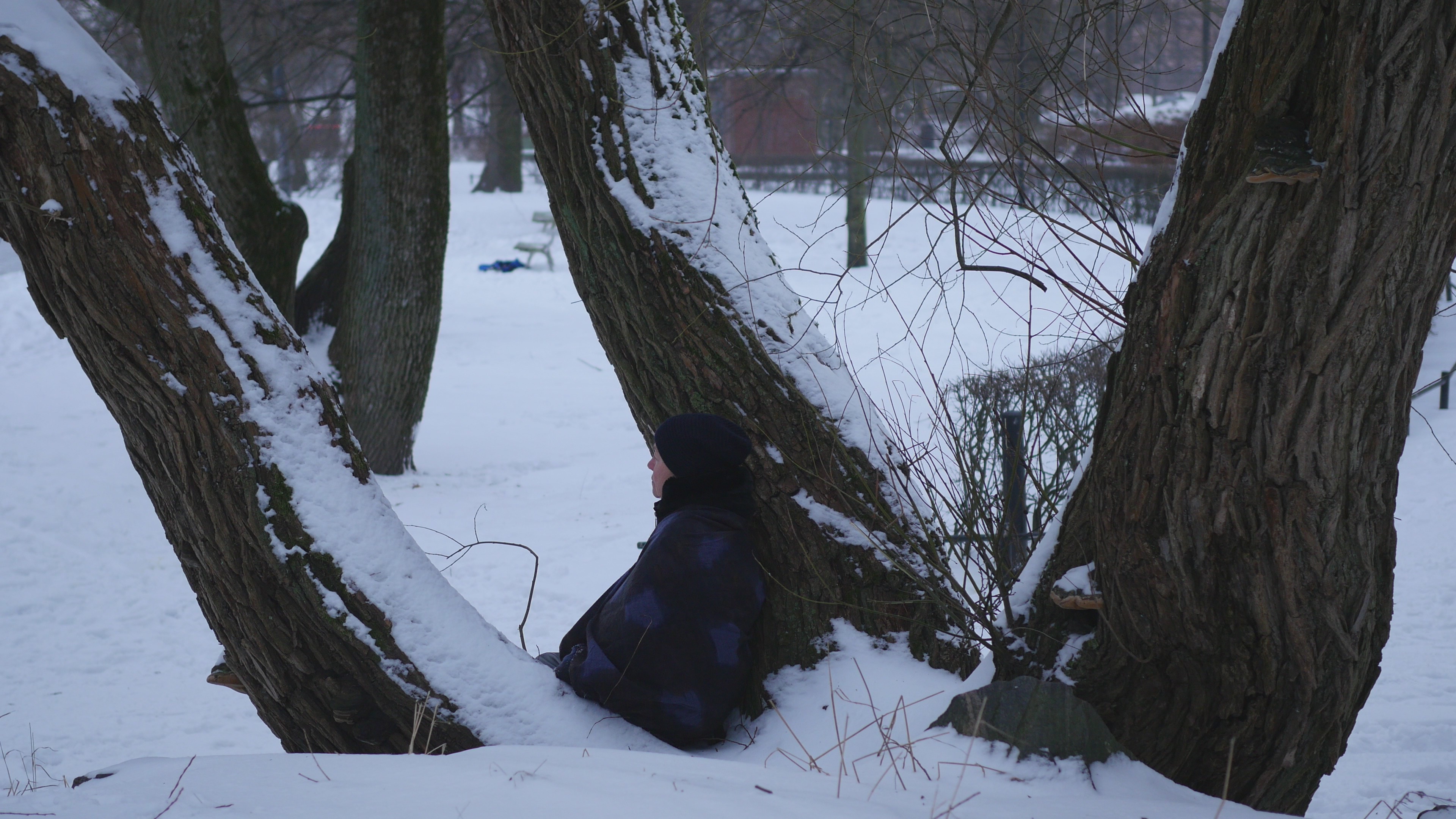
To celebrate staying alive for seventy years I decided to return to an old work – Sitting on a Birch – which I also call My fiftieth Year from 2006, when I travelled to Koivumäki every Sunday and sat on the outgrowth of a birch there. And decided to make it easier and choose a tree to sit on in my vicinity, one in Stockholm and one in Helsinki. The oak (probably an oak) I lean on the 10th January 2026 in the image above is growing on Fredhäll cliffs in Kungsholmen and the willow (probably a willow) I sit on the 17th January 2026, in the image below, is growing in the southwestern corner of Kaivopuisto park. The time is Saturday, if possible, Saturnus’ day. The blue and grey scarf is the same. If all goes well this will become two video works or perhaps a two-channel installation.
Mitt sjuttionde år
För att fira det faktum att jag hållits vid liv i sjuttio år bestämde jag mig för att återvända till ett gammalt arbete – Sitting on a Birch – som jag också kallar mitt femtionde år från 2006, då jag reste till Koivumäki varje söndag och satt på en knöl på en björk där. Och beslöt att göra det lättare genom att välja ett träd i närheten, ett i Stockholm och ett i Helsingfors. Eken (antagligen en ek) som jag lutar mot den 10.1.2026 i bilden här ovan växer på Fredhällsklippan på Kungsholmen och pilen (antagligen en pil) jag sitter på den 17.1.2026 i bilden här nedan växer i den sydvästra delen av Brunnsparken. Tidpunkten är om möjligt lördagen, saturnus dag. Den blå och grå duken är densamma. Om allt går väl blir det här till två videoarbeten eller en tudelad videoinstallation.
Seitsemäskymmenes vuoteni
Juhlistaakseni sitä, että olen pysynyt hengissä seitsemänkymmentä vuotta palasin vanhaan työhön – Istun koivulla – jota kutsun myös nimellä viideskymmenes vuoteni, jolloin matkustin Koivumäkeen joka sunnuntai ja istuin siellä koivunpahkan päällä. Ja päätin tehdä sen helpommaksi valitsemalla puun lähistöltä, yhden Tukholmassa ja yhden Helsingissä. Tammi (luultavasti tammi) johon nojaan 10.1.2026 kuvassa yllä kasvaa Fredhällin kallioilla Kungsholmenilla ja paju (luultavasti paju) jolla istun 17.1.2026 kuvassa alla kasvaa Kaivopuiston lounaiskulmassa. Ajankohta on mahdollisuuksien mukaan lauantai, saturnuksen päivä. Sininen ja harmaa huivi on sama. Jos kaikki sujuu hyvin tästä tulee kaksi videotyötä tai ehkä kaksikanavainen videoinstallaatio.

Thank you 2025 – Welcome 2026
My 69th year was my first year as a pensioner, and in the beginning that seemed like a big change. Because I had a working grant the years before the change was not that remarkable; I continued with my practice at my own pace and accepted some small teaching or reviewing assignments on the side. After the three-year project Pondering with Pines, which ended in 2024, I created an informal project, Joining Junipers, as a transition activity. And that has worked rather well, including monthly meetings with three junipers, two of them in Helsinki and one in Stockholm, published as podcast episodes as well. The major change looming on the horizon, which I have been preparing for and which will take place only this coming spring, is leaving my studio on Harakka Island, where I have been since 1997. And the challenge is not only in sorting all the stuff but also finding a new studio, probably or hopefully in Lapinlahti, the old hospital in the park near the city center.
I have travelled to Stockholm with the cats Pipo and Pompe every month and also made some trips without them, including two doctoral summerschools, one in Oslo in the spring and the other in Stameriena castle in Latvia in the summer, both of which I really enjoyed. The project Gifts from the Sentient Forest ended this year with an exhibition in Rovaniemi, which I was gallery sitting for a week in the summer and a weekend retreat in Äkäslompolo in the autumn. And I have had the opportunity to join three conferences, the 16th SAR (Society for Artists Research) conference in Porto in May, the IFTR (International Federation for Theatre Research) conference in Cologne in June – where I joined the excom (executive committee) meeting for the last time, since my term ended now – and last but not least the 30th PSi (Performance Studies international) conference in Fortaleza in Brasil in December, where I now serve on the board as one of the archivists.
Regarding exhibitions and screenings this has not been a prominent year, although I did have my usual solo show in the Telegraph gallery on Harakka in the summer and participated in the joint exhibition Artists’ Island there in the autumn. And of course I had a work in the Gifts from the Sentient Forest exhibition, too. An old work was shown in Pimento gallery in Oulu in the spring and another one in Bioart society’s screening, but nothing much else to boost of. With publications I have been more prolific, partly because some delayed ones have now finally come out; see the lists below, with the latest on top.
Exhibitions, events and performances in 2025
“With the Juniper on Fredhäll Cliff” (performance response) in the Artistic Research Working Group of PSi (Performance Studies International) at the PSi #30 conference XXX – Cruzo, Cruising, Crossroads in Fortaleza, Brasil 11-15.12.2025.
Year of the Dog – Sitting in a Tree (2007) and Time with a Pine , video poster at Kuva Research Days, Academy of Fine Arts, Uniarts Helsinki 9-12.12.2025.
Shadow of a Pine – Remix in Artists’ Island exhibition on Harakka Island 10.-28.9.2025.
“More Pines – Lisää mäntyjä – Mera tallar” in the Telegraph Gallery on Harakka Island 12-17.8.2025 See also
Day with a Mountain Birch in Night of the Arts at SOLU space: To Notice is to Remember 14.8.2025.
With a Pine at Äkäslompolo in Gifts from the Sentient Forest – exhibitionin
Villa Vinkkeli, Rovaniemi 10.6.-1.8.2025
Day with a Mountain Birch in Bioart Society members’ screening 7.6. and online until 15.6.2025.
“FlowerPower” in the Impossible week peace agora exhibition on Harakka Island 22-25.5.2025.
With the Tarri Pine, Pimento gallery, Oulu, 22.1.-16.2.2025 See info in Finnish
Publications in 2025
“Duration through Repetition – Revisiting as Method”, HUB – Journal of Research in Art, Design and Society, 5 (2025) https://www.researchcatalogue.net/view/2797281/2797282/0/0
“Walking in the Woods.” Global Performance Studies 7 (2) (2024). https://doi.org/10.33303/gpsv7n2a122
Arlander, Annette & Pilvi Porkola “Performance” in Karin Murris
“Sunnuntait männyn kanssa – performanssia ja performatiivista kirjoitusta” [Sundays with a Pine – performance and performative writing ] in Pilvi Porkola (ed.) Kirjeitä ja Meritähtiä: Näkökulmia performatiiviseen kirjoittamiseen [Letters and Starfish – Perspectives on Performative Writing] Nivel 22, pp. 57-73 https://urn.fi/URN:ISBN:978-952-353-100-0
“Talking about sentience” as one of the testimonials on the Gift from the Sentient webpages https://www.sentientforestproject.com/annettearlander
“Liikkuvaa ja lähes liikkumatonta kuvaa mäntyjen kanssa: Miten kohdata puu subjektina?”. [Moving and almost immobile images with pines: How to encounter a tree as a subject?] Lähikuva – audiovisuaalisen kulttuurin tieteellinen julkaisu 38 (3) 2025:51-68. https://doi.org/10.23994/lk.173157
“Esityksestä julkaisuksi. Miten tehdä asioita esityksellä -tutkimushankkeen kokemuksia konferenssiesitysten julkaisemisesta” [From performance to publication] in Teo Kurki, Jari Martikainen, Tuija Saresma, Saara Jäntti ja Sari Pöyhönen (eds.) Taide tietämisen tapana. Nykykulttuurin tutkimuskeskuksen julkaisuja 137, Nykykulttuuri 2025.
“Pondering with Contorta Pines – Towards Post-humanist Approaches in Performance as Research”. Näyttämö ja Tutkimus [Stage and Research] Vol. 11 No 1 (2025), 11-32. See https://journal.fi/teats/article/view/145411
“Public and archivable” in Mika Elo and Maiju Loukola (eds/toim) In Line, online, off the grid / Linjassa, linjoilla, katveessa. Academy of Fine Arts, University of the Arts Helsinki 2025, 252-255.
“Pondering with Örö Pines: Talking with Trees as an Undisciplinary Method”. Plant Perspectives. 2025 https://doi.org/10.3197/WHPPP.63845494909748
“Trees as experts in Site-specificity” in Hunter, Victoria and Cathy Turner (eds.) Routledge Companion to Site-Specific Performance, London & New York: Routledge 2025, 318-328. See here
Talks, papers, presentations and other tasks in 2025
Joining Junipers at the Crossroads (presentation) in the Artistic Research Working Group of PSi (Performance Studies International) at the PSi #30 conference XXX – Cruzo, Cruising, Crossroads in Fortaleza, Brasil 11-15.12.2025.
Examining a performance by Karolin Poska, Estonian Academy of Arts 12-13.11.2025.
Lecture at Aalto doctoral school 6.11.2025.
Panelist in the online event “Plants, Memory, Belonging” organised by Oak Spring Garden & Plant Perspectives 8.10.2025 See poster PMB_2026_Final
“On creating podcast episodes” at the Sentient Forest retreat in Äkäslompolo 5-7.9.2025.
Presentation in Teo Kurki, Jari Martikainen, Tuija Saresma, Saara Jäntti ja Sari Pöyhönen (eds.) Taide tietämisen tapana. Publishing event (webinar) 27.8.2025.
Lecture and workshop at International Doctoral Summer School in Latvia 18-22.8.2025.
“Junipering” (response to Denise Ackerl’s Mermaiding) in the online gathering of the Artistic Research Working group of Psi (Performance studies international) 18.6.2025.
“How to do things with Pinecones: Carnivalizing the undisciplinary?” in the PAR (performance as research) working group at IFTR conference in Cologne 9.-13.6.2025.
“Documenting and Sharing” at seminar 2 of the Norwegian Artistic Research Program, Oslo 13-15.5.2025.
”Performing for a Pine – Resonance in Repetition” at SAR (Society for Artistic Research) conference on Resonance in Porto 8-9.5.2025.
Participating in the Kone Forest Dialogue conversation as part of the Gifts from the Sentient Forest project 2.4.2025
“Finding the Research Question in Speculative Creative Practice” conversation with Roy Hanney in the seminar series Research for Creative Media: Practice and Pedagogy (online) 12.2.2025 See recording
 Performing Landscape